Is a Certificate of Analysis a guarantee of purity or just a marketing document? For most professional researchers, the reality is often the latter. You've likely dealt with the frustration of receiving batch-substituted materials even after reviewing a "clean" report, or you've paid triple the manufacturing cost for the convenience of domestic warehousing. It's a common industry pain point where supply chain opacity leads to inconsistent results and questionable data integrity.
This guide shows you how to properly verify bpc-157 with coa documentation by identifying batch-specific data and sourcing directly from synthesis facilities. We'll help you reduce supply chain uncertainty by moving past reseller layers and establishing a more transparent procurement process. We'll break down the technical requirements for HPLC and Mass Spectrometry, the impact of the July 2026 PCAC recommendation, and the logistics of scaling laboratory research through $600+ wholesale orders.
Key Takeaways
Treat the Certificate of Analysis as a baseline technical reference rather than a final guarantee of product identity or purity.
Recognize the risks of static reporting and batch substitution common among domestic resellers who reuse outdated analytical papers.
Utilize both HPLC and Mass Spectrometry data to verify the molecular weight and purity levels of bpc-157 with coa before procurement.
Reduce supply chain uncertainty by sourcing directly from synthesis facilities to ensure batch-specific traceability and lower overhead costs.
Access manufacturer-side channels through the PFC B2B bridge, which requires a $10 verification deposit and a $600 minimum for wholesale orders.
Table of Contents
Understanding BPC-157 and the Role of Certificate of Analysis (COA)
The Reality of COA Reliability in the 2026 Peptide Market
Technical Standards: HPLC and Mass Spectrometry for BPC-157
Strategic Wholesale Procurement: Direct Sourcing vs. Domestic Resellers
Optimizing Lab Supply with Peptides From China (PFC)
Understanding BPC-157 and the Role of Certificate of Analysis (COA)
BPC-157 is a 15-amino acid pentadecapeptide primarily utilized in laboratory settings to study biochemical signaling and tissue repair. When procurement professionals request bpc-157 with coa, they're looking for a Certificate of Analysis. This document provides the reference analytical data needed to verify the identity and purity of a specific synthesis batch. It isn't a final guarantee of quality, but rather a technical baseline for further laboratory assessment.
In the current peptide market, professional researchers treat these documents as baseline data. Industry flaws like supply chain opacity and the reuse of "static" COAs make it difficult to trust documentation at face value. Sourcing requires a clear distinction between generic marketing reports and lot-matched documentation. A lot-matched COA provides a direct link between the manufacturer's synthesis run and the physical material delivered to the lab, which is essential for maintaining a professional chain of custody.
The Core Components of a BPC-157 COA
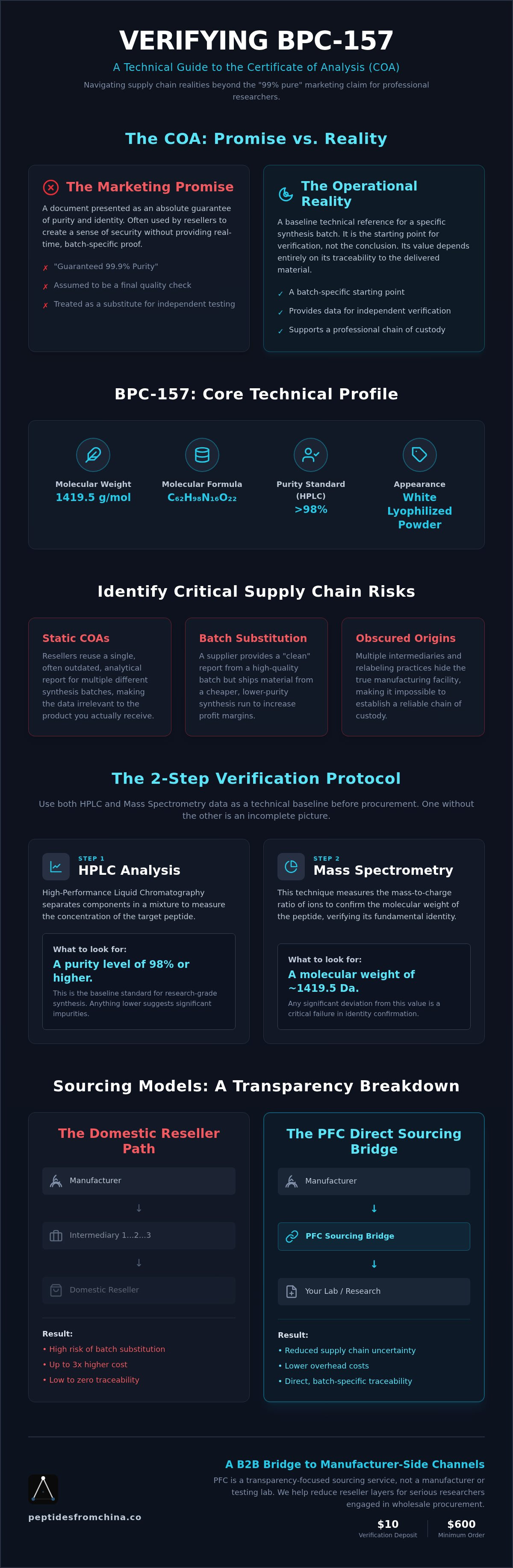
A technical report for this pentadecapeptide must align with its known chemical profile. BPC-157 has a molecular formula of C62H98N16O22 and a molecular weight of 1419.5 g/mol. Any significant deviation in the Mass Spectrometry data indicates a failure in identity confirmation. Standard components of a professional report include:
Purity Thresholds: A minimum of 98% purity is the standard baseline for research-grade synthesis as measured by HPLC.
Chemical Appearance: The material should be presented as a white, lyophilized powder.
Solubility Metrics: Reports should specify the solubility in sterile water or acetic acid to confirm physical consistency.
Confirming these data points helps reduce supply chain uncertainty. If a supplier provides a report where the molecular weight doesn't match the 1419.5 Da standard, the material's identity is compromised before it even reaches the bench.
Why Sourcing with a COA is Mandatory for Professional Labs
Procuring bpc-157 with coa is a non-negotiable step for reducing initial variables in complex studies. It allows researchers to establish a baseline for internal laboratory verification protocols. Without this data, you can't be sure if experimental results are influenced by the peptide's quality or the study's design. The documentation supports independent verification by providing the manufacturer's stated values for comparison.
Using these reports also improves traceability within the procurement process. It forces manufacturers to remain accountable for the specific batches they produce. While no single document can fully guarantee product purity, maintaining a rigorous documentation standard is the only way to ensure operational consistency across different synthesis batches.
The Reality of COA Reliability in the 2026 Peptide Market
The "99% pure" claim on a PDF is often more of a marketing tool than a scientific fact. In the 2026 market, many resellers rely on a "Static COA." This occurs when a single analytical report is used to represent multiple years of inventory or entirely different synthesis batches. Professional buyers looking for bpc-157 with coa must understand that a report from six months ago has little relevance to a batch synthesized yesterday. Documentation is only as good as its proximity to the actual production run.
Batch substitution is a persistent risk in the retail landscape. A reseller might provide a legitimate HPLC report from a high-quality manufacturer while shipping material from a lower-cost facility with variable quality control. Relabeling and the involvement of multiple intermediaries further obscure the true origin of synthesis. Because BPC-157 is currently prohibited under the S0 Non-Approved Substances category by global sports authorities, the market remains largely self-policed. This lacks the oversight found in human-grade pharmaceutical supply chains, making independent verification an operational necessity for serious research.
Identifying Reused or Falsified Documentation
You can often spot falsified documents by looking for inconsistent fonts, missing dates, or generic headers that don't match the purported laboratory. Domestic resellers frequently lack direct access to the original synthesis data because they are three or four layers removed from the actual production line. They provide reference analytical data as a courtesy, but it rarely functions as a verified chain of custody. If the documentation looks like a photocopied template or lacks a specific batch number, it's a red flag for supply chain opacity. Retail marketing claims often prioritize sales volume over the granular analytical reality labs require.
The PFC Transparency-First Approach
Peptides From China (PFC) operates as a B2B sourcing bridge to help researchers bypass these pitfalls. By establishing a direct line to synthesis facilities, we help reduce supply chain uncertainty. This model ensures that when institutions procure wholesale peptides, they are receiving manufacturer-side analytical data that is actually relevant to their specific order. Note that our wholesale procurement requirements include a minimum order amount of $600 to maintain these direct factory links and ensure batch consistency.
Our methodology prioritizes factual integrity over retail hype. We don't claim to be the manufacturer, but we do ensure that the documentation you receive is the same baseline data provided by the facility. For labs requiring consistent results, accessing direct manufacturer channels is the most effective way to minimize the risks of batch substitution and relabeling. This transparency-first positioning supports your own independent verification protocols by providing a clearer starting point.
Technical Standards: HPLC and Mass Spectrometry for BPC-157
Verifying the technical data on a report for bpc-157 with coa requires more than just scanning for a high percentage. Analytical verification relies on two distinct methods: High-Performance Liquid Chromatography (HPLC) and Mass Spectrometry (MS). While purity is a common focus, it's meaningless without confirmed identity. You can have a 99% pure substance that isn't the peptide you ordered. Professional labs use both tests to ensure the material isn't a substituted fragment or an entirely different compound.
The FDA identifies significant safety risks associated with impurities and unknown side-products in peptide synthesis. These risks underscore why manufacturer-side documentation is a baseline reference rather than a final assurance. For researchers, understanding how to read these chromatograms is the first step in establishing a reliable supply chain.
HPLC Analysis: Evaluating Purity Peaks
HPLC measures the purity of the pentadecapeptide by separating its components based on molecular interactions. When you examine an HPLC report, you're looking for the "main peak," which represents the BPC-157 molecule. Minor peaks on the baseline indicate impurities or residual solvents from the synthesis process. High-quality synthesis documentation should use analytical-grade standards to ensure the baseline is accurately calibrated. HPLC purity is the ratio of the target peptide peak to the total peak area. If the report shows multiple large peaks, the synthesis is likely inconsistent, leading to variable research outcomes.
Mass Spectrometry: Verifying Molecular Identity
Mass Spectrometry is the primary tool for identity confirmation. It measures the mass-to-charge ratio of the molecule to determine its exact weight. For BPC-157, the observed mass must match the theoretical molecular weight of approximately 1419.5 g/mol. If the MS report shows a significant deviation from 1419.5 Da, the substance is likely a different peptide or a degraded sequence. Identity verification is your best defense against batch relabeling, a common issue where resellers misidentify stock to meet demand.
Because documentation can be manipulated or reused, PFC emphasizes that manufacturer papers are only the start of the verification process. We encourage institutions to treat peptide testing as a mandatory buyer-side requirement. By acting as a B2B bridge to synthesis facilities, PFC helps labs access the raw analytical data they need to perform their own independent checks. Our wholesale procurement model, which requires a minimum order of $600, is designed to support researchers who prioritize this level of technical transparency and batch-specific traceability.
Strategic Wholesale Procurement: Direct Sourcing vs. Domestic Resellers
Professional labs often face a choice between the speed of domestic fulfillment and the transparency of direct manufacturer routing. While domestic resellers offer faster shipping, they typically operate as a "black box" regarding the synthesis origin. When you procure bpc-157 with coa from a retail site, you're often paying a 3x to 10x markup to cover the reseller's domestic overhead and marketing costs. This retail model frequently results in mixed inventory where vials from different synthesis runs are combined to fill a single order, compromising batch consistency.
Direct sourcing helps reduce these variables by establishing a clear line to the synthesis facility. By bypassing the reseller layers, researchers gain better visibility into the manufacturing timeline and the associated analytical data. Understanding the functional difference between a peptide sourcing agent vs platform is critical for procurement professionals. A platform like PFC acts as a transparency-focused B2B bridge, facilitating direct access to manufacturer-side channels rather than acting as a traditional retail middleman.
The Economics of the $600 Minimum Wholesale Order
The $600 minimum threshold isn't an arbitrary number. It's the operational floor required to bypass retail middleman structures and access the synthesis facility's wholesale queue. For long-term laboratory protocols, the ROI of bulk sourcing is significant. Direct procurement allows labs to secure a single, large batch of bpc-157 with coa, ensuring that every vial in the study shares the same reference analytical data. This eliminates the risk of variable purity levels that often plague smaller, fragmented retail purchases. Scaling research through wholesale orders supports large-scale studies without the recurring intermediary fees that drain laboratory budgets.
International Logistics and Neutral Packaging
Navigating the global supply chain requires a methodical approach to international logistics. Direct manufacturer-to-lab shipping routes utilize neutral packaging and professional tracking to ensure secure delivery and efficient customs clearance. This logistical transparency is often lost when using domestic resellers who obscure the original shipping data. Professional procurement through PFC includes a $10 verification deposit to confirm manufacturer stock before the full order is processed, providing a grounded, step-by-step verification process. If you're looking to establish a more reliable supply chain, you can secure manufacturer-direct routing through our B2B platform to minimize reseller interference and improve batch traceability.
Optimizing Lab Supply with Peptides From China (PFC)
Peptides From China (PFC) functions as a transparency-focused B2B bridge, connecting professional research institutions directly to verified synthesis facilities. This model is built to counter the inherent flaws of the retail market, such as supply chain opacity and the common practice of batch substitution. When procurement teams search for bpc-157 with coa, they often run into resellers who can't verify the specific origin or synthesis date of their stock. PFC addresses this by facilitating manufacturer-side channels where the analytical data is tied directly to the production run you receive.
Our commitment to operational realism means we don't engage in the marketing hype typical of retail supplement blogs. We position ourselves as a strategic partner that prioritizes factual integrity over superficial sales tactics. By removing the reseller layers, we help labs reduce supply chain uncertainty and establish a more reliable procurement protocol. This approach ensures that the reference analytical data provided acts as a legitimate baseline for your own independent laboratory verification.
The PFC Sourcing Workflow
The procurement process is methodical and designed to ensure stock availability before any significant capital is committed. It begins with a $10 verification deposit, which allows us to confirm current manufacturer stock and lead times for specific synthesis batches. This step acts as a protective filter for the buyer, preventing the delays and substitutions common in "add-to-cart" retail environments. Once the stock is confirmed, researchers can review batch-specific documentation before the final procurement is processed.
This workflow is specifically tailored for institutions looking to scale their research. By accessing bulk bpc-157 wholesale channels, labs can secure larger quantities from a single synthesis run. This consistency is vital for long-term studies where variable purity between vials could compromise data integrity. Note that all wholesale procurement through PFC requires a minimum order amount of $600 to maintain direct manufacturer routing and ensure the logistics remain cost-effective for the laboratory.
Transparency as a Sourcing Standard
PFC prioritizes traceability because we understand the technical demands of professional research. We don't claim to be a pharmaceutical manufacturer or a testing laboratory; instead, we act as a streamlined bridge to the facilities that are. This distinction is important for maintaining a professional chain of custody. By shipping directly from the facility to your lab using neutral packaging, we improve the transparency of the entire logistics chain.
Helping labs reduce uncertainty requires a no-nonsense approach to documentation. We provide bpc-157 with coa as a baseline technical reference, while always emphasizing that no single document replaces the need for independent buyer-side testing. This transparency-first positioning helps you navigate the global market with better data and fewer intermediaries. If you're ready to move beyond retail markups and inconsistent supply, you can start your wholesale BPC-157 sourcing with Peptides From China to establish a more grounded procurement strategy.
Establishing a Transparent Procurement Standard
Transitioning to a direct sourcing model is the most effective way to mitigate the inherent risks of the peptide supply chain. Relying on a Certificate of Analysis from a domestic reseller often leaves labs vulnerable to batch substitution and outdated reporting. By treating bpc-157 with coa documentation as a baseline for your own independent verification, you improve the traceability of your research materials. Moving past the layers of intermediaries ensures that your analytical reference data matches the physical vials on your laboratory bench.
Peptides From China provides the direct-to-manufacturer sourcing bridge needed to access synthesis facilities. This methodical approach facilitates COA-verified batch routing and transparent B2B wholesale pricing, eliminating the high markups associated with retail warehousing. With a $600 minimum wholesale requirement, you can secure consistent supply lines that support the integrity of your laboratory protocols. Establishing a more reliable supply chain starts with better data and direct manufacturer communication.
Access Direct Manufacturer Sourcing for BPC-157
Frequently Asked Questions
What does a COA for BPC-157 actually prove in a research setting?
A Certificate of Analysis for bpc-157 with coa provides baseline analytical reference data for the identity and purity of a specific synthesis batch. In a laboratory setting, it helps reduce initial variables by confirming the manufacturer's stated molecular weight and purity percentage. It's essential to understand that a COA isn't definitive proof of quality. It serves as a technical starting point for independent verification protocols that laboratories must perform to ensure their research data remains consistent.
How can I verify if a BPC-157 COA is authentic or just a reused document?
Authentic documentation should include specific batch numbers and recent synthesis dates that align with your procurement timeline. Red flags include generic headers, inconsistent fonts, or missing dates, which often suggest the report is a static document reused across multiple years. Professional researchers cross-reference the molecular weight on the Mass Spectrometry report against the theoretical 1419.5 Da standard. If the report looks like a photocopied template, it likely lacks a direct link to the physical material.
Why do B2B sourcing platforms require a deposit for manufacturer verification?
Sourcing platforms use a $10 verification deposit to confirm current manufacturer stock and lead times before processing a full order. This methodical approach protects the buyer from the common industry problem of ghost inventory where resellers accept payment for out-of-stock items. It establishes a grounded verification step, ensuring that the synthesis facility has the specific batch available. This process helps minimize supply chain uncertainty and prevents the delays associated with traditional retail middleman structures.
What is the technical difference between HPLC and Mass Spectrometry in a COA?
HPLC measures the purity of the peptide by separating its components to determine the ratio of the target molecule to impurities. Mass Spectrometry confirms the molecular identity by measuring the exact molecular weight. While HPLC tells you how much of the substance is pure, Mass Spectrometry confirms that the substance is actually BPC-157. Both tests are required on a report for bpc-157 with coa to prevent the accidental procurement of substituted fragments or mislabeled compounds.
Why is independent third-party testing still necessary if I have a manufacturer COA?
Independent testing is necessary because manufacturer-issued papers are self-reported data that can be manipulated, reused, or batch-substituted by intermediaries. No single document fully guarantees product identity or purity in a self-policed market. Buyer-side verification through an independent laboratory provides an objective check against the manufacturer's reference analytical data. This practice improves traceability and is the only reliable way to confirm that the physical material delivered matches the technical specifications required for your study.
How does direct sourcing from China impact BPC-157 batch consistency?
Direct sourcing helps maintain batch consistency by ensuring that your entire order comes from a single synthesis run at one facility. Domestic resellers often combine vials from different manufacturers or batches to fill inventory gaps, leading to variable purity levels within a single shipment. By establishing a direct line to the synthesis facility, researchers can secure a uniform lot. This minimizes the risk of inconsistent experimental results that often occur when using fragmented retail supply chains.
What are the primary risks of buying BPC-157 from domestic resellers?
The primary risks include paying high reseller markups for domestic warehousing and receiving material through an opaque supply chain. Resellers are often several layers removed from the synthesis origin, which increases the likelihood of batch substitution or the use of reused documentation. Many domestic sources lack direct access to manufacturer-side analytical data, providing only generic marketing reports. This results in higher costs and lower traceability compared to using a transparency-focused B2B bridge to the production facility.
Why is there a $600 minimum order for wholesale BPC-157 procurement?
The $600 minimum order amount is the operational requirement to bypass retail middleman structures and access manufacturer-side wholesale channels. This threshold ensures that the order is large enough to be routed directly from the synthesis facility rather than pulled from fragmented reseller inventory. It supports the logistics of neutral global shipping and allows the platform to maintain its transparency-first B2B model. For professional institutions, this minimum facilitates the procurement of consistent, lot-matched batches for long-term research protocols.