A manufacturer-issued Certificate of Analysis is not proof of what's in your batch. It's a reference document, and in the BPC-157 wholesale market, treating it as anything more is one of the most common and costly procurement mistakes a B2B buyer can make. Reused COAs, relabeled stock, and batch substitution are operational realities in this supply chain, not edge cases.
If you've spent time sourcing peptides at volume, you already know the frustration: opaque supplier chains, inconsistent synthesis quality from one order to the next, and reseller layers that inflate cost while adding zero traceability. BPC-157 wholesale quality assurance isn't solved by requesting more paperwork. It's built through a systematic process of reducing supply chain uncertainty at the source level, before product ever ships.
This guide is written for procurement professionals, research facility buyers, and B2B operators who need a repeatable, operationally realistic approach to high-volume BPC-157 sourcing. You'll get a practical framework for manufacturer-direct verification, independent batch testing protocols, and a clear-eyed look at how to reduce reseller markups by accessing synthesis facilities through a transparent intermediary model.
Key Takeaways
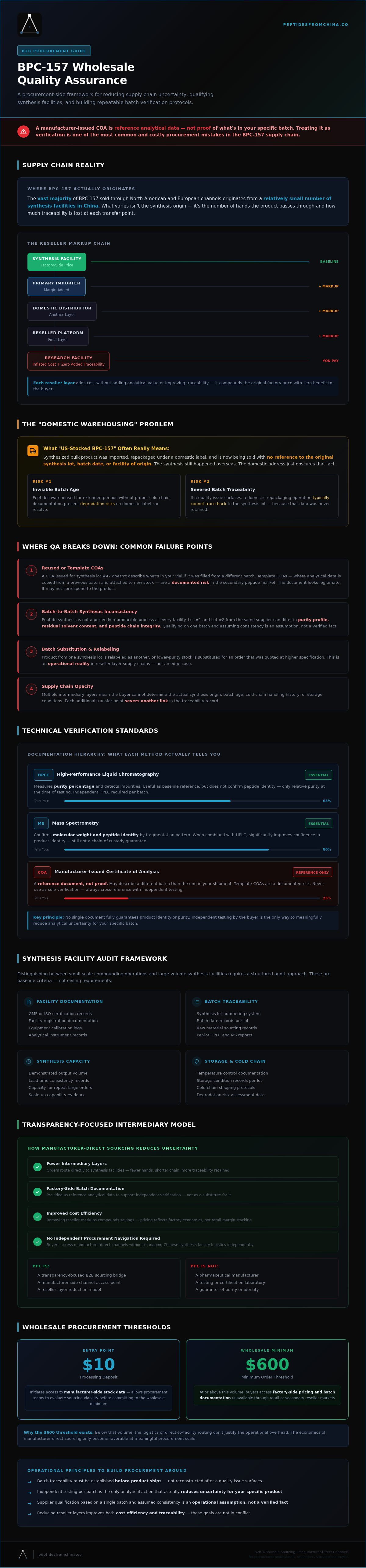
A manufacturer-issued COA is reference analytical data, not proof of what's in your specific batch — BPC-157 wholesale quality assurance requires independent verification protocols built around HPLC and Mass Spectrometry results, not paperwork alone.
Domestic warehousing claims frequently obscure true synthesis origin and batch age, making supply chain transparency a non-negotiable evaluation criterion when qualifying any high-volume peptide supplier.
Distinguishing between small-scale compounding operations and large-volume synthesis facilities requires a structured audit framework — facility documentation, synthesis capacity, and batch traceability records are the baseline, not the ceiling.
Accessing manufacturer-direct channels through a transparency-focused intermediary model can meaningfully reduce reseller markups and improve batch traceability without requiring buyers to navigate Chinese synthesis facilities independently.
A low-commitment entry point — such as a $10 processing deposit — can initiate access to manufacturer-side stock data, allowing procurement teams to evaluate sourcing viability before committing to the $600 minimum wholesale threshold.
Table of Contents
The Reality of BPC-157 Wholesale Sourcing in 2026
Technical Verification Standards for High-Volume BPC-157
Evaluating Synthesis Facilities: A Procurement Audit Framework
Operational Logistics and Risk Mitigation in Bulk Procurement
Peptides From China: Streamlining Your BPC-157 Supply Chain
The Reality of BPC-157 Wholesale Sourcing in 2026
The peptide market has undergone a structural shift. What was once dominated by retail-facing shops selling single vials to individual researchers has increasingly given way to B2B procurement platforms, institutional purchasing workflows, and volume-based sourcing models. That shift is real, and it's creating genuine opportunities for procurement professionals who understand how to navigate it. It's also creating new vectors for quality failures that didn't exist at smaller scale.
Here's the operational reality: the vast majority of BPC-157 sold through North American and European channels originates from a relatively small number of synthesis facilities in China. What varies isn't the synthesis origin. It's the number of hands the product passes through before it reaches your facility, and how much traceability is lost at each transfer point.
The 'Domestic Warehousing' Problem
Domestic warehousing claims deserve more scrutiny than most buyers give them. When a supplier advertises "US-stocked BPC-157," what that frequently means is that synthesized bulk product was imported, repackaged under a domestic label, and is now being sold with no reference to the original synthesis lot, batch date, or facility of origin. The synthesis still happened overseas. The domestic address just obscures that fact.
This matters for two reasons. First, batch age becomes invisible. Peptides that have been warehoused for extended periods without proper cold-chain documentation present degradation risks that no domestic label can resolve. Second, batch-specific traceability is severed. If you need to trace a quality issue back to a specific synthesis lot, a domestic repackaging operation typically can't provide that data because it was never retained.
Reseller Markups vs. Manufacturer-Direct Pricing
The traditional reseller model adds cost at every layer without adding analytical value. A synthesis facility produces BPC-157 at one price point. A primary importer takes a margin. A domestic distributor adds another. A reseller-facing platform adds a final layer. By the time product reaches a research facility buyer, the markup over factory-side pricing is often substantial, with multiple intermediary layers compounding the original cost.
Accessing manufacturer-direct channels removes those layers without requiring buyers to manage international procurement logistics independently. A transparency-focused intermediary model, like the one Peptides From China operates, routes orders directly to synthesis facilities and provides factory-side batch documentation as reference analytical data, not as a substitute for independent testing. The practical result is improved cost efficiency and a shorter, more traceable chain of custody for a compound that's sensitive to handling and storage conditions.
The $600 minimum order threshold for professional wholesale procurement reflects the economics of direct-to-facility sourcing. Below that volume, the logistics of direct routing don't justify the operational overhead. At or above it, buyers gain access to pricing and batch documentation that simply isn't available through the retail or secondary reseller market.
Common QA Failures in the Global Supply Chain
BPC-157 wholesale quality assurance breaks down at predictable points in the global supply chain. Understanding where those failures occur is the first step toward building procurement protocols that account for them:
Reused or template COAs: A COA issued for synthesis lot #47 doesn't describe what's in the vial labeled lot #47 if that vial was filled from a different batch. Template COAs, where analytical data is copied from a previous batch and attached to new stock, are a documented risk in the secondary peptide market. The document looks legitimate. It may not correspond to the product.
Batch-to-batch synthesis inconsistency: Peptide synthesis is not a perfectly reproducible process at every facility. Lot #1 and lot #2 from the same supplier can differ in purity profile, residual solvent content, and peptide chain integrity. Buyers who qualify a supplier based on one batch and assume consistency across subsequent orders are operating on an assumption, not a verified fact.
Relabeling and loss of traceability: When product changes hands through a reseller chain, original batch identifiers are frequently replaced with internal SKUs or generic lot numbers. The synthesis-level data, including the specific HPLC and mass spectrometry results for that batch, becomes inaccessible. Independent verification becomes harder, and in some cases, impossible to trace back to origin.
None of these risks are hypothetical. They're the operational baseline in a market where synthesis origin is routinely obscured and documentation standards vary widely between facilities. Procurement decisions built on COA review alone don't adequately account for this reality.
Technical Verification Standards for High-Volume BPC-157
Documentation review is where most B2B procurement processes start. It's also where they stop, which is the problem. Understanding what analytical reports actually tell you, and what they don't, is foundational to any serious BPC-157 wholesale quality assurance framework at volume.
Reading HPLC and Mass Spectrometry Reports
High-Performance Liquid Chromatography is the standard method for detecting impurities in peptide samples, including residual trifluoroacetic acid (TFA), synthesis byproducts, and residual solvents that affect both potency and safety profiles. When reviewing an HPLC report, three metrics carry the most diagnostic weight:
Retention time: The time at which BPC-157 elutes from the column under standardized conditions. Significant deviation from expected retention time suggests the compound present may not be what's labeled, or that the chromatographic method used differs from the reference standard.
Peak area and peak symmetry: A clean, symmetrical primary peak with minimal shoulder peaks or trailing indicates a well-synthesized batch. Multiple peaks or asymmetrical profiles warrant closer scrutiny of what those secondary signals represent.
Purity percentage: Reported as a percentage of the primary peak area relative to total detected area. A figure like "99.57% purity" looks definitive on paper. What it doesn't tell you is which impurities make up the remaining fraction, how the baseline was set, or whether the method was calibrated against an authenticated reference standard for BPC-157 specifically.
Mass Spectrometry closes a gap that HPLC alone can't address: sequence identity. HPLC confirms relative purity within a sample. MS confirms the molecular weight of the compound itself. For BPC-157, the expected monoisotopic molecular weight is approximately 1419.5 g/mol. A mass spectrum that aligns with this value provides meaningful evidence that the correct peptide sequence was synthesized. A match doesn't eliminate all synthesis errors, but a mismatch is a definitive disqualifier. Both data points together, HPLC purity profile and MS molecular weight confirmation, represent the minimum analytical baseline for high-volume procurement decisions.
Independent Verification: The Buyer's Responsibility
Here's where the market gap becomes operationally significant. Most suppliers present HPLC and MS data as settled proof of product quality. It isn't. Manufacturer-issued analytical papers describe the batch as the manufacturer tested it, under their conditions, using their equipment, at a point in time that may predate your shipment by weeks or months. That's reference data. It's not a substitute for peptide testing conducted by an independent laboratory on a sample drawn from your specific received lot.
For procurement teams managing long-term research programs or recurring wholesale orders, independent testing serves a second function beyond identity confirmation: it establishes a batch-to-batch consistency baseline. A single qualified batch tells you what that lot contained. Testing across three, five, or ten sequential lots tells you whether the synthesis facility is maintaining reproducible output, which is the data point that actually supports reliable procurement planning.
Practically, this means pulling random samples from received inventory, not just testing the first vial opened, and submitting them to a third-party analytical lab with peptide characterization capabilities. The cost of that testing is modest relative to the procurement volume it protects. Treating it as optional is how quality failures get discovered after the fact rather than before product enters use.
Procurement teams evaluating manufacturer-side sourcing channels can request batch documentation through Peptides From China's wholesale sourcing process as a starting reference point, with the explicit understanding that independent verification remains the buyer's responsibility and the non-negotiable final step in any rigorous intake protocol.
Evaluating Synthesis Facilities: A Procurement Audit Framework
Most B2B buyers never see the facility that produced their peptides. That's not inherently a problem. What is a problem is making procurement decisions without a structured method for evaluating what that facility is actually capable of, and whether its documentation reflects operational reality or just passes a surface-level review. Distinguishing between a small-scale compounding operation and a large-volume synthesis facility requires more than reading a supplier's "About" page.
The audit framework that actually works at the procurement level operates on three axes: synthesis capacity, documentation integrity, and traceability continuity. Each one can be evaluated before a purchase commitment is made, provided the buyer knows what to ask for and what the responses should look like.
For context on how facility-level standards fit into broader wholesale peptides procurement, the distinction between GLP-aligned facilities and informal synthesis operations is foundational. Good Laboratory Practice compliance, or credible documentation of equivalent internal standards, indicates that a facility maintains defined protocols for equipment calibration, reagent handling, environmental controls, and batch record retention. It doesn't guarantee output quality. It does indicate that quality failures are traceable, which is what makes corrective action possible.
Synthesis Capacity and Scalability
A facility capable of producing 50 vials per run and one capable of producing 1,000+ vials per run are not interchangeable suppliers at wholesale volume. Scale matters for reasons beyond raw throughput. Lyophilization, the freeze-drying process that converts peptide solution into stable powder form, is particularly sensitive to batch size. Larger lyophilization runs require validated cycle parameters to ensure uniform moisture removal across the entire batch. Facilities that lack industrial-grade lyophilization equipment frequently produce batches with inconsistent residual moisture levels, which directly affects shelf stability and reconstitution behavior.
When evaluating a facility for high-volume BPC-157 wholesale quality assurance purposes, request documentation on:
Maximum batch output per synthesis run, with reference to the specific equipment used, not just a stated capacity figure.
Lead times differentiated by order type: custom synthesis versus off-the-shelf inventory. A facility quoting identical lead times for both is likely working from pre-synthesized bulk stock regardless of what you've ordered.
Lyophilization cycle records for recent batches, including chamber pressure and shelf temperature logs. These are standard outputs from GLP-aligned operations. Their absence is informative.
Red Flags in Manufacturer Documentation
Document inconsistencies are easier to spot than most buyers assume, once you know what to look for. Start with the shipping manifest. The lot number on the manifest should correspond exactly to the lot number on the COA. Discrepancies between these two documents, even minor formatting differences, warrant a direct inquiry before product is accepted into inventory.
Digitally altered HPLC chromatograms are a documented risk in the secondary peptide market. Specific indicators include pixel-level inconsistencies around peak labels, metadata timestamps that don't align with the stated analysis date, and chromatographic baselines that appear unnaturally flat or artificially smoothed. These aren't always detectable without forensic tools, but a supplier that resists providing raw data files alongside the rendered report image is already signaling a problem.
This is precisely where working through reputable peptide companies with transparent sourcing structures provides operational value. A platform that routes orders directly to synthesis facilities and provides factory-side batch documentation as reference material, rather than as a sales tool, gives procurement teams a cleaner starting point for their own independent verification. It doesn't replace that verification. It reduces the number of undocumented transfer points between synthesis and receipt, which is where traceability typically breaks down.
The bottom line: facility evaluation isn't a one-time qualification exercise. It's an ongoing audit discipline. Suppliers that passed review six months ago may have changed production partners, shifted to different raw material sources, or scaled in ways that affected output consistency. Procurement teams that treat initial qualification as permanent approval are managing a risk they've stopped measuring.
Operational Logistics and Risk Mitigation in Bulk Procurement
Qualifying a synthesis facility and verifying batch documentation are upstream decisions. Getting product from a facility in China to a research lab in the US or EU without compromising what you just qualified is a separate operational discipline, and one that receives less systematic attention than it deserves in most B2B procurement frameworks.
Customs and Compliance for Research Peptides
BPC-157 shipped for research purposes is classified as a Research Use Only compound. Correct commodity classification on shipping documentation isn't a formality. Misclassification creates customs delays, potential seizure, and in some cases, irreversible cold-chain failures if a shipment sits in a customs hold without temperature controls. For high-volume orders, the classification language on the commercial invoice and the accompanying documentation should be reviewed before shipment, not after a problem surfaces at the border.
Tracking and insurance are non-negotiable on orders at or above the $600 minimum wholesale threshold. A high-value peptide shipment without end-to-end tracking creates a liability gap that no COA or batch record can resolve after the fact. Full declared-value insurance tied to the specific shipment lot protects the procurement investment and preserves the option for a supplier dispute if the product arrives compromised. Neutral packaging is the industry standard for research-grade compounds shipped internationally; it reduces customs scrutiny without misrepresenting the contents of the shipment.
Climate-Controlled Shipping and Cold-Chain Integrity
Lyophilized BPC-157 powder is stable under proper conditions, but that stability is contingent on the cold chain remaining intact from facility to receipt. Exposure to elevated temperatures during transit degrades peptide integrity in ways that aren't always visible on reconstitution. For shipments crossing multiple climate zones or transit hubs, insulated packaging with temperature-monitoring indicators provides a basic audit trail for cold-chain compliance. A shipment that arrives within the correct temperature range, documented, gives your independent verification process a cleaner starting point. One that doesn't is a disqualifying event regardless of what the COA says.
Risk mitigation for large-scale procurement deposits follows the same logic. A low-commitment entry point, such as the $10 processing deposit model used to access manufacturer-side stock data before committing to a full order, reduces financial exposure during the supplier evaluation phase. It's a structurally sound approach to BPC-157 wholesale quality assurance at scale: confirm sourcing viability before capital is fully committed, not after.
Handling and Storage for Batch Longevity
Once received, lyophilized BPC-157 powder should be stored at -20°C for long-term stability, with short-term working stock held at 4°C in a sealed, desiccated environment. Reconstitution introduces the primary post-receipt risk: contamination from non-sterile diluents, improper bacteriostatic water concentration, or repeated freeze-thaw cycling all degrade the peptide fraction that your analytical testing confirmed was present in the original batch. Reconstituted solutions should be used within a defined window appropriate to your storage conditions and never refrozen after preparation. BPC-157's cyclic structure gives it greater inherent stability than linear peptides like TB-500, but that advantage is forfeited quickly if handling protocols aren't enforced consistently across the laboratory phase.
Procurement teams building repeatable intake workflows can initiate access to manufacturer-side batch documentation and stock data through Peptides From China's wholesale sourcing process, providing a reference baseline before independent verification is conducted on received inventory.
Peptides From China: Streamlining Your BPC-157 Supply Chain
Every layer of the conventional reseller chain adds cost and removes traceability. By the time BPC-157 reaches a research facility through a standard distribution path, the synthesis-level documentation has often been replaced with internal SKUs, the batch age is unknown, and the pricing reflects margins stacked at each transfer point. Peptides From China operates as a direct alternative to that model: a transparency-focused B2B sourcing bridge that routes orders to synthesis facilities and provides factory-side batch documentation as reference analytical data, not as a sales instrument.
The distinction matters. PFC is not a manufacturer. It doesn't synthesize peptides, operate a testing laboratory, or guarantee purity. What it does is reduce the number of undocumented transfer points between a synthesis facility and your receiving dock, and provide procurement teams with access to manufacturer-side stock data before a full capital commitment is made.
The Transparency-First Sourcing Model
Accessing manufacturer-side channels directly means that the HPLC and mass spectrometry reports provided as reference documentation correspond to the actual synthesis lot being routed to your order, not a template COA pulled from a previous batch. That's a meaningful operational difference from secondary reseller sourcing, where batch-specific analytical data is frequently unavailable because it was never retained through the distribution chain. PFC's direct routing model supports independent verification by giving procurement teams a cleaner starting point: factory-side reference data tied to a specific lot, which a third-party laboratory can then test against your received inventory. For bulk BPC-157 wholesale procurement specifically, that traceability baseline is what separates a defensible intake protocol from one that relies on paperwork alone.
Initiating a Wholesale Order
The process is structured to reduce financial exposure during supplier evaluation. A $10 processing deposit initiates access to current manufacturer-side stock data, including available batch documentation for review before any full order commitment. This low-commitment entry point allows procurement teams to assess sourcing viability, review reference analytical data, and confirm batch availability against their specific volume requirements before the $600 minimum wholesale threshold is reached.
Once a procurement team is ready to proceed, the order workflow follows a direct-routing model: stock is sourced from the synthesis facility, shipped with neutral packaging appropriate for international research compound transit, and accompanied by factory-side batch documentation for use as reference material in your independent verification process. BPC-157 wholesale quality assurance at this stage remains the buyer's responsibility. PFC's role is to reduce supply chain uncertainty upstream, not to replace the independent testing protocols that any rigorous intake process requires.
Procurement teams evaluating current BPC-157 manufacturer stock can contact Peptides From China to verify current BPC-157 manufacturer stock and initiate the sourcing process through the $10 deposit model.
Build a Sourcing Framework That Holds at Scale
BPC-157 wholesale quality assurance isn't a documentation exercise. It's an operational discipline built on three interconnected decisions: qualifying synthesis facilities before committing capital, independently verifying received batches rather than accepting manufacturer-issued analytical data as final, and reducing the number of undocumented transfer points between synthesis and receipt. Get those three things right, and the supply chain uncertainty that undermines most high-volume peptide procurement becomes measurable and manageable.
The reseller layers that inflate cost and sever batch traceability aren't inevitable. A direct-to-manufacturer sourcing model, structured around transparent reference documentation and a realistic intake protocol, gives procurement teams a defensible foundation without requiring them to navigate international synthesis facilities independently.
If your team is evaluating current manufacturer-side BPC-157 stock, the $10 deposit model at Peptides From China lets you access batch documentation and pricing data before committing to the $600 wholesale minimum. That's the right sequence: verify sourcing viability first, then scale.
Secure direct-to-manufacturer BPC-157 pricing at Peptides From China and start building a procurement framework that doesn't rely on paperwork alone.
Frequently Asked Questions
How do I verify a BPC-157 wholesale batch if I don't trust the COA?
Submit a random sample from your received inventory to an independent third-party laboratory with peptide characterization capabilities. Request both HPLC purity analysis and mass spectrometry confirmation of molecular weight. These two data points together, conducted on your specific received lot rather than on the manufacturer's reference sample, are the minimum analytical baseline for a defensible intake protocol.
Don't pull just the first vial. Random sampling across multiple units from the same shipment is more representative of actual batch consistency. The cost of independent testing is modest relative to the procurement volume it protects, and it's the only way to confirm that what arrived matches the reference documentation provided at the point of sale.
What is the minimum order for wholesale BPC-157 through Peptides From China?
The minimum wholesale order threshold through Peptides From China is $600. This reflects the operational economics of direct-to-facility routing. Below that volume, the logistics overhead of manufacturer-direct sourcing doesn't justify the process. At or above it, buyers gain access to factory-side pricing and batch documentation that isn't available through retail or secondary reseller channels.
Procurement teams that want to evaluate sourcing viability before committing to the full threshold can initiate the process with a $10 processing deposit. This provides access to current manufacturer-side stock data and reference batch documentation for review, allowing teams to confirm batch availability and assess documentation quality before capital is fully committed.
Is BPC-157 stable during international shipping from China?
Lyophilized BPC-157 powder is stable during transit when the cold chain remains intact, but that's the operative condition. Exposure to elevated temperatures at transit hubs or during customs holds can degrade peptide integrity in ways that aren't always visible on reconstitution. Insulated packaging with temperature-monitoring indicators provides a basic audit trail for cold-chain compliance and gives your independent verification process a cleaner starting point.
Shipments should include end-to-end tracking and full declared-value insurance tied to the specific lot. If a shipment arrives outside documented temperature parameters, that's a disqualifying event regardless of what the accompanying COA states. Don't accept product that can't demonstrate cold-chain integrity from facility to receipt.
What is the difference between research-grade and pharmaceutical-grade BPC-157?
Research-grade BPC-157 is produced for laboratory and investigational use, classified as Research Use Only, and is not manufactured under the regulatory controls required for pharmaceutical-grade compounds intended for human clinical administration. Pharmaceutical-grade designation requires compliance with pharmacopeial standards, validated manufacturing processes, and regulatory oversight that research synthesis facilities don't operate under.
In practical procurement terms, the distinction matters most for documentation expectations. Research-grade suppliers provide HPLC and mass spectrometry data as reference analytical material. That's appropriate for the classification. Buyers who require pharmaceutical-grade documentation standards are operating in a different regulatory context entirely, and no research peptide supplier, regardless of synthesis quality, can legitimately fulfill that requirement.
How can I tell if an HPLC report has been reused or altered?
Start by cross-referencing the lot number on the HPLC report against the lot number on the shipping manifest and the vial label. Any discrepancy is an immediate flag. For the report itself, look for pixel-level inconsistencies around peak labels, chromatographic baselines that appear unnaturally flat or smoothed, and metadata timestamps that don't align with the stated analysis date. These are indicators of digital alteration that don't require forensic tools to identify.
The most reliable test is to request raw data files alongside the rendered report image. A legitimate analytical laboratory produces exportable raw data as a standard output. A supplier that resists providing it, or claims the format isn't available, is signaling a problem worth taking seriously. Template COAs that recycle analytical data from previous batches often fall apart at exactly this step.
Does Peptides From China provide independent third-party testing?
No. Peptides From China is a B2B sourcing bridge, not a testing laboratory. PFC provides factory-side batch documentation, including HPLC and mass spectrometry reports from the synthesis facility, as reference analytical data. That documentation supports your independent verification process by giving procurement teams a traceable starting point tied to a specific synthesis lot, but it doesn't replace third-party testing conducted on your received inventory.
Independent verification remains the buyer's responsibility and is the non-negotiable final step in any rigorous BPC-157 wholesale quality assurance intake protocol. PFC's operational value is in reducing undocumented transfer points between synthesis and receipt, not in substituting for the analytical work that qualified procurement teams should be conducting on every received batch.
What are the common impurities found in low-quality BPC-157?
The most operationally significant impurities in substandard BPC-157 batches are residual trifluoroacetic acid (TFA) from the synthesis process, truncated or deletion peptide sequences resulting from incomplete chain assembly, and residual solvents from insufficient post-synthesis purification. TFA residuals are particularly relevant because they affect both the safety profile and the reconstitution behavior of the final product.
A well-reported HPLC chromatogram will show secondary peaks that correspond to these impurity fractions. The purity percentage figure alone doesn't tell you what those secondary signals represent. That's why reviewing the full chromatographic profile, not just the headline purity number, is essential when evaluating batch documentation from any synthesis facility.
Can I request a specific manufacturer's batch before paying my full invoice?
Yes. Through Peptides From China's sourcing process, the $10 processing deposit model is specifically structured to allow procurement teams to access current manufacturer-side stock data and reference batch documentation before committing to the $600 minimum wholesale threshold. This lets buyers review available lot information, assess documentation quality, and confirm batch availability against their volume requirements before full payment is made.
This sequencing reflects a sound procurement discipline: verify sourcing viability upstream, then scale. It doesn't eliminate the need for independent testing on received inventory, but it does reduce financial exposure during the supplier evaluation phase and ensures that procurement decisions are based on actual batch data rather than generic stock availability claims.