
Most domestic peptide suppliers aren't actually manufacturers; they're high-margin logistics firms masquerading as labs. If you're tired of the opaque pricing and inconsistent batch quality that defines the retail market, it's time to shift your procurement strategy. This wholesale peptide pricing guide provides a technical roadmap for navigating the two-tiered market of 2026. You'll learn how to identify the true manufacturing cost of high-demand compounds while filtering out the resellers who add cost without adding value.
We understand that the current landscape is fraught with reused COAs and batch substitution risks. It's frustrating to pay premium rates only to receive documentation that doesn't meet the rigorous May 2026 USP <233> and <232> standards for elemental impurities. This guide promises to show you how to establish a robust sourcing protocol that helps reduce supply chain uncertainty through a transparency-first model. We'll preview the specific logistics of manufacturer-direct routing, the necessity of independent buyer verification, and the operational requirements for professional procurement, such as the standard $600 minimum order threshold for wholesale access.
Key Takeaways
Identify the hidden economic costs of domestic resellers and why shifting to a direct synthesis model is essential for managing batch quality in 2026.
Use this wholesale peptide pricing guide to interpret volume-based pricing tiers and professional B2B quotes that bypass standard retail markups.
Establish a verification protocol that treats manufacturer HPLC and MS reports as baseline technical references rather than definitive proof of identity.
Navigate international logistics requirements, including the use of neutral packaging and global tracking, to maintain a transparent chain of custody.
Leverage a transparency-first sourcing bridge with a $600 minimum order threshold to eliminate intermediary layers and improve overall batch traceability.
Table of Contents
The Reality of Wholesale Peptide Pricing: Resellers vs. Direct Sourcing
How to Read a Wholesale Peptide Price List in 2026
Evaluating Manufacturer Quotes: Beyond HPLC and MS Reports
Operational Logistics: Managing Bulk Imports and Verification
The Peptides From China (PFC) Model: Streamlining Direct Sourcing
The Reality of Wholesale Peptide Pricing: Resellers vs. Direct Sourcing
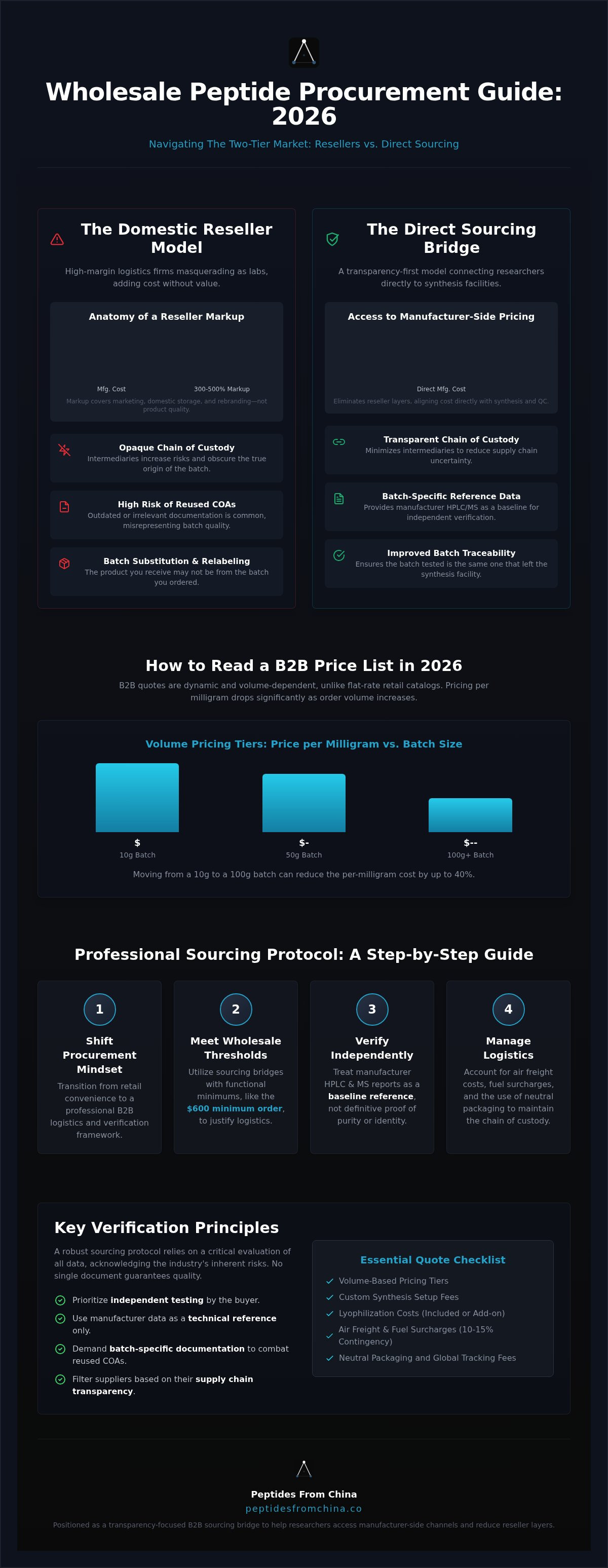
The peptide market in 2026 is sharply divided between retail-facing resellers and manufacturing-direct sourcing bridges. Most researchers begin their procurement journey in the retail space, paying significant premiums for the perceived convenience of domestic warehousing. However, this model frequently obscures the true chain of custody. A professional wholesale peptide pricing guide must address the economic reality that domestic stock is almost exclusively imported, relabeled, and marked up to cover localized overhead and aggressive marketing budgets. This transition from retail buying to a B2B procurement mindset is the first step in establishing a sustainable research budget.
Professional sourcing requires a shift in how you view order volume and logistics. Peptides From China (PFC) maintains a $600 minimum order threshold specifically to align with professional lab requirements. This isn't an arbitrary figure; it's a functional barrier that ensures every shipment justifies the logistical rigors of international transport and neutral packaging. By focusing on volume, synthesis facilities can maintain consistent output and prioritize high-level quality control rather than managing the fragmented demands of single-vial retail distribution.
The Anatomy of a Reseller Markup
Resellers don't just add a small service fee. They often apply a 300% to 500% markup to manufacturing rates. This price hike covers domestic storage, expensive digital marketing campaigns, and the kitting process where bulk vials are rebranded for retail appeal. These additional layers don't just inflate costs; they degrade traceability. Each intermediary hand that touches the product increases the risk of batch substitution or the use of outdated, reused COAs. When you buy from a domestic reseller, you're often paying for their branding and warehouse rent rather than the actual synthesis of the compound.
Why Labs are Shifting to Direct-to-Manufacturer Sourcing
Researchers increasingly demand a direct line to the chemical peptide synthesis facility to ensure better visibility into production protocols. By utilizing a B2B sourcing bridge like PFC, labs can bypass the reseller "black box." This helps reduce supply chain uncertainty and minimizes the risk of receiving degraded stock that has sat in a domestic warehouse for months. Direct routing supports independent verification by ensuring the batch you test is the same batch that left the synthesis facility, without the risk of intermediary relabeling or batch mixing. This methodical approach prioritizes factual integrity and long-term reliability over the superficial convenience of domestic shipping.
How to Read a Wholesale Peptide Price List in 2026
A professional wholesale peptide pricing guide isn't just a list of numbers; it's a technical specification sheet. Unlike retail catalogs that offer flat rates per vial, B2B quotes are dynamic and volume-dependent. You'll need to distinguish between catalog pricing for stock items and custom synthesis quotes for specific research needs. Standard quotes should clearly outline synthesis setup fees, especially for custom sequences, and specify if lyophilization is included in the base rate or billed as an additional processing step.
Hidden fees can quickly erode the perceived savings of a low per-milligram price. Always look for line items related to shipping, fuel surcharges, and neutral packaging. In 2026, air freight costs fluctuate significantly due to geopolitical factors, often adding a 10-15% contingency to the landed cost. If a quote lacks these details, it's incomplete. To access these manufacturing rates, professional sourcing bridges like Peptides From China require a minimum order of $600, which ensures the logistical effort matches the batch value.
Pricing Tiers for High-Demand Research Compounds
Volume tiers usually break at the 10g, 50g, and 100g+ scales. For high-demand compounds like BPC-157 or TB-500, the price per milligram can drop by 40% when moving from a 10g batch to a 100g batch. GLP-1 analogs like Semaglutide and Tirzepatide follow similar logic but are more sensitive to raw material availability. If you encounter prices significantly below the 2026 median, be cautious. These outliers often indicate batch degradation, leftover stock, or issues with the salt-form ratio that can compromise your research data.
Technical Specifications in a Price List
Purity and peptide content are not the same thing. A quote might state 98% purity, which refers to the percentage of the target peptide relative to other peptide impurities. However, the actual peptide content, which is the weight of the peptide itself versus moisture and counter-ions, might only be 80%. Professional quotes specify the salt form, such as Acetate or TFA. While TFA is often the default due to lower cost, many labs require Acetate for specific biological assays. Always clarify if you're receiving lyophilized powder. Liquid solutions are prone to degradation during the transit times associated with international logistics and should be avoided in bulk procurement.
Evaluating Manufacturer Quotes: Beyond HPLC and MS Reports
Most procurement errors stem from a misplaced trust in manufacturer-issued paperwork. A professional wholesale peptide pricing guide doesn't just show you price points; it teaches you how to interrogate the documentation behind them. HPLC reports and Mass Spectrometry (MS) data should be viewed as baseline technical references rather than absolute proof of quality. In an industry where supply chain opacity is common, the risk of receiving reused COAs or substituted batches is real. No single document fully guarantees product identity; it only serves as a starting point for your own internal verification.
Comparing Manufacturer Documentation
HPLC measures purity while Mass Spec confirms identity. Understanding this distinction is vital for any lab manager. You should always cross-reference batch numbers with manufacturing dates to ensure the data is current. Discrepancy in dates often signals relabeled or old stock that has been sitting in a reseller's warehouse. Integrating peptide testing into your procurement strategy is the only way to confirm that the material received matches the reference analytical data provided during the quote phase.
Red flags in manufacturer-issued HPLC reports include:
Perfectly flat baselines that suggest digital manipulation or "templated" reports.
Integration tables that don't visually align with the peaks on the chromatogram.
Missing headers or truncated batch information that obscures the facility of origin.
Generic dates that don't align with your specific synthesis timeline.
The PFC Verification Protocol
Peptides From China (PFC) operates a transparency-first model designed to protect the buyer from the pitfalls of blind trust. Instead of requiring full payment upfront for unverified stock, researchers utilize a $10 sourcing deposit to initiate facility verification. This small commitment allows you to review manufacturer-side stock and quality papers before committing to a larger transaction. This step helps reduce supply chain uncertainty by establishing a direct line to the synthesis facility and ensuring the documentation provided is specific to your potential batch.
Once the facility is verified and the technical data is reviewed, the standard $600 minimum order applies for wholesale procurement. This structure establishes a transparent chain of custody from the moment of synthesis to the final shipment. It shifts the burden of proof back to the source and ensures that your laboratory has the necessary data to perform its own independent verification upon arrival. This methodical approach is the standard for professional-grade sourcing in 2026, prioritizing factual integrity over marketing promises.
Operational Logistics: Managing Bulk Imports and Verification
Managing the physical transit of research compounds is as critical as the synthesis itself. A comprehensive wholesale peptide pricing guide is incomplete if it doesn't account for the complexities of international logistics and customs clearance. For laboratories, the goal is to maintain a transparent chain of custody while minimizing the risk of seizure or degradation. This requires moving away from retail-style shipping towards professional B2B logistical protocols that prioritize neutral packaging and discreet labeling. These methods help reduce supply chain uncertainty by ensuring that the contents are described accurately for commercial compliance without attracting unnecessary scrutiny from non-technical intermediaries.
Establishing a "test before use" protocol is the final safeguard in the procurement process. No matter how reputable a synthesis facility appears, every wholesale arrival must be treated as unverified until independent analytical data is produced. This methodical approach identifies potential batch substitution or purity variances before the material is integrated into research projects. To facilitate this level of professional access, Peptides From China acts as a sourcing bridge to verified facilities, requiring a $600 minimum order to ensure shipments meet the scale required for formal import procedures.
Shipping and Handling for Wholesale Orders
In 2026, China-to-US/EU logistics rely on express air freight, which typically offers transit times of 3-7 days. While standard air freight is more economical, express routes are preferred for high-value research chemicals to minimize exposure to fluctuating warehouse temperatures. Most lyophilized peptides are stable at ambient temperatures for the duration of an express flight, but sensitive compounds may require specific thermal packing. Professional sourcing agents should provide global tracking data immediately upon dispatch and maintain clear reshipment policies for orders that encounter documented logistical failures.
Internal Laboratory Verification Steps
Calculating the real cost per milligram requires adding independent testing fees to your landed cost. In 2026, a combined HPLC/MS analysis at a corporate rate typically costs approximately $238 per sample. For a 100g bulk order, you shouldn't just test a single vial. Implement a random sampling protocol that pulls from different sections of the shipment to check for batch consistency. If your testing reveals a purity of 98% but the manufacturer's reference analytical data claimed 99.5%, you've identified a discrepancy that requires immediate facility accountability. This independent verification is the only way to support the factual integrity of your research data and ensure long-term operational consistency.
The Peptides From China (PFC) Model: Streamlining Direct Sourcing
The domestic warehouse model relies on high inventory turnover and significant markups to sustain localized operations. This often results in a "black box" supply chain where the buyer has no visibility into the synthesis facility. Peptides From China (PFC) functions as a transparency-first sourcing bridge, connecting professional researchers directly to verified synthesis channels. By eliminating the middleman, you aren't just lowering your cost per milligram; you're improving batch traceability. This wholesale peptide pricing guide emphasizes that removing reseller layers is the most effective way to access manufacturing-side data for wholesale peptides without the typical retail inflation.
The $600 minimum order requirement is a deliberate operational standard. It ensures that every transaction is large enough to justify professional international logistics and neutral packaging. This scale allows for more efficient customs clearance and more consistent batch handling compared to fragmented, single-vial retail shipments. It moves the procurement process away from speculative retail buying toward a methodical, B2B framework.
Getting Started with Direct Sourcing
The process begins with a $10 sourcing deposit, which serves as a commitment to the verification phase. This deposit initiates the review of manufacturer-side stock and quality papers, allowing you to see the reference analytical data before full payment. Once you've identified your requirements, you can request a custom price list tailored to your specific research volume. This is particularly useful for hard-to-source research compounds like Retatrutide, Ipamorelin, or Selank, where market availability and pricing can be volatile. After the facility is verified and the quote is accepted, the order moves to synthesis or fulfillment, followed by express air freight with global tracking.
The Future of Peptide Procurement
As we move through 2026, the peptide sourcing platform landscape is shifting toward greater technical accountability. Price trends suggest that while commodity peptides like GHK-Cu remain stable, complex analogs will see pricing fluctuations based on raw material purity and synthesis difficulty. This wholesale peptide pricing guide confirms that transparency is no longer a luxury; it's an industry-wide requirement for professional labs that value factual integrity over marketing promises.
Final checklist for professional peptide procurement:
Confirm the $600 minimum order threshold is met for logistical efficiency.
Verify the salt form (Acetate vs. TFA) matches your specific research protocol.
Ensure the synthesis facility has been verified through the PFC bridge.
Allocate a budget for independent HPLC/MS testing upon arrival.
Review the neutral packaging and tracking protocols for international transit.
Establishing a Transparency-First Procurement Strategy
Sourcing research compounds in 2026 requires a departure from the high-margin reseller model. This wholesale peptide pricing guide has outlined the technical and logistical steps necessary to bypass domestic middle-men and establish a direct link to synthesis facilities. You've learned that manufacturer-issued HPLC reports are merely reference analytical data. The only way to support independent verification is through a methodical "test before use" protocol on every bulk arrival.
Peptides From China helps reduce supply chain uncertainty by acting as a dedicated sourcing bridge. Our model prioritizes factual integrity through direct-to-manufacturer routing and a $10 processing deposit for facility verification. By maintaining a $600 minimum order threshold, we ensure logistical efficiency and professional-grade handling for every shipment. It's time to move beyond the black box of domestic warehousing and take control of your laboratory's chain of custody.
Request a Transparent Wholesale Price List from PFC to begin your transition toward a more reliable procurement framework. We look forward to supporting your research objectives with clarity and operational consistency.
Frequently Asked Questions
How do I get a wholesale peptide price list for my laboratory?
You can obtain a tailored price list by submitting a request through the Peptides From China sourcing bridge. This process begins with a $10 sourcing deposit, which allows you to review current manufacturer-side stock and quality papers. This wholesale peptide pricing guide emphasizes that viewing data specific to available synthesis batches is more reliable than generic catalog rates. Once verified, a custom quote is generated based on your specific volume requirements.
What is the minimum order amount for wholesale peptide sourcing?
The minimum order amount for professional procurement through PFC is $600. This threshold is established to maintain logistical efficiency and justify the rigors of international air freight and neutral packaging. It distinguishes professional laboratory sourcing from single-vial retail transactions. By grouping orders at this scale, researchers can access manufacturer-direct pricing and more robust chain-of-custody documentation that isn't typically available for smaller, fragmented shipments that often pass through multiple resellers.
How can I verify the purity of peptides sourced directly from China?
Purity verification requires independent, third-party laboratory analysis using HPLC and Mass Spectrometry. While manufacturer-issued reports serve as reference analytical data, they don't replace the need for buyer-side testing. You should implement a random sampling protocol for every wholesale arrival. This helps reduce supply chain uncertainty by confirming that the batch received matches the technical specifications provided by the synthesis facility before the material is integrated into your research projects.
Why is there such a large price difference between resellers and direct sources?
The price gap exists because domestic resellers add significant margins to cover localized warehousing, retail marketing, and kitting costs. This wholesale peptide pricing guide highlights that these middlemen often apply 300% to 500% markups while providing limited transparency regarding the original synthesis source. Direct sourcing through a bridge like PFC eliminates these unnecessary cost layers, allowing laboratories to allocate more of their budget toward actual material and independent verification instead of branding.
What documents should be included with a wholesale peptide order?
A standard wholesale shipment should be accompanied by baseline technical references, including HPLC purity reports and Mass Spectrometry identity data. Additionally, professional B2B orders include commercial invoices and neutral packing lists for customs compliance. It's important to remember that these papers are baseline references. You must cross-reference batch numbers and manufacturing dates to ensure the documentation is specific to the material you received rather than an old, reused report from a previous batch.
Is it legal to source research peptides for laboratory use in 2026?
Sourcing peptides for laboratory research is a standard procurement activity for institutions and professional buyers in 2026. Compliance involves adhering to import regulations and ensuring the compounds are used strictly for laboratory research purposes. Buyers must manage customs documentation and ensure the synthesis facility follows international shipping standards. Utilizing neutral packaging and global tracking helps maintain a professional logistical flow through international borders while minimizing supply chain uncertainty during the import process.
How does the sourcing deposit work at Peptides From China?
The $10 sourcing deposit is a transparency-first mechanism used to initiate facility verification. It allows PFC to provide you with manufacturer-side stock information and quality papers for review before you commit to a full purchase. This step is designed to alleviate anxieties associated with international sourcing by providing a methodical filter for the client. The deposit is a small commitment that supports the factual integrity of the procurement process and ensures you're dealing with a verified facility.
What happens if a batch fails independent laboratory testing?
If an independent HPLC or MS test reveals a significant discrepancy from the reference analytical data, the sourcing bridge facilitates facility accountability. This is why establishing a "test before use" protocol is essential for every shipment. While PFC acts as a bridge rather than a guarantor of purity, it ensures that logistical failures or batch inconsistencies are addressed through manufacturer reshipment policies. This methodical approach helps improve traceability and supports long-term operational consistency for your laboratory.