
A high-purity HPLC report in your inbox is no longer a definitive proof of quality; in many cases, it is merely the entry price for a conversation that requires much deeper scrutiny. As the global peptide therapeutics market scales toward $163.98 billion in 2026, the complexity of vetting peptide suppliers has shifted from checking certificates to auditing entire supply chains. Many laboratories still struggle with reused COAs, batch-to-batch inconsistency, and excessive reseller mark-ups that inflate procurement costs without adding technical value.
You likely understand that the "research use only" label often masks a significant lack of operational transparency. This article outlines the specific protocols used by industry insiders to identify reputable peptide companies and help reduce supply chain uncertainty. We will cover how to navigate the 2026 regulatory landscape, including the latest EMA guidelines and FDA 503A considerations, while establishing a framework for verifiable batch traceability. You'll learn how to move beyond the reseller carousel and leverage transparency-focused B2B sourcing bridges, such as Peptides From China for wholesale orders starting at $600, to access manufacturer-side channels that prioritize independent verification over marketing hype.
Key Takeaways
Learn why website aesthetics are a poor proxy for quality and how to audit a facility's actual synthesis scale and in-house analytical equipment.
Understand the "zombie COA" phenomenon and why independent verification is necessary to mitigate risks associated with reused or outdated HPLC reports.
Develop a systematic protocol for vetting peptide suppliers that identifies hidden reseller layers and "domestic warehouse" illusions which often mask supply chain opacity.
Establish a strategic sourcing bridge to access manufacturer-side channels, reducing intermediary mark-ups and improving long-term batch traceability for laboratory efficiency.
Table of Contents
The Evolving Landscape of Reputable Peptide Companies in 2026
Operational Checklist: Vetting Synthesis Facility Capabilities
Analytical Verification: Moving Beyond the Certificate of Analysis (COA)
Red Flags: Identifying Reseller Layers and Supply Chain Opacity
Strategic Sourcing: Implementing a Professional Procurement Protocol
The Evolving Landscape of Reputable Peptide Companies in 2026
The peptide market has reached a critical inflection point. As the global therapeutics market is projected to hit $163.98 billion in 2026, the "grey market" for research peptides remains fraught with supply chain opacity. Identifying reputable peptide companies now requires looking past high-end web design and marketing copy. A sleek interface often disguises a domestic reseller with no actual insight into the synthesis process or quality control measures. For professional laboratories, the priority has shifted from localized convenience to verified manufacturer access.
Effective vetting peptide suppliers in this environment means distinguishing between legitimate synthesis facilities and "garage-op" resellers. The latter often operate with zero technical staff, relying entirely on the word of their own intermediaries. This creates a dangerous lack of accountability when batch-to-batch inconsistency occurs. Transparency-focused sourcing agents have emerged to counter this, acting as an analytical filter that prioritizes raw data over superficial brand prestige.
Institutional CROs vs. Boutique Sourcing Platforms
Large contract research organizations (CROs) offer high levels of institutional prestige, but their pricing models often include significant overhead that doesn't necessarily translate to better batch quality for standard research materials. Conversely, boutique sourcing bridges like Peptides From China (PFC) provide a direct path to manufacturer-side channels. This model helps reduce reseller layers that typically inflate costs without adding value. When vetting peptide suppliers, you must determine if you're paying for a brand's marketing budget or the actual chemistry. Reputation is relative; a reputable supplier for a university lab might be a massive CRO, while a B2B procurement professional might prioritize the direct-to-factory transparency of a sourcing bridge.
The 2026 Trend: Direct-to-Manufacturer Transparency
Domestic warehousing in the U.S. and EU has become increasingly difficult to maintain due to stricter regulatory oversight, such as the April 2026 FDA removal of 12 peptides from the Category 2 list. This shift has exposed the "domestic warehouse" illusion; many suppliers were simply relabeling imported goods and adding significant mark-ups while offering no additional verification. Professional labs now prefer direct-from-China logistics to ensure better batch traceability. By understanding the underlying peptide synthesis methodologies employed at the facility level, researchers can better assess the risks of batch-to-batch inconsistency.
Sourcing directly from production facilities helps reduce supply chain uncertainty. A transparency-first approach involves auditing the synthesis scale and analytical capabilities before committing to a purchase. For those moving toward this direct model, PFC facilitates wholesale procurement with a $600 minimum order requirement, acting as a logistical bridge rather than a traditional middleman. This strategy prioritizes reference analytical data and manufacturer-issued papers over the superficial promises often found in retail environments.
Operational Checklist: Vetting Synthesis Facility Capabilities
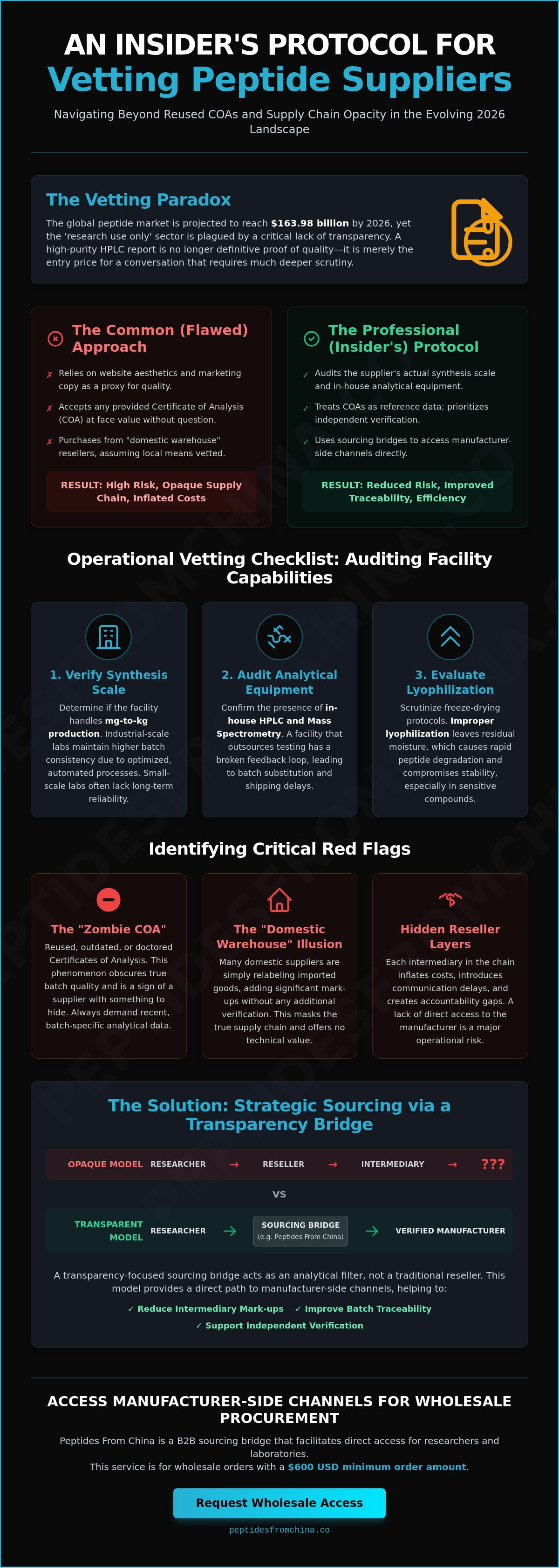
Vetting peptide suppliers effectively requires a shift in focus from digital storefronts to physical infrastructure. The first step in any professional audit is verifying the synthesis scale. You must determine if the facility handles mg-to-kg production. Industrial-scale labs often maintain higher levels of batch consistency because their processes are optimized for volume and repetition. Small-scale boutique labs frequently lack the standardized automation necessary for long-term research reliability.
Step two involves auditing the analytical equipment on-site. The presence of in-house HPLC and Mass Spectrometry is a baseline requirement. If a facility outsources its testing, the feedback loop between synthesis and verification is broken. This delay often leads to batch substitution or the shipping of sub-par material to meet deadlines. A supplier without on-site analytical tools is essentially a blind operator in a high-precision field.
Beyond the hardware, you must evaluate lyophilization protocols. Improper freeze-drying leaves residual moisture, which causes rapid peptide degradation, especially in sensitive compounds like IGF-1 LR3 or HGH Fragment 176-191. Step four is the verification of documentation. Always prioritize manufacturer-issued papers over reseller-generated PDFs. Re-typed reports are a major red flag; they often mask zombie COAs used to represent multiple unrelated batches. Finally, assess communication regarding lead times. Realistic synthesis and purification for custom sequences take time. Suppliers who promise immediate shipping on every item are often relying on domestic reseller chains with high mark-ups. For labs looking to optimize their procurement, sourcing peptides directly from manufacturer channels helps reduce these unnecessary layers.
Synthesis Scale and Equipment Standards
Industrial-scale facilities utilize automated synthesizers that significantly reduce human error during the amino acid coupling process. High-resolution Mass Spectrometry is essential for sequence identity verification. It's the only method to confirm the molecular weight matches the target peptide exactly. Operating within Class 100,000 clean-room environments ensures that environmental contaminants don't compromise the final product during the vial-filling and sealing stages.
Lyophilization and Post-Synthesis Handling
Compound stability depends heavily on post-synthesis handling. Reputable suppliers use advanced lyophilization cycles to ensure a shelf-stable cake rather than a loose, unstable powder. Vetting a supplier also means checking their storage protocols for bulk powders versus pre-filled vials. When moving to a manufacturer-direct model through Peptides From China, labs can maintain these standards while meeting the $600 wholesale minimum order requirement, ensuring both technical quality and cost-efficiency for long-term research projects.
Analytical Verification: Moving Beyond the Certificate of Analysis (COA)
A Certificate of Analysis (COA) is often presented by vendors as a final seal of quality. In reality, it is merely baseline reference analytical data. Relying solely on a supplier's provided documentation is one of the most common mistakes when vetting peptide suppliers. These reports are easily fabricated, altered, or reused across multiple unrelated batches. To maintain operational consistency, professional laboratories must treat a manufacturer's COA as a starting point for their own internal verification process rather than a definitive guarantee of batch identity or purity.
The industry is currently plagued by "zombie" COAs. These are legitimate reports from high-quality historical batches that resellers continue to use long after the original stock has been depleted. When you receive a report, check for smoothed baselines in the HPLC chromatogram. A perfectly flat baseline with no signal noise often indicates digital manipulation to hide impurities. If the chromatogram looks too clean for the stated purity level, it's a significant red flag. Reputable peptide companies don't fear independent scrutiny; they provide the technical documentation necessary to facilitate it.
Interpreting HPLC and Mass Spec Data
Understanding the distinction between purity and concentration is vital for accurate research results. A report might show 98% purity via HPLC, but this doesn't account for TFA salt content or residual moisture which can vary significantly between batches. High-resolution Mass Spectrometry (MS) is equally critical. You must read the MS peak to confirm the molecular weight aligns precisely with the target peptide sequence. Because of the inherent risks associated with batch substitution and relabeling, conducting your own peptide testing remains the only reliable method to ensure laboratory identity and purity.
The "Reused Report" Trap
Verification requires a methodical approach to manufacturing documentation. Always cross-reference the batch number and date on the manufacturing papers with the physical product received. If a supplier is hesitant to provide batch-specific data before a wholesale purchase, it's a clear indicator of supply chain opacity. Peptides From China (PFC) coordinates manufacturer-side sourcing for eligible wholesale requests. Manufacturer-side analytical documentation may be available depending on the product and batch. This supports independent verification by giving your chosen third-party lab a technical reference point to compare against their own findings. This transparency-first model helps reduce supply chain uncertainty, allowing researchers to build long-term data sets on verifiable material rather than relying on the word of an intermediary.
Red Flags: Identifying Reseller Layers and Supply Chain Opacity
A significant challenge in vetting peptide suppliers is the proliferation of the "domestic warehouse" illusion. Many buyers prioritize local shipping speeds, assuming that a domestic address implies domestic synthesis. In reality, most retail sites are multi-layer resellers that purchase bulk powders from overseas, fill vials in a non-sterile environment, and apply a premium label. This practice often masks a complete lack of supply chain oversight. When a reseller cannot identify the specific synthesis facility or the batch-specific parameters of the material, they're essentially passing on unverified risk to your laboratory.
Marketing-heavy websites are another primary red flag. If a platform prioritizes lifestyle imagery and aggressive sales tactics over technical specifications, it's likely they lack the technical depth to support professional research. Reputable suppliers focus on logistical transparency and analytical data. Every layer of the supply chain typically adds between 50% and 200% to the base manufacturing price. By the time a peptide reaches a retail customer, the price reflects the marketing budget and the risk premium of the reseller rather than the quality of the chemistry itself.
Spotting White-Labeling and Relabeling
Visual cues such as generic vial caps, inconsistent labeling alignment, or a lack of batch-specific tracking often suggest a relabeling operation. "Made in the USA" claims in the peptide industry are frequently misleading; they often refer only to the final bottling process rather than the complex synthesis of the amino acid chain. Understanding the difference between a peptide sourcing agent vs platform is critical for researchers who require direct access to manufacturer documentation. A platform acts as a bridge, while a reseller acts as a barrier to traceability.
The Hidden Costs of Supply Chain Intermediaries
The price discrepancy in the market is stark. While a retail vial might cost $20, the actual manufacturer-side cost for bulk procurement is often closer to $3. Resellers justify this markup by claiming "domestic testing," yet they frequently compromise batch traceability to protect their sourcing channels from competitors. Direct-to-manufacturer sourcing has become the standard for high-volume research because it removes these unnecessary financial and technical hurdles. For labs ready to bypass the reseller carousel, accessing wholesale peptide channels through Peptides From China requires a $600 minimum order, ensuring you receive manufacturer-side material without the domestic markup.
Strategic Sourcing: Implementing a Professional Procurement Protocol
Implementing a professional protocol for vetting peptide suppliers requires moving beyond the transactional nature of retail websites. For research laboratories, procurement is a strategic function that must prioritize batch traceability and cost-efficiency over localized shipping speed. Transitioning from retail "blind buying" to a transparent B2B model allows researchers to audit their supply chain at the source. This methodical approach helps reduce supply chain uncertainty by establishing a direct line to synthesis facilities, bypassing the information barriers created by domestic resellers. By treating procurement as an analytical process, labs can secure the operational consistency necessary for long-term data integrity.
The first step in this protocol is the transition to manufacturer-side channels. Most domestic suppliers function as black boxes, where the origin of the material is intentionally obscured to protect mark-ups. A professional protocol reverses this by demanding transparency regarding the synthesis facility. To facilitate this, Peptides From China (PFC) requires a $10 deposit initiates manual request processing and real-time stock verification and is credited toward the final invoice. This small operational fee serves as a filter, ensuring that logistical resources are dedicated to laboratories ready to implement a formal procurement strategy. It moves the conversation from superficial marketing to technical specifications and lead-time logistics.
The PFC Sourcing Model: Direct Access to Synthesis
The PFC model functions as a transparency-focused B2B sourcing bridge rather than a traditional middleman. It reduces reliance on multi-layer reseller supply chains through manufacturer-side coordination. This direct path improves traceability, as the documentation originates from the facility itself. For international logistics, international logistics may involve logistics partners, and shipping details are confirmed during order processing. It's vital to remember that PFC is a sourcing bridge, not a pharmaceutical manufacturer or a testing laboratory; its value lies in reducing the distance between the production floor and the researcher's bench.
Managing Bulk Procurement for High-Volume Research
High-volume laboratories often face the challenge of balancing synthesis quality with project timelines. When sourcing bulk BPC-157 wholesale or other research compounds, labs must optimize their order frequency to maintain batch consistency. The $600 minimum order requirement at PFC is designed for laboratory efficiency, allowing procurement professionals to consolidate their needs into fewer, more traceable shipments. This reduces the variability often seen when buying single vials from various retail sources. A skepticism-first approach remains the best defense; even with manufacturer-side access, independent verification of reference analytical data should always be the final step in your procurement protocol.
Optimizing Your Laboratory Sourcing for 2026
The peptide landscape in 2026 demands a shift from passive procurement to active supply chain auditing. Identifying the infrastructure behind the label and treating manufacturer-issued documentation as reference material rather than absolute proof helps your lab reduce supply chain uncertainty. Successful vetting peptide suppliers involves moving beyond the "domestic warehouse" illusion and establishing a direct bridge to synthesis facilities. This approach ensures you aren't paying for a reseller's marketing budget but for the actual chemistry and traceable data your research requires.
Peptides From China (PFC) provides a structured path for professional labs to bypass intermediaries. Through this B2B sourcing bridge, you request manufacturer-side pricing while coordinating international logistics. While no single document guarantees identity, this model supports independent verification and improves long-term batch consistency. Access Direct-to-Manufacturer Sourcing Channels with PFC to streamline your wholesale procurement. Start with a $10 processing deposit to initiate your verification and secure the reliable supply chain your high-volume research deserves.
Frequently Asked Questions
How can I tell if a peptide company is actually manufacturing their own products?
You can identify a true manufacturer by their ability to provide real-time updates on custom synthesis lead times and specific analytical data from on-site equipment. Most companies are merely resellers if they lack in-house HPLC and Mass Spectrometry capabilities. Manufacturers can discuss the technical nuances of the amino acid coupling process, whereas resellers generally rely on generic marketing templates and can't provide manufacturer-issued papers upon request.
What is the minimum order requirement for professional B2B sourcing?
Professional direct-to-manufacturer channels, such as Peptides From China, typically require a minimum order of $600. This threshold is established to maintain logistical efficiency and filter out retail-level transactions. By consolidating procurement into wholesale batches, laboratories can reduce the per-vial cost while while allowing multiple catalog products to be combined to reach the minimum.
Why do some reputable peptide companies ship from China instead of the US?
Shipping directly from China is often a sign of a more transparent supply chain that avoids the relabeling risks of domestic warehouses. Since China is the global center for large-scale peptide synthesis, direct shipping preserves batch traceability. It helps labs avoid the "domestic warehouse" illusion, where resellers mark up products by 50 to 200 percent while offering no additional verification of the original synthesis facility.
Can I trust an HPLC report provided by the supplier?
An HPLC report should be treated as baseline reference material rather than a definitive proof of purity. While reputable suppliers provide these documents to support their batches, they don't replace the need for independent laboratory testing by the buyer. Reports can be altered or reused for different lots, so professional vetting peptide suppliers always involves a "trust but verify" protocol using your own third-party analytical lab.
What should I do if a batch fails independent laboratory testing?
If a batch fails verification, you should immediately provide the raw analytical data to your sourcing partner. A professional sourcing bridge will facilitate a direct inquiry with the manufacturing facility to investigate the discrepancy. This is why maintaining a direct-to-manufacturer link is vital; it ensures you have a clear path for resolution rather than being stuck behind a reseller who has no technical influence over the production lab.
How does a sourcing platform differ from a traditional peptide reseller?
A sourcing platform acts as a transparent bridge to the manufacturer, whereas a reseller acts as a barrier. Platforms like PFC focus on reducing intermediary layers and may coordinate access to manufacturer-side documentation depending on the product and batch. Resellers typically hide their sources to protect their mark-ups, which compromises your ability to track the material back to the original synthesis facility. Platforms prioritize supply chain transparency and logistical efficiency for wholesale buyers.
What are the risks of buying peptides from domestic resellers?
The primary risks include supply chain opacity and the potential for batch substitution. Domestic resellers often buy in bulk from unknown sources, relabel the vials with their own branding, and sell them at retail prices. This process breaks the chain of custody and makes it difficult to verify the synthesis environment or the age of the material. Additionally, the lack of technical oversight at the reseller level increases the risk of receiving degraded compounds.
Is it possible to verify a manufacturer’s synthesis facility remotely?
Remote verification is possible by auditing a facility's technical documentation and synthesis scale. You should request proof of mg-to-kg production capabilities and verify the presence of on-site analytical hardware. Professional vetting peptide suppliers also involves assessing their communication regarding synthesis methodologies. If a supplier cannot explain their purification protocols or post-synthesis handling, it's a strong indicator that they aren't directly connected to the manufacturing floor.