
A high-purity HPLC report is often the least reliable metric for evaluating a manufacturer's actual production standards. In an industry where certificates of analysis are frequently recycled or batch-substituted, relying on a single PDF is a significant operational risk. You likely already know that 99 percent purity claims are the baseline for marketing, yet they rarely reflect the nuances of batch-to-batch consistency or the presence of specific truncated sequences. Understanding the semaglutide synthesis process for research requires looking past these surface-level metrics and into the actual chemistry of Solid-Phase Peptide Synthesis (SPPS) and recombinant technologies, especially since no official USP monograph exists as of July 2026.
This article provides a technical breakdown of industrial manufacturing methods, the specific impurity risks inherent to large-scale production, and the operational realities of B2B procurement. We'll examine how to identify synthesis-related artifacts, verify documentation like Mass Spectrometry reports with a critical eye, and implement a protocol for direct-to-manufacturer sourcing. By the end of this overview, you'll have a framework for reducing supply chain uncertainty and navigating manufacturer-side channels, including the $600 minimum order requirements typical for professional B2B procurement through Peptides From China.
Key Takeaways
Understand the structural requirements of the 31-amino acid backbone and the critical C18 fatty diacid side chain modification at Lys26.
Analyze the differences between Solid-Phase Peptide Synthesis (SPPS) and recombinant methods within the semaglutide synthesis process for research.
Identify manufacturing risks such as deletion sequences and racemization that can lead to inconsistent batch quality and inactive isomers.
Develop a verification framework that treats HPLC and Mass Spectrometry as reference data rather than definitive proof of identity or purity.
Navigate B2B sourcing by utilizing direct-to-manufacturer channels through PFC to reduce supply chain layers, noting the $600 minimum order requirement for wholesale procurement.
Table of Contents
Understanding the Semaglutide Molecular Architecture
Primary Methods of Semaglutide Synthesis for Research
Impurity Profiles and Manufacturing Risks
Verification Standards for Research-Grade Semaglutide
Navigating Wholesale Semaglutide Sourcing with PFC
Understanding the Semaglutide Molecular Architecture
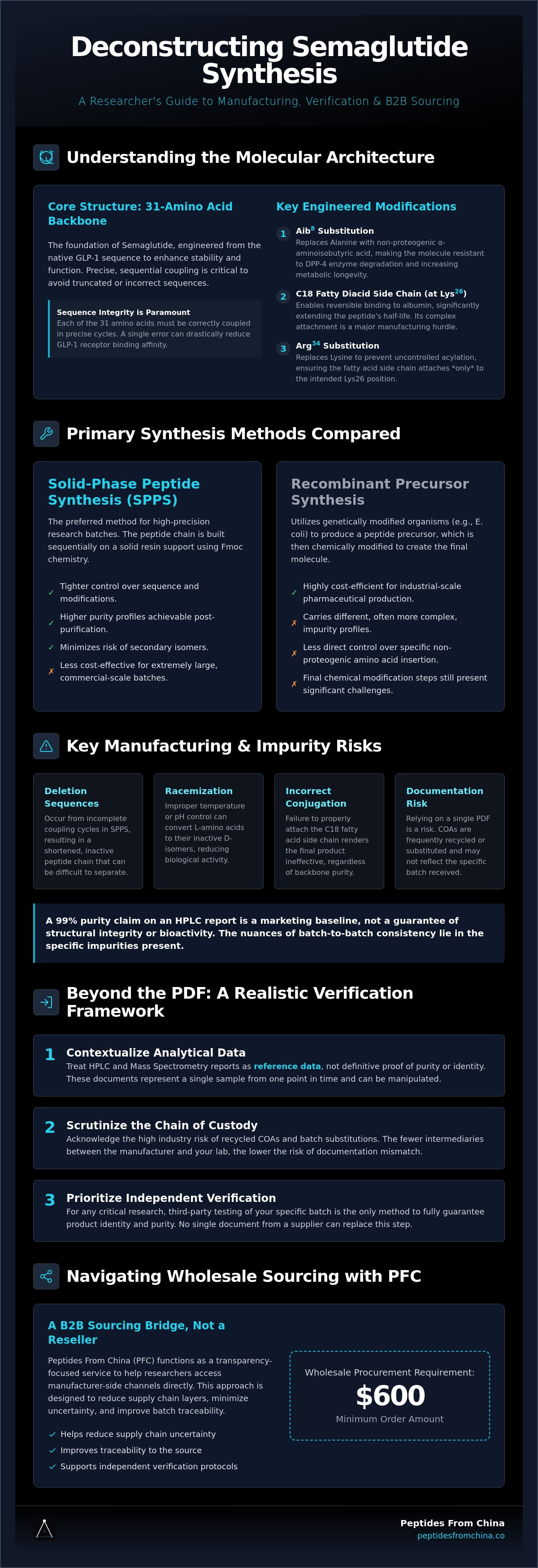
Semaglutide is a GLP-1 receptor agonist defined by its 31-amino acid backbone. While the primary sequence provides the biological blueprint, the operational complexity of the semaglutide synthesis process for research lies in its specific structural modifications. These changes weren't arbitrary; they were engineered to solve the inherent instability of native GLP-1. Specifically, the substitution of alpha-aminoisobutyric acid (Aib) at position 8 makes the molecule resistant to dipeptidyl peptidase-4 (DPP-4) degradation. Synthesis labs must handle Aib8 with precision. This non-proteogenic amino acid is essential for the peptide’s metabolic longevity, but it requires specific coupling conditions to ensure high yield.
The Role of the C18 Fatty Acid Side Chain
The defining feature of this molecule is the C18 fatty diacid side chain attached to the Lys26 residue. This isn't a direct attachment. It utilizes a complex spacer composed of a gamma-glutamic acid (gamma-Glu) and two units of 8-amino-3,6-dioxaoctanoic acid (AEEA). This arrangement allows the peptide to bind reversibly to albumin. This binding significantly extends its half-life in research models. From a manufacturing standpoint, attaching this large hydrophobic chain to a hydrophilic peptide backbone presents a significant technical hurdle. It requires specialized solvent systems and coupling reagents to prevent the peptide from aggregating during the semaglutide synthesis process for research. If the side chain isn't correctly conjugated, the resulting product will fail to meet the required pharmacokinetic profile, regardless of what a basic purity report claims.
Amino Acid Sequence and Substitutions
The sequence includes a critical Arg34 substitution, replacing the lysine found in the native human GLP-1 sequence. This modification is strategic. It ensures that the C18 fatty acid side chain only attaches to the Lys26 position. Without this substitution, manufacturers would face uncontrolled acylation at multiple sites. This creates a mixture of isomers that are nearly impossible to separate via standard HPLC. Successful production depends on several technical factors: Orthogonal protection: The Lys26 epsilon-amino group must be protected differently than other residues to allow site-specific side chain attachment. Rigorous deprotection: Every amino acid in the 31-unit chain must be correctly coupled through precise cycles to avoid deletion sequences. Racemization control: Precise temperature and pH controls are necessary to minimize the formation of inactive D-amino acid isomers. Sequence errors will drastically reduce GLP-1 receptor binding affinity. These structural nuances are why baseline documentation is only a starting point. You've got to understand the underlying chemistry to evaluate batch integrity effectively.
Primary Methods of Semaglutide Synthesis for Research
The semaglutide synthesis process for research generally follows two distinct paths: purely chemical synthesis or a hybrid recombinant-synthetic approach. Choosing between these methods depends on the required batch size and the specific purity profile needed for the study. While recombinant methods dominate commercial pharmaceutical production for cost efficiency, Solid-Phase Peptide Synthesis (SPPS) remains the preferred choice for high-precision research batches where secondary isomers must be minimized. Each method carries different risks regarding the final impurity profile, which is why a single HPLC report shouldn't be the only metric for verification.
Solid-Phase Peptide Synthesis (SPPS) Protocols
SPPS involves building the 31-amino acid chain on a solid resin support. The process follows a repetitive cycle: resin loading, deprotection of the N-terminus, coupling of the next amino acid, and final cleavage. Fmoc chemistry is the industry standard for this peptide because it allows for milder deprotection conditions compared to Boc chemistry. This protects the integrity of the acid-sensitive side chains. The semaglutide synthesis process for research via SPPS is particularly effective because it allows for tighter control over the addition of the Aib8 residue and the complex acylation at Lys26. High-purity batches often rely on SPPS to ensure that truncated sequences are removed during the multi-stage purification process.
Recombinant Precursor Production
For larger scales, manufacturers often use E. coli or yeast expression systems to produce the GLP-1 (7-37) backbone. This biological method creates inclusion bodies, which are essentially dense aggregates of the precursor protein. These must be harvested, refolded, and enzymatically cleaved to yield the raw peptide backbone. A major challenge here is the refolding process; improper folding can lead to biological inactivity.
The industry frequently uses a hybrid approach where the backbone is fermented and the C18 side chain is chemically attached later. This method attempts to balance high yields with the precision of chemical acylation. When evaluating semaglutide manufacturing methods, researchers should be aware that recombinant precursors can sometimes introduce host-cell protein impurities. These aren't always visible on a standard HPLC report but can impact research outcomes.
To further improve yields, some facilities utilize fragment condensation. Instead of adding amino acids one by one, they synthesize shorter segments and join them together. This reduces the cumulative risk of deletion sequences in the 31-unit chain. For researchers looking to access manufacturer-side supply channels, understanding these technical trade-offs is vital for verifying that a batch meets their specific operational requirements. Minimizing the number of intermediaries helps ensure that the specific synthesis method used is actually the one documented in the batch records.
Impurity Profiles and Manufacturing Risks
The semaglutide synthesis process for research is a high-stakes sequence of 31 individual coupling reactions. In a chain of this length, even a 99 percent coupling efficiency at each step results in a crude peptide mixture containing significant amounts of truncated or "deletion" sequences. These impurities are peptides missing one or more amino acids from the intended 31-unit structure. While purification via preparative HPLC helps reduce these variants, some deletion sequences have molecular weights and hydrophobicity profiles so similar to the target peptide that they are exceptionally difficult to remove. These "close-boiling" impurities can skew research results by competing for GLP-1 receptor binding without providing the expected biological activity.
Racemization is another critical manufacturing risk. This occurs when the L-amino acids used in synthesis partially convert to D-isomers due to improper pH levels or excessive heat during the coupling or cleavage phases. These inactive isomers are chemically identical to the target peptide in molecular weight, meaning they often pass a standard Mass Spectrometry (MS) test. However, their altered spatial configuration makes them biologically inert or reduces their receptor affinity. Beyond isomers, the final lyophilized powder often contains residual solvents such as acetonitrile or Trifluoroacetic acid (TFA). While TFA is a standard counter-ion used during the cleavage and purification steps, high residual levels can be cytotoxic in certain cell-based assays or impact the stability of the peptide during long-term storage.
Common Synthesis-Related Impurities
Beyond simple deletions, sequence-specific degradation pathways like beta-aspartyl formation present a constant challenge. This happens when the aspartic acid residue undergoes a side-reaction, creating a kink in the peptide backbone. Identifying these requires more than a cursory glance at an HPLC report. Researchers should look for "shoulder peaks" in the chromatogram, which often indicate the presence of these closely related substances. The semaglutide synthesis process for research must be tightly controlled to prevent these artifacts from reaching the final batch, yet many low-tier manufacturers bypass the rigorous secondary purification steps required to eliminate them.
Supply Chain Opacity in Peptide Production
The B2B market is frequently compromised by supply chain opacity. Resellers often obscure the original production facility to protect their margins, which leads to the prevalence of relabeled retail products being sold as wholesale batches. It's common to see the same HPLC report reused across multiple different batches or even different vendors. This lack of traceability makes it impossible for a buyer to know if the synthesis conditions were consistent or if the batch was substituted with lower-quality material.
Verification Standards for Research-Grade Semaglutide
A manufacturer-issued Certificate of Analysis (COA) is a baseline reference, not a definitive guarantee of batch integrity. In the current global market, COAs are frequently recycled across different production runs or even different vendors. This makes independent verification a necessity rather than an option for serious researchers. The semaglutide synthesis process for research is technically demanding; consequently, the documentation must be scrutinized for more than just a high purity percentage. You've got to understand the difference between purity and identity to effectively evaluate what's actually in the vial.
High-Performance Liquid Chromatography (HPLC) is the industry standard for measuring purity. It tells you what percentage of the sample is the main component. However, HPLC doesn't confirm that the main component is actually semaglutide. For sequence confirmation, Mass Spectrometry (MS) is required. MS verifies the molecular weight of the peptide, ensuring it matches the theoretical mass of the 31-amino acid sequence. Without both tests, you're essentially operating on trust rather than data. Even then, standard MS won't always detect the D-amino acid isomers mentioned in previous sections, which is why sourcing transparency is your primary defense against batch substitution.
Interpreting HPLC and MS Reports
When reviewing an HPLC chromatogram, don't just look at the final number. Analyze the baseline for peak tailing or small "shoulder" peaks. These often indicate the presence of deletion sequences or closely related substances that weren't fully removed during purification. In Mass Spectrometry reports, a low signal-to-noise ratio can obscure minor impurities that might impact your research outcomes. For a deeper look at these technical requirements, see our Peptide Testing and Analysis: A Professional Guide to Laboratory Verification.
Establishing a Chain of Custody
Supply chain uncertainty is best managed by minimizing the number of intermediaries between the laboratory and the synthesis floor. Every reseller layer adds a point where documentation can be swapped or batches can be relabeled. Reliable sourcing requires manufacturer-direct documentation and a clear understanding of the facility-side quality control measures. You can find more details on these logistical requirements in our Peptides Production: An Operational Guide to Large-Scale Synthesis and Sourcing.
Operational consistency is easier to maintain when you have direct routing to verified production channels. Peptides From China (PFC) acts as a transparency-focused B2B bridge to help researchers access these manufacturer-side channels while avoiding the risks of domestic resellers. Professional procurement through these channels typically involves a $600 minimum order, ensuring that you're accessing wholesale production batches rather than retail-grade leftovers. To start reducing your supply chain uncertainty, explore our direct-to-manufacturer sourcing protocols.
Navigating Wholesale Semaglutide Sourcing with PFC
Accessing a reliable semaglutide synthesis process for research requires moving beyond the fragmented retail market and into direct manufacturer-side channels. Most domestic resellers operate by purchasing bulk quantities, relabeling the vials, and inflating prices while obscuring the original production source. This practice creates a significant gap in the chain of custody. Peptides From China (PFC) functions as a transparency-focused B2B bridge, specifically designed to help research institutions and professional buyers bypass these reseller layers. We don't act as a manufacturer or a testing laboratory; instead, we provide the logistical infrastructure to route your procurement directly to verified synthesis facilities.
Our operational model begins with a $10 processing deposit. This small fee isn't a payment for the product itself, but a mechanism to initiate the manufacturer-side verification process for your specific request. It allows us to filter for serious B2B inquiries and begin the work of matching your requirements with current production batches. To maintain the efficiency of these direct-to-manufacturer channels, professional wholesale procurement through PFC requires a minimum order amount of $600. This threshold ensures that your order is handled as a dedicated production batch rather than a retail leftover, supporting better consistency across your research project.
The Direct-to-Manufacturer Advantage
Eliminating middlemen is about more than just cost. It's about reducing the risk of batch substitution and relabeling. When you access manufacturer-side channels, you're receiving reference analytical data that is tied directly to the production run of your specific order. This helps reduce supply chain uncertainty by providing a clearer line of sight to the facility where the SPPS or recombinant synthesis actually occurred. For a more comprehensive look at these dynamics, consult our Wholesale Peptides: A 2026 B2B Sourcing Guide for Research Institutions.
Logistics and Quality Assurance
Once the synthesis and primary purification are complete, the logistics phase must protect the chemical integrity of the peptide. We facilitate global shipping using neutral, tracking-enabled packaging to ensure your materials arrive without unnecessary delays. PFC acts as a protective, analytical filter for researchers, helping you navigate the complexities of international logistics while maintaining a methodical approach to documentation. By closing the loop between the synthesis facility and your laboratory, we help you implement a sourcing protocol that prioritizes factual integrity and operational reliability. This structured path minimizes the typical anxieties of international sourcing, allowing you to focus on the technical realities of your research rather than the flaws of the global supply chain.
Operationalizing Your Peptide Procurement Strategy
Success in research depends on the technical integrity of your materials. You've seen how the semaglutide synthesis process for research involves complex site-specific acylation and rigorous purification to remove truncated sequences. Relying on baseline documentation is a starting point; it's not a substitute for independent verification and a transparent chain of custody. By understanding these manufacturing risks, you can better identify the subtle indicators of batch inconsistency before they impact your data.
Reducing supply chain uncertainty requires a shift away from reseller-dominated markets toward direct manufacturer access. Peptides From China (PFC) provides this bridge, offering direct-to-manufacturer routing and COA-verified batches for professional labs. Our model prioritizes factual accuracy over marketing hype, requiring a $600 minimum for wholesale procurement to ensure you're accessing dedicated production channels. Request a direct manufacturer quote for wholesale Semaglutide to secure your research supply. Taking control of your sourcing protocols is the most effective way to ensure long-term operational consistency.
Frequently Asked Questions
How is Semaglutide synthesized for research use?
Semaglutide is synthesized using either Solid-Phase Peptide Synthesis (SPPS) or a hybrid recombinant-synthetic approach. These methods involve assembling a 31-amino acid chain and attaching a specific C18 fatty diacid side chain at the Lys26 position. The semaglutide synthesis process for research requires precise control over pH and temperature to ensure the correct sequence is formed without significant degradation or isomer formation.
What is the difference between SPPS and recombinant Semaglutide?
SPPS is a purely chemical method that builds the peptide on a resin support, while recombinant synthesis uses biological expression systems like E. coli. SPPS is often preferred for high-precision research batches because it allows for more direct control over side-chain modifications. Recombinant methods are typically used for large-scale production of the peptide backbone, which then requires chemical acylation to attach the fatty acid chain.
Why is Semaglutide purity often inconsistent between batches?
Inconsistency usually stems from variable coupling efficiencies and the technical difficulty of removing "close-boiling" impurities. Each of the 31 coupling steps in the synthesis carries a risk of creating deletion sequences. If a manufacturer skips secondary purification stages to reduce costs, these truncated peptides remain in the final batch, leading to variable purity levels that impact research reproducibility.
Can I trust the HPLC report provided by a peptide supplier?
You should treat a supplier-issued HPLC report as a baseline technical reference rather than a definitive guarantee of quality. It's common in the industry for vendors to reuse reports across multiple batches or substitute products. Because HPLC measures purity but not identity, it doesn't confirm the peptide's sequence; independent laboratory verification by the buyer is the only way to support the data provided.
What are the common impurities found in research-grade Semaglutide?
The most common impurities include deletion sequences, D-amino acid isomers, and residual solvents like TFA. Deletion sequences occur when an amino acid fails to couple during the semaglutide synthesis process for research. Racemization creates inactive isomers that are difficult to detect via standard HPLC, while residual TFA can impact the stability and cytotoxicity of the lyophilized powder in sensitive assays.
How much does wholesale Semaglutide cost for research labs?
What is the minimum order quantity for Semaglutide through PFC?
The minimum order requirement for wholesale procurement through Peptides From China is $600. This threshold is necessary to maintain operational efficiency and ensure that orders are routed as dedicated production batches rather than retail-grade leftovers. By maintaining this minimum, we help researchers access manufacturer-side supply channels that offer better traceability and reduced reseller interference.
How do you verify the synthesis facility in China?
Verification involves direct routing to facilities with established quality control protocols and documented synthesis capabilities. PFC acts as a strategic bridge, using a $10 processing deposit to initiate a manufacturer-side verification process for each inquiry. This methodical approach helps filter for reliable production channels and reduces supply chain uncertainty by providing a clearer line of sight to the actual synthesis floor.