A manufacturer-issued Certificate of Analysis is a baseline document, not a final guarantee of molecular integrity. In an industry where supply chain opacity and reused COAs are common, implementing rigorous semaglutide stability testing protocols is the only way to confirm that a bulk batch hasn't degraded during international transit. You're likely aware that the peptide market often prioritizes speed over verifiable consistency, leaving research labs to shoulder the risk of batch substitution or synthesis flaws. Relying on a supplier's paper trail without independent verification is an operational gamble that most professional procurement teams can't afford to take.
This reference provides a technical breakdown of the analytical frameworks required to verify the shelf-life and structural stability of bulk Semaglutide batches. PeptidesFromChina currently has a $600 total minimum order. Multiple catalog products can be combined to reach the minimum, with orders starting from one 10-vial kit per product. We'll outline how to move beyond basic HPLC reports to establish a longitudinal stress-testing model that accounts for temperature fluctuations and long-term storage. This framework ensures your research materials remain consistent from the moment they leave the production facility until they reach your lab bench.
Key Takeaways
Identify the primary degradation pathways for Semaglutide, such as hydrolysis and deamidation, to better predict how storage conditions impact molecular integrity.
Establish standardized semaglutide stability testing protocols using RP-HPLC and LC-MS to verify batch consistency beyond manufacturer-provided documentation.
Apply ICH Q1A(R2) guidelines to differentiate between accelerated and real-time degradation, ensuring bulk materials maintain their primary sequence during transit.
Implement a "Blind Sample" protocol for independent laboratory verification to mitigate the risks associated with reused COAs and batch substitution.
Reduce "time-on-shelf" degradation by utilizing direct-to-manufacturer sourcing for wholesale orders of $600 or more, improving supply chain traceability.
Table of Contents
Molecular Integrity: The Science of Semaglutide Degradation
Analytical Frameworks: Primary Stability Testing Methodologies
ICH Guidelines and Forced Degradation Protocols
Operational Verification: Independent Stability Testing for B2B Buyers
Mitigating Supply Chain Risk with Direct Sourcing via PFC
Molecular Integrity: The Science of Semaglutide Degradation
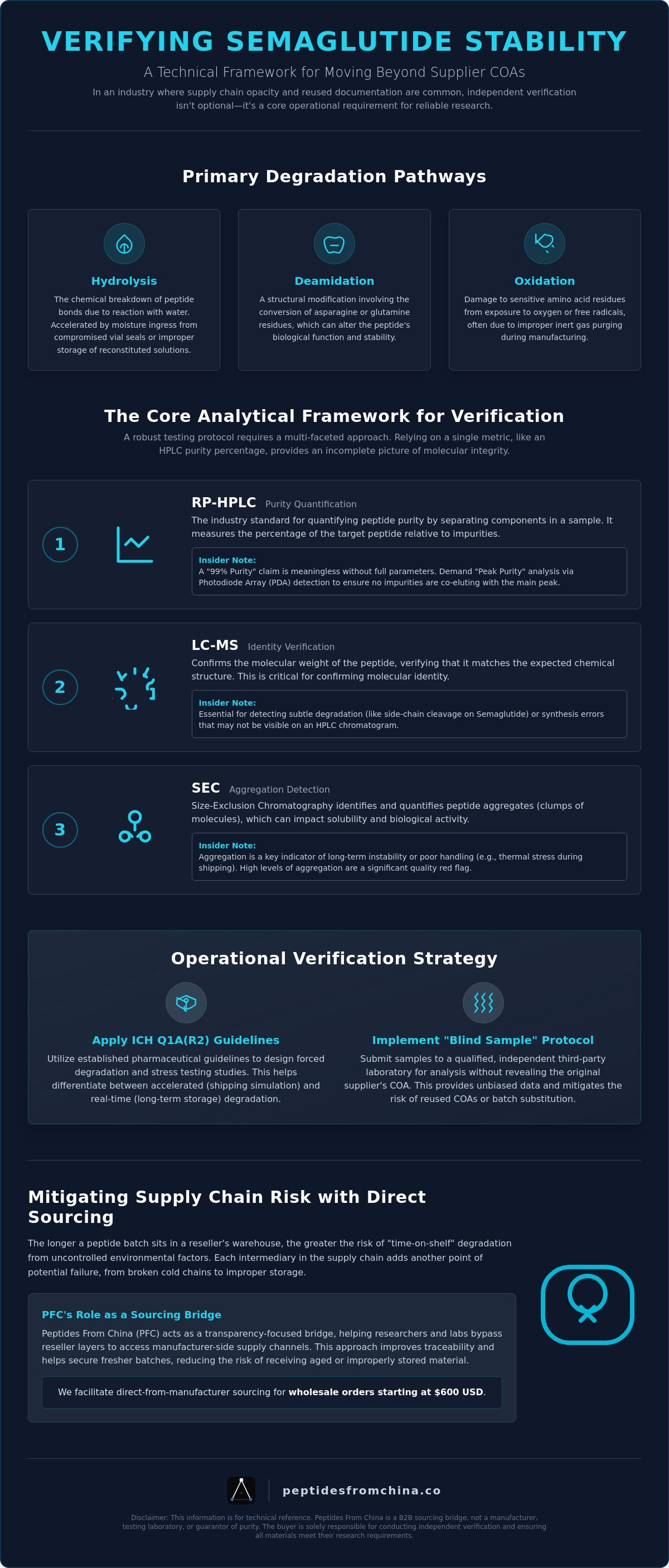
Stability in a B2B sourcing context means more than just a passing grade on a manufacturer's HPLC report. It refers to the maintenance of the peptide’s primary amino acid sequence and its specific acylation. When we discuss semaglutide stability testing protocols, we're looking for evidence that the molecule hasn't succumbed to hydrolysis, oxidation, or deamidation. These chemical pathways are the primary culprits behind batch degradation. Hydrolysis often occurs at specific peptide bonds, while deamidation involves the conversion of glutamine or asparagine residues. Oxidation typically targets sensitive residues if the vial wasn't properly purged with an inert gas like nitrogen during the finishing process.
The pH and temperature of the environment significantly dictate the rate of these reactions. Lyophilized powder is the industry standard for a reason. It offers a much higher baseline stability than reconstituted solutions. In its solid state, molecular mobility is restricted. This drastically slows down the chemical degradation processes that occur in a liquid medium. Once a researcher adds a bacteriostatic solvent, the peptide backbone becomes far more susceptible to structural shifts.
The Role of the C-18 Fatty Acid Side Chain
What sets Semaglutide apart from earlier GLP-1 analogs is its C-18 fatty acid side chain. This acylation allows the molecule to bind to albumin, which is what extends its half-life so effectively. However, this side chain is also a point of vulnerability. If the acylation is lost or modified during synthesis or improper storage, the peptide loses its primary functional advantage. Mass Spectrometry is essential here. It helps identify structural markers of degradation that a standard HPLC might miss, specifically detecting changes in molecular weight that indicate side-chain cleavage or incomplete acylation during the manufacturing stage.
Environmental Triggers for Peptide Instability
International logistics present several risks to molecular integrity. Thermal sensitivity is the most common concern. A "cold chain" break during shipping can accelerate degradation even in lyophilized products. Hygroscopicity is another factor. If the vial seal is compromised, moisture ingress facilitates hydrolytic pathways. Finally, photo-stability cannot be ignored. UV exposure can trigger free radical reactions that lead to peptide purity loss. Professional sourcing via Peptides From China (PFC) focuses on minimizing these risks by reducing the time a batch spends in transit. PeptidesFromChina currently has a $600 total minimum order. Multiple catalog products can be combined to reach the minimum, with orders starting from one 10-vial kit per product.
Analytical Frameworks: Primary Stability Testing Methodologies
Establishing robust semaglutide stability testing protocols requires an analytical approach that goes beyond the basic purity percentages found on a typical supplier's website. While Reverse-Phase High-Performance Liquid Chromatography (RP-HPLC) remains the industry gold standard for quantifying purity, it's only one piece of the puzzle. A truly comprehensive framework must also account for molecular identity and physical state. Many manufacturers provide a clean chromatogram that looks impressive but fails to disclose the specific parameters used to achieve that result. Without knowing the injection volume or the baseline noise level, a "99% purity" claim is essentially meaningless. To verify the molecular integrity of a batch, researchers should look for "Peak Purity" analysis, which uses photodiode array (PDA) detection to ensure that no hidden degradation products are co-eluting with the main peptide peak.
Identity verification relies heavily on Liquid Chromatography-Mass Spectrometry (LC-MS). This method confirms that the synthesized peptide matches the expected molecular structure. It's also vital for detecting subtle shifts caused by oxidation or deamidation, which might not significantly alter the retention time on a standard HPLC run but will change the molecular weight. Additionally, Size-Exclusion Chromatography (SEC) should be used to detect peptide aggregation. Aggregation is a common sign of poor handling or long-term instability, and it can significantly impact the reliability of research outcomes. By combining these methodologies, labs can move from simple acceptance of manufacturer data to a state of active verification. If you're looking to reduce supply chain uncertainty, implementing these internal checks is a necessary step.
HPLC Parameter Optimization for Semaglutide
Precision in HPLC starts with optimized mobile phases. Most reliable protocols utilize a gradient elution involving Acetonitrile and Water, typically buffered with Trifluoroacetic acid (TFA) or Formic Acid (FA) to maintain a stable pH. These buffers help sharpen the peaks and improve the resolution of closely related impurities that might otherwise blend into the main signal. Optimal detection of the peptide bond occurs at a wavelength of 214nm. Using this specific setting ensures that the detector is sensitive enough to capture low-level impurities that might be invisible at higher wavelengths like 280nm, where only aromatic residues are detected.
Interpreting the Certificate of Analysis (COA)
A manufacturer-provided COA is a snapshot in time, not a perpetual stability guarantee. Manufacturer-side analytical documentation may be available depending on the product and batch, and buyers should not treat it as independent verification. Learn more: PubChem Compound Summary for Semaglutide.
ICH Guidelines and Forced Degradation Protocols
Implementing semaglutide stability testing protocols isn't just about checking a box; it's about validating that your analytical methods can actually detect degradation. The ICH Q1A(R2) guidelines provide the international standard for this process. These guidelines require researchers to move past real-time monitoring and engage in "stress testing." The goal is to intentionally break the peptide to see what the resulting impurities look like on a chromatogram. This ensures that your HPLC method is truly a "Stability-Indicating Method." Without this step, you might be looking at a clean peak that's actually masking hidden degradation products. For a deeper look at how these standards are applied in a regulatory context, the FDA Product Quality Review for semaglutide offers significant technical insight into the expected stability profiles of this molecule.
Distinguishing between real-time, accelerated, and forced degradation is critical for operational success. Real-time studies are too slow for procurement decisions, while accelerated studies provide a helpful but limited window into shelf-life. Forced degradation is the most aggressive tool in your kit. It identifies the most likely failure points of a batch before it ever enters your long-term storage. By establishing these baselines, you can more accurately interpret the reference analytical data provided by manufacturers and identify when a batch has strayed from its expected stability profile.
The Forced Degradation Procedure
Forced degradation involves exposing a sample to extreme conditions to identify potential failure points. This isn't about simulating a shelf-life; it's about mapping the peptide's chemical vulnerabilities. A standard procedure includes:
Acid/Base Stress: Exposing the peptide to 0.1M HCl and 0.1M NaOH helps identify susceptibility to hydrolytic cleavage at different pH levels.
Oxidative Stress: Using H2O2 simulates long-term atmospheric exposure, highlighting risks related to improper vial sealing.
Thermal Stress: Incubating samples at 60°C accelerates kinetic degradation, revealing how the peptide backbone holds up under extreme heat.
Photolytic Stress: Exposure to high-intensity UV and visible light tests sensitivity to light, which is critical for determining secondary packaging needs.
Accelerated Stability Testing vs. Shelf-Life
Accelerated testing usually follows a schedule of 40°C ± 2°C at 75% RH ± 5% RH for a six-month period. Researchers use the Arrhenius equation to correlate this high-stress data with real-world shelf-life. This mathematical model helps predict the rate of chemical reactions at lower temperatures based on the activation energy observed during stress. However, it's vital to recognize the limitations of this data. Accelerated studies don't account for the "spiky" temperature fluctuations common in international shipping. A batch might survive a month at 40°C but fail after 24 hours at 55°C in a cargo hold. PeptidesFromChina currently has a $600 total minimum order. Multiple catalog products can be combined to reach the minimum, with orders starting from one 10-vial kit per product. While we help researchers access manufacturer-side reference data, we maintain that independent verification is the only way to confirm a batch hasn't been compromised by logistical realities.
Operational Verification: Independent Stability Testing for B2B Buyers
In the peptide industry, a manufacturer-issued COA is a starting point, not a final verdict. Independent peptide testing is a non-negotiable step for any serious procurement team. Relying solely on supplier documentation ignores the risks of batch substitution or degradation during international transit. When you receive a bulk batch, you're essentially inheriting the storage history of that material. Verification helps reduce supply chain uncertainty by confirming that the molecular integrity hasn't been compromised before it reaches your inventory.
Implementing a "Blind Sample" protocol is the most effective way to ensure unbiased results from third-party labs. By submitting samples without labeling them as Semaglutide, you force the laboratory to rely strictly on their analytical equipment rather than pre-conceived expectations. This practice, combined with a longitudinal tracking schedule, provides a clear picture of how your specific storage environment affects the material. We recommend testing a batch at 0, 3, and 6 months post-receipt. This data helps you refine your own semaglutide stability testing protocols and provides a factual basis for future sourcing decisions. While budgeting for this level of analysis can be significant, the cost is minor compared to the financial and scientific fallout of using degraded research materials.
Handling Reconstituted Stability in the Lab
Once you reconstitute the lyophilized powder, the stability clock accelerates. Semaglutide shows different degradation rates in bacteriostatic water compared to Phosphate-Buffered Saline (PBS). While bacteriostatic water prevents microbial growth, PBS provides a more stable pH environment that can help preserve the peptide backbone. For short-term use, storage at 2-8°C is usually sufficient. However, for long-term storage of reconstituted aliquots, -20°C is required. You must avoid multiple freeze-thaw cycles. Each cycle introduces mechanical stress and temperature fluctuations that can lead to side-chain cleavage or aggregation. It's better to aliquot the solution into single-use vials immediately after reconstitution.
Sample Preparation for Accurate Analysis
Accuracy in semaglutide stability testing protocols depends heavily on sample preparation. You need to ensure complete dissolution without using aggressive mechanical shearing, which can damage the peptide's delicate structure. Concentration also plays a role in physical stability. For example, a 5mg/mL solution might behave differently than a 10mg/mL solution regarding aggregation risk. High-concentration samples are more likely to exhibit molecular crowding, which can trigger the formation of fibrils or insoluble aggregates. Always use high-purity solvents and sterile equipment to avoid cross-contamination during the sampling process. If you want to streamline your procurement and access manufacturer-side analytical data directly, explore our B2B sourcing bridge for wholesale orders of $600 or more.
Mitigating Supply Chain Risk with Direct Sourcing via PFC
Sourcing is the logistical foundation upon which all semaglutide stability testing protocols must sit. Even the most rigorous analytical framework can't salvage a batch that's been degraded by months of improper storage in a reseller's warehouse. Traditional retail channels often involve multiple intermediaries, each adding "time-on-shelf" and increasing the risk of cold-chain violations. By shifting to a direct-to-manufacturer model, researchers can minimize these variables. Peptides From China (PFC) functions as a transparency-focused bridge, helping B2B buyers bypass the reseller layers that often obscure the true age and origin of a peptide batch. This direct access allows you to view manufacturer-side analytical data as a starting point for your own internal verification.
The economic logic of wholesale peptides is built on batch consistency. When procurement is fragmented into small, single-vial purchases, the risk of receiving mixed batches with different synthesis dates increases significantly. We maintain a $600 minimum order requirement to ensure that researchers are receiving material from a single, traceable production run. This scale makes independent testing more cost-effective; it's easier to justify a $300 lab analysis when it verifies a $1,000 batch rather than a $50 vial. Transitioning from reseller dependence to independent verification standards is the only way to ensure long-term operational consistency in a market known for its opacity.
Operationalizing Large-Scale Procurement
Managing the $600 minimum order helps maximize batch consistency by ensuring your entire inventory originates from the same synthesis cycle. To initiate the process, we use a $10 processing deposit through our peptide sourcing platform. This small step starts the verification and routing process, connecting your lab directly to verified facilities. Reducing intermediary handling is critical for preserving cold-chain integrity. Every time a package is opened, relabeled, or repackaged by a middleman, the risk of thermal stress increases. Direct routing ensures the material stays in a controlled environment for as long as possible before transit.
Beyond the COA: A Strategy for Researchers
PFC coordinates manufacturer-side sourcing and international logistics. Products are subject to the manufacturer’s applicable quality-control procedures and product-specific specifications. Manufacturer-side analytical documentation may be available depending on the product and batch, but PFC is not an independent analytical testing laboratory and does not guarantee a universal documentation package. Buyers requiring independent verification may arrange third-party analytical testing.
Establishing a Standard for Verifiable Batch Integrity
Implementing rigorous semaglutide stability testing protocols is a prerequisite for maintaining the scientific validity of your research. A manufacturer's COA serves only as a technical baseline; it doesn't account for the variables of international logistics or long-term storage kinetics. By utilizing forced degradation studies and independent third-party verification, you transition from passive procurement to active quality management. This methodical approach helps reduce supply chain uncertainty and ensures that your bulk materials remain structurally intact despite the inherent risks of global sourcing.
PeptidesFromChina currently has a $600 total minimum order. Multiple catalog products can be combined to reach the minimum, with orders starting from one 10-vial kit per product. PFC coordinates manufacturer-side sourcing and international logistics. Products are subject to the manufacturer’s applicable quality-control procedures and specifications. Manufacturer-side analytical documentation may be available depending on the product and batch. PeptidesFromChina is not an independent analytical testing laboratory. Learn more: access direct manufacturer sourcing for wholesale Semaglutide.
Frequently Asked Questions
How long is lyophilized Semaglutide stable at room temperature?
Lyophilized Semaglutide typically remains stable at room temperature (approximately 25°C) for four to eight weeks without significant degradation. This window is usually sufficient for international shipping. However, room temperature storage isn't suitable for long-term inventory management. For extended shelf-life, you should maintain temperatures of 2-8°C or -20°C to restrict molecular mobility and prevent hydrolytic pathways from compromising the peptide backbone.
Does a 99% purity COA guarantee the stability of a Semaglutide batch?
A 99% purity report is a snapshot of a batch at a single point in time. It doesn't account for the rate of degradation or the quality of the finishing process. Stability is a variable, not a fixed state. A batch can show high purity today but degrade rapidly if residual moisture or improper pH levels were present during lyophilization. This is why semaglutide stability testing protocols must include longitudinal tracking.
What is the most common degradation product found in Semaglutide?
The most common degradation products in Semaglutide are deamidation residues and high-molecular-weight aggregates. Deamidation typically occurs at asparagine or glutamine sites, while aggregation is often triggered by temperature spikes or mechanical stress. These impurities are critical to monitor because they can alter the peptide's binding affinity. Identifying these markers requires sensitive analytical methods like LC-MS to detect subtle molecular weight shifts that standard HPLC might miss.
Can I use HPLC to determine the shelf-life of my research peptides?
HPLC is the primary tool for shelf-life determination, but it must be part of a validated stability-indicating method. You can't simply run a standard purity check and call it a stability study. The method must be stressed via forced degradation to prove that the HPLC parameters can actually resolve degradation products from the main peak. Without this validation, your shelf-life data is technically unreliable and potentially misleading.
What temperature should be maintained during the shipping of bulk Semaglutide?
Bulk Semaglutide should ideally be shipped under cold-chain conditions (2-8°C). While lyophilized powder is resilient, international transit often involves unpredictable delays in unconditioned cargo holds where temperatures can exceed 50°C. Maintaining a cold chain helps reduce supply chain uncertainty and preserves the molecular integrity of high-value wholesale orders. PeptidesFromChina currently has a $600 total minimum order. Multiple catalog products can be combined to reach the minimum, with orders starting from one 10-vial kit per product.
How does the acylation of Semaglutide affect its chemical stability?
The C-18 fatty acid side chain (acylation) is what gives Semaglutide its long half-life, but it also influences its physical stability. This hydrophobic tail increases the peptide's tendency to aggregate, especially at higher concentrations. Accurate semaglutide stability testing protocols must account for this by using Size-Exclusion Chromatography (SEC) to monitor for fibril formation. Proper acylation is essential for the molecule's function, so verifying its presence via Mass Spectrometry is a non-negotiable step.
Why is independent testing necessary if the manufacturer provides an HPLC report?
Independent testing is necessary because manufacturer-issued papers are baseline references, not definitive proof of quality. The peptide industry faces challenges like batch substitution and reused COAs. Testing a "Blind Sample" at a third-party lab confirms that the material you received matches the documentation. This practice is the only way to account for degradation that may have occurred during transit or due to synthesis variations that the manufacturer failed to disclose.
What happens if a Semaglutide batch fails a forced degradation test?
If a batch fails a forced degradation test, it indicates that the peptide is chemically vulnerable or the synthesis was flawed. A failure under acid, base, or thermal stress helps you identify the specific pathways where the batch is likely to break down first. This data allows you to refine your storage protocols and set realistic expiration dates. It also provides a factual basis for rejecting batches that don't meet your lab's stability standards.