
Market pricing and availability can vary substantially by supplier, product, order size, and current conditions; exact comparisons require current, like-for-like data.
We understand that relying on opaque supply chains creates unnecessary risks for your laboratory operations. This guide provides a technical analysis of the GLP-1, GIP, and glucagon ratios that define this compound's unique mechanism. We'll outline a framework for verifying manufacturer-side documentation and establishing a direct sourcing pathway to help reduce supply chain uncertainty. By moving beyond baseline technical reference material, you can implement more realistic sourcing practices that prioritize batch traceability and operational consistency.
Key Takeaways
Analyze the unimolecular triple-agonist mechanism of Retatrutide (LY3437943) and its specific affinities for GIP, GLP-1, and GCG receptors.
Compare quantitative efficacy metrics against existing dual-agonists to understand the baseline performance expected in controlled laboratory settings.
Examine the broader scope of retatrutide research applications, including its therapeutic potential for metabolic conditions like NAFLD and chronic kidney disease.
Develop a verification framework for manufacturer-side documentation to mitigate risks associated with supply chain opacity and batch variability.
Establish a direct-to-manufacturer sourcing pathway that minimizes reseller markups and improves traceability, starting with a $600 minimum wholesale order.
Table of Contents
Understanding the Retatrutide Mechanism: The GIP/GLP-1/GCG Tri-Agonist
Retatrutide vs. Tirzepatide and Semaglutide: Comparative Research Metrics
Core Research Applications: Beyond Weight Loss
Sourcing Challenges: Verifying Batch Consistency and Purity
Direct Sourcing with Peptides From China (PFC)
Understanding the Retatrutide Mechanism: The GIP/GLP-1/GCG Tri-Agonist
Retatrutide (LY3437943) represents a significant evolution in metabolic pharmacology. Unlike its predecessors that target one or two pathways, Retatrutide (LY-3437943) is a unimolecular peptide that functions as a triple-hormone-receptor agonist. It integrates three distinct metabolic pathways: Glucose-dependent insulinotropic polypeptide (GIP), Glucagon-like peptide-1 (GLP-1), and Glucagon (GCG). This triple-target approach is the primary focus of current retatrutide research applications, as it attempts to address metabolic dysfunction through multiple physiological vectors simultaneously.
The molecule's structural backbone consists of a 39-amino acid sequence. This length and the specific sequence required to maintain affinity for all three receptors create substantial hurdles during peptide production. For B2B buyers, this complexity means that standard synthesis protocols often result in truncated sequences or purity variations. If the synthesis environment isn't strictly controlled, the resulting peptide may show reduced affinity for one or more of the target receptors, which can compromise the integrity of laboratory data.
The Role of Glucagon Receptor Agonism
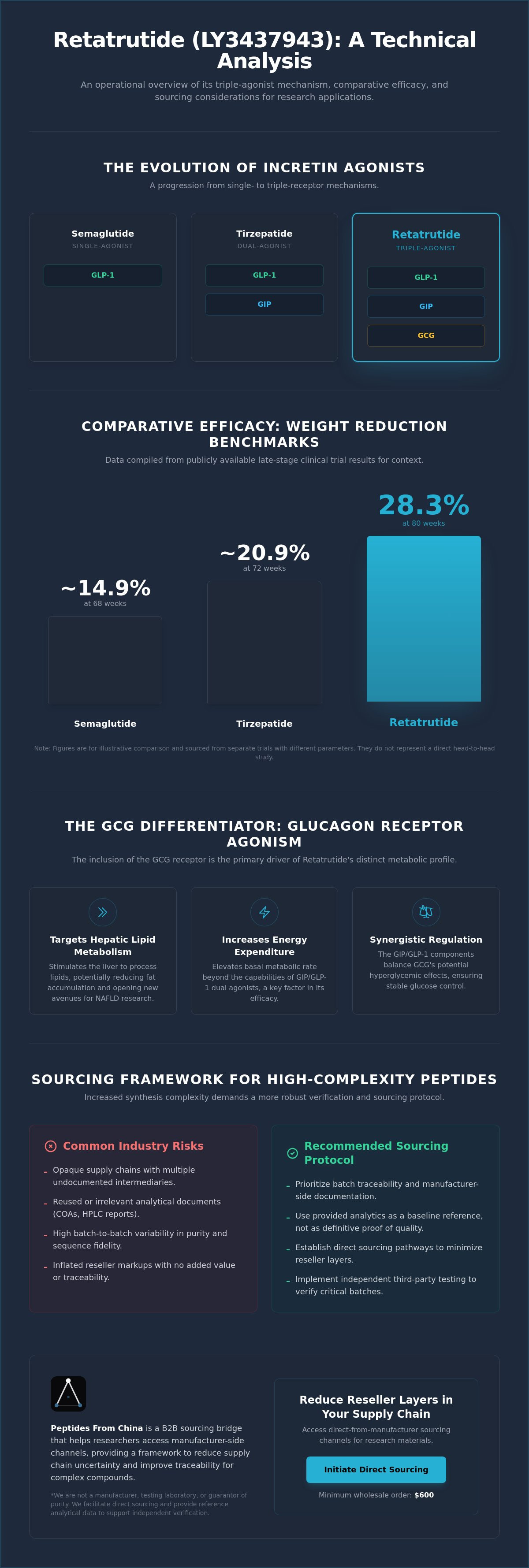
The inclusion of the glucagon (GCG) receptor is the primary differentiator from dual-agonist models like tirzepatide. While GLP-1 and GIP focus on insulin secretion and satiety, GCG agonism targets hepatic lipid metabolism and increases energy expenditure. Recent clinical data from June 2026 suggests that this addition helps drive the high weight loss percentages seen in late-stage trials. Key research implications include:
Stimulation of the liver to process lipids more efficiently, potentially reducing fat accumulation.
An increase in basal metabolic rate that exceeds the capabilities of GIP/GLP-1 dual agonists.
New avenues for investigating non-alcoholic fatty liver disease (NAFLD) by directly influencing liver fat content.
Synergistic Effects in Metabolic Research
A frequent concern in metabolic research is the inherent hyperglycemic potential of glucagon. However, the GIP and GLP-1 components within the Retatrutide molecule act as a regulatory balance to stabilize glucose levels while the glucagon component drives energy expenditure. The 'unimolecular' design is essential here because it ensures that these three receptors are activated in a fixed, consistent ratio. This provides a level of experimental control that can't be achieved by simply co-administering separate compounds. The peptide backbone is based on the GIP sequence, modified with specific amino acids to enable triple-receptor affinity while maintaining a long half-life. These structural nuances are why retatrutide research applications require such high levels of analytical verification during the sourcing process.
Retatrutide vs. Tirzepatide and Semaglutide: Comparative Research Metrics
Analyzing retatrutide's performance requires a quantitative look at how it differs from existing dual and single-agonist models. While semaglutide targets only the GLP-1 receptor and tirzepatide targets both GLP-1 and GIP, retatrutide's triple-agonist design adds a glucagon (GCG) component. This structural change shifts the potency profile. Retatrutide's backbone is primarily derived from the GIP sequence, making it more potent at the GIP receptor than at the GLP-1 receptor. This specific weighting is a key variable in retatrutide research applications, as it attempts to maximize metabolic throughput without over-stimulating single pathways.
The Phase 2 clinical trial data published in the New England Journal of Medicine highlighted the compound's aggressive efficacy. In these trials, non-diabetic participants receiving the highest dose achieved up to 24.2% weight reduction at 48 weeks. This significantly outpaces the 48-week benchmarks typically associated with dual-agonists. Research protocols usually follow a titration schedule starting at 1mg and escalating to 12mg. These escalations are necessary to manage the increased metabolic rate and ensure the GCG component doesn't cause excessive glycemic volatility before the GIP and GLP-1 components can stabilize insulin response.
Efficacy Benchmarks in Obesity and T2D
Research cohorts involving Type 2 Diabetes (T2D) participants show slightly different metrics than obesity-only groups. In the TRANSCEND-T2D-1 trials from March 2026, participants saw A1C reductions of up to 2.0% and an average weight loss of 16.8% over 40 weeks. While the weight loss percentages are lower than in non-diabetic subjects, the lipid profile improvements are often more pronounced. Researchers frequently observe significant drops in triglycerides and LDL cholesterol, which suggests that the triple-agonist mechanism provides a more comprehensive cardiovascular research profile than previous peptide generations.
Laboratory Handling and Storage Protocols
Stability is a significant operational hurdle for this 39-amino acid peptide. Retatrutide is more sensitive to temperature and pH fluctuations than semaglutide. In a lyophilized state, the powder remains stable at -20°C for extended periods, but its shelf-life drops rapidly once reconstituted. International transit presents the highest risk of degradation, as heat exposure can cause the peptide to aggregate or cleave. You should prioritize shipping methods that minimize time in transit and maintain a cold chain whenever possible. Once reconstituted in bacteriostatic water, the solution should be used within 14 to 21 days for optimal integrity. Establishing direct-to-manufacturer sourcing pathways helps reduce these operational variables by shortening the time between synthesis and laboratory receipt.
Core Research Applications: Beyond Weight Loss
While high-percentage weight loss often dominates the headlines, the technical utility of this compound extends deep into systemic metabolic health. The triple-hormone-receptor agonist mechanism allows researchers to investigate multi-organ responses that single or dual-agonists cannot replicate. Specifically, the integration of the glucagon receptor opens new pathways for studying hepatic, renal, and cardiovascular health. These retatrutide research applications are particularly valuable for laboratories focusing on chronic metabolic syndromes where weight loss is only one of several necessary outcomes. By engaging three distinct hormonal pathways, the peptide provides a more holistic view of metabolic flexibility than previous generations of incretin mimetics.
Hepatic Lipid Metabolism and NAFLD
The glucagon receptor component is the primary driver for hepatic fat clearance. Unlike GLP-1, which primarily influences the liver indirectly through weight loss and improved insulin sensitivity, glucagon receptors in the liver directly stimulate fatty acid oxidation and help regulate lipid synthesis. Data from the Phase 2 NAFLD substudy indicated that participants achieved over 80% liver fat reduction at the higher dose tiers within 24 weeks. This makes the peptide a critical reference material for future steatohepatitis research. However, the complexity of the synthesis means that laboratories must verify that the GCG-to-GIP ratio remains within strict analytical parameters; otherwise, the observed hepatic clearance may not reflect the compound's true potential.
Secondary Metabolic Indicators
Beyond liver health, the triple-agonist approach significantly impacts resting energy expenditure (REE) and renal protection. Glucagon agonism is known to increase REE, which helps offset the metabolic slowdown typically seen during aggressive caloric restriction in research subjects. In renal research, the combined effects of GLP-1 and GIP show potential reno-protective qualities, including improved filtration metrics and reduced inflammatory markers. Cardiovascular metrics, including heart rate and blood pressure changes, also remain a high-priority area of study. Retatrutide is often selected for multi-organ metabolic studies because its unimolecular design ensures that every receptor is engaged simultaneously, reducing the variables found in multi-peptide cocktails. Laboratories sourcing this material must prioritize transparency-first channels to ensure that the complex 39-amino acid sequence hasn't been compromised by truncated synthesis or batch substitution during the international supply chain process. Independent testing remains the only reliable method to confirm that the material matches the reference analytical data provided by the manufacturer.
Sourcing Challenges: Verifying Batch Consistency and Purity
Procurement professionals often encounter the "Reseller Trap" when sourcing for laboratory use. Domestic warehouses frequently operate as opaque intermediaries that mask batch-to-batch variability. They often rely on single, outdated COAs for multiple distinct production runs, which provides no insight into the specific material you receive. Because retatrutide is a complex 39-amino acid tri-agonist, the synthesis carries a high risk of truncated sequences. These partial chains can compromise the integrity of retatrutide research applications by providing inconsistent receptor activation. Rigorous peptide testing is therefore essential to establish an analytical baseline before any research begins.
Interpreting HPLC and Mass Spec Reports
A PDF claiming 99% purity is not a guarantee of product identity. High-Performance Liquid Chromatography (HPLC) measures purity by area under the curve, but it doesn't necessarily confirm that the molecule is retatrutide. Mass Spectrometry is required to verify the molecular weight and ensure the sequence is correct. Large-scale tri-agonist synthesis often produces common impurities like diastereomers or oxidation products that are difficult to detect without high-resolution equipment. You should treat manufacturer-issued papers as reference material only. Independent third-party verification for every batch is the only way to confirm that the material meets your specific laboratory requirements.
Reducing Supply Chain Uncertainty
Direct-to-manufacturer sourcing helps improve traceability by removing the layers where relabeling and batch substitution typically occur. This approach is vital for maintaining the consistency of retatrutide research applications across multiple study phases. When you engage with manufacturer-side channels, you can request original documentation that hasn't been scrubbed of its origin data. This transparency allows for better accountability in the event of a quality deviation. International logistics should utilize neutral, tracked packaging to minimize the risk of seizure or tampering. By reducing the number of intermediaries, you can better manage the operational risks inherent in the global peptide market. If you are ready to streamline your procurement, you can access manufacturer-side sourcing channels for your next project.
Direct Sourcing with Peptides From China (PFC)
PFC coordinates sourcing from established Chinese manufacturing facilities together with international logistics. By eliminating the multiple layers of domestic resellers, you can bypass the common practice of batch relabeling and markup inflation. The economic logic of wholesale peptides procurement is straightforward: it allows laboratories to allocate more of their budget toward independent verification rather than middleman margins. This model is specifically designed for professional buyers who prioritize supply chain traceability over the convenience of single-vial retail purchases.
The sourcing process begins with a $10 deposit, which initiates manual request processing and real-time stock verification, places the request into the processing workflow, validates the payment wallet, and is credited toward the final invoice. Manufacturer-side analytical documentation may be available depending on the product and batch; the deposit does not release or guarantee it.
Operational Requirements for Researchers
PeptidesFromChina currently has a $600 total minimum order. Multiple catalog products can be combined to reach the minimum, with orders starting from one 10-vial kit per product. The minimum is an operational requirement for orders placed through the PFC sourcing platform. Buyers requiring independent verification may arrange third-party analytical testing after receipt.
The PFC Direct Sourcing Model
The process begins when a request and $10 deposit initiate manual processing and real-time stock verification; the deposit is credited toward the final invoice. PFC then coordinates manufacturer-side sourcing and international logistics. Products are subject to the manufacturer’s applicable quality-control procedures and specifications, while manufacturer-side analytical documentation may be available depending on the product and batch. Shipping methods, pricing, and estimated transit times vary by destination and are confirmed during order processing.
Advancing Metabolic Research Through Supply Chain Transparency
The transition to triple-agonist compounds represents a significant technical leap for metabolic science, but it also demands a more rigorous approach to procurement. Successfully managing retatrutide research applications requires you to look past the superficial guarantees of domestic resellers and implement a direct verification framework. By prioritizing batch traceability and independent testing, your laboratory can mitigate the risks of truncated sequences and sequence variability that often plague complex peptide synthesis. It's essential to treat manufacturer documentation as a baseline rather than absolute proof of quality.
PFC coordinates sourcing from established Chinese manufacturing facilities together with international logistics. Products are subject to the manufacturer’s applicable quality-control procedures and specifications. Manufacturer-side analytical documentation may be available depending on the product and batch. PeptidesFromChina is not an independent analytical testing laboratory. We invite you to request manufacturer-side Retatrutide sourcing through Peptides From China and take control of your laboratory's procurement standards today. Building a reliable sourcing foundation is the first step toward generating reproducible, high-quality research data.
Frequently Asked Questions
What is the recommended storage temperature for Retatrutide powder?
Lyophilized powder should be stored at -20°C for long-term stability. While the peptide can remain stable at 2°C to 8°C for shorter durations during active use, deep freezing helps minimize the risk of degradation over several months. Once you reconstitute the powder in bacteriostatic water, the solution must be refrigerated and used within 14 to 21 days to maintain its structural integrity for laboratory applications.
How does Retatrutide differ from Tirzepatide in research outcomes?
Retatrutide adds a third mechanism of action by targeting the glucagon (GCG) receptor in addition to GIP and GLP-1. Tirzepatide is a dual-agonist that only targets GIP and GLP-1. This triple-agonist approach is designed to increase energy expenditure and hepatic lipid metabolism more aggressively. This structural difference is a primary driver for the high weight loss percentages observed in current retatrutide research applications.
Can Retatrutide be used for NAFLD research specifically?
Yes, retatrutide is a high-priority compound for non-alcoholic fatty liver disease (NAFLD) research due to its glucagon receptor agonism. This component directly stimulates fatty acid oxidation in the liver and helps regulate lipid synthesis. Clinical data from June 2026 suggests that the triple-agonist mechanism can reduce liver fat content by up to 80%, making it a critical reference material for steatohepatitis studies.
What are the common impurities found in low-quality Retatrutide batches?
Common impurities include truncated sequences and diastereomers that occur when the complex 39-amino acid chain is not synthesized correctly. You may also find residual solvents, oxidation products, or trifluoroacetic acid (TFA) salts in poorly refined batches. These contaminants can interfere with receptor affinity and compromise your data. Independent mass spectrometry is the only way to verify that the molecular weight matches the target compound exactly.
Why is the Glucagon receptor important in Retatrutide's mechanism?
The glucagon receptor is essential for increasing resting energy expenditure and promoting hepatic fat clearance. In a triple-agonist model, it works synergistically with GIP and GLP-1 to drive metabolic throughput while the other two pathways help stabilize glucose levels. This balance allows researchers to study metabolic flexibility and weight loss metrics that exceed the capabilities of single or dual-pathway incretin mimetics.
Does Peptides From China provide third-party testing for Retatrutide?
No, Peptides From China is a B2B sourcing bridge and does not operate as a testing laboratory. Manufacturer-side analytical documentation may be available depending on the product and batch. Buyers requiring independent verification may arrange third-party analytical testing for retatrutide research applications.
What is the minimum order quantity for wholesale Retatrutide?
The minimum order requirement for wholesale procurement is $600. This threshold is necessary to manage the logistical costs of international shipping and neutral, tracked packaging. This requirement ensures that the volume of material is sufficient to justify the cost of independent laboratory verification upon arrival, which is a standard best practice for professional research institutions and B2B buyers.
How do I verify an HPLC report provided by a Chinese manufacturer?
You cannot fully verify an HPLC report without conducting your own independent analysis. While you can check for red flags like inconsistent fonts, blurred axes, or reused batch numbers, these documents should only be treated as baseline technical reference material. The most reliable method is to compare the manufacturer's provided data against your own independent mass spectrometry and HPLC results to ensure the batch identity hasn't been substituted.