
Market pricing and availability can vary substantially by supplier, product, order size, and current conditions; exact comparisons require current, like-for-like data.
This industry insider’s guide deconstructs the marketing hype to help you establish a transparent, manufacturer-direct sourcing strategy. You'll learn how to eliminate unnecessary middlemen, reduce procurement costs, and implement a repeatable verification protocol that accounts for the latest 2026 regulatory shifts. We’ll examine the operational impact of the June 2026 EMA guidelines, the upcoming July 23-24 FDA PCAC reviews for substances like BPC-157 and TB-500, and how to utilize B2B bridges like Peptides From China to access wholesale channels with a $600 minimum. This approach helps reduce supply chain uncertainty by prioritizing technical reality over retail promises.
Key Takeaways
Distinguish between retail-focused "brands" and a legitimate peptides source by evaluating the intersection of synthesis capability and logistical transparency.
Understand that "USA-Made" claims are often marketing labels. Most global synthesis occurs in specialized Chinese facilities, making vendor qualification more critical than geography.
Treat HPLC and Mass Spectrometry reports as baseline technical references rather than absolute guarantees of quality, highlighting the need for independent, batch-specific testing.
Identify common reseller red flags such as instant domestic shipping and proprietary blends that typically signal a lack of batch-level traceability.
Establish a direct-to-manufacturer pipeline through a B2B bridge, utilizing a $10 processing deposit for verification and a $600 minimum for wholesale procurement.
Table of Contents
Defining a "Peptides Source" Beyond Marketing Hyperbole
The "Domestic vs. International" Manufacturing Myth
Deconstructing the "99% Purity" and COA Guarantee
Red Flags in Peptide Procurement: Spotting Reseller Tactics
Strategic Sourcing: Transitioning to Direct Manufacturer Channels
Defining a "Peptides Source" Beyond Marketing Hyperbole
In the research procurement sector, the term "peptides source" is frequently misused as a synonym for a retail storefront. A true source represents the intersection of chemical peptide synthesis capability and logistical transparency. While retail brands focus on packaging and user interface, a professional sourcing channel focuses on the technical integrity of the supply chain. This distinction is critical for researchers who require consistent batch quality rather than just a one-off purchase. Every layer added to the supply chain, from domestic importers to tertiary resellers, increases the final cost while simultaneously decreasing the visibility of the manufacturing origin. When a source functions correctly, it acts as a data conduit between the lab and the researcher, providing more than just a physical vial.
The Distinction Between Resellers and Manufacturers
Market pricing and availability can vary substantially by supplier, product, order size, and current conditions; exact comparisons require current, like-for-like data.
Why Technical Readers Are Moving Away from Retail Models
Manufacturer-side analytical documentation may be available depending on the product and batch. It is not guaranteed with every order and is not independent verification by PFC. Buyers may arrange third-party analytical testing when required.
The "Domestic vs. International" Manufacturing Myth
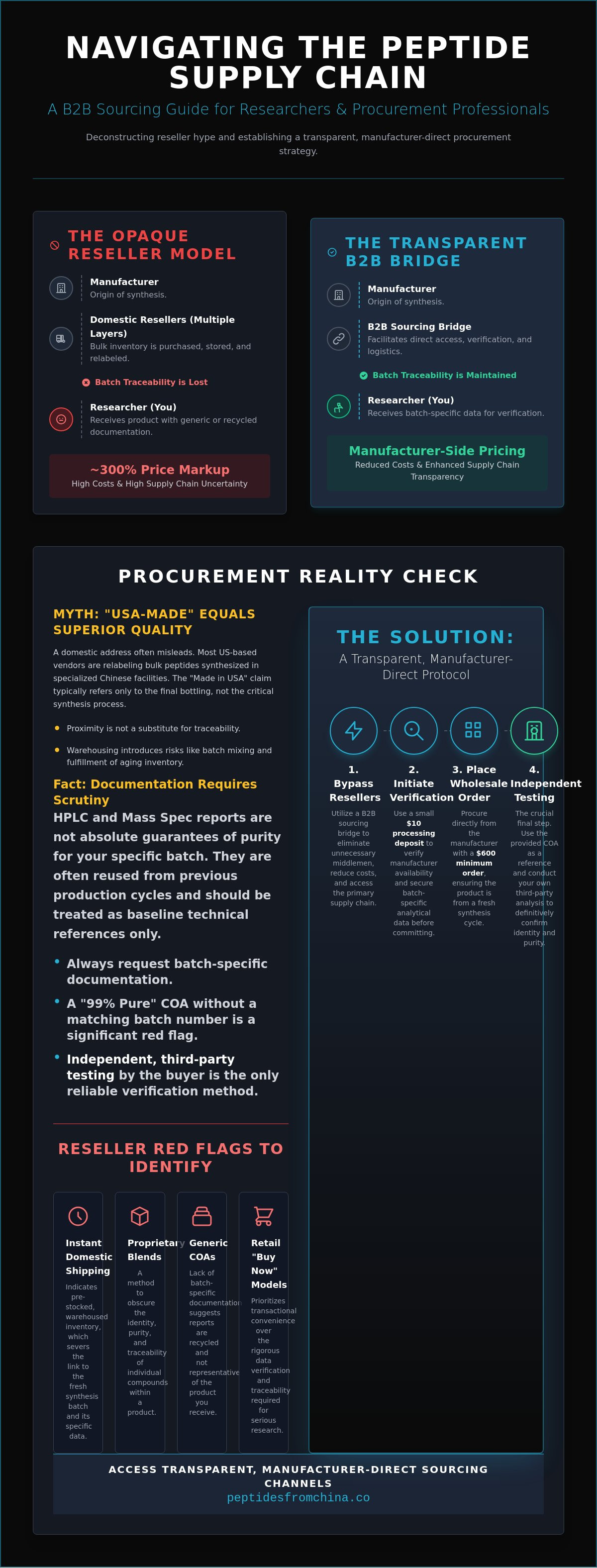
Many researchers prioritize a domestic peptides source under the assumption that a local address correlates with superior purity or oversight. This is a common misconception. Most domestic vendors function as high-volume resellers that purchase bulk synthesis products from specialized Chinese facilities. These resellers then relabel the vials and market them as "USA-Made," a claim that often refers only to the final bottling or labeling stage. In reality, the core peptides production, including the synthesis of complex sequences like Tirzepatide or Retatrutide, is concentrated in the Asia-Pacific region. This is due to established high-throughput infrastructure and massive economies of scale.
Relying on domestic warehousing can actually introduce specific risks, such as batch mixing. When a reseller maintains stock, they may fulfill a single order using vials from different production lots to clear aging inventory. This compromises research integrity because the analytical data from one lot doesn't apply to the next. Adhering to FDA guidance on peptide impurities requires a level of batch-level traceability that domestic resellers often fail to maintain. Proximity is not quality. Knowing exactly which facility synthesized your batch provides a transparency advantage that a local warehouse cannot replace.
The Reality of Global Synthesis Hubs
China remains the dominant force in the global peptide synthesis market, which is projected to reach approximately $1.44 trillion by 2035. The region's specialized facilities utilize advanced Solid-Phase Peptide Synthesis (SPPS) and green chemistry protocols that many smaller domestic labs cannot afford to implement. Direct sourcing from these hubs reduces the risk of receiving "re-shipped" inventory that has sat in uncontrolled domestic environments for months. By accessing manufacturer-direct channels, professional labs ensure they receive the most recent synthesis lot rather than a reseller's surplus.
Transparency vs. Proximity: What Matters More?
In 2026, logistical transparency is more valuable than physical proximity. A direct link to a Chinese manufacturer, supported by reference analytical data, is more reliable than a domestic vendor with no clear chain of custody. Logistical concerns regarding international customs are often overstated. Professional sourcing bridges use neutral packaging and tracked international shipping to ensure consistent delivery. While the June 2026 EMA guidelines have tightened standards for synthetic peptides, these requirements apply to the manufacturing process itself. This makes the qualification of the specific production facility far more important than the location of the warehouse. Choosing a peptides source based on its ability to provide raw manufacturing data helps reduce supply chain uncertainty while supporting more rigorous independent verification protocols. Utilizing a B2B bridge like Peptides From China, which facilitates manufacturer-side access with a $600 minimum wholesale requirement, allows researchers to bypass the reseller layer entirely.
Deconstructing the "99% Purity" and COA Guarantee
In the 2026 procurement landscape, "99% purity" has become a baseline technical standard rather than a premium feature. Any batch falling below 98% purity is generally considered a synthesis failure in professional laboratory settings. Many retail vendors use this figure as a static marketing slogan to distract from the lack of batch-specific data. However, a high purity percentage on a piece of paper doesn't account for the Regulatory Status of Peptide Compounding or the complex impurity profiling required for high-sensitivity research. For a professional peptides source, these documents are merely starting points for a deeper verification process. No single document, even one issued directly by a manufacturer, can fully guarantee product identity without independent confirmation.
Reading Between the Lines of an HPLC Report
Purity and concentration are often conflated by inexperienced buyers. An HPLC report measures the ratio of the target peptide to other peptide-related impurities, but it doesn't necessarily quantify the exact milligram content within a lyophilized vial. High-Performance Liquid Chromatography (HPLC) reports should be viewed as "reference analytical data" rather than definitive proof of quality. Mass Spectrometry (MS) reports are equally susceptible to manipulation. Red flags include inconsistent font styles, missing timestamps, or MS peaks that don't align with the theoretical molecular weight of the sequence. Independent, buyer-led testing remains the only professional standard for ensuring that the physical product matches the provided documentation.
The Myth of the "Permanent" COA
A Certificate of Analysis (COA) is a snapshot of a single batch at a specific point in time. Generic or recycled reports do not establish the identity or purity of material received. PeptidesFromChina coordinates manufacturer-side sourcing, but analytical documentation may be available depending on the product and batch and should not be treated as independent verification. A $10 deposit initiates manual request processing and real-time stock verification and is credited toward the final invoice. PeptidesFromChina currently has a $600 total minimum order, and multiple catalog products may be combined to reach it.
Red Flags in Peptide Procurement: Spotting Reseller Tactics
Instant shipping is often marketed as a primary benefit, but in the research sector, it's a significant red flag for batch-level traceability. When a vendor fulfills an order in 48 hours, they're shipping from pre-existing inventory that has likely sat in a domestic warehouse for months. This breaks the chain of custody and makes it impossible to verify if the product in the vial matches the latest synthesis lot. A professional peptides source should prioritize transparency over speed. If a vendor cannot provide the specific synthesis date for your order, they're likely mixing batches to clear aging stock. This practice compromises research integrity by introducing variables that your analytical data cannot account for.
Proprietary blends and non-standardized concentrations are another tactic used to obscure synthesis quality. These products often hide low yields or poor purification results behind "unique" formulations. Similarly, the pricing trap is a constant risk. If a product is priced significantly below market averages, it usually indicates that the manufacturer skipped essential purification steps to save on solvent and labor costs. High-purity synthesis is a resource-intensive process. Cutting costs at the production level directly impacts the consistency of the final peptide sequence.
The Reseller Markup and Opacity Trap
Domestic resellers must account for high customer acquisition costs, Google Ads budgets, and warehouse overhead. These expenses are passed to the buyer through significant markups that don't reflect the actual value of the peptide. Multiple intermediaries also increase the danger of batch substitution. Every time a product changes hands, the risk of relabeling or misidentifying a lot increases. A transparency-first model routes orders straight to the manufacturing floor, eliminating these layers of risk. This ensures that your procurement budget is spent on synthesis quality rather than a reseller's marketing campaign.
Operational Realistic Sourcing vs. Retail Convenience
Professional researchers understand that batch consistency is more valuable than two-day shipping. Retail platforms are designed for high turnover, not technical precision. When evaluating your supply chain, a peptide sourcing agent vs platform comparison reveals that agents provide better manufacturer-side access. A sourcing bridge focuses on the logistical reality of the supply chain rather than website aesthetics. They facilitate the flow of raw manufacturing data, helping you verify the origin and age of every batch. By moving away from retail convenience, you gain the ability to implement more rigorous internal verification protocols. This shift is essential for labs that require long-term supply stability for their research projects.
Establish a direct-to-manufacturer pipeline and reduce your reliance on high-markup resellers by visiting Peptides From China.
Strategic Sourcing: Transitioning to Direct Manufacturer Channels
PFC coordinates manufacturer-side sourcing and international logistics. Products are subject to the manufacturer’s applicable quality-control procedures and product-specific specifications. Manufacturer-side analytical documentation may be available depending on the product and batch, but PFC is not an independent analytical testing laboratory and does not guarantee a universal documentation package. Buyers requiring independent verification may arrange third-party analytical testing.
The PFC Sourcing Protocol
The operational reality of direct sourcing involves a methodical verification process. At PFC, this begins with a $10 processing deposit. This fee isn't a product payment but a logistical trigger that initiates a direct verification check with manufacturer-side inventory. It ensures that the specific batch you're requesting is currently available and that the manufacturer can provide the necessary reference analytical data before you commit to a larger purchase. This model is particularly effective for managing large-scale procurement of compounds such as:
BPC-157 and TB-500 (Thymosin Beta-4)
Semaglutide, Tirzepatide, and Retatrutide
Selank and Semax
Thymosin Alpha-1 and Epithalon
PFC coordinates manufacturer-side sourcing and international logistics. Products are subject to the manufacturer’s applicable quality-control procedures and product-specific specifications. Manufacturer-side analytical documentation may be available depending on the product and batch, but PFC is not an independent analytical testing laboratory and does not guarantee a universal documentation package. Buyers requiring independent verification may arrange third-party analytical testing.
Implementing a Professional Sourcing Strategy
Moving away from opaque reseller supply chains involves manufacturer-side coordination, careful review of any available documentation, and buyer-arranged independent testing where required. Manufacturer-side analytical documentation may be available depending on the product and batch, but no vendor or manufacturer document should be treated as independent verification. PFC coordinates sourcing from established Chinese manufacturing facilities together with international logistics.
Establishing a Transparent Procurement Pipeline for 2026
Finding a legitimate peptides source requires looking past retail storefronts and focusing on the manufacturing floor. You've seen how "USA-Made" labels often hide global synthesis hubs and how static COAs fail to provide batch-level security. Success in this sector depends on minimizing intermediaries and implementing independent verification protocols for every wholesale delivery. By transitioning to a direct sourcing model, you reduce the opacity of the supply chain while securing the reference analytical data necessary for high-sensitivity research. This methodical approach helps ensure that your procurement budget is spent on synthesis quality rather than reseller marketing budgets.
A more transparent procurement approach can reduce reliance on anonymous reseller supply chains. The $10 deposit initiates manual request processing and real-time stock verification and is credited toward the final invoice. PeptidesFromChina currently has a $600 total minimum order, and multiple catalog products can be combined to reach it. Products remain subject to the manufacturer’s applicable quality-control procedures and specifications; manufacturer-side analytical documentation may be available depending on the product and batch.
Frequently Asked Questions
What should I look for in a legitimate peptides source?
A legitimate peptides source should prioritize data transparency and batch-level traceability over retail marketing slogans. Look for entities that facilitate direct access to manufacturer-issued papers and reference analytical data for every specific lot. You should avoid vendors that use static, years-old COAs as a marketing shield for their current inventory. A professional partner focuses on the technical integrity of the supply chain rather than flashy website design.
Is it safe to source research peptides directly from China?
Sourcing from China is the global industry standard, as it's the primary hub for high-throughput synthesis and raw material production. Safety depends on your ability to qualify the specific production facility rather than the country of origin. Using a B2B bridge helps reduce supply chain uncertainty by auditing these facilities on your behalf. This ensures you're accessing manufacturer-side channels that utilize advanced synthesis protocols and impurity profiling.
How can I verify the purity of a peptide batch independently?
Independent verification requires submitting random samples from your wholesale batch to an accredited third-party laboratory for HPLC and Mass Spectrometry analysis. You shouldn't rely solely on documentation provided by the seller, as these reports are baseline technical references. Professional labs treat vendor reports as data that must be confirmed before research begins. This is the only way to ensure the physical product matches the claimed identity and purity levels.
Why do some peptide companies have much higher prices than others?
Market pricing and availability can vary substantially by supplier, product, order size, and current conditions; exact comparisons require current, like-for-like data.
What is the difference between a peptide reseller and a sourcing agent?
Resellers may purchase bulk inventory and relabel it for retail sale, which can weaken traceability to the original synthesis source. PFC instead coordinates manufacturer-side sourcing through a limited network of verified facilities. Its $10 deposit initiates manual request processing and real-time stock verification and is credited toward the final invoice; the platform has a $600 total minimum order that may combine multiple catalog products.
Can I trust the HPLC reports provided by a peptides source?
You should treat any HPLC report provided by a peptides source as reference analytical data rather than a definitive guarantee of purity. These documents are easily recycled across different batches or manipulated by low-tier resellers to hide synthesis failures. Professional procurement protocols require independent testing to confirm that the physical product identity matches the provided documentation. Trust in this industry is built through repeatable verification, not just paperwork.
What are the risks of buying peptides from domestic warehouses?
Domestic warehouses often suffer from aged inventory and batch mixing, where vials from different synthesis cycles are fulfilled in a single order. This lack of traceability makes it impossible to apply a single analytical report to your entire purchase. Direct-to-manufacturer shipping ensures you receive the most recent production run with consistent lot conditions. Bypassing domestic storage reduces the risk of receiving degraded product that has sat in uncontrolled environments.
How do I handle international shipping and customs for large peptide orders?
Professional sourcing agents manage large-scale logistics using neutral packaging and tracked international shipping to navigate customs efficiently. While the May 19, 2026, update to FDA Import Alert 66-41 allows for the detention of unapproved drugs, research-grade peptides with clear documentation typically move through established professional channels. Large orders are handled with methodical logistical planning to ensure consistent delivery timelines. This process is far more reliable than the unpredictable nature of retail parcels.