A Certificate of Analysis is often less a proof of quality and more a baseline for further verification in a market flooded with recycled data. You likely understand that in high-stakes IGF-1 LR3 research applications, relying on a reseller's PDF is an operational risk that can compromise months of laboratory data. Supply chain opacity and the prevalence of reused HPLC reports make it difficult to maintain the 98% purity standards required for sensitive receptor-grade assays.
This analysis provides a technical look at how the Long R3 modification bypasses binding proteins to extend half-life and outlines a framework for establishing a more reliable supply chain. We'll examine the molecular dynamics of the 13-amino acid extension, the realities of batch-to-batch consistency, and how to minimize middleman markups. PeptidesFromChina currently has a $600 total minimum order. Multiple catalog products can be combined to reach the minimum, with orders starting from one 10-vial kit per product. We'll move past the marketing hype to focus on the independent testing protocols and logistical realities necessary for high-volume metabolic research in 2026.
Key Takeaways
Understand how the Long R3 modification inhibits binding to IGFBPs, providing a technical rationale for the molecule's extended half-life in metabolic studies.
Identify the specific advantages of using the Long R3 variant in IGF-1 LR3 research applications targeting satellite cell proliferation and connective tissue remodeling.
Learn why manufacturer-issued HPLC reports should be treated as reference material, making independent Mass Spectrometry essential to verify the specific LR3 sequence.
Improve supply chain traceability by utilizing a transparency-focused bridge to access manufacturer-side channels, effectively reducing unnecessary reseller markups.
Establish a reliable procurement pipeline for high-purity peptides by meeting the $600 minimum order threshold required for direct-to-manufacturer sourcing.
Table of Contents
Understanding the LR3 Modification: Molecular Structure and Rationale
Primary Research Applications: Metabolic and Tissue-Specific Studies
Evaluating Synthesis Quality: HPLC, Mass Spec, and Sequence Verification
Operational Logistics for High-Volume IGF-1 LR3 Procurement
Manufacturer-Side Sourcing: The PFC Transparency Model
Understanding the LR3 Modification: Molecular Structure and Rationale
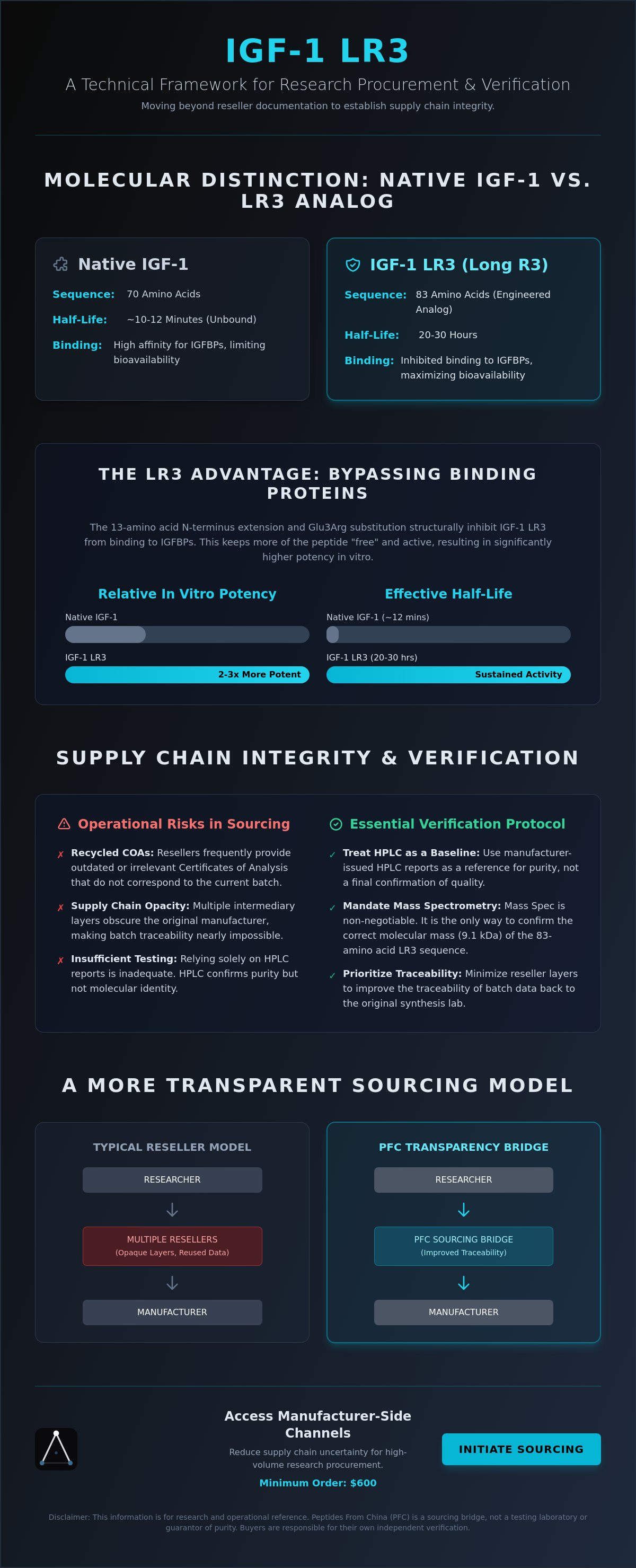
Native Insulin-like Growth Factor-1 (IGF-1) is a 70-amino acid polypeptide that plays a central role in mammalian growth and cellular development. However, its utility in laboratory settings is often limited by its high affinity for IGF-binding proteins (IGFBPs). These proteins sequester native IGF-1, effectively preventing it from interacting with the IGF-1 receptor (IGF-1R). The development of Long R3 IGF-1 was a direct response to this limitation. By engineering the primary sequence, researchers created a molecule that maintains receptor affinity while effectively ignoring the regulatory proteins that usually control its bioavailability.
Sequence Analysis: The 83-Amino Acid Analog
The IGF-1 LR3 molecular structure consists of an 83-amino acid chain. This includes two critical alterations from the native sequence. First, the glutamic acid at position 3 is replaced with arginine (Glu3Arg). Second, a 13-amino acid extension is added to the N-terminus. These aren't just arbitrary additions. They represent a calculated effort to alter the electrostatic and structural profile of the peptide. Because IGFBPs rely on specific binding sites at the N-terminus, these modifications prevent the proteins from "recognizing" the peptide. This structural evolution is the technical foundation for most modern IGF-1 LR3 research applications.
LR3 vs. Native IGF-1 in Laboratory Settings
In vitro, the LR3 variant is significantly more potent than its native counterpart. While native IGF-1 has a half-life measured in minutes when not bound to proteins, the LR3 analog remains active for 20 to 30 hours. This extended duration allows for sustained receptor activation without the need for constant re-administration in cell cultures. It's often cited as being 2 to 3 times more active in laboratory environments. This isn't because it binds to the receptor more strongly; it's because more of the peptide remains "free" and available for receptor interaction. Bioavailability is the primary differentiator here.
For procurement professionals, understanding this sequence is vital for quality control. Since LR3 is an 83-amino acid analog, a standard HPLC report for native IGF-1 (70 amino acids) is useless for verification. You need Mass Spectrometry to confirm the specific mass of the 83-amino acid structure. Relying on generic documentation from resellers is an operational risk that often leads to inconsistent batch results. Real-world laboratory utility in IGF-1 LR3 research applications depends entirely on verifying that the Glu3Arg substitution and the N-terminal extension are actually present. Without this verification, you're essentially guessing at the identity of your research materials.
Primary Research Applications: Metabolic and Tissue-Specific Studies
The engineered stability of the LR3 modification makes it a preferred tool for investigating systemic growth and tissue-specific repair. Unlike native IGF-1, which is often neutralized before reaching target tissues, the LR3 variant allows for sustained observation of cellular pathways. This is particularly evident in a study on IGF-1 LR3 and organ growth, which demonstrated that the peptide's reduced binding affinity significantly increases its biological potency in vivo. For those managing IGF-1 LR3 research applications, understanding these functional outcomes is critical for accurate study design.
Skeletal Muscle and Satellite Cell Activation
In myogenesis research, IGF-1 LR3 is primarily used to study the activation of the mTOR (mammalian target of rapamycin) pathway. This signaling cascade is essential for protein synthesis and cellular proliferation. Researchers often use this analog to distinguish between hypertrophy, the enlargement of existing muscle fibers, and hyperplasia, the formation of new fibers. Because LR3 doesn't bind to IGFBPs, it provides a more consistent stimulus for these pathways than native IGF-1. Satellite cell activation within the context of IGF-1 LR3 signaling involves the transition of quiescent myogenic precursors into a proliferative state, facilitating the donation of new nuclei to existing myofibers or the formation of entirely new muscle cells.
Insulin-Mimetic Effects and Glucose Partitioning
The structural similarity between IGF-1 LR3 and insulin allows the peptide to interact with both the IGF-1 receptor and, to a lesser extent, the insulin receptor. This interaction facilitates the translocation of GLUT4 transporters to the cell membrane, significantly increasing glucose uptake in skeletal muscle and adipose tissue. In metabolic research, this insulin-mimetic effect is studied to understand glucose partitioning and its potential role in mitigating insulin resistance. However, the peptide's potency requires careful management of hypoglycemia risks in experimental protocols. Unlike insulin, IGF-1 LR3 influences glucose metabolism without the same degree of lipogenesis, making it a unique subject for metabolic syndrome studies.
Beyond muscle and metabolism, researchers are exploring the peptide’s role in connective tissue remodeling. It has been shown to stimulate fibroblast activity and collagen synthesis, which is relevant for studies on wound healing and tendon repair. Neurobiological research also utilizes the peptide to investigate neuronal survival and synaptic plasticity, particularly in models of neurodegeneration. Researchers looking to stabilize their laboratory supply chain often find that sourcing through manufacturer-side channels helps reduce the variability found in retail-grade products, ensuring that experimental data remains consistent across different batches.
Evaluating Synthesis Quality: HPLC, Mass Spec, and Sequence Verification
A High-Performance Liquid Chromatography (HPLC) report showing 99% purity is often the primary selling point for resellers, but it's a metric that procurement professionals should view with caution. HPLC measures the quantity of a peptide relative to its impurities; it doesn't verify the sequence identity. In the context of IGF-1 LR3 research applications, a purity score only tells you that the vial contains a high concentration of a specific peptide. It doesn't confirm that the peptide is actually the 83-amino acid LR3 analog with the Glu3Arg substitution. Without Mass Spectrometry (MS) data, you can't distinguish between high-purity native IGF-1 and the engineered LR3 variant.
Beyond 99% Purity: Assessing Sequence Identity
Synthesis errors in large-scale production can lead to truncated sequences or byproducts that mimic the target peptide's retention time on an HPLC graph. These impurities might be biologically inactive or produce unintended signaling effects, yet they often count toward the "purity" percentage on a manufacturer's sheet. For B2B buyers, verifying the molecular mass through independent peptide testing is the only way to ensure the batch matches the theoretical mass of 9111.6 Da. Relying on baseline technical data from a factory isn't enough. Professional laboratory verification helps reduce supply chain uncertainty by confirming that the structural modifications required for extended half-life are actually present.
Navigating Falsified Documentation in the Global Market
The peptide industry suffers from significant documentation fraud. It's common to see reused HPLC graphs where the batch number has been digitally altered or the date has been removed. Mismatched batch numbers between the vial and the Certificate of Analysis (COA) are a major red flag that indicates a lack of traceability. Establishing batch-side oversight requires moving beyond the "trust but verify" model to a "verify before purchase" strategy. This is where the Peptides From China (PFC) model provides value. By acting as a transparency-focused bridge to synthesis facilities, PFC helps researchers navigate these complexities. Products are subject to the manufacturer’s applicable quality-control procedures and specifications. Manufacturer-side analytical documentation may be available depending on the product and batch. PeptidesFromChina is not an independent analytical testing laboratory.
Operational consistency in IGF-1 LR3 research applications depends on rigorous, independent testing of every batch. Small-scale synthesis often produces higher consistency than high-volume runs where temperature fluctuations or reagent quality can vary. Buyers should look for manufacturers that provide reference analytical data but must always budget for third-party MS and HPLC analysis. Minimizing intermediaries helps improve traceability, but the final responsibility for batch validation always rests with the procurement professional or the lead researcher.
Operational Logistics for High-Volume IGF-1 LR3 Procurement
Market pricing and availability can vary substantially by supplier, product, order size, and current conditions; exact comparisons require current, like-for-like data.
The economic logic of manufacturer-side sourcing necessitates a higher entry point than retail platforms. PeptidesFromChina currently has a $600 total minimum order. Multiple catalog products can be combined to reach the minimum, with orders starting from one 10-vial kit per product. This threshold allows for the implementation of more rigorous shipping protocols and direct coordination with synthesis facilities. It's an operational reality that small-scale, single-vial orders don't justify the overhead required for manufacturer-direct transparency and batch-side oversight.
Bulk Sourcing Protocols for Research Institutions
Long-term longitudinal studies require extreme consistency in peptide potency. Buying from multiple resellers over the course of a study introduces unnecessary variables into the data set. Standardizing procurement through a single manufacturer-side batch helps ensure that every vial used in the study has the same synthesis origin and degradation profile. Procurement professionals should consult a wholesale peptides guide to understand how to structure these large-scale agreements. Managing inventory for IGF-1 LR3 research applications also involves strict storage protocols. While lyophilized peptides are stable at room temperature for short durations, professional laboratories must maintain long-term stock at -20°C or -80°C to prevent peptide cleavage.
International Shipping and Customs Compliance
Global peptide logistics rely on efficiency and discretion. Neutral packaging is a standard industry practice that facilitates smoother customs clearance by focusing on accurate technical descriptions rather than marketing-heavy labeling. Tracking and delivery timelines are critical for time-sensitive projects; shipping methods, pricing, and estimated transit times vary by destination and are confirmed during order processing. The $10 deposit initiates manual request processing and real-time stock verification and is credited toward the final invoice. This small fee serves as a filter to ensure that logistical resources are dedicated to serious B2B inquiries. For those ready to move past retail intermediaries, you can request manufacturer-side pricing by establishing a direct sourcing bridge today.
Manufacturer-Side Sourcing: The PFC Transparency Model
The traditional peptide supply chain is intentionally opaque. Most retail platforms operate as tertiary resellers, often separating the end-user from the manufacturing source by three or more layers of intermediaries. This structure doesn't just inflate costs; it obscures the origin of the material, making it nearly impossible to resolve batch-side quality issues. PFC coordinates sourcing from established Chinese manufacturing facilities together with international logistics. By focusing on operational transparency rather than traditional marketing, we help researchers establish a clearer chain of custody for their IGF-1 LR3 research applications.
Sourcing IGF-1 LR3 via Peptides From China
Accessing manufacturer-side channels requires a departure from retail purchasing habits. The $10 deposit initiates manual request processing and real-time stock verification and is credited toward the final invoice. This deposit isn't a fee for the product itself; it's an operational mechanism that initiates the quality verification process and filters for serious B2B inquiries. PeptidesFromChina currently has a $600 total minimum order. Multiple catalog products can be combined to reach the minimum, with orders starting from one 10-vial kit per product. This model allows laboratories to audit manufacturing partners through PFC’s peptide sourcing platform, ensuring that procurement decisions are based on factory-side capacity and reference analytical data rather than reseller hype.
Commitment to Research Integrity
It's vital to clarify that PFC does not function as a pharmaceutical manufacturer or a testing laboratory. We act as a transparency agent. Manufacturer-side analytical documentation may be available depending on the product and batch and should not be treated as independent verification. The inherent risks of the global market, including batch substitution and the reuse of HPLC reports, mean that research integrity can only be maintained through buyer-side verification. Products are subject to the manufacturer’s applicable quality-control procedures and specifications. Manufacturer-side analytical documentation may be available depending on the product and batch. PeptidesFromChina is not an independent analytical testing laboratory. This supports independent verification and helps reduce the typical anxieties associated with international sourcing.
Establishing a direct pipeline for research-grade compounds helps reduce supply chain uncertainty over the long term. By minimizing the number of intermediaries, laboratories can improve the traceability of their materials and ensure that the IGF-1 LR3 research applications they're conducting are supported by consistent analogs. This methodical approach to sourcing prioritizes factual accuracy and operational reliability. It provides a strategic advantage to procurement professionals who value data and manufacturer-side documentation over superficial sales tactics. Moving to a direct-to-manufacturer model is the most effective way to stabilize your laboratory’s supply chain in 2026.
Stabilizing Your IGF-1 LR3 Procurement Pipeline
Navigating the complexities of high-purity peptide procurement requires a shift away from the traditional middleman model. You've seen how the Long R3 modification's structural evolution provides the technical rationale for extended half-life, but that utility is only realized when sequence identity is verified through independent Mass Spectrometry. For those managing high-volume IGF-1 LR3 research applications, the priority is establishing a supply chain that minimizes reseller markups while maximizing batch-side traceability.
Peptides From China (PFC) helps researchers bridge the gap between production facilities and the laboratory. Products are subject to the manufacturer’s applicable quality-control procedures and specifications. Manufacturer-side analytical documentation may be available depending on the product and batch. PeptidesFromChina is not an independent analytical testing laboratory. When you're ready to stabilize your research materials and access manufacturer-side channels with a minimum order of $600, we're here to facilitate that connection. Establishing a methodical, data-driven procurement strategy is the best way to ensure your experimental outcomes remain consistent and reproducible.
Access Direct-to-Manufacturer IGF-1 LR3 Sourcing
Frequently Asked Questions
What is the primary difference between IGF-1 LR3 and native IGF-1 in research?
The primary difference is the 13-amino acid N-terminal extension and the Glu3Arg substitution at position 3. These specific modifications prevent the peptide from binding to IGF-binding proteins (IGFBPs) which usually sequester native IGF-1. While the native version is neutralized quickly, the LR3 variant remains free and active for 20 to 30 hours. This structural evolution is what defines most modern IGF-1 LR3 research applications.
How long does IGF-1 LR3 remain stable at room temperature?
Lyophilized IGF-1 LR3 is generally stable at room temperature for approximately two to four weeks during international transit. However, professional laboratories must store the powder at -20°C or -80°C for long-term preservation to prevent peptide cleavage. Once you've reconstituted the peptide, it becomes highly sensitive and should be kept at 2°C to 8°C. Degradation occurs rapidly if the solution is exposed to heat or vigorous agitation.
Why is Mass Spectrometry required for IGF-1 LR3 verification?
Mass Spectrometry is the only way to verify the specific molecular mass of the 83-amino acid analog. HPLC alone only measures purity relative to impurities; it can't distinguish between native IGF-1 and the LR3 variant. Without MS data, you can't confirm the presence of the Glu3Arg substitution or the 13-amino acid extension. Relying on manufacturer-issued HPLC reports without independent MS verification is a significant operational risk.
What are the common side effects observed in IGF-1 LR3 research models?
In vivo research models often exhibit hypoglycemia due to the peptide's insulin-mimetic effects and increased glucose uptake. Other observed phenomena include localized tissue edema and organomegaly if high dosages are maintained over long durations. These effects are documented in various IGF-1 LR3 research applications focusing on systemic growth and myogenesis. Researchers must carefully monitor glucose levels and connective tissue changes to ensure data integrity.
How does the $600 minimum order requirement benefit laboratory procurement?
The $600 minimum order threshold allows for the consolidation of logistical resources toward professional-scale B2B procurement. It enables direct-to-manufacturer access, which helps reduce the markups and opacity associated with retail resellers. This is an operational minimum for orders placed through the PFC sourcing platform. It's a methodical approach designed for laboratories that value batch consistency and traceability over single-vial retail convenience.
Can IGF-1 LR3 be used for human-grade pharmaceutical applications?
What is the typical purity range for manufacturer-direct IGF-1 LR3?
High-quality manufacturer-direct batches typically fall within a purity range of 95% to 99% as determined by HPLC. However, receptor-grade standards often require a minimum of 98% purity for sensitive cell-based assays. It's important to remember that these percentages are reference analytical data provided by the factory. Independent third-party testing remains the only way to confirm these values and ensure the batch hasn't been substituted or relabeled during transit.
How does the LR3 modification affect the peptide’s binding to insulin receptors?
The LR3 modification maintains a high affinity for the IGF-1 receptor but still exhibits a low-level cross-reactivity with the insulin receptor. This interaction is responsible for the peptide's ability to stimulate glucose transporter translocation. While it mimics some effects of insulin, it doesn't promote lipogenesis to the same degree as the native hormone. Understanding this specific binding profile is essential for researchers studying metabolic syndrome or systemic insulin resistance.