
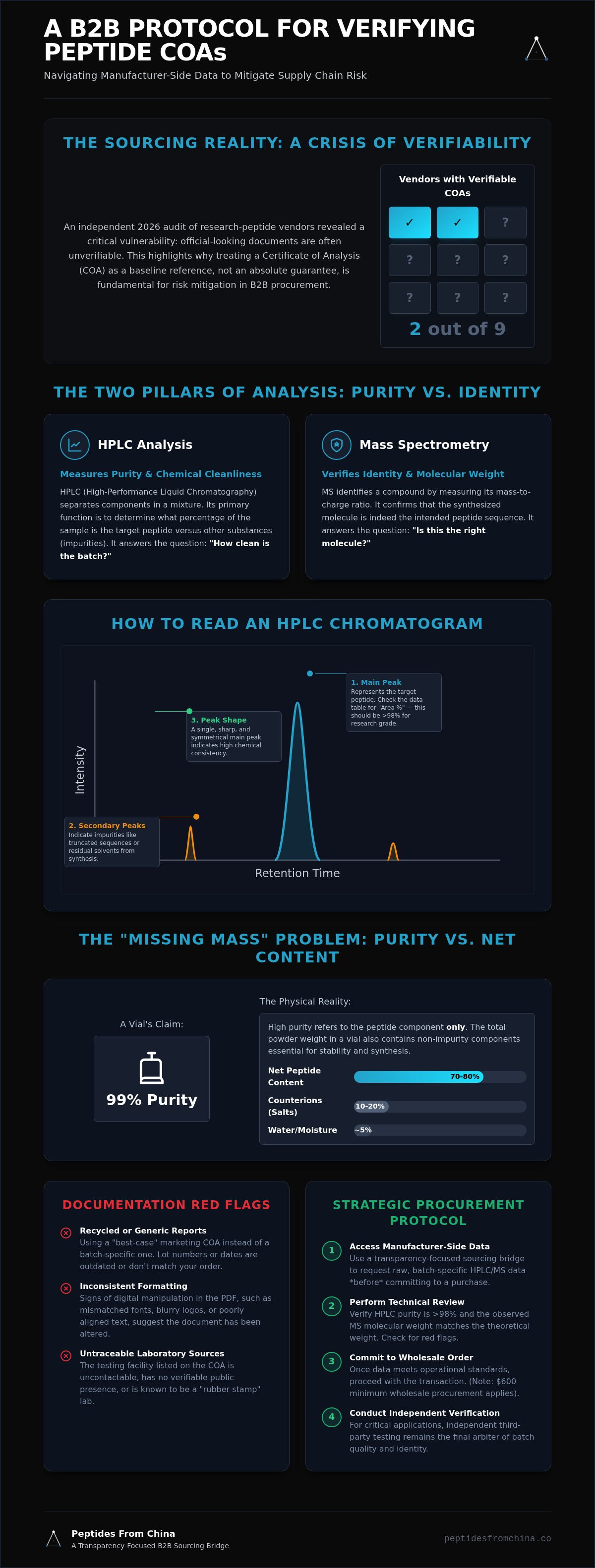
In 2026, an independent audit of research-peptide vendors revealed that only two out of nine suppliers provided Certificates of Analysis that could be verified with the original lab. This reality highlights a critical vulnerability for procurement professionals; a document that looks official is often just a recycled template. Learning how to read a peptide coa is no longer a luxury for researchers, it's a fundamental requirement for risk mitigation. You likely already know that relying on a manufacturer's word is insufficient in an industry plagued by batch substitution and supply chain opacity.
This guide provides a technical protocol to master HPLC and Mass Spectrometry reports so you can verify batch consistency and identify fraudulent data before placing an order. We'll explain the distinction between purity percentages and actual peptide content while highlighting specific manufacturer-side red flags. For those utilizing Peptides From China as a transparency-focused bridge to synthesis facilities, understanding these nuances is the first step toward a secure $600 minimum wholesale procurement strategy. We'll move from basic document verification to independent testing requirements, ensuring your laboratory-grade reagents meet professional standards.
Key Takeaways
Differentiate between HPLC and Mass Spectrometry to verify both the chemical cleanliness of a batch and the actual molecular identity of the sequence.
Solve the "missing mass" problem by distinguishing between the purity percentage and the actual net peptide content present in the vial.
Develop a technical protocol for how to read a peptide coa that identifies digital red flags, such as inconsistent PDF formatting and uncontactable laboratory sources.
Use manufacturer-issued documentation as a baseline reference while leveraging sourcing bridges to access raw data before committing to the $600 wholesale procurement minimum.
Table of Contents
Beyond the PDF: Why a Peptide COA is Only the Starting Point
Decoding the Technical Core: HPLC Purity and Mass Spectrometry
The "Missing Mass" Problem: Net Peptide Content vs. Purity
Red Flags and Verification: Spotting Fraudulent Documentation
Strategic Sourcing: Navigating Manufacturer-Side Transparency
Beyond the PDF: Why a Peptide COA is Only the Starting Point
A Certificate of Analysis is a batch-specific technical record that outlines the laboratory findings for a particular synthesis run. It is a data sheet, not a marketing brochure. In professional B2B sourcing, we treat these documents as a baseline reference. They represent the manufacturer's claim regarding identity, purity, and quantity. However, the document is only as reliable as the supply chain it travels through. Industry flaws like reused reports and batch substitution mean that the physical reality in the vial might not match the paper in your inbox. Documentation is the map, not the territory.
The Role of Documentation in B2B Sourcing
Procurement officers use these documents to approve manufacturer stock before finalizing large orders. There is a vital difference between a generic marketing report and a specific batch COA. A marketing report is often a best-case scenario document used to lure buyers. A batch COA includes a unique lot number that corresponds directly to the vials in your shipment. This traceability is essential for reducing operational uncertainty and ensuring batch-to-batch consistency. When you understand how to read a peptide coa, you can spot inconsistencies that suggest a report has been recycled from a previous year or a different facility entirely.
Why Purity Claims Require Context
High purity claims require critical context to be meaningful. A report showing 99% purity doesn't automatically ensure a successful research outcome. Synthesis byproducts can remain hidden within that 1% margin if the testing parameters are narrow or the HPLC settings are not optimized. These impurities might include residual solvents, salts, or truncated peptide sequences that interfere with biological assays. Viewing the COA as a single step in a multi-step verification process is the only way to maintain laboratory standards. Independent testing remains the final arbiter of quality, but the manufacturer's report helps you decide if a batch is even worth the cost of third-party verification.
Peptides From China functions as a transparency-focused bridge to synthesis facilities. We provide manufacturer-issued papers for batch approval before shipping, allowing researchers to review data without the interference of reseller layers. For those meeting the $600 minimum wholesale procurement requirement, this documentation serves as a necessary filter to ensure manufacturer-side transparency. It allows for a methodical approach to sourcing where data precedes the transaction. This reduces the risk of receiving mislabeled or under-dosed materials from opaque middleman channels.
Decoding the Technical Core: HPLC Purity and Mass Spectrometry
HPLC and Mass Spectrometry (MS) are the primary analytical tools used to evaluate batch quality. While HPLC measures the chemical cleanliness of the sample, MS confirms that the molecule synthesized is actually the intended peptide. Learning how to read a peptide coa requires understanding that these two tests perform entirely different functions. One tells you how much of the powder is the target substance; the other tells you what that substance is. These documents should be viewed as reference analytical data rather than an absolute guarantee of quality.
Interpreting the HPLC Chromatogram
The HPLC report features a graph known as a chromatogram. The horizontal axis represents retention time, while the vertical axis shows intensity. The "Area %" column in the data table is the most critical figure. It represents the percentage of the total area under the peaks that corresponds to the main peak. For research-grade peptides, the industry standard is typically 98% or higher. Understanding these peaks is a core component of knowing how to read a peptide coa effectively.
Secondary peaks or "noise" on the baseline indicate impurities. These are often truncated sequences, which are shorter, incomplete versions of the target peptide created during the synthesis process. A single, sharp, symmetrical peak indicates a high level of chemical consistency. If you see multiple significant peaks, the batch likely contains significant byproducts that could compromise your research data. This level of detail helps reduce supply chain uncertainty by identifying poorly synthesized batches before they reach your lab.
Mass Spectrometry: Verifying the Sequence
Mass Spectrometry identifies the compound by measuring its mass-to-charge ratio. The MS report will list a "Theoretical Molecular Weight" and a "Found Molecular Weight." These numbers should be nearly identical. A small variance is normal due to the sensitivity of the equipment, but a significant discrepancy suggests the batch is mislabeled or entirely different from what was ordered. It's a binary check: the substance is either the correct sequence or it isn't.
The [M+H]+ peak is the primary indicator of the peptide's identity. It represents the molecular weight of the peptide plus one hydrogen ion. It's vital to remember that MS cannot determine purity. A sample could be 50% pure but still show a perfect MS report because the MS only identifies the presence of the target molecule, not the concentration of impurities surrounding it. For researchers seeking manufacturer-side transparency, accessing these raw data files is a prerequisite for batch approval.
If you're looking to streamline your sourcing process and reduce reseller layers, evaluating these technical nuances is essential before committing to the $600 wholesale procurement minimum. This methodical approach ensures that your procurement decisions are based on data rather than marketing claims. By matching manufacturer data with independent batch testing, you can maintain a more reliable chain of custody for your research materials.
The "Missing Mass" Problem: Net Peptide Content vs. Purity
One of the most frequent points of confusion in B2B procurement is the discrepancy between HPLC purity and the physical weight of the powder in the vial. When you learn how to read a peptide coa, you realize that a 99% purity rating refers only to the peptide fraction of the sample. It doesn't account for the non-peptide components that inevitably remain after the synthesis and lyophilization process. In many cases, a vial labeled as 10mg may contain only 7mg to 8mg of actual peptide. The remaining mass consists of counter-ions, residual moisture, and salts. This difference is known as the Net Peptide Content (NPC).
Salt Content and Lyophilization Byproducts
During the final stages of peptide manufacturing, crude peptides are purified using HPLC. This process typically involves Trifluoroacetic acid (TFA) as a mobile phase additive. Unless an explicit salt exchange is performed, the resulting powder will contain significant amounts of TFA. This counter-ion can account for 10% to 30% of the total weight. While acetate-converted or salt-free peptides are available, they require additional processing steps and command a higher price. For researchers, the presence of TFA isn't just a weight issue; it can also influence the pH of the reconstituted solution and affect sensitive in-vitro research outcomes.
Adjusting Laboratory Metrics for Net Content
Understanding the 'missing mass' is vital for calculating precise molar concentrations. If a researcher assumes a vial contains 10mg of pure peptide when the net content is actually 7.5mg, every subsequent dilution will be mathematically flawed. This leads to chronic under-dosing in studies, which compromises the reliability of the data. Most manufacturer-issued COAs prioritize HPLC purity because it's easier to achieve and looks better on a spec sheet. Knowing how to read a peptide coa means looking beyond the purity percentage to find the actual mass of the active compound.
Peptides From China helps reduce supply chain uncertainty by providing access to manufacturer-side data before you commit to a $600 wholesale procurement minimum. While manufacturer COAs are a necessary baseline, they often omit the NPC data required for hyper-accurate laboratory metrics. We act as a bridge to ensure you understand exactly what you're sourcing, helping you navigate the complexities of documentation versus physical reality. This methodical approach ensures that your laboratory-grade reagents meet the specific requirements of your research protocols.
Red Flags and Verification: Spotting Fraudulent Documentation
Spotting a fraudulent document requires a critical eye for digital forensics. When you're learning how to read a peptide coa, look for inconsistent fonts, blurred logos, or misaligned text blocks. These are often signs of a "photoshopped" report where a reseller has replaced the original manufacturer's name or the batch number with their own. High-resolution PDF reports should have crisp, selectable text rather than flattened, pixelated images that suggest multiple rounds of editing. If the document looks like a scan of a scan, it's likely being reused to hide a lack of current testing.
Date discrepancies provide another layer of verification. A synthesis date should logically precede the testing date by a reasonable margin. If a report shows a testing date from 2024 but the synthesis lot is labeled as 2026, the documentation is fundamentally flawed. Similarly, keep a database of chromatograms for the peptides you source. If you see identical peak patterns across different batches, the manufacturer is likely reusing old data. Every synthesis run produces a unique chemical fingerprint; identical graphs are a statistical impossibility in real laboratory environments. This indicates a systemic failure in the manufacturer's quality control reporting.
Verifying Third-Party Authenticity
Digital verification tools like QR codes and unique report IDs have become industry standards for a reason. Most reputable facilities allow you to verify a report's authenticity directly through their web portal. If a COA comes from a "Generic Lab" with no contactable source, no physical address, or a non-functional website, it should be disregarded. Professional peptide testing by an independent third party remains the most effective way to validate manufacturer claims and ensure research standards are met. Always contact the lab directly if you suspect a report has been altered.
Manufacturer vs. Third-Party Reports
Manufacturer-issued COAs carry an inherent conflict of interest. While these documents are useful as a pre-shipment screening tool to filter out obviously flawed batches, they don't replace the need for independent validation. A robust sourcing protocol uses manufacturer data to establish a baseline before the $600 wholesale procurement minimum is finalized. Once the material is received, independent testing provides the final confirmation of identity and purity. This two-step process helps reduce supply chain uncertainty and improves traceability across international borders. It's about building a defense-in-depth strategy for your procurement.
Peptides From China acts as a transparency-focused bridge, providing you with the manufacturer's raw data to review before shipping. By helping researchers access manufacturer-side channels directly, we minimize the layers of intermediaries who often obfuscate documentation. This methodical approach allows you to build a repeatable protocol for document verification, ensuring that your procurement decisions are grounded in factual integrity rather than marketing hype. You aren't just buying a product; you're securing a verified supply chain.
Strategic Sourcing: Navigating Manufacturer-Side Transparency
Direct manufacturer relationships are the final objective for most high-volume researchers. Opaque reseller layers often inflate costs and obfuscate the true origin of the material. Peptides From China (PFC) acts as a transparency-focused bridge, connecting labs directly to verified Chinese synthesis facilities. This model prioritizes factual accuracy over marketing flair. By removing intermediaries, you gain clearer visibility into the production source. This shift helps reduce supply chain uncertainty and ensures that the reference analytical data you receive is actually tied to your specific lot.
The PFC Sourcing Model
Managing the logistics of international procurement requires a structured approach. We offer a $10 processing deposit that allows you to secure and review batch-specific documentation before you commit to a full payment. This is a critical step in learning how to read a peptide coa within a real-world sourcing environment. It gives you the opportunity to verify the technical nuances of HPLC and MS reports while the material is still at the facility. For those managing wholesale peptides, our $600 minimum procurement requirement ensures that you're accessing manufacturer-side channels rather than retail-level stock. Orders are shipped in neutral packaging with tracked international logistics to maintain operational consistency.
Best Practices for Professional Buyers
Professional procurement involves more than just reading a PDF. It requires setting up internal QA protocols for every incoming batch. While we provide manufacturer-issued COAs for approval, we strongly support independent verification by researchers once the shipment arrives. You should budget for independent testing as a non-negotiable part of your total procurement cost. This methodical approach ensures that your laboratory-grade reagents meet the necessary research standards. Transparency in a peptide sourcing platform is far more valuable than the convenience of domestic warehousing, which often hides the true age and origin of the stock.
Direct manufacturer routing eliminates the common pitfalls of the global market. Transitioning away from reseller dependence allows you to build a more resilient supply chain. When you understand how to read a peptide coa and pair that knowledge with a transparency-first sourcing bridge, you minimize the risks of batch substitution and relabeling. This grounded, operationally realistic strategy is the only way to ensure long-term reliability in your research supply chain.
Establishing a Verification-First Procurement Protocol
Mastering how to read a peptide coa is the first step in moving from a passive buyer to an active procurement strategist. You've learned that HPLC purity measures chemical cleanliness, while Mass Spectrometry confirms the sequence identity. Critically, the "missing mass" of counter-ions and moisture means that 99% purity rarely equates to 100% of the labeled weight. By identifying digital red flags and inconsistent peak patterns, you can filter out fraudulent documentation before it impacts your research budget.
Documentation serves as a baseline, but physical reality is verified through independent testing and direct manufacturer relationships. Peptides From China acts as a dedicated B2B sourcing bridge, providing batch-specific COA verification for every order. We help you navigate the complexities of international logistics and manufacturer-side transparency, ensuring you access raw data without reseller interference. For those ready to implement a professional sourcing strategy with a $600 wholesale minimum order, we provide the methodical framework necessary for consistent results.
Access Verified Manufacturer Channels - Start Your Sourcing Request and take control of your laboratory supply chain today.
Frequently Asked Questions
Can I trust a COA issued directly by a Chinese manufacturer?
Manufacturer-issued documentation should be viewed as reference analytical data rather than a final guarantee of quality. These reports are useful for pre-shipment screening to filter out obviously flawed batches, but they carry an inherent conflict of interest. Peptides From China acts as a B2B sourcing bridge to provide these papers for approval before shipping. You should always use this data as a baseline while maintaining a protocol for independent verification once the material arrives.
What is the difference between HPLC purity and peptide content?
HPLC purity measures the chemical cleanliness of the peptide fraction, while peptide content represents the actual mass of the peptide in the vial. A vial labeled as 10mg with 98% purity might only contain 7mg of actual peptide because the remaining mass consists of counter-ions like TFA and residual moisture. Understanding this distinction is vital for accurate laboratory dosing. Most manufacturer reports prioritize purity percentages because they appear more favorable on technical spec sheets.
Is 99% purity the highest possible for research peptides?
While 99% is a common benchmark for high-quality synthesis, it is rarely the absolute limit. However, claims of "100% purity" are generally unrealistic marketing hype and should be viewed with skepticism. Synthesis byproducts and truncated sequences are almost always present in trace amounts. For professional procurement, a result of 98% or higher is the accepted standard for research-grade material. Anything significantly lower suggests a failure in the purification or synthesis process.
Why do some COAs lack a Mass Spectrometry report?
Manufacturers often omit Mass Spectrometry (MS) to reduce operational costs or because they are skipping essential identity verification steps. Without an MS report, you have no confirmation that the molecule in the vial is actually the sequence you ordered. HPLC alone only measures purity, not identity. A batch could be 99% pure but consist of the entirely wrong compound. For B2B buyers, a missing MS report is a significant red flag.
How do I verify if a Janoshik or similar 3rd party report is real?
You must verify the report using the unique ID or QR code directly on the testing laboratory's official website. Never rely on a PDF or screenshot provided by a reseller, as these are easily altered. Learning how to read a peptide coa includes knowing that authentic reports must match the lab's internal database exactly. If the digital record doesn't exist or shows different data, the document has likely been tampered with or reused.
What should I do if the COA molecular weight doesn’t match the theoretical weight?
Reject the batch immediately if there is a significant discrepancy between the found and theoretical molecular weights. This mismatch indicates that the substance is not the correct peptide sequence. While a tiny variance of less than 1 Dalton is normal due to equipment calibration, larger gaps suggest a synthesis error or a mislabeled product. Accurate identity confirmation is a non-negotiable requirement for maintaining laboratory standards and ensuring research consistency across different batches.
Does a high purity COA guarantee the peptide is sterile?
No, a high purity rating on an HPLC report has no correlation with the sterility of the product. Purity refers to chemical composition, whereas sterility refers to the absence of living microorganisms and endotoxins. Most standard research COAs don't include results for bioburden or USP <71> sterility testing. If your research requires sterile reagents, you must request specific, additional testing. Don't assume that a chemically clean peptide is free from biological contaminants.
How often should a research lab perform its own independent testing?
Independent testing should be performed on every new batch to reduce supply chain uncertainty. Relying solely on manufacturer data is an operational risk that can compromise long-term research data. For those meeting the $600 wholesale minimum, budgeting for third-party analysis is a standard part of the procurement process. Understanding how to read a peptide coa helps you identify which batches are worth the additional cost of independent verification, ensuring your lab maintains professional standards.