
Market pricing and availability can vary substantially by supplier, product, order size, and current conditions; exact comparisons require current, like-for-like data.
This guide provides a technical roadmap to help reduce supply chain uncertainty by establishing direct-to-manufacturer procurement protocols. We'll detail how to navigate manufacturing standards, evaluate HPLC and Mass Spectrometry data, and implement independent verification strategies that bypass redundant middleman layers. By moving toward a transparency-focused sourcing bridge, labs can access verifiable technical data and reliable wholesale supply while maintaining the $600 minimum order requirements necessary for direct B2B channels. We'll examine the specific logistics of procurement, from neutral international shipping to the necessity of independent laboratory testing for every batch.
Key Takeaways
Distinguish between synthetic peptides like Semaglutide, Tirzepatide, and Retatrutide to align specific receptor affinities with your laboratory's research objectives.
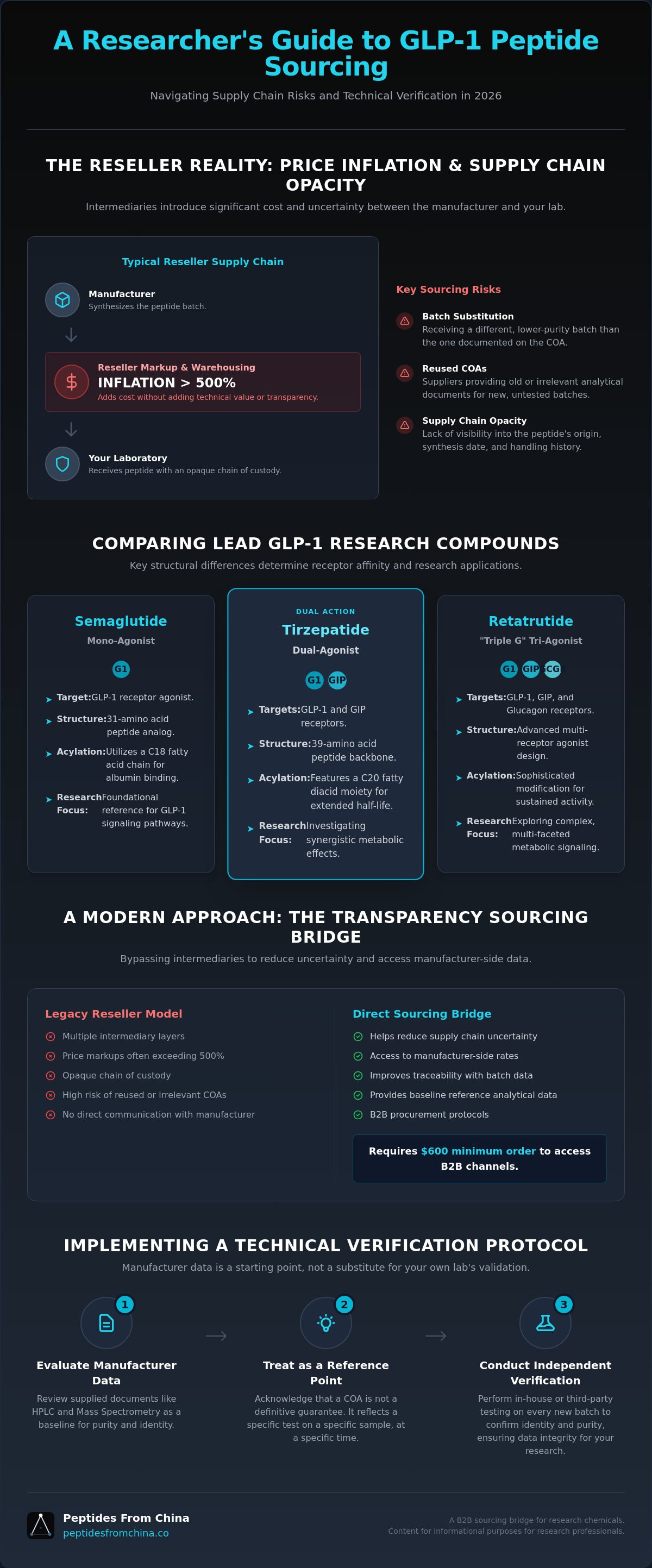
Identify how retail intermediaries and domestic warehousing logistics contribute to price inflation exceeding 500% over manufacturer-side rates.
Learn to interpret HPLC chromatograms and Mass Spectrometry data as reference points for GLP-1 receptor agonist research chemicals rather than definitive guarantees.
Navigate the B2B procurement process through transparency-focused bridges that require a $600 minimum to access direct-to-manufacturer supply channels.
Establish independent verification protocols to manage the inherent risks of batch variability and supply chain opacity in the global peptide market.
Table of Contents
The Landscape of GLP-1 Receptor Agonist Research Chemicals
Comparing Lead Compounds: Semaglutide, Tirzepatide, and Retatrutide
Sourcing Logistics: Reseller Markups vs. Direct Manufacturing
Technical Verification: Navigating HPLC, MS, and COA Documentation
Optimizing B2B Procurement with Peptides From China (PFC)
The Landscape of GLP-1 Receptor Agonist Research Chemicals
The study of metabolic signaling has evolved rapidly since the initial discovery of Exendin-4 in the venom of the Gila monster. Today, researchers focus on GLP-1 receptor agonist research chemicals as synthetic peptides designed to probe receptor affinity and downstream signaling pathways. These analogs mimic the action of the endogenous glucagon-like peptide-1 hormone but are engineered for enhanced stability and specific binding profiles. While early research focused primarily on glucose homeostasis, modern investigations have expanded into neuroprotection and cardiovascular pathology.
It's vital to distinguish between human-grade pharmaceuticals and research-grade chemicals. Pharmaceutical versions are finished products intended for clinical use, whereas research chemicals are reference materials used for in-vitro or non-clinical animal studies. The synthesis of these peptides involves complex solid-phase peptide synthesis (SPPS) methods. Labs must recognize that GLP-1 receptor agonists sourced for research purposes lack the final clinical formulation and regulatory approvals required for human administration. Understanding this distinction is the first step in maintaining institutional compliance and data integrity.
Incretin Mimetics in Laboratory Settings
Incretin mimetics simulate natural hormones to trigger specific cellular responses. In a laboratory environment, these compounds allow for the observation of insulin secretion patterns and gastric emptying mechanics without the rapid degradation seen in natural GLP-1. The role of acylation is critical here. By attaching a fatty acid chain to the peptide backbone, manufacturers extend the half-life of the compound by allowing it to bind to albumin. This structural modification ensures the peptide remains active for longer periods during longitudinal studies. GLP-1 research chemicals are synthetic analogs intended exclusively for non-clinical metabolic investigation.
Regulatory Status and Compliance for Labs
As of 2026, the regulatory environment for peptide research has become increasingly stringent. Procurement professionals must strictly adhere to the "Research Use Only" (RUO) designation. This classification is not a mere suggestion; it's a legal boundary that dictates how these chemicals are handled, stored, and reported. International laboratory procurement requires precise non-clinical labeling to ensure customs clearance and institutional safety.
Labeling Accuracy: Every vial must be clearly marked for laboratory research only.
Documentation: Maintain a clear chain of custody from the manufacturer to the lab bench.
IRB Oversight: Institutional Research Boards now require detailed synthesis data to approve metabolic study protocols.
Relying on transparent sourcing bridges like Peptides From China helps reduce supply chain uncertainty by providing direct access to manufacturer-side data. While no single document replaces independent testing, having baseline reference analytical data is essential for regulatory filings and internal quality control. Proper compliance ensures that your laboratory remains focused on data generation rather than legal or logistical setbacks.
Comparing Lead Compounds: Semaglutide, Tirzepatide, and Retatrutide
The progression of metabolic research has shifted from simple peptide analogs to complex multi-receptor agonists. Researchers now categorize GLP-1 receptor agonist research chemicals based on their specific binding profiles and acylation strategies. Semaglutide remains the foundational mono-agonist. It's a 31-amino acid peptide that utilizes a C18 fatty acid chain at the Lys26 position. This structural choice is a standard reference point for GLP-1 receptor agonists, as it allows for stable albumin binding and extended half-life in non-clinical models.
Tirzepatide introduces dual agonism by targeting both GLP-1 and glucose-dependent insulinotropic polypeptide (GIP) receptors. Its sequence consists of 39 amino acids, featuring a C20 fatty diacid moiety. This dual-action mechanism significantly alters binding affinity compared to mono-agonists. Retatrutide represents the current frontier, acting as a "Triple G" agonist that targets GLP-1, GIP, and the glucagon receptor (GCGR). Each addition to the receptor profile increases the complexity of the peptide's amino acid sequence and the precision required during synthesis.
Binding Affinities and Potency Metrics
Comparing Ki values across these compounds is essential for determining receptor selectivity. In metabolic research, mono-agonists show high selectivity for the GLP-1 receptor, while multi-agonists like Retatrutide must balance affinity across three distinct targets. This balance is fragile. Even minor sequence variations can shift the potency profile. Verifying the molecular weight (MW) via Mass Spectrometry is a critical step during batch testing. It's the only way to confirm that the synthesized peptide matches the intended sequence rather than a simplified analog or a substituted batch. To secure these compounds through a transparency-focused B2B bridge, researchers often access manufacturer-direct channels that prioritize batch traceability.
Synthesis Complexity and Batch Consistency
The solid-phase peptide synthesis (SPPS) of multi-agonists presents unique challenges. As sequence length increases, the risk of "missing" amino acids or truncated sequences grows. These impurities are often difficult to separate during the purification phase, leading to variable yields. For a deeper look at these technical hurdles, refer to this Peptides Production: An Operational Guide. Manufacturer-side production must account for these complexities to maintain consistency across different lots. Labs should treat manufacturer-issued papers as reference analytical data, acknowledging that synthesis quality can fluctuate between batches despite what a baseline COA might suggest.
Sourcing Logistics: Reseller Markups vs. Direct Manufacturing
Market pricing and availability can vary substantially by supplier, product, order size, and current conditions; exact comparisons require current, like-for-like data.
The primary driver of price inflation in the peptide market is the convenience of local shipping. While domestic warehousing offers faster transit, it significantly increases supply chain opacity. When a product is relabeled by a third party, the original manufacturer's lot data is often lost or intentionally obscured. Adopting a transparency-first model helps reduce supply chain uncertainty by connecting labs directly to the source. This requires managing international shipping and neutral packaging, but the trade-off is a clearer line of sight to the synthesis facility and reference analytical data that hasn't been filtered through multiple intermediaries.
Understanding the mechanisms of GLP-1 and GIP/GLP-1 agonists is essential for study design, but procurement requires an equally technical approach to logistics. Professional labs prioritize batch consistency over retail convenience, moving away from single-vial purchases toward structured wholesale procurement.
The Economics of Wholesale Procurement
Retail single-vial pricing is fundamentally unsustainable for large-scale longitudinal studies. For institutional research, professional sourcing channels typically require a $600 minimum order threshold. This baseline ensures that the procurement process remains within B2B channels, filtering out retail-level noise and connecting buyers with manufacturer-side pricing models. For a detailed breakdown of these structures, labs should consult our Wholesale Peptides: A 2026 B2B Sourcing Guide, which outlines the operational shift from retail buying to institutional supply management.
Reducing Intermediary Layers
Every additional layer in the supply chain increases the risk of batch substitution or relabeling. A reseller might receive a batch of Semaglutide but, due to inventory pressure, relabel it as a more expensive multi-agonist. Peptides From China (PFC) serves as a transparency-focused bridge, facilitating direct manufacturer access rather than acting as a traditional reseller. The $10 deposit initiates manual request processing and real-time stock verification and is credited toward the final invoice. Products are subject to the manufacturer’s applicable quality-control procedures and specifications. Manufacturer-side analytical documentation may be available depending on the product and batch. PeptidesFromChina is not an independent analytical testing laboratory.
Technical Verification: Navigating HPLC, MS, and COA Documentation
A Certificate of Analysis (COA) is a baseline technical reference, not a definitive guarantee of product quality. In the market for GLP-1 receptor agonist research chemicals, technical documentation is often treated as a marketing asset rather than a rigorous quality control tool. High-Performance Liquid Chromatography (HPLC) chromatograms are the standard for measuring purity, but they're easily manipulated. A professional buyer looks beyond the stated percentage and examines the baseline of the chromatogram for "ghost peaks" or broad shoulders that indicate co-eluting impurities. If the baseline is too "clean," it might suggest the data has been digitally smoothed to hide synthesis byproducts.
Mass Spectrometry (MS) serves as the definitive tool for molecular identity verification. While HPLC tells you how much of a substance is in the vial, MS confirms that the substance is actually the peptide you ordered. For complex molecules like Tirzepatide or Retatrutide, checking the observed mass against the theoretical molecular weight is non-negotiable. The "reused COA" problem is rampant; many resellers provide generic or outdated reports from previous years. Red flags include blurry text on the batch number, mismatched dates between the HPLC and MS reports, or the absence of a verifiable lab technician's signature. Spotting these discrepancies is the first line of defense against batch substitution.
Independent Laboratory Testing Protocols
Relying solely on manufacturer-issued papers is an operational risk that can compromise months of research. Researchers must conduct third-party testing on all incoming batches to ensure the data aligns with internal standards. It's important to distinguish between absolute purity and peptide content. A vial might show 99% purity on an HPLC report, but the actual peptide content could be significantly lower due to residual salts or moisture from the lyophilization process. For a deeper technical dive into these metrics, consult our Peptide Testing and Analysis: A Professional Guide.
Traceability and Batch Identification
Traceability requires that every HPLC report correlates exactly with the specific batch number on your invoice. In professional sourcing, reference analytical data acts as a baseline for your own independent verification. When sourcing from Chinese facilities, ask for high-resolution scans of the original reports rather than re-typed versions. This helps reduce supply chain uncertainty by making it harder for intermediaries to substitute batches or relabel older stock. Maintaining this level of scrutiny ensures that your laboratory data remains consistent across different study phases. If you are looking to establish a more transparent supply line, access our sourcing platform to connect with manufacturers who provide verifiable lot-specific data for wholesale orders over $600.
Optimizing B2B Procurement with Peptides From China (PFC)
Efficiently securing GLP-1 receptor agonist research chemicals requires a shift from retail-focused purchasing to a structured B2B procurement strategy. Peptides From China (PFC) serves as a transparency-focused bridge, facilitating direct access to manufacturer-side channels for professional laboratories. By bypassing the traditional reseller model, labs can mitigate the risks associated with domestic warehousing and relabeled inventory. This approach doesn't just reduce costs; it improves traceability by ensuring that the reference analytical data you receive originates directly from the synthesis facility.
The operational process at PFC is designed for institutional efficiency. The $10 deposit initiates manual request processing and real-time stock verification and is credited toward the final invoice. This small commitment allows us to confirm current synthesis capacity and lot availability with the manufacturer before you commit to a larger order. Once availability is verified, the procurement moves into the wholesale phase. PeptidesFromChina currently has a $600 total minimum order. Multiple catalog products can be combined to reach the minimum, with orders starting from one 10-vial kit per product. This threshold ensures that your laboratory is accessing the B2B tier of the supply chain, where pricing reflects manufacturing reality rather than retail speculation.
International logistics are managed with a focus on research continuity. Every shipment utilizes neutral packaging to facilitate smooth customs clearance and maintain the non-clinical status of the materials. Comprehensive tracking data is provided for every order, allowing procurement officers to manage laboratory timelines with precision. This methodical approach helps reduce supply chain uncertainty, providing a grounded alternative to the opaque practices often found in the retail peptide market.
Direct-to-Manufacturer Sourcing Advantage
PFC coordinates sourcing from established Chinese manufacturing facilities together with international logistics, without relying on anonymous retail-reseller supply chains. Manufacturer-side analytical documentation may be available depending on the product and batch.
The PFC Transparency Protocol
The PFC protocol recognizes that no single document is an absolute guarantee of purity. Products are subject to the manufacturer’s applicable quality-control procedures and specifications. Manufacturer-side analytical documentation may be available depending on the product and batch. PeptidesFromChina is not an independent analytical testing laboratory. Buyers requiring independent verification may arrange third-party analytical testing. Learn more: Explore our GLP-1 sourcing options and start your verification process today..
Establishing a Transparent Pipeline for Metabolic Research
The complexities of sourcing GLP-1 receptor agonist research chemicals in 2026 demand a move away from retail convenience toward institutional-grade transparency. Success in longitudinal studies depends on reducing intermediary layers that obscure batch traceability and inflate costs through domestic warehousing. It's essential to prioritize direct manufacturing routing and treat manufacturer-issued papers as reference analytical data rather than final proof. This grounded approach allows labs to better manage the inherent risks of the peptide market while maintaining rigorous data integrity throughout the study lifecycle.
PeptidesFromChina currently has a $600 total minimum order. Multiple catalog products can be combined to reach the minimum, with orders starting from one 10-vial kit per product. Products are subject to the manufacturer’s applicable quality-control procedures and specifications. Manufacturer-side analytical documentation may be available depending on the product and batch. PeptidesFromChina is not an independent analytical testing laboratory.
Request a Wholesale GLP-1 Sourcing Quote ($600 Min)
We look forward to supporting the consistency and reliability of your next study phase.
Frequently Asked Questions
What is the difference between pharmaceutical-grade and research-grade GLP-1 agonists?
Pharmaceutical-grade GLP-1 agonists are finished medications intended for clinical administration to humans. Research-grade chemicals are synthetic analogs for non-clinical metabolic investigation. These materials lack the final formulation, sterile processing, and regulatory approvals required for human use. They are strictly for in-vitro or animal studies; often requiring reconstitution by the researcher before use in a laboratory setting.
How do I verify the purity of a Semaglutide powder batch from a Chinese manufacturer?
Independent third-party analysis using HPLC and Mass Spectrometry is the only reliable method for verification. You shouldn't treat manufacturer-issued papers as definitive proof of quality. Instead, use them as reference analytical data. Professional labs compare the observed molecular weight against theoretical values to confirm identity and examine chromatogram baselines for co-eluting impurities that might indicate synthesis errors.
Why is there a $600 minimum order for GLP-1 research chemicals at PFC?
The $600 minimum order threshold ensures that procurement remains within professional B2B channels. This baseline filters out retail-level noise and allows labs to access manufacturer-side pricing models directly. By maintaining this requirement, PFC can provide a transparency-focused bridge to synthesis facilities while managing the logistical costs of international shipping and neutral packaging for wholesale GLP-1 receptor agonist research chemicals.
What are the common impurities found in low-quality GLP-1 peptide synthesis?
Low-quality peptide synthesis often results in truncated sequences or missing amino acids, especially in longer chains like Tirzepatide. Residual solvents, salts, and moisture from improper lyophilization are also common. These impurities can alter binding affinity and compromise study data. Identifying these requires careful reading of HPLC reports for ghost peaks and verifying that the peptide content matches the stated purity percentage.
Can I request HPLC and Mass Spec data before finalizing a wholesale order?
Products are subject to the manufacturer’s applicable quality-control procedures and specifications. Manufacturer-side analytical documentation may be available depending on the product and batch. PeptidesFromChina is not an independent analytical testing laboratory. Buyers requiring independent verification may arrange third-party analytical testing.
How does Retatrutide differ from Tirzepatide in a research context?
Retatrutide is a Triple G agonist targeting the GLP-1, GIP, and glucagon receptors, while Tirzepatide is a dual GLP-1 and GIP agonist. In metabolic research, this additional glucagon receptor affinity changes the potency profile and downstream signaling pathways. Retatrutide's 39-amino acid sequence also presents higher synthesis complexity, making batch-to-batch variability a more significant concern for labs conducting comparative studies.
What are the risks of buying peptides from domestic US or EU warehouses?
Market pricing and availability can vary substantially by supplier, product, order size, and current conditions; exact comparisons require current, like-for-like data.
How should GLP-1 research chemicals be stored to maintain batch stability?
Lyophilized GLP-1 receptor agonist research chemicals should be stored in a freezer at -20°C to ensure long-term stability. For studies lasting several months, -80°C is often preferred to prevent peptide degradation. Protect the vials from light and moisture. It's critical to avoid repeated freeze-thaw cycles after reconstitution, as this can significantly alter the binding affinity and potency of the peptide in vitro.