A signed HPLC report is often treated as a definitive proof of purity, yet in the professional peptide trade, these documents are frequently reused or outright forged to hide batch inconsistencies. If you're searching for a reliable epithalon wholesale supplier, you've likely encountered the opaque supply chains and heavy domestic markups that define the current market. We understand that finding a consistent source isn't about luck; it's about establishing a methodical procurement process that prioritizes factory-side transparency over marketing claims.
The regulatory landscape for Epitalon shifted in 2026 after the FDA's April removal of the substance from the Category 2 list and the July PCAC vote recommending its addition to the 503A Bulks List. This guide provides an operationally realistic framework for B2B procurement, focusing on how to access manufacturer-side channels while maintaining strict batch traceability. We'll outline how to evaluate technical documentation, manage the $600 minimum wholesale requirement, and why independent verification remains your only true safeguard against synthesis variability.
Key Takeaways
Shift from domestic resellers to direct synthesis channels to minimize intermediary markups and gain better control over your procurement pipeline.
Treat manufacturer-provided HPLC and Mass Spectrometry reports as baseline technical data rather than final proof of purity.
Streamline your logistics by utilizing a transparency-focused bridge to manage neutral packaging, customs navigation, and factory-side verification.
Evaluate an epithalon wholesale supplier based on their willingness to provide batch-specific documentation and support independent laboratory testing.
Master the operational requirements of B2B sourcing, including the $600 minimum order threshold and the $10 manufacturer verification deposit.
Table of Contents
The Landscape of Epithalon Wholesale Sourcing in 2026
Technical Specifications and Quality Benchmarks for Epitalon
Evaluating Wholesale Models: Resellers vs. Direct-to-Manufacturer
Operational Logistics: Procurement Protocols for Research Labs
PFC: A Transparency-Focused Bridge to Chinese Peptide Synthesis
The Landscape of Epithalon Wholesale Sourcing in 2026
The 2026 market for Epitalon (CAS 307297-39-8) has entered a phase of heightened transparency and increased regulatory scrutiny. After the FDA removed the compound from its Category 2 list in April 2026, and the subsequent PCAC recommendation in July to include it on the 503A Bulks List, interest from research institutions has intensified. This regulatory shift has forced a transition in how professional labs identify a reliable epithalon wholesale supplier. Traditional domestic resellers, who often rely on high markups and generic documentation, are being bypassed in favor of direct-to-manufacturer procurement models that offer better traceability.
Market Realities and Supply Chain Opacity
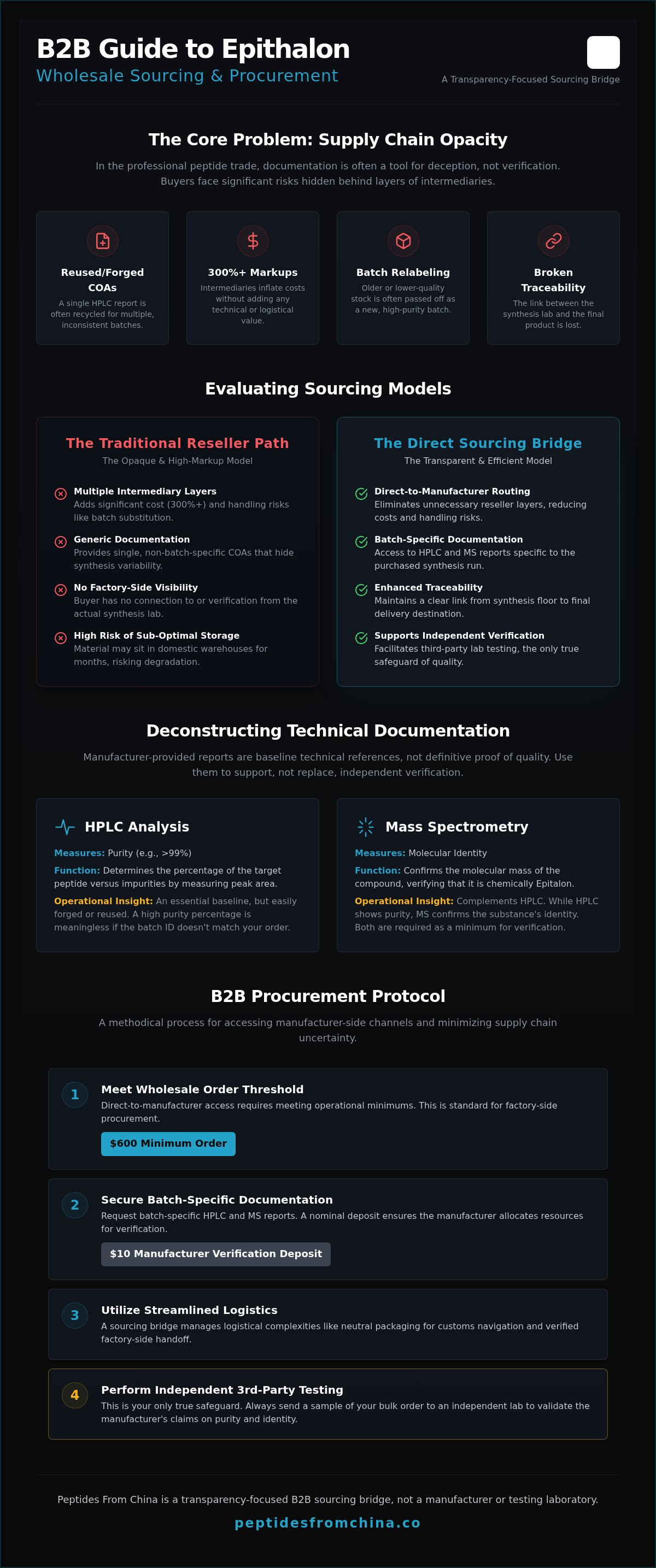
Procurement professionals frequently encounter "middleman markups" that can inflate costs by 300% or more without adding any technical value. The most significant risk in this opaque supply chain isn't just the price; it's the prevalence of reused HPLC reports and relabeled batches. Many resellers provide a single Certificate of Analysis (COA) for multiple synthesis runs, which doesn't account for the variable standards inherent in peptide production. Professional labs now prioritize batch traceability from the synthesis floor to the final destination, recognizing that documentation is only a baseline reference rather than a guarantee of quality.
Why Direct Sourcing from China is the Global Standard
The concentration of peptide synthesis expertise in Chinese industrial hubs has made direct sourcing the logical choice for large-scale research. These facilities benefit from economies of scale that domestic Western labs can't match, particularly for complex tetrapeptides like Epithalon. By reducing the number of intermediaries, buyers minimize handling risks and the potential for batch substitution. Bypassing domestic warehousing also reduces the time between synthesis and delivery, ensuring that the material hasn't been sitting in sub-optimal conditions for months.
Peptides From China (PFC) serves as a transparency-focused bridge for this process. We help researchers access manufacturer-side channels while requiring a $600 minimum order for wholesale procurement. This model allows for:
Direct-to-manufacturer routing that eliminates unnecessary reseller layers.
Access to batch-specific documentation rather than recycled or forged reports.
Logistical oversight through neutral packaging and verified tracking protocols.
By moving toward a direct-to-factory model, procurement officers can better manage the inherent risks of the global peptide market. It's a strategy rooted in verification rather than blind trust in a reseller’s marketing claims.
Technical Specifications and Quality Benchmarks for Epitalon
Epitalon is a synthetic tetrapeptide consisting of L-alanyl-L-glutamyl-L-aspartyl-glycine. In the context of longevity research, this Highly Bioactive Pineal Tetrapeptide is primarily studied for its influence on telomerase activity and cellular senescence. When you're vetting an epithalon wholesale supplier, understanding the chemical structure is just the first step. The real challenge lies in verifying that the bulk powder delivered matches the specifications promised in the technical data sheets. Professional procurement requires moving beyond surface-level descriptions to evaluate the underlying analytical data.
HPLC and Mass Spectrometry: Baseline Verification
High-Performance Liquid Chromatography (HPLC) is the industry standard for determining purity, but it's often misinterpreted in wholesale environments. HPLC measures purity via peak area integration, where the ratio of the main peak to all other peaks determines the purity percentage. However, a "99%" result on a manufacturer-provided report shouldn't be taken as an absolute guarantee. These reports are baseline references that indicate the standard of a specific batch at the time of synthesis. They don't account for degradation during transit or potential batch substitution by resellers.
Mass Spectrometry (MS) complements HPLC by confirming the molecular identity. While HPLC tells you how much of the substance is "pure," MS confirms that the substance is actually Epithalon by measuring its molecular mass. Without both reports, a supplier hasn't provided the bare minimum for technical verification. Even then, professional labs should perform independent third-party testing to validate these manufacturer-side claims. To help reduce supply chain uncertainty, sourcing through a transparency-focused bridge allows you to access batch-specific data directly from the synthesis facility.
Lyophilization and Storage Stability
The synthesis process concludes with lyophilization, a freeze-drying method that removes solvent while preserving the integrity of the peptide bonds. This state is critical for long-term stability. Bulk Epithalon powder is highly hygroscopic; it attracts moisture from the air, which can lead to rapid hydrolysis and degradation. Standard storage protocols for research-grade Epithalon include:
Temperature Control: Maintaining temperatures between -20°C and -80°C for long-term preservation.
Light Protection: Protecting vials from direct UV light exposure to prevent photo-degradation.
Moisture Management: Utilizing desiccant-controlled environments to prevent moisture ingress.
When evaluating an epithalon wholesale supplier, inquire about their post-synthesis handling and packaging protocols. Ensuring the material is sealed in a vacuum or under inert gas like nitrogen is a key indicator of a professional synthesis operation that understands the physics of peptide stability. These technical details often separate high-tier manufacturers from low-cost operations that cut corners on stabilization.
Evaluating Wholesale Models: Resellers vs. Direct-to-Manufacturer
Selecting an epithalon wholesale supplier requires a clear understanding of the logistics between the synthesis floor and your laboratory. Most buyers choose between domestic resellers and direct-to-manufacturer channels. While domestic warehousing offers shorter lead times, it often comes at the expense of technical transparency and price efficiency. The choice isn't just about cost; it's about the integrity of the data supporting your research.
The Hidden Costs of Domestic Reselling
Domestic markups are rarely just about convenience. They reflect the high costs of US or EU warehousing, retail marketing, and labor. In many cases, prices are 3x to 10x higher than factory rates. More concerning than the price is the risk of "relabeled" stock. A reseller might buy in bulk from an unknown facility and apply their own label, effectively obscuring the original manufacturer's synthesis logs and batch-specific data. This breaks the chain of custody, making it difficult to trace a specific vial back to its original analytical reference point. When the origin is hidden, the buyer has no way to verify if the synthesis standard remains consistent across different orders.
Advantages of Direct Sourcing Platforms
The economic logic of the wholesale peptides model is built on volume and directness. By removing the domestic middleman, labs can allocate more budget toward independent verification rather than reseller overhead. Direct sourcing helps reduce supply chain uncertainty by allowing access to manufacturer-side documentation and synthesis logs. This level of visibility is nearly impossible to find in the retail market, where batch substitution is a common tactic to clear out old or sub-par inventory.
Direct sourcing platforms provide a strategic advantage for labs requiring peptide sourcing agent vs platform clarity. Instead of relying on a reseller's word, you're interacting with a transparency-focused bridge that facilitates direct communication with synthesis facilities. This is essential for labs needing custom specifications or specific lyophilization protocols. Peptides From China (PFC) functions as this bridge, maintaining a $600 minimum order requirement to ensure a professional B2B environment. This model prioritizes batch traceability and minimizes the number of hands a product passes through. It's an operationally realistic approach that acknowledges the risks of batch substitution while providing the tools to mitigate them through direct manufacturer access.
Operational Logistics: Procurement Protocols for Research Labs
Identifying a reliable epithalon wholesale supplier is only the first step in a professional procurement strategy. The actual friction often occurs during the transition from the synthesis floor to the laboratory bench. Managing large-scale peptide sourcing requires a methodical approach to international logistics, ensuring that the material remains stable and the chain of custody stays intact. For most B2B buyers, this involves navigating a complex web of customs protocols, lead times, and verification deposits.
Navigating International Shipping and Neutral Packaging
International transit for research compounds necessitates a nuanced understanding of customs protocols. Professional sourcing utilizes neutral packaging, which helps reduce supply chain uncertainty by minimizing the profile of the shipment during the clearance process. This isn't about evasion; it's about reducing the likelihood of unnecessary delays caused by the misclassification of technical materials. Standardized tracking numbers provide an essential layer of technical oversight, allowing labs to verify the movement of material through each logistical checkpoint. To maintain peptide integrity, shipments are typically routed through high-efficiency carriers that prioritize speed and temperature stability.
Optimizing Bulk Orders for Laboratory Consistency
Peptides From China (PFC) operates as a transparency-focused bridge to synthesis facilities, maintaining a $600 minimum order requirement for all wholesale procurement. This threshold is specifically designed to support batch consistency. When orders fall below this amount, buyers often receive "split batches" or leftovers from multiple synthesis runs, which can introduce unwanted variables into your research. By meeting the $600 minimum, you help ensure your material comes from a single, dedicated synthesis window.
The procurement cycle typically begins with a $10 sourcing deposit, which initiates the manufacturer verification process. From there, labs must plan for synthesis lead times that account for both production and the lyophilization stabilization phase. Once the batch arrives, we recommend a strict protocol for peptide testing and analysis. Independent laboratory verification is the only way to confirm that the reference analytical data provided by the manufacturer aligns with the actual physical material received. To begin your procurement process and bypass the risks of domestic resellers, you can access our manufacturer-side sourcing channels today.
PFC: A Transparency-Focused Bridge to Chinese Peptide Synthesis
The role of a reliable epithalon wholesale supplier in 2026 is no longer just about moving product; it's about providing a clear window into the synthesis floor. Peptides From China (PFC) functions as a B2B sourcing intermediary that connects research institutions and professional laboratories directly with Chinese manufacturing hubs. By eliminating the traditional reseller layers, we help reduce the financial burden of domestic markups while improving the traceability of every batch. Our model is built on the reality that blind trust is a liability in peptide procurement, replaced instead by methodical verification and direct factory routing.
The Sourcing Deposit and Manufacturer Verification Process
Our procurement protocol begins with a $10 sourcing deposit. This isn't a service fee; it's a commitment that initiates a specific audit of a manufacturer's current inventory and synthesis logs. This step is critical because it forces the facility to provide documentation that corresponds to the physical material currently on their shelves. Many resellers provide "reference" HPLC reports that are years old; our process ensures you receive baseline technical data that actually reflects the batch you intend to purchase.
As a sourcing bridge, we audit these facilities to ensure they meet the synthesis standards required for high-tier research. We verify that the manufacturer has the capacity to fulfill the $600 minimum order requirement while maintaining the structural integrity of the peptide. This audit helps reduce supply chain uncertainty by filtering out facilities that rely on batch substitution or recycled Certificates of Analysis to move sub-par stock.
Building a Reliable Pipeline for Epithalon Research
Establishing a long-term peptide sourcing platform relationship is essential for labs that require consistent material over multi-year studies. PFC facilitates this by maintaining a direct line to synthesis chemists, allowing for better communication regarding custom specifications or specific lyophilization needs. While we provide manufacturer-issued papers as a baseline, we always encourage our clients to perform independent third-party testing upon receipt. This two-tier verification approach; manufacturer data followed by independent lab analysis; is the only professional way to handle international peptide sourcing.
To initiate a wholesale request for Epithalon, researchers can start the verification process through our platform. We provide the logistical oversight needed to manage neutral packaging and international tracking, ensuring your material moves efficiently from the factory to your bench. This structured approach allows you to focus on your research data rather than the anxieties of supply chain opacity. By choosing a transparency-first epithalon wholesale supplier, you're investing in an operational framework that prioritizes factual accuracy and batch-specific reliability above all else.
Securing Your 2026 Epithalon Procurement Pipeline
Transitioning from domestic resellers to a direct-to-manufacturer model is the most effective way to reduce supply chain uncertainty and eliminate unnecessary markups. Professional laboratories must prioritize batch traceability and independent verification over the generic marketing claims found in the retail sector. By utilizing reference analytical data as a baseline rather than definitive proof, researchers can better manage the inherent risks of variable synthesis standards and batch substitution.
Finding a reliable epithalon wholesale supplier requires a methodical approach that emphasizes transparency and direct factory routing. Peptides From China facilitates this by providing a B2B sourcing bridge that includes neutral packaging with tracking and access to COA-verified batches. With our $600 minimum order requirement, we help ensure your procurement stays within professional channels while maintaining the integrity of your research material. It's time to take control of your supply chain and move closer to the source of production.
Ready to streamline your laboratory's logistics? Request an Epithalon Wholesale Sourcing Quote to begin your manufacturer verification process today.
Frequently Asked Questions
How do I verify the purity of wholesale Epithalon from a Chinese supplier?
Purity verification requires a two-tier approach starting with manufacturer-provided HPLC and Mass Spectrometry reports. These documents serve as reference analytical data but don't replace the need for independent laboratory testing by the buyer. Professional researchers often use the $10 verification deposit to ensure they receive batch-specific documentation from an epithalon wholesale supplier before committing to a larger order. This process helps reduce supply chain uncertainty during the procurement phase.
What is the standard minimum order quantity for Epithalon wholesale?
While some retail sites offer single vials, professional B2B sourcing typically requires a $600 minimum order to access manufacturer-side pricing and batch consistency. This threshold ensures that the synthesis facility can dedicate a specific production window to your request. Ordering at this volume helps maintain a consistent chemical profile across your entire supply, which is critical for longitudinal research studies where batch variability must be minimized.
Is factory-provided COA documentation sufficient for research purposes?
Factory-provided Certificates of Analysis (COA) should be viewed as baseline technical reference material rather than definitive proof of quality. The peptide industry frequently struggles with reused or relabeled reports that may not match the physical batch in transit. For professional research, independent verification is the only method to confirm identity and purity. Sourcing through a transparency-focused bridge helps you obtain more reliable documentation, but the responsibility for final validation remains with the laboratory.
How should bulk Epithalon powder be stored to prevent degradation?
Bulk Epithalon powder is highly sensitive to moisture and light, necessitating strict storage protocols. Lyophilized powder should be kept in a vacuum-sealed environment at temperatures between -20°C and -80°C for long-term stability. Exposure to ambient humidity can lead to rapid hydrolysis of the peptide bonds. Once a vial is opened or reconstituted, its stability decreases significantly, making proper climate control a priority for maintaining the integrity of your research material.
What are the risks of buying Epithalon from domestic resellers?
Buying from domestic resellers often involves paying markups of 300% to 1000% while losing visibility into the original synthesis facility. These middlemen frequently relabel stock from unknown origins, breaking the chain of custody and making batch traceability impossible. You also risk receiving older inventory that has been stored in sub-optimal domestic warehouses. Direct-to-manufacturer routing through a professional epithalon wholesale supplier eliminates these layers and provides a more direct path to the production floor.
How long does international shipping take for wholesale peptide orders?
Total lead times generally include a synthesis phase and an international transit window. Once the lyophilization process is complete, shipping typically takes 7 to 14 days depending on the destination and customs protocols. Utilizing neutral packaging and verified tracking numbers helps streamline this process. Professional sourcing agents manage these logistics to ensure that the material moves through the supply chain efficiently, reducing the time the peptide spends in transit environments.
What is the difference between Epithalon and Epitalon in a wholesale context?
Epithalon and Epitalon refer to the same synthetic tetrapeptide (CAS 307297-39-8) used in telomere research. The variation in spelling is largely a result of transliteration from the original Russian research papers. In a wholesale context, both names are used interchangeably by manufacturers and suppliers. When ordering, it's more important to verify the CAS number and the specific Ala-Glu-Asp-Gly sequence to ensure you are receiving the correct molecular identity for your research.
Why does Peptides From China require a $600 minimum order?
The $600 minimum order requirement is a structural filter that maintains a professional B2B environment. This threshold allows synthesis facilities to prioritize production for serious researchers rather than small-scale retail buyers. It also ensures that every order is large enough to justify the logistical costs of manufacturer verification and neutral packaging. By focusing on wholesale volumes, we can better support batch traceability and help labs secure a consistent supply of research compounds.