
A 98% HPLC report is not a certificate of quality; it's a baseline technical reference that is frequently reused or fabricated by resellers to mask batch inconsistency. For procurement professionals, the difficulty isn't just finding China peptide synthesis labs, but identifying which facilities actually maintain the rigorous quality management systems required by the May 15, 2026, revisions to the Drug Administration Law. You likely recognize the inherent risks of supply chain opacity, where relabeling and batch substitution are common industry shortcuts that inflate costs while compromising research data.
This guide provides a methodical framework for eliminating reseller markups and establishing a direct manufacturing bridge. You'll learn how to implement batch-specific verification protocols that move beyond superficial documentation to ensure operational consistency. We'll examine the impact of the 2026 regulatory shifts on contract manufacturing and outline the logistics of wholesale procurement, including the standard $600 minimum order requirement for those seeking a transparency-first sourcing model.
Key Takeaways
Distinguish between direct manufacturers and resellers to eliminate hidden markups and improve supply chain transparency.
Learn to evaluate China peptide synthesis labs by identifying technical bottlenecks in the HPLC purification phase that impact batch consistency.
Replace reliance on recycled COAs and 99% purity claims with methodical, batch-specific verification protocols and independent testing.
Navigate the specific operational requirements of direct B2B sourcing, including the $600 minimum order threshold for wholesale procurement.
Discover how a transparency-focused sourcing bridge helps researchers bypass retail layers and access manufacturer-side channels.
Table of Contents
The Landscape of China Peptide Synthesis Labs in 2026
Technical Standards in Professional Synthesis Facilities
Evaluating Laboratory Reliability: Moving Beyond Reused COAs
Operational Protocols for Direct Sourcing and Procurement
Bridging the Gap: The Peptides From China B2B Model
The Landscape of China Peptide Synthesis Labs in 2026
China remains the primary global hub for peptide synthesis, driven by a massive infrastructure of specialized labs and CDMOs. While the market is projected to reach USD 158.9 million by 2033, the sheer volume of China peptide synthesis labs has created a fragmented environment. Buyers must distinguish between a legitimate Contract Development and Manufacturing Organization (CDMO) and a simple reseller. A CDMO typically handles complex, large-scale production with rigorous quality management systems. Custom synthesis labs focus on smaller, research-specific batches. Resellers act as intermediaries, buying in bulk from various labs and rebranding the product for retail or domestic distribution.
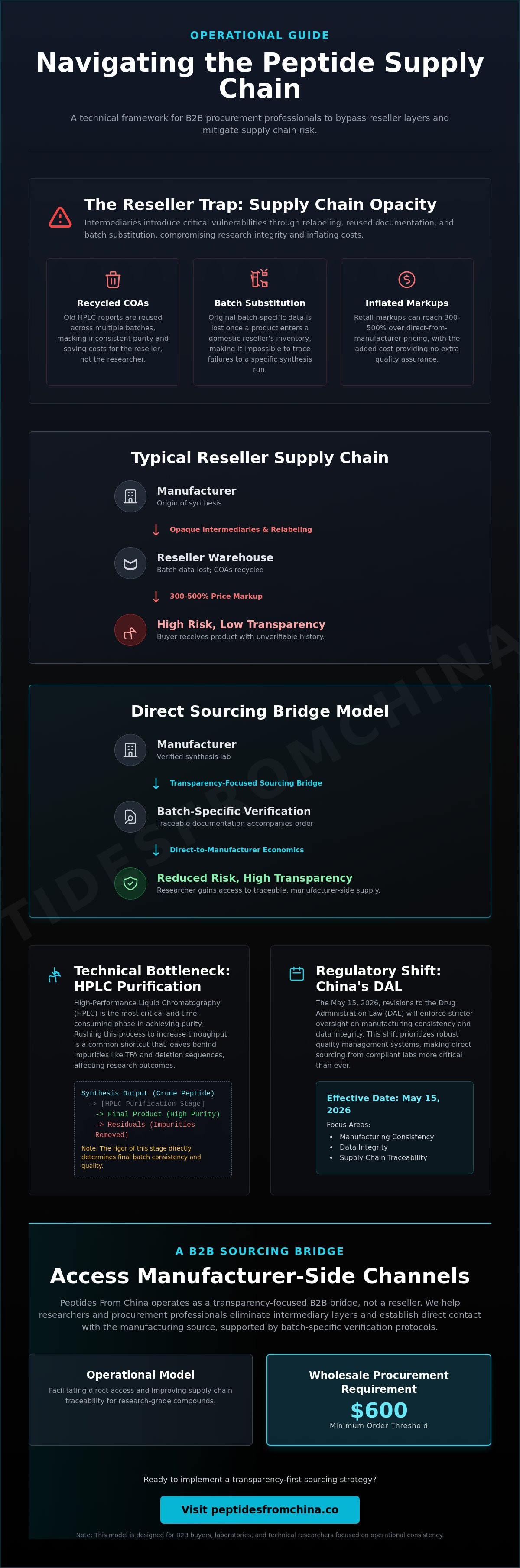
The "Reseller Trap" is a significant hurdle. Many resellers operate domestic warehouses in the US or EU to offer faster shipping, but this convenience often hides manufacturer-side flaws. By the time a vial reaches a domestic shelf, it's likely been relabeled. Its original batch-specific data is often lost. This makes it impossible to trace a failure back to the specific synthesis run. Direct sourcing is becoming the 2026 standard for labs that prioritize data integrity over shipping speed. The 2026 landscape is further defined by the revised Drug Administration Law, effective May 15, 2026, which has tightened oversight on manufacturing consistency and data integrity across the supply chain.
Manufacturer vs. Reseller: Identifying Your Source
Identifying a middleman requires a close look at documentation. If a lab provides a Certificate of Analysis (COA) with a generic letterhead or a date that doesn't align with the order timeline, it's a red flag. Middlemen often recycle old HPLC reports across multiple batches to save on testing costs. Relabeling disrupts the chain of custody and introduces variable consistency into your research. Bypassing these layers helps reduce supply chain uncertainty. It also addresses the economic disparity. Retail markups often reach 300% to 500% compared to direct-to-manufacturer pricing. Look for these visual cues in your documentation:
Generic or redacted letterheads on COAs.
Inconsistent batch numbers between the vial and the reference report.
Purity claims that remain identical across different orders over several months.
The Role of Research-Grade Compounds in 2026
Research-grade manufacturing follows different protocols than human-grade pharmaceutical production. Legitimate China peptide synthesis labs specializing in research compounds prioritize chemical purity and identity over clinical-grade sterile fill-finish requirements. Any vendor claiming "human grade" for research peptides is using marketing hype rather than technical standards. These export-only facilities operate under regulatory frameworks that focus on manufacturing consistency for laboratory use. For organizations like Peptides From China (PFC), acting as a B2B sourcing bridge means facilitating access to these manufacturer-side channels while maintaining a strict $600 minimum order threshold for wholesale viability. This model prioritizes transparency and directness over the superficial guarantees of the retail market.
Technical Standards in Professional Synthesis Facilities
Professional China peptide synthesis labs operate on a foundation of chemical precision that far exceeds the simple mixing of ingredients. The transition from individual amino acids to a stable, lyophilized powder involves multiple stages of chain elongation and rigorous purification. While many labs can perform basic synthesis, the ability to maintain consistency across recurring batches of catalog items like BPC-157 or Tirzepatide requires a high degree of operational maturity. First developed by Robert Bruce Merrifield in 1963, solid-phase peptide synthesis (SPPS) remains the industry standard, achieving modern 2026 efficiency through microwave-assisted automation and optimized resin loading.
High-Performance Liquid Chromatography (HPLC) is the most critical phase for achieving research-grade purity levels. It's also the industry's primary bottleneck. Labs must carefully manage the mobile phase to remove residual solvents and counter-ions like TFA (trifluoroacetic acid). If a lab rushes the HPLC process to increase throughput, the final product may contain higher levels of these contaminants, which can interfere with sensitive research applications. Efficiency in this purification stage determines the final yield and the concentration of impurities such as "deletion sequences," where an amino acid fails to attach to the growing peptide chain.
The Synthesis Process: From Amino Acids to Lyophilized Powder
Reliable facilities use automated synthesizers to minimize human error and implement solvent recovery systems to manage residual contaminants. Lyophilization, or freeze-drying, is the final step that ensures the peptide remains stable during international shipping. Without proper moisture removal, the compound's shelf life is significantly reduced. Understanding these technical nuances helps researchers evaluate manufacturer-side capabilities before committing to a wholesale procurement. Catalog peptides are often produced in larger, recurring batches, while custom sequences require unique optimization of the synthesis cycle, which typically extends lead times to the standard 2-3 week window.
In-House Analytics and Quality Control
In-house analytics at China peptide synthesis labs typically involve mass spectrometry (MS) to confirm the molecular weight and identity of the synthesized compound. While MS confirms what the substance is, HPLC measures its purity. Professional labs issue these reports as baseline technical reference material. However, they don't replace the need for independent testing. Even with the FDA guidance on synthetic peptides providing a framework for purity standards, internal lab reports should be viewed as a starting point for verification rather than a final guarantee of quality. Independent verification remains the only way to ensure the data aligns with the physical product in the vial.
Evaluating Laboratory Reliability: Moving Beyond Reused COAs
China's role in the global supply chain is massive. According to Global Peptide Synthesis Market Insights, the region continues to dominate production hubs. However, the abundance of China peptide synthesis labs creates a significant verification challenge for procurement professionals. A common industry practice involves recycling High-Performance Liquid Chromatography (HPLC) reports. A facility might synthesize a high-quality batch once, generate a report, and then use that same digital file for the next ten batches, regardless of actual purity fluctuations. This lack of transparency makes it difficult to rely solely on manufacturer-issued paperwork.
A 99% purity claim on a PDF is not a guarantee of laboratory integrity; it's reference analytical data at best. The risk of "bait and switch" shipping is a reality in high-volume sourcing. A lab may provide a high-purity sample for initial verification but substitute a lower-quality batch for the actual wholesale shipment. This batch substitution often remains hidden until the researcher experiences inconsistent results in their laboratory work. To mitigate this, documentation should be used only as a baseline to support independent verification rather than as definitive proof of quality.
Red Flags in Lab Documentation
Identifying unreliable sources starts with a close inspection of the chromatograms. Signs of digital manipulation, such as perfectly straight baselines or identical noise patterns across different reports, suggest the data has been "cleaned" or fabricated. Inconsistencies between manufacturing dates and test dates are also major warning signs. If a report is dated six months before the batch was supposedly synthesized, the documentation is clearly recycled. Researchers should also view "perfect" 100% purity reports with extreme skepticism. In real-world chemical synthesis, achieving absolute 100% purity is statistically improbable, and such claims usually point to a lack of analytical rigor.
The Necessity of Independent Third-Party Testing
Building a "trust but verify" relationship with Chinese facilities is the only way to ensure operational consistency. Researchers often utilize independent labs like Janoshik or MZ Biolabs to perform blind testing on random vials from their shipments. For a $600 wholesale order, the additional cost of independent testing acts as a necessary insurance policy. It validates the manufacturer's internal data and helps reduce supply chain uncertainty. This practice forces China peptide synthesis labs to maintain higher standards, as they know the buyer is performing their own due diligence. Transparency-focused sourcing bridges like Peptides From China (PFC) support this independent verification by providing direct-to-manufacturer access, making it easier for buyers to correlate their own test results with a specific production source.
Operational Protocols for Direct Sourcing and Procurement
Moving from laboratory evaluation to actual procurement requires a shift in operational strategy. For many professional China peptide synthesis labs, the $600 minimum order threshold serves as a critical filter. This requirement ensures that the facility is engaging with wholesale-ready researchers rather than retail consumers. It also allows the lab to allocate resources for batch-specific verification without the overhead associated with single-vial sales. To initiate this process, a $10 processing deposit is often used to verify the manufacturer's current stock and availability before a full invoice is issued.
Step-by-Step Wholesale Sourcing Workflow
The workflow begins with a technical inquiry where you align your specifications with the lab's current production capabilities. You should review the manufacturer's available stock and request reference analytical data, such as preliminary HPLC or MS reports, for the specific batch in question. Once technical details are confirmed, the procurement is finalized via international wire transfer or Bitcoin. These payment methods are standard in the B2B peptide industry because they facilitate faster cross-border settlement and reduce the high fees associated with retail payment processors.
Logistics and Global Distribution Research
Logistics in 2026 involve navigating tightened management of drug manufacturing and export protocols. Legitimate labs utilize neutral, discreet packaging to protect the integrity of research compounds during transit. This practice helps reduce supply chain uncertainty and minimizes unnecessary attention during customs clearance. You can find more detail on our peptide sourcing platform regarding large-scale synthesis logistics. Following the synthesis, which typically takes 2-3 weeks for custom orders, tracking protocols allow for monitoring the batch from the synthesis facility through international distribution hubs.
Managing customs risk is a shared responsibility between the sourcing bridge and the buyer. Most reputable China peptide synthesis labs operate with clear reship policies that address the reality of international logistics. If a shipment is seized or lost due to documented courier errors, a reshipment protocol should be in place to maintain research consistency. This system supports independent verification by ensuring the buyer receives the physical product they've already validated through documentation. For those ready to begin the procurement process, you can access our direct manufacturer channels to view current wholesale availability.
Bridging the Gap: The Peptides From China B2B Model
Peptides From China (PFC) operates as a transparency-focused B2B sourcing bridge, specifically designed to address the systemic flaws in the global peptide market. It isn't a pharmaceutical manufacturer or a testing laboratory. Instead, it functions as a methodical filter between professional buyers and the high-capacity China peptide synthesis labs that dominate the industry. By removing the reseller layers that typically inflate costs by 300% to 500%, PFC provides a direct path to manufacturer-side pricing and batch-specific data. This model prioritizes factual integrity over marketing flair, acknowledging that research consistency depends on traceable, direct-from-lab supply chains.
Researchers choose this model because it addresses the anxieties of international procurement through an organized, methodical approach. While retail platforms focus on single-vial sales and domestic warehousing, PFC focuses on wholesale volume and manufacturer-side verification. This helps reduce supply chain uncertainty for procurement professionals who require high-volume consistency for compounds like Tirzepatide, Semaglutide, or IGF-1 LR3. The goal isn't to offer a "guaranteed" outcome, but to provide the technical transparency required for researchers to conduct their own independent verification effectively.
Minimizing Supply Chain Uncertainty
The selection process for China peptide synthesis labs is rigorous. PFC identifies verified synthesis facilities by auditing their operational protocols and history of batch consistency. Understanding the lab-side flaws discussed in previous sections, such as recycled HPLC reports or batch substitution, allows PFC to act as a protective filter for the client. This insider perspective helps identify which labs maintain the infrastructure for complex sequences and which ones rely on middleman tactics. By establishing a direct manufacturing bridge, the model improves traceability and supports the researcher's need for operational consistency across multiple production runs.
Getting Started with Wholesale Sourcing
Professional procurement through this channel begins with a clear understanding of wholesale requirements. The $600 minimum order threshold is a standard protocol that ensures the synthesis facility can dedicate the necessary resources to batch-specific verification. To initiate the process, a $10 processing deposit is required. This small fee allows the sourcing bridge to verify current manufacturer stock and preliminary analytical data before you commit to a full invoice. For those researching specific catalog items, you can review our bulk BPC-157 wholesale guide for detailed operational data on large-scale procurement.
This B2B model is built for the sophisticated buyer who understands that documentation like mass spectrometry is a baseline reference rather than a final proof of purity. It supports a "trust but verify" workflow where the buyer uses manufacturer-side access to facilitate their own independent testing. By minimizing intermediaries and focusing on direct manufacturer channels, researchers can secure a more predictable and cost-effective supply chain for their 2026 laboratory requirements.
Establishing Traceable Supply Chains in 2026
Success in peptide procurement depends on moving beyond the superficial security of recycled PDF reports and embracing a methodical "trust but verify" framework. You've seen how direct manufacturer access helps reduce supply chain uncertainty by eliminating reseller markups and providing batch-specific HPLC/MS reference data. Navigating China peptide synthesis labs effectively requires a commitment to independent verification and a clear understanding of the $600 minimum order threshold necessary for professional wholesale viability. This approach prioritizes factual accuracy and logistical consistency over marketing hype.
By leveraging a transparency-focused sourcing bridge, researchers can bypass retail layers to access direct-to-manufacturer pricing and neutral global shipping with tracking. Establishing these direct channels is a strategic investment in the long-term integrity of your laboratory data. It's the most realistic path to securing high-volume compounds without the risks associated with opaque supply chains. Taking control of your sourcing protocols is the first step toward achieving predictable research outcomes.
Secure Your Research Supply: Start Your Direct Sourcing Request
Frequently Asked Questions
Are peptides from China safe for laboratory research?
Safety in a laboratory context depends entirely on the specific synthesis facility and the buyer's internal verification protocols. China is the global hub for research-grade peptide production, but the lack of standardized oversight for export-only labs means batch quality can be variable. Researchers should treat all incoming material as unverified until independent third-party testing confirms the identity and purity of the compound.
How do I verify the purity of peptides sourced from a Chinese lab?
Independent testing at specialized facilities like Janoshik or MZ Biolabs is the only reliable method for purity verification. While China peptide synthesis labs provide HPLC and MS reports, you should view these as baseline technical reference material rather than absolute proof. You must correlate the manufacturer's data with your own blind test results to ensure the batch meets your research specifications.
What is the typical minimum order quantity (MOQ) for wholesale peptide sourcing?
Professional wholesale procurement through a B2B sourcing bridge typically requires a minimum order amount of $600. This threshold is necessary to justify the logistical overhead and the provision of batch-specific reference data. It filters for professional buyers and laboratories that prioritize manufacturer-side transparency and long-term consistency over the convenience of single-vial retail purchases.
How long does shipping take from a China peptide synthesis lab to the US or EU?
International shipping usually takes between 7 to 14 business days once the batch has cleared the synthesis and internal quality check phases. If you are requesting a custom sequence, you must account for the standard 2 to 3 weeks required for the synthesis process itself. Logistics are handled through international hubs using neutral, discreet packaging to maintain the integrity of the research supply chain.
Why are prices so much lower when sourcing directly from a manufacturer?
Direct sourcing eliminates the 300% to 500% markups typically applied by retail resellers who must cover domestic warehousing, marketing, and small-batch processing costs. By bypassing these intermediaries, you pay for the chemical synthesis and international logistics rather than a middleman's overhead. This model provides direct-to-manufacturer pricing for researchers capable of managing their own batch-specific verification and testing.
Can I trust the HPLC reports provided by Chinese peptide labs?
You should approach provided HPLC reports with professional skepticism because the industry often recycles these documents across multiple batches. These reports prove the lab has the analytical equipment to perform the test, but they don't guarantee the specific vial you receive matches the data. Use manufacturer-issued papers as a starting point for your own independent verification and traceability protocols.
What happens if my wholesale peptide order is seized by customs?
Reputable sourcing bridges operate with established reship policies to mitigate the risks of international logistics. If a shipment is seized or lost due to documented courier errors, the protocol usually involves a one-time reshipment of the order to maintain your research consistency. This risk management is a standard component of the B2B model, helping to reduce supply chain uncertainty for high-volume buyers.
Do I need a special license to buy research peptides from China?
Most research peptides don't require specific pharmaceutical licenses for procurement when intended for laboratory use, though you must ensure compliance with your local jurisdiction's regulations for research chemicals. It is the buyer's responsibility to verify that their intended application aligns with legal requirements. China peptide synthesis labs focus on export-only manufacturing for scientific and technical applications rather than clinical use.