Most researchers treat a reconstituted vial as a static asset, but the reality is that BPC-157 stability in solution begins to degrade the moment the vacuum seal is broken. You've likely experienced the frustration of a longitudinal study where results begin to drift as the batch ages, often due to subtle molecular shifts that aren't visible to the naked eye. It's a common pain point in an industry where supply chain opacity and reused COAs make it difficult to establish a baseline for integrity. We agree that inconsistent data is a waste of both time and capital, especially when the cause is a preventable failure in storage or solvent choice.
This guide provides an operational deep-dive into the molecular degradation, solvent interactions, and storage protocols required to maintain BPC-157 integrity post-reconstitution. You'll learn why bacteriostatic water supports a 4 to 6 week stability window under refrigeration while sterile water alternatives often fail within 14 days. We also discuss how sourcing through a transparency-focused B2B bridge like Peptides From China helps reduce supply chain uncertainty. By following a standardized SOP and utilizing manufacturer-side channels with a $600 minimum order, you can minimize batch-to-batch variability and protect the technical value of your research materials.
Key Takeaways
Establish a technical baseline by distinguishing between the long-term stability of lyophilized powder and the immediate degradation risks present after reconstitution.
Identify the specific kinetic pathways, such as hydrolysis, that compromise BPC-157 stability in solution and how to mitigate them through precise thermal management.
Adopt a standardized SOP for reconstitution that avoids mechanical shear stress and utilizes aliquoting to limit the impact of repeated atmospheric exposure.
Evaluate the impact of solvent selection, comparing the antimicrobial benefits of bacteriostatic water against the shorter utility window of sterile water for injection.
Understand how sourcing directly from manufacturer-side channels helps bypass the degraded inventory often found with domestic resellers who hold stock for extended periods.
Table of Contents
Defining BPC-157 Stability: Molecular Integrity vs. Environmental Stress
Kinetic Degradation Pathways in Aqueous BPC-157
Solvent Selection: Impact on BPC-157 Solution Longevity
Operational Protocols for Maintaining Solution Integrity
Sourcing Transparency: Why Batch Freshness Matters
Defining BPC-157 Stability: Molecular Integrity vs. Environmental Stress
BPC-157 is a synthetic pentadecapeptide composed of a specific sequence of 15 amino acids: Gly-Glu-Pro-Pro-Pro-Gly-Lys-Pro-Ala-Asp-Asp-Ala-Gly-Leu-Val. While its sequence is relatively short compared to larger proteins, its structural behavior is complex. In the sourcing industry, BPC-157 is frequently marketed under the moniker "Stable Gastric Pentadecapeptide." This term is technically accurate regarding its resistance to harsh acidic environments, but it's often misinterpreted by researchers as an indicator of indefinite shelf-life. BPC-157 stability in solution is a separate metric entirely, governed by different chemical stresses than those found in the digestive tract.
The sequence length of 15 residues makes it more robust than larger proteins, yet it remains susceptible to bond cleavage at specific points. Most commercial vendors rely on HPLC reports as definitive proof of quality, but these documents are merely snapshots of a single point in time. They don't reflect how the peptide will behave once you introduce a solvent. Understanding the difference between molecular integrity and environmental resilience is the first step in establishing a reliable research protocol. It's vital to remember that no single document fully guarantees product identity over the long term; independent verification remains a necessity.
Lyophilization as the Baseline for Stability
Lyophilization, or freeze-drying, is the industry standard for preserving the peptide backbone. By removing water through sublimation, manufacturers create a porous, stable cake that minimizes the risk of hydrolysis. However, the effectiveness of this process depends on the level of residual moisture remaining in the vial. If a manufacturer rushes the secondary drying phase, the peptide will degrade faster even in its dry state. This is a common issue with high-volume resellers who prioritize speed over technical precision.
Researchers should only reconstitute what is needed for immediate study phases. Once the vacuum is broken and liquid is added, the degradation clock accelerates. When sourcing through a B2B bridge like Peptides From China, which facilitates direct manufacturer-side access with a $600 minimum order, you're more likely to receive recently synthesized batches. This helps reduce supply chain uncertainty and minimizes the risk of starting your study with a product that's already undergone significant atmospheric degradation during long-term storage by domestic middle-men.
The Gastric Juice Paradox
BPC-157's primary claim to fame is its resilience in acidic environments, specifically within the pH 1.0 to 2.0 range of human gastric juice. This unique property allows the peptide to remain bioactive where others would be destroyed. It's a mistake to conflate this pH resistance with general stability in neutral laboratory solvents. Resistance to stomach acid doesn't translate to resistance to microbial hydrolysis or oxidation over several weeks.
While the peptide can withstand high acidity, it's still highly vulnerable to environmental factors once in an aqueous state. In a laboratory setting, BPC-157 stability in solution is dictated more by the presence of proteases and the chemical purity of the solvent than by pH levels. Resistance to stomach acid doesn't protect the peptide from the shear stress of improper reconstitution or the thermal degradation that occurs at room temperature. Accurate research requires recognizing that "stable" is a relative term dependent on the specific environment and the absence of contaminants.
Kinetic Degradation Pathways in Aqueous BPC-157
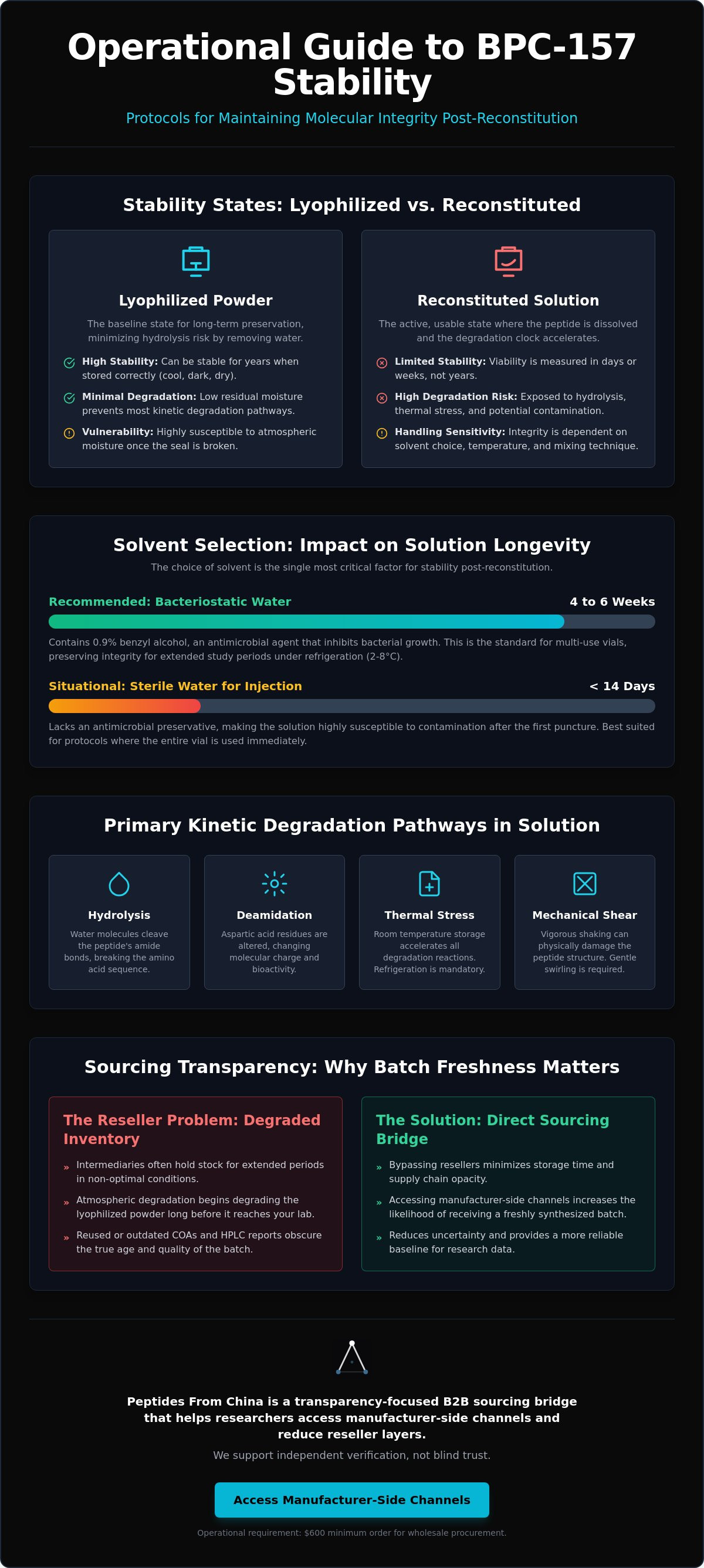
Once you introduce an aqueous solvent, the peptide's chemical environment shifts from a protected solid to a reactive liquid. Hydrolysis is the primary mechanism of degradation here, where water molecules facilitate the cleavage of the amide bonds that hold the pentadecapeptide sequence together. While BPC-157 lacks Cysteine and Methionine residues, which are common targets for oxidation, it remains vulnerable to deamidation. This process specifically targets the aspartic acid residues in its sequence, potentially altering the peptide's molecular charge and bioactivity. These changes are often subtle, making BPC-157 stability in solution a moving target that requires precise management rather than assumptions of permanence.
Relying on a single HPLC report from a reseller doesn't account for these kinetic shifts. Instead, researchers should view analytical data as a baseline rather than a permanent guarantee of purity. Understanding these pathways helps you design better storage protocols and choose sourcing partners that prioritize batch freshness over long-term warehousing.
Thermal Stress and Molecular Motion
Temperature is the most significant variable in the rate of chemical degradation. Research indicates that BPC-157 remains stable for approximately 4 to 6 weeks when reconstituted in bacteriostatic water and kept at 2 to 8°C. At room temperature, the rate of molecular motion increases, leading to a much faster decline in integrity. BPC-157 stability in solution is also compromised by "hot spots" near heat-generating equipment like centrifuges or computers, which can create localized environments well above 25°C. These fluctuations accelerate bond cleavage and reduce the effective half-life of the batch.
Repeated freeze-thaw cycles are another often-overlooked risk. Each cycle creates mechanical stress that can disrupt the peptide's structure. For those conducting longitudinal studies, accessing fresh batches through Peptides From China, a transparency-focused B2B sourcing bridge, helps reduce supply chain uncertainty. When procurement is managed through these manufacturer-side channels with a $600 minimum order, researchers can better coordinate their reconstitution schedules with the arrival of fresh material, ensuring the peptide hasn't already begun its kinetic decline in a reseller's warehouse.
Photolytic Degradation and UV Exposure
Light energy, particularly in the ultraviolet spectrum, can catalyze the breakdown of peptide bonds through photolysis. This process is often faster than hydrolysis in environments with high light exposure. While many researchers use standard clear glass vials, these provide minimal protection against UV rays. Amber vials or light-shielded storage boxes are necessary to maintain solution longevity. If your laboratory environment has high ambient light, even brief periods of exposure on a lab bench can begin the degradation process. Shielding the solution is a simple but critical step in preserving the baseline purity of your research material and ensuring that your results aren't skewed by light-induced molecular shifts.
Solvent Selection: Impact on BPC-157 Solution Longevity
The choice of solvent is the most critical operational decision researchers make after procurement. While the previous sections established the chemical pathways of degradation, the solvent acts as the medium that either accelerates or mitigates these risks. BPC-157 stability in solution is not a fixed property; it's a variable of the solvent's chemical composition and its ability to inhibit secondary reactions like microbial growth. Choosing a medium without considering its preservative capacity often leads to the rapid introduction of proteases, which catalyze the hydrolysis of the peptide backbone far faster than water alone.
Solubility limits also play a role in long-term integrity. While BPC-157 is generally highly soluble in aqueous buffers, attempting to create ultra-concentrated mother liquors can lead to peptide precipitation over time. This is especially true if the solution is subject to temperature fluctuations during refrigeration. Once a peptide precipitates, returning it to a fully bioactive, monomeric state can be difficult, often requiring mechanical agitation that introduces shear stress. Researchers should aim for concentrations that support independent verification while remaining well within known solubility parameters.
The Case for Bacteriostatic Water
Bacteriostatic water (0.9% benzyl alcohol) is the industry standard for multi-use vials. The benzyl alcohol acts as a potent stabilizer against bacterial proliferation, which is the primary source of exogenous peptide hydrolysis. In a laboratory setting, even minor contamination during the reconstitution process can compromise an entire batch if the solvent lacks an antimicrobial agent. Most reference analytical data suggests that BPC-157 remains stable in bacteriostatic water for approximately 28 to 30 days when properly refrigerated. While some interactions between the alcohol and specific peptide sequences can occur, BPC-157's robust structure generally tolerates this preservative well without significant loss of identity.
Saline and Isotonic Considerations
Some research models require the use of 0.9% Sodium Chloride (Normal Saline) or Phosphate-Buffered Saline (PBS) to ensure isotonicity or pH stability. PBS is particularly effective at maintaining a neutral pH, which can help reduce the rate of deamidation in the aspartic acid residues mentioned earlier. However, the trade-off is the total lack of antimicrobial protection. Solutions made with sterile water or saline are highly susceptible to contamination and should be used within a much shorter window, typically 24 to 48 hours.
For longitudinal studies where long-term BPC-157 stability in solution is required, relying on saline alone is often a logistical risk. Sourcing high-purity bulk batches through a B2B bridge like Peptides From China allows laboratories to access manufacturer-side inventory and plan their reconstitution schedules with greater precision. By utilizing these direct channels, which require a $600 minimum order, procurement professionals can ensure they have enough fresh material to avoid stretching the utility of a single saline-based vial beyond its safe operational limits.
Operational Protocols for Maintaining Solution Integrity
Establishing a rigorous SOP for handling reconstituted peptides is the only way to ensure BPC-157 stability in solution remains within acceptable research parameters. Even the highest purity batch can be compromised by poor laboratory technique. These protocols aren't about achieving a "perfect" state; they're about minimizing the variables that lead to batch-to-batch inconsistency. In an industry where supply chain opacity is the norm, controlling your internal handling is a necessary step for data reliability.
Step 1: Controlled Reconstitution. Never spray the solvent directly onto the lyophilized cake. This creates mechanical shear stress that can denature the peptide. Instead, angle the needle so the liquid trickles down the side of the vial, allowing the peptide to dissolve gradually.
Step 2: Immediate Aliquoting. Once the solution is clear, transfer it into single-use containers. This prevents repeated temperature fluctuations and reduces the risk of contamination from multiple needle penetrations of the vial septum.
Step 3: Thermal Consistency. Store all solutions at a steady 2 to 8°C. Use a dedicated laboratory refrigerator with a digital logger to track any "hot spots" or cooling failures that could accelerate kinetic degradation.
Step 4: Visual Monitoring. Perform a visual check before every use. Any signs of cloudiness, precipitation, or "floaties" indicate that the peptide has either aggregated or been compromised by microbial growth.
Step 5: Strict Disposal. Even if a solution appears clear, don't use it beyond the 30 day window for bacteriostatic water or the 48 hour window for saline. The risk of subtle deamidation makes older solutions unreliable for precise data collection.
Aliquoting for Longitudinal Studies
Repeatedly piercing a single vial introduces atmospheric oxygen and potential contaminants every time the seal is broken. For studies spanning several weeks, aliquoting is the most effective way to preserve BPC-157 stability in solution. Use low-protein binding (LPB) tubes to minimize the amount of peptide that adheres to the plastic walls, a phenomenon known as adsorption. Each tube should be clearly labeled with the reconstitution date, solvent type, and original batch number. This level of traceability helps you identify if a specific subset of your study was impacted by a handling error rather than a product flaw.
Handling and Mechanical Agitation
Vigorous shaking is a common mistake that leads to peptide denaturation. Peptides have delicate tertiary structures that can be disrupted by aggressive movement. The "gentle swirl" method is the standard; rotate the vial slowly between your fingers until no visible particles remain. It's also vital to use peptide testing as a baseline for batch quality before you even begin the handling process. If you start with a batch that has high residual moisture or synthesis impurities, no amount of careful handling will save the solution from rapid decline.
Managing these protocols requires a steady supply of fresh, manufacturer-side material. You can source high-purity BPC-157 through Peptides From China, where we act as a B2B bridge to reduce reseller layers. By procurement through these direct channels with a $600 minimum order, you ensure your laboratory always has access to the technical reference data and fresh inventory needed to maintain operational consistency.
Sourcing Transparency: Why Batch Freshness Matters
The technical longevity of BPC-157 stability in solution is fundamentally capped by the age and storage history of the lyophilized powder before it ever reaches your laboratory. While previous sections detailed how to manage degradation post-reconstitution, those efforts are often undermined by "aged stock" from domestic resellers. Many intermediaries hold inventory for 12 to 18 months, allowing subtle degradation to occur within the vial due to residual moisture or traces of Trifluoroacetic acid (TFA) salts left over from the synthesis process. These impurities act as catalysts for bond cleavage the moment a solvent is introduced, significantly shortening the viable research window.
Supply chain opacity remains a primary risk for procurement professionals. Standard marketing claims often rely on reused COAs or generic HPLC reports that don't reflect the specific batch in your hand. At Peptides From China, we prioritize batch-specific reference analytical data, including Mass Spectrometry (MS) to verify identity and HPLC to assess purity levels. We view these manufacturer-issued papers as baseline technical reference material rather than absolute proof of quality. Independent verification by the buyer is the only way to truly confirm that the starting material hasn't undergone significant atmospheric degradation during transit or warehousing.
The Direct-to-Manufacturer Advantage
Eliminating unnecessary reseller layers is the most effective way to ensure you're working with fresh material synthesized shortly before shipment. When you bypass domestic middle-men, you reduce the time the peptide spends in non-ideal storage conditions. Understanding bulk BPC-157 wholesale dynamics allows researchers to improve traceability and maintain a tighter chain of custody.
Navigating the $600 minimum order requirement for these manufacturer-side channels helps laboratories optimize their procurement cycles. Instead of buying single vials that may have sat on a shelf for a year, high-volume researchers can secure fresh batches that support consistent BPC-157 stability in solution across longitudinal studies. This direct-to-manufacturer approach helps reduce supply chain uncertainty by providing a clearer timeline from synthesis to benchwork.
Verification Standards for B2B Buyers
Relying on a sourcing partner's word is never a substitute for a methodical verification SOP. Professional buyers must distinguish between the roles of different market participants. Understanding the nuances of a peptide sourcing agent vs platform is critical for handling quality disputes or verifying manufacturer credentials. A transparency-focused bridge like PFC doesn't claim to be a manufacturer or a guarantor of purity; instead, we facilitate the access points needed for researchers to perform their own due diligence. This "transparency-first" model prioritizes factual accuracy and batch traceability, ensuring that your research is built on a foundation of verified data rather than marketing hype.
Optimizing Your Research Procurement Strategy
Managing BPC-157 stability in solution is an operational necessity that begins with the removal of unnecessary reseller layers. We've established that kinetic degradation pathways and solvent selection dictate the utility window of your reconstituted batches. By adopting a standardized SOP that includes precise thermal logging and single-use aliquoting, you can minimize the batch-to-batch variability that often plagues longitudinal studies. It's about moving away from industry assumptions and toward a transparency-first model where independent verification is the standard.
To support this level of research-grade consistency, you need access to batches direct from synthesis facilities. You can access direct-to-manufacturer BPC-157 sourcing at Peptides From China, where we provide COA-verified material through a transparent B2B model. By utilizing our manufacturer-side channels with a $600 minimum order, you help reduce supply chain uncertainty and ensure your laboratory starts with the freshest inventory possible. We're here to help you secure more reliable research outcomes.
Frequently Asked Questions
How long is BPC-157 stable in bacteriostatic water at 4°C?
BPC-157 remains stable for approximately 4 to 6 weeks when reconstituted in bacteriostatic water and stored at a consistent 4°C. This utility window depends on the absence of contaminants and the initial purity of the lyophilized batch. Beyond this timeframe, the risk of deamidation and peptide bond cleavage increases, which can lead to inconsistent research data and batch-to-batch variability.
Can I freeze BPC-157 after it has been reconstituted?
Freezing reconstituted BPC-157 isn't recommended because repeated freeze-thaw cycles create mechanical shear stress. This stress can disrupt the peptide's delicate structure and lead to denaturation. It's more operationally realistic to aliquot the solution into single-use containers and keep them refrigerated to maintain BPC-157 stability in solution without risking structural damage.
Does BPC-157 degrade faster in saline than in sterile water?
BPC-157 doesn't necessarily degrade faster in saline due to the salt content, but it's more vulnerable because saline lacks antimicrobial preservatives. While saline provides an isotonic environment, it doesn't stop microbial-induced hydrolysis. Sterile water for injection (SWFI) shares this same risk, making both solvents inferior to bacteriostatic water for any study requiring multi-use vials.
What are the visible signs that my BPC-157 solution has degraded?
Visible signs of degradation include cloudiness, the formation of precipitates, or small particles often referred to as "floaties." However, molecular degradation like deamidation often happens without any visible change to the liquid's appearance. Visual inspection is a baseline safety check, but it doesn't replace the necessity of following strict documented stability windows and disposal timelines.
How does light exposure affect the potency of BPC-157?
Ultraviolet light exposure catalyzes photolysis, which is the direct cleavage of peptide bonds by light energy. This process can significantly reduce the potency of the solution even if thermal protocols are followed perfectly. Using amber vials or opaque storage boxes helps protect the integrity of the batch during benchwork and reduces the risk of light-induced molecular shifts.
Is BPC-157 really stable in the presence of stomach acid?
BPC-157 is uniquely resilient in acidic environments between pH 1.0 and 2.0, which is why it's technically classified as a stable gastric pentadecapeptide. This resilience is specific to stomach acid and doesn't protect the peptide from other environmental stresses. In a neutral laboratory solvent, the peptide is still subject to standard kinetic degradation pathways like any other synthetic peptide.
Why does the purity of the lyophilized powder affect its stability in solution?
The purity of the lyophilized powder is the foundation of BPC-157 stability in solution. Residual moisture or synthesis byproducts like TFA salts act as catalysts for hydrolysis once the peptide is aqueous. Starting with fresh material from manufacturer-side channels helps reduce these early-stage degradation risks, especially when procurement is managed through direct bridges like Peptides From China.
What is the recommended storage time for a reconstituted BPC-157 vial?
The recommended storage time is 30 days for solutions using bacteriostatic water and 24 to 48 hours for those using sterile water or saline. These timelines assume proper refrigeration and aseptic handling throughout the study. For longitudinal research, procurement should be timed with fresh batches to avoid the risks associated with aged inventory from domestic resellers.