
The standard acetate form of BPC-157, while widely utilized, often fails to maintain its molecular integrity in the presence of gastric acid, leading many researchers to inadvertently waste their laboratory resources. It's a common frustration in the peptide industry where supply chain opacity and reused HPLC reports make it difficult to verify exactly what salt form is arriving at your facility. You likely already know that choosing the wrong variant can skew your data, especially in oral administration models where stability is the primary variable. This article provides a technical analysis of BPC-157 arginine salt vs acetate for research, focusing on the operational realities of chemical stability and procurement.
You'll gain a clear understanding of how these salt forms differ in shelf-life and research utility, helping you make a data-backed decision for your next protocol. We will also address the logistical challenges of sourcing batches through manufacturer-side channels, such as Peptides From China (PFC). By reducing intermediary layers and focusing on independent verification, we help you navigate the risks of batch substitution and relabeling. Whether you're preparing for the upcoming July 23, 2026, FDA review or optimizing current wholesale procurement, this guide clarifies the trade-offs between stability and cost in $600 minimum order volume environments.
Key Takeaways
Identify the molecular differences between the traditional acetate form and the modified arginine salt to determine which salt is required for your specific delivery method.
Compare BPC-157 arginine salt vs acetate for research by analyzing degradation rates in simulated gastric juice alongside resistance to room-temperature shelf-life decay.
Assess the procurement trade-offs between the two forms, including the typical 20-40% price premium for arginine salt and its more complex synthesis requirements.
Discover how to use the PFC sourcing bridge to access manufacturer-side channels, which helps you reduce reseller mark-ups and improve batch traceability on orders starting at $600.
Understand why manufacturer-issued COAs are only baseline references and how to implement independent testing to mitigate risks like batch substitution or relabeling.
Table of Contents
Chemical Foundations: BPC-157 Acetate vs. Arginine Salt
Stability Metrics: Gastric Acid Resistance and Shelf Life
Procurement Realities: Cost, Synthesis, and Purity
Protocol Alignment: Which Form Suits Your Research?
Sourcing Strategy: Manufacturer-Direct Procurement via PFC
Chemical Foundations: BPC-157 Acetate vs. Arginine Salt
The peptide sequence itself is only half of the equation in laboratory procurement. When evaluating BPC-157 arginine salt vs acetate for research, you're primarily choosing between different counter-ions used to stabilize the synthetic molecule. These salts are necessary because the pure peptide sequence is often unstable and difficult to handle in its raw form. By bonding the sequence to a salt, manufacturers create a stable, lyophilized powder that can be measured, stored, and reconstituted for experimental use. The choice of salt dictates the compound's resilience against environmental stressors like heat and acidity.
Counter-ions play a critical role during the final stages of the synthesis process. They neutralize the overall charge of the BPC-157 molecule, which directly influences its solubility and bioavailability. While both forms are chemically identical in their amino acid sequence, their physical performance in a research setting varies significantly. Understanding these molecular foundations helps researchers avoid the common pitfalls of peptide degradation that can occur during shipping or administration. At Peptides From China (PFC), we act as a transparency-focused bridge to help procurement professionals verify these chemical specifications directly with production facilities, ensuring that the salt form matches the intended research protocol.
The Acetate Standard in Peptide Research
Acetate remains the historical baseline for most synthetic peptides. It's the form used in the vast majority of early literature and pilot studies because it's relatively inexpensive to produce and highly soluble in aqueous solutions. When you source wholesale peptides, the acetate version is typically the default offering. It requires strict cold chain management, as it's susceptible to rapid degradation if left at room temperature for extended periods. Standard reconstitution protocols usually involve bacteriostatic water or sterile saline, making it a predictable choice for systemic research models where the peptide bypasses the digestive tract.
The Rise of Di-L-Arginine Salt
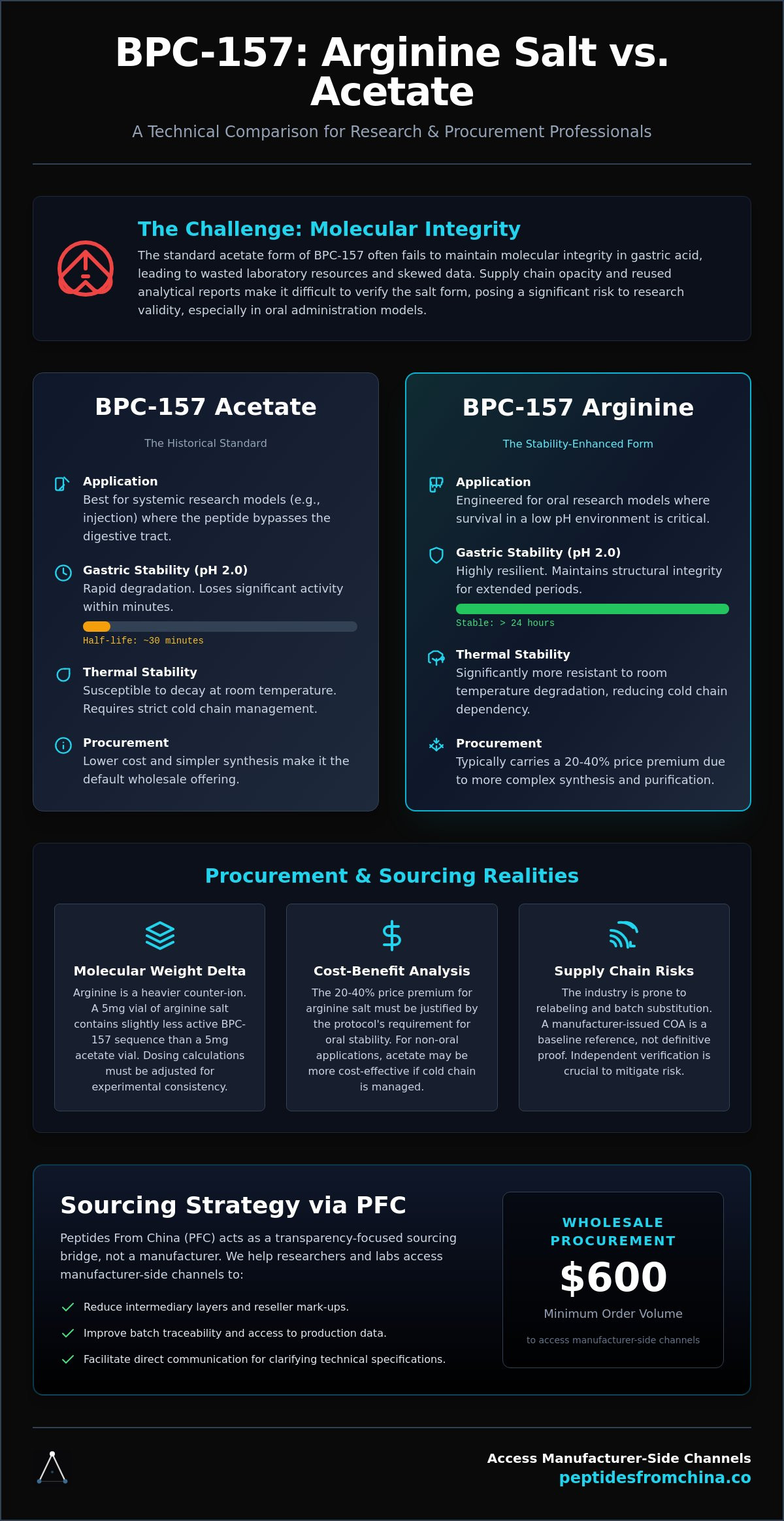
The Di-L-Arginine salt, frequently referred to as "Stable BPC," was engineered to solve the stability issues inherent in the acetate form. By bonding the BPC-157 sequence to L-Arginine, manufacturers create a molecular buffer that protects the peptide chain from premature cleavage. This is especially vital in oral research models where the peptide must survive the low pH environment of gastric acid. It's also more thermally resilient, maintaining its integrity at room temperature far longer than its acetate counterpart.
From an operational perspective, researchers must account for the difference in molecular weight. Arginine is a heavier counter-ion than acetate. Consequently, a 5mg vial of arginine salt contains slightly less of the actual BPC-157 peptide sequence than a 5mg vial of acetate. Dosing calculations in a lab setting must be adjusted to account for this mass delta to maintain experimental consistency. While the synthesis of arginine salt is more complex and requires additional purification steps, it helps reduce supply chain uncertainty for projects where temperature control cannot be strictly guaranteed.
Stability Metrics: Gastric Acid Resistance and Shelf Life
Stability is the primary operational differentiator when comparing BPC-157 arginine salt vs acetate for research. While both share the same peptide sequence, their survival in hostile environments varies drastically. In simulated gastric juice with a pH range of 1.0 to 2.0, acetate-bound BPC-157 experiences rapid hydrolytic cleavage. This vulnerability is documented in the BPC-157 Stability Patent, which highlights that the traditional salt form loses significant biological activity within minutes of exposure to stomach acid. In a pH 2.0 environment, the half-life of BPC-157 acetate is approximately 30 minutes, while the arginine salt variant maintains structural integrity for over 24 hours.
Thermal stability is another critical factor for procurement professionals. Arginine salt offers superior resistance to room temperature degradation. Acetate usually requires strict refrigeration at 2-8°C to prevent degradation during international transit. Arginine salt can withstand room temperature exposure for weeks without measurable loss in purity. Both forms remain sensitive to UV light and should be stored in amber vials or dark environments to prevent photo-degradation. Long-term storage for eligible research buyers still dictates -20°C for lyophilized powders to ensure maximum longevity.
Gastric Stability and Oral Research Models
Oral research models require the peptide to survive the digestive tract to be effective. Most acetate-bound BPC-157 is neutralized before reaching systemic circulation, making it an inefficient choice for these protocols. Arginine salt is the standard for gastric ulcer and inflammatory bowel research because it remains active in the gut. While the 'Stable BPC' moniker is often used as a marketing tool, the chemical reality is that the L-Arginine counter-ion provides a genuine buffer against acidic environments, though it doesn't eliminate the need for careful handling.
Storage Logistics for Large-Scale Labs
For large-scale labs, cold chain logistics for acetate represent a significant overhead and a potential point of failure. Arginine salt helps reduce supply chain uncertainty, especially when shipping from manufacturer-side channels where transit times can fluctuate. When you access manufacturer-side supply channels, the increased stability of the arginine salt provides an extra layer of protection against batch spoilage during the customs clearance process. Researchers should remember that once reconstituted, both forms should be used promptly. However, arginine salt in solution shows slightly better resistance to room temperature decay. For wholesale procurement through PFC, where orders start at $600, choosing the arginine salt can minimize the risk of receiving a degraded product due to logistics delays.
Procurement Realities: Cost, Synthesis, and Purity
Sourcing high-purity arginine salt involves more than just a higher price tag; it requires a more intensive synthesis cycle compared to the acetate standard. When evaluating BPC-157 arginine salt vs acetate for research at the wholesale level, buyers typically encounter a 20% to 40% price premium for the stable variant. This delta isn't arbitrary. It reflects the additional purification steps required to exchange the acetate ions for arginine counter-ions and the inherently lower yields associated with this complex molecular bonding. Many manufacturers find it difficult to scale arginine salt production without compromising the final purity of the batch, which is why it's often produced in smaller, more controlled quantities.
The regulatory landscape also adds a layer of procurement complexity. Organizations like Operation Supplement Safety categorize the compound as a BPC-157 Prohibited Substance for certain personnel, emphasizing its status as an unapproved drug. This makes transparency in your supply chain vital. In the intermediary market, the risk of batch substitution is high. Resellers often relabel standard acetate as "Stable BPC" to capitalize on the higher margins. Since both forms appear as identical white lyophilized powders, independent verification is the only way to ensure your research protocol isn't compromised by cheaper, less stable material.
Manufacturing Overhead in Peptide Production
The peptide production process for arginine salt is technically demanding. While acetate is the natural byproduct of the most common cleavage methods, converting it to a di-L-arginine salt requires an ion-exchange chromatography step that can significantly reduce the final yield. Manufacturers must balance the pressure for high output with the necessity of maintaining the specific salt bond. For researchers accessing manufacturer-side channels through PFC, these technical hurdles often dictate a minimum order amount of $600 to justify the specialized synthesis runs required for authentic arginine salt batches.
Verifying Salt Identity in Technical Documentation
Relying on a manufacturer-provided HPLC report is rarely sufficient for salt verification. While HPLC confirms the purity of the peptide sequence, it doesn't always distinguish between the counter-ions used. Sophisticated peptide testing using Mass Spectrometry is required to identify the specific mass peaks associated with arginine.
Mass Spectrometry: Look for a distinct peak at approximately 174.2 Da, which corresponds to the arginine counter-ion.
Elemental Analysis: This can help determine the nitrogen-to-carbon ratio, which differs between the two salt forms.
Reference Data: Always compare your results against reference analytical data rather than taking a COA at face value.
By focusing on these technical markers, procurement professionals can improve traceability and help reduce supply chain uncertainty. Peptides From China acts as a bridge to these manufacturing details, though we always advocate for independent laboratory verification of every batch to confirm the salt identity before research begins.
Protocol Alignment: Which Form Suits Your Research?
Selecting the correct salt form is a strategic decision that depends entirely on your delivery method and the environmental stressors of your laboratory protocol. When choosing BPC-157 arginine salt vs acetate for research, the primary consideration is the route of administration. The amino acid sequence itself remains identical in both forms; the salt choice does not alter the peptide's primary mechanism or biological targets. Instead, it dictates the efficiency with which that sequence reaches those targets. Misaligning the salt form with the protocol often leads to degraded samples and unrecoverable data.
A cost-benefit analysis is essential for any procurement professional. While the arginine salt offers superior stability, the acetate version is often "good enough" for protocols where environmental variables are strictly controlled. Consistency is the most critical factor for research reproducibility. Switching between salt forms during a multi-phase study introduces a significant variable that can skew results, making it difficult to compare data across different batches or labs. Independent verification of the salt form is necessary to ensure this consistency, as relying on manufacturer documentation alone carries inherent risks in an opaque market.
Systemic Research and Injection Models
For research protocols involving subcutaneous or intramuscular injection, BPC-157 acetate remains the industry standard. Since the peptide bypasses the digestive tract, the acid-resistant properties of the arginine salt provide no functional advantage. There is currently no definitive evidence suggesting that arginine salt improves the systemic half-life of the peptide once it enters the bloodstream. For high-frequency testing environments, the lower cost of acetate allows for larger sample sizes within the same budget. When sourcing through PFC, researchers can manage their $600 minimum order more efficiently by choosing the acetate form for these systemic models, provided they maintain a strict cold chain.
Gastrointestinal and Long-Term Stability Studies
Arginine salt is non-negotiable for oral delivery models or studies where the peptide is exposed to high temperatures. Its molecular structure prevents the rapid degradation that occurs when acetate is introduced to a low pH environment. This stability is also relevant when evaluating complex blends, such as those involving the tb-500 peptide. If your protocol requires a combination of these regenerative sequences in an oral format, the arginine salt of BPC-157 is the only viable foundation. Future-proofing your research against environmental variables helps reduce supply chain uncertainty and ensures that your results are based on the intended molecular concentration. To secure high-purity batches verified at the source, you can contact us for manufacturer-direct BPC-157 procurement.
Sourcing Strategy: Manufacturer-Direct Procurement via PFC
The global peptide market often lacks the technical accountability required for high-stakes research. When procurement professionals evaluate BPC-157 arginine salt vs acetate for research, they typically face a wall of resellers who provide little more than a generic, often reused, COA. The Peptides From China (PFC) model operates as a transparency-focused bridge, designed to eliminate the reseller mark-ups and information gaps that plague this industry. By facilitating a direct connection to Chinese synthesis facilities, we help you bypass the secondary market where acetate is frequently relabeled as stable arginine salt to capture higher margins.
The $10 deposit initiates manual request processing and real-time stock verification and is credited toward the final invoice. PFC checks current availability directly with the manufacturing side. Products are subject to the manufacturer’s applicable quality-control procedures and specifications. Manufacturer-side analytical documentation may be available depending on the product and batch. PeptidesFromChina is not an independent analytical testing laboratory. PeptidesFromChina currently has a $600 total minimum order. Multiple catalog products can be combined to reach the minimum, with orders starting from one 10-vial kit per product.
Reducing Intermediary Layers
The choice between a peptide sourcing agent vs platform significantly impacts the traceability of your materials. Platforms often obscure the origin of the peptide, making it impossible to verify the synthesis environment. PFC prioritizes direct communication with the facility, ensuring that your requirements for arginine salt are understood at the production level rather than lost in translation through multiple resellers. We also handle the logistics of neutral packaging and international tracking, which helps reduce supply chain uncertainty for global research labs that can't afford transit delays or customs seizures.
The PFC Verification Protocol
PFC positions itself as a guide through the manufacturing landscape, not as a testing laboratory or guarantor of purity. We facilitate the acquisition of manufacturer-side analytical documentation, when available, but we always emphasize that these documents are baseline technical references. For B2B buyers, we provide the infrastructure to support independent testing. By accessing manufacturer-side channels, you can secure batch-specific samples for your own HPLC or Mass Spectrometry analysis before committing to large-scale procurement. This approach improves traceability and ensures that your laboratory is actually working with the specific BPC-157 salt form your research demands, effectively minimizing the risks associated with supply chain opacity.
Optimizing Procurement for Long-Term Research Consistency
Success in peptide research depends on matching the molecular salt form to your specific protocol requirements. While the arginine salt is essential for oral or gastric models due to its superior acid resistance, the acetate form remains a cost-effective standard for controlled systemic studies. Choosing between BPC-157 arginine salt vs acetate for research isn't just about stability; it's about managing laboratory overhead and ensuring data reproducibility. You must move beyond reliance on manufacturer-issued PDFs and implement independent testing to mitigate the pervasive risks of batch substitution and supply chain opacity.
Reducing intermediary layers is the most effective way to improve traceability and secure reliable material. By working through a transparency-focused bridge, you can access raw manufacturer data and minimize the reseller mark-ups that inflate institutional costs. To access manufacturer-side analytical documentation, when available, and manufacturer-side sourcing for wholesale orders starting at $600, you can Secure Direct-to-Manufacturer Pricing for BPC-157 at Peptides From China. Taking control of your supply chain today helps ensure that your future data is built on a foundation of chemical integrity and operational transparency.
Frequently Asked Questions
Is BPC-157 arginine salt better than acetate for all research?
No, the choice between salt forms depends entirely on your administration protocol. While the arginine salt is superior for oral research due to its gastric stability, acetate remains the industry standard for systemic or injectable models. Acetate is often more cost-effective for high-frequency testing where environmental variables are strictly controlled within a laboratory cold chain. Choosing BPC-157 arginine salt vs acetate for research should be based on whether your protocol requires resistance to acidic environments or thermal stressors.
Can I use HPLC to tell the difference between acetate and arginine salt?
Standard HPLC is insufficient for salt verification because it primarily measures the purity of the peptide sequence rather than the counter-ion. To distinguish between these forms, you need Mass Spectrometry (MS) to identify the specific mass peaks of the arginine counter-ion or elemental analysis to determine the nitrogen-to-carbon ratio. Relying solely on manufacturer-provided HPLC reports carries significant risk, as these documents rarely confirm the identity of the salt used during the final synthesis steps.
Why is BPC-157 arginine salt more expensive in wholesale orders?
The 20% to 40% price premium for arginine salt reflects the increased synthesis complexity and lower final yields. Manufacturers must perform additional ion-exchange chromatography steps to replace the acetate ions with di-L-arginine, a process that is harder to scale than standard acetate production. When sourcing through the PFC bridge, this manufacturing overhead is reflected in the wholesale pricing, though accessing manufacturer-side channels helps you avoid the additional mark-ups typically added by international resellers.
Does the salt form affect the reconstitution of BPC-157?
Yes, the salt form influences both solubility and dosing calculations. While both variants are soluble in bacteriostatic water, the arginine salt has a higher molecular weight than the acetate form. This means a 5mg vial of arginine salt contains a slightly lower concentration of the actual peptide sequence by mass. Researchers must adjust their reconstitution volumes and dosing protocols to account for this delta to ensure experimental consistency across different batches.
What is the shelf life of BPC-157 acetate compared to arginine salt?
Arginine salt offers significantly better thermal resistance, maintaining its integrity at room temperature for several weeks. In contrast, BPC-157 acetate is highly susceptible to degradation and requires a strict cold chain of 2-8°C to prevent loss of purity. This difference helps reduce supply chain uncertainty during international transit, as arginine salt is less likely to spoil if shipping delays occur. For long-term institutional storage, both forms should still be kept at -20°C in lyophilized form.
How do I verify a manufacturer's claim of arginine salt stability?
You should never accept stability claims at face value without independent laboratory verification. The peptide industry is prone to batch substitution, where standard acetate is relabeled as "Stable BPC" to increase profit margins. The only reliable method is to request reference analytical data and conduct your own Mass Spectrometry on a sample from the batch. PFC facilitates this transparency by providing access to raw manufacturer records, but we always advocate for third-party testing by the buyer.
What is the minimum order for bulk BPC-157 from China?
When using the PFC sourcing bridge to access manufacturer-side channels, the minimum order for wholesale procurement is $600. This is an operational minimum for orders through the PFC sourcing platform and may include multiple catalog products. This model is designed for eligible research-use buyers who require batch traceability and direct communication with the synthesis facility rather than the opaque service provided by retail-focused middlemen.
Can BPC-157 acetate be used in oral research models effectively?
Acetate is generally ineffective for oral research because it undergoes rapid hydrolytic cleavage when exposed to gastric acid. Experimental data shows that the acetate form loses most of its biological activity within 30 minutes at a pH of 2.0. If your research protocol requires the peptide to survive the digestive tract, the arginine salt is the only viable option. Using acetate in these models often results in failed experiments and unrecoverable data due to the peptide's inherent instability in acidic environments.