
Independent analysis shows that approximately 30% of peptide samples sourced from the grey market are mislabeled, contain incorrect dosages, or are contaminated. You're likely aware that wholesale peptide sourcing often feels like a gamble against opaque supply chains and reused HPLC reports. It's difficult to maintain operational consistency when you're forced to rely on intermediaries who prioritize their markups over your batch traceability and synthesis quality.
We agree that the traditional reseller model is fundamentally flawed, often masking batch substitution behind recycled paperwork. This guide provides a professional framework for direct-to-manufacturer procurement, helping you reduce supply chain uncertainty through rigorous independent verification. We'll examine how to vet international production facilities, navigate the April 2026 FDA updates regarding peptide compounding, and manage the logistics of manufacturer-side channels. You'll learn how to move beyond baseline technical references to establish a reliable pipeline for assets like BPC-157, Semaglutide, and Tirzepatide, starting with a realistic understanding of the $600 minimum wholesale requirements for professional procurement.
Key Takeaways
Learn to navigate the transition from inflated reseller models to direct-to-manufacturer wholesale peptide sourcing to reduce supply chain bloat and improve batch traceability.
Understand why HPLC and Mass Spectrometry reports should be treated as baseline reference data rather than definitive proof of quality, necessitating independent third-party verification.
Identify how to manage the logistical complexities and the $600 minimum order requirement to maintain cost-efficiency and operational consistency in international procurement.
Discover how to use a transparency-focused sourcing bridge to bypass domestic markups and access manufacturer-side channels directly.
Explore the structured $10 deposit process for initiating manufacturer verification and reducing the inherent risks associated with opaque international supply chains.
Table of Contents
The Reality of Wholesale Peptide Sourcing in 2026
The Mechanics of Direct-to-Manufacturer Sourcing
Technical Due Diligence: Beyond HPLC and MS Reports
Strategic Procurement: MOQs, Logistics, and Scaling
Streamlining Sourcing with Peptides From China (PFC)
The Reality of Wholesale Peptide Sourcing in 2026
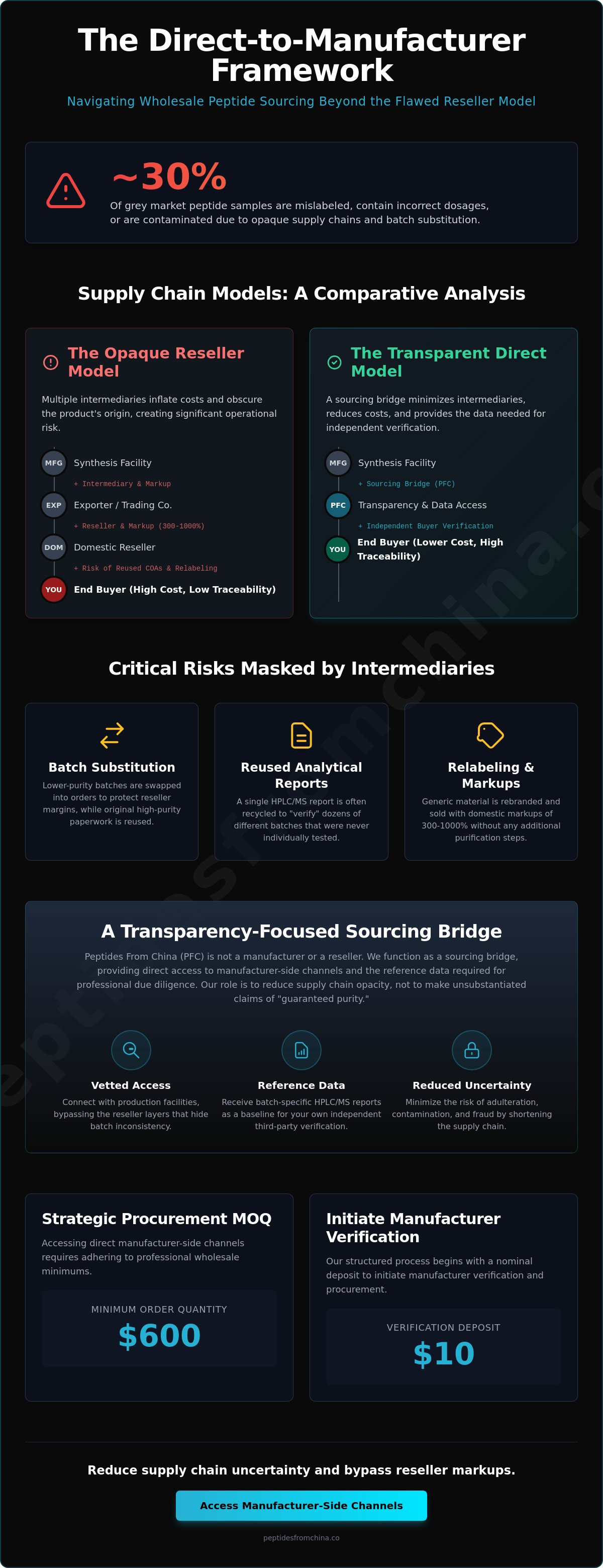
The landscape of wholesale peptide sourcing has shifted significantly as we move through 2026. Most institutional buyers and professional procurement officers have realized that domestic "warehousing" is frequently a logistical facade. It's often a relabeling operation for products sourced from the same global facilities you could access directly, but with a 300% to 500% markup. This realization has triggered a necessary move toward direct-to-manufacturer models that prioritize traceability over the perceived convenience of domestic shipping.
Reseller bloat is the primary driver of this shift. When a domestic middleman adds multiple layers to the supply chain, they don't just increase the price; they obscure the technical reality of the product. The 2026 market demands a transparency-first approach because the risks of opaque procurement are now too high to ignore. Independent analysis indicates that approximately 30% of samples from the grey market are mislabeled or contaminated, a statistic that professional laboratories cannot afford to ignore.
The Problem with Opaque Supply Chains
Multiple intermediaries create a "black box" around the original synthesis facility. When you buy from a reseller, you're often paying for their marketing budget and domestic overhead rather than the quality of the chemical peptide synthesis itself. This opacity leads to several systemic failures that compromise research integrity:
Batch Substitution: Lower-purity batches are often swapped into large orders to maintain reseller margins during price fluctuations.
Reused Analytical Reports: A single HPLC or Mass Spectrometry report is frequently used to "verify" dozens of subsequent batches, regardless of whether they came from the same production run.
Relabeling: Generic vials are given premium branding without any additional purification or stabilization steps, creating a false sense of quality.
Domestic shipping often masks these international sourcing risks by providing a false sense of regulatory compliance. In reality, the "domestic" product has usually bypassed the same customs hurdles, just at a significantly higher cost to the end user.
Positioning for Transparency
Professional procurement requires moving beyond marketing hype and absolute claims of "guaranteed purity." Reliable wholesale peptide sourcing involves establishing a baseline for laboratory expectations that includes independent verification. A sourcing bridge, such as Peptides From China (PFC), functions as a transparency-focused filter. It helps researchers access manufacturer-side channels while stripping away the reseller layers that inflate costs and hide batch-to-batch inconsistency.
This approach doesn't promise a "perfect" chain of custody. Instead, it provides the technical reference data and direct access needed for you to conduct your own due diligence. By reducing the number of touchpoints, you minimize the opportunities for fraudulent documentation or contaminated batches to enter your supply chain. It's about establishing a grounded, operationally realistic pipeline that values data over retail-style promises.
The Mechanics of Direct-to-Manufacturer Sourcing
The transition to a direct-to-manufacturer model is primarily a move toward economic and technical efficiency. Traditional retail structures operate on a high-margin, low-volume basis that is incompatible with the needs of large-scale research institutions. By engaging in wholesale peptide sourcing directly at the production level, procurement officers can bypass the 300% to 1,000% markups typically applied by domestic resellers who add little value beyond local warehousing.
Reducing the number of touchpoints between the synthesis lab and your facility is a critical step in maintaining product integrity. Every intermediary represents a potential point of failure where documentation can be falsified, batches can be substituted, or storage conditions can be compromised. Adhering to FDA guidance on peptide impurities requires a level of control that is difficult to achieve when the original manufacturer is hidden behind multiple layers of trading companies. Direct access ensures that the reference analytical data you receive actually corresponds to the specific synthesis run you are purchasing.
Direct Access vs. Domestic Resellers
The price disparity in the current market is most evident with high-demand assets like BPC-157 and Semaglutide. A domestic reseller might charge premium rates for a single vial that costs a fraction of that amount when sourced in bulk from the factory floor. This "reseller tax" doesn't just drain budgets; it limits the scope of research by making high-frequency dosing protocols prohibitively expensive. Moving to a direct model improves batch traceability because you're dealing with the source of the synthesis, allowing for more direct accountability if a batch fails to meet your internal specifications. If you're looking to optimize your procurement budget, you might consider how the Peptides From China (PFC) model facilitates this direct connection.
Synthesis Facility Verification
Auditing a manufacturing facility in China requires looking beyond a professional-looking website. Professional buyers distinguish between actual synthesis labs and trading companies by requesting specific documentation, such as ISO 9001 certifications and evidence of cGMP-compliant cleanroom environments. Trading companies often lack the technical staff to discuss synthesis complexities or impurity profiles in detail. A sourcing bridge is a risk-mitigation tool that facilitates direct communication and logistical coordination between a professional buyer and a verified production facility. This approach allows researchers to manage the $600 minimum order requirement effectively while ensuring that they are not simply purchasing from another unverified middleman on a global marketplace platform.
Technical Due Diligence: Beyond HPLC and MS Reports
In the context of wholesale peptide sourcing, the Certificate of Analysis (COA) is often treated as a definitive seal of quality. This is an operational mistake. A manufacturer-issued HPLC report is merely a baseline technical reference; it represents a single point in time and a specific sample that may or may not match the actual batch you receive. The industry myth of "guaranteed purity" often serves as a marketing shield for resellers who lack the technical infrastructure to verify their own stock. Professional procurement requires a grounded understanding that no single document provides a full guarantee of identity or purity.
High-Performance Liquid Chromatography (HPLC) and Mass Spectrometry (MS) are standard tools for identifying a compound's purity and molecular weight. However, these reports can be manipulated, reused across different production runs, or generated from "representative" samples that don't reflect the variability of bulk synthesis. Relying on these documents without independent verification is a significant risk. For researchers, the goal isn't to find a "perfect" document but to use reference analytical data as a starting point for their own validation protocols.
The Role of Analytical Documentation
Identifying red flags in manufacturer-issued reports is a core competency for any B2B buyer. Common issues include inconsistent dates, low-resolution chromatograms that hide impurity peaks, or reports that lack a clear integration table. Batch-specific testing is the only way to improve traceability, yet many suppliers provide the same report for every shipment of a specific compound. For a deeper dive into these technical nuances, consult our resource on Peptide Testing and Analysis: A Professional Guide to Laboratory Verification. Relying on "representative" samples is a significant risk in wholesale peptide sourcing, as synthesis conditions can vary between runs even within the same facility.
Verification Protocols for Researchers
Establishing a robust internal chain of custody is essential once a shipment arrives. This involves documenting the condition of the neutral packaging and immediately sequestering samples for independent third-party verification. You shouldn't rely solely on the manufacturer's data. Instead, coordinate with independent laboratories to conduct blind purity and concentration checks. This practice helps reduce supply chain uncertainty and supports independent verification of the reference analytical data provided during the procurement process. While this adds a layer of logistical complexity, it's the only methodical way to ensure operational consistency across large-scale research projects. By prioritizing factual integrity over marketing promises, you can build a more resilient and transparent supply chain.
Strategic Procurement: MOQs, Logistics, and Scaling
Transitioning from individual research vials to institutional procurement requires a shift in logistical mindset. Successful wholesale peptide sourcing isn't just about finding the lowest price point; it's about managing the friction of international trade while maintaining a consistent supply of research assets. Scaling from pilot batches to large-scale procurement demands a methodical approach to minimum order quantities (MOQs) and a realistic understanding of the synthesis-to-delivery timeline.
Establishing a consistent supply chain helps reduce supply chain uncertainty, but it requires the buyer to take an active role in logistics management. Unlike retail environments where shipping is often a background process, B2B procurement involves tracking batch traceability through multiple customs jurisdictions. For compounds like Retatrutide or Ipamorelin, the goal is to move beyond sporadic orders toward a structured procurement schedule that aligns with laboratory throughput.
Optimizing the Wholesale Order
A $600 MOQ is the standard entry point for manufacturer-direct orders. This threshold exists because the administrative and logistical costs of international shipping, neutral packaging, and customs clearance make smaller orders economically unviable for production facilities. When sourcing compounds like Tirzepatide or TB-500, calculating the ROI of bulk procurement involves factoring in the cost of independent verification for each batch. You can explore this further in our analysis of The Economic Logic of Bulk Peptide Sourcing. By meeting these minimums, researchers can access the same manufacturer-side channels used by domestic resellers, effectively removing the intermediary markup that drains research budgets.
International Logistics and Customs
Managing the delivery of research compounds from Chinese synthesis facilities requires specific protocols to ensure operational consistency. Neutral packaging is essential for international lab shipments, as it helps minimize unnecessary scrutiny while maintaining the privacy of the procurement process. Professional buyers should plan for a standard delivery window of 10 to 15 business days, though timelines can fluctuate based on global logistics patterns or seasonal synthesis backlogs.
Protocols for handling delayed or seized shipments are a necessary part of a professional sourcing framework. In a B2B context, these events are treated as manageable operational risks rather than catastrophic failures. A reliable sourcing bridge provides the tracking and transparency needed to navigate these hurdles, ensuring that you have the reference analytical data to account for every batch in transit. If you are ready to stabilize your research pipeline, you can initiate a wholesale procurement inquiry to discuss your specific logistical requirements.
Streamlining Sourcing with Peptides From China (PFC)
Peptides From China (PFC) operates as a transparency-focused sourcing bridge, specifically designed for researchers who require direct-to-manufacturer access without the traditional reseller layer. In a market where independent analysis shows significant rates of mislabeling and contamination, the PFC model prioritizes data integrity and batch traceability. We don't claim to be a manufacturer or a testing facility; instead, we act as a protective filter that helps you navigate the complexities of wholesale peptide sourcing. This approach allows professional buyers to move beyond retail-style marketing and establish a grounded procurement pipeline based on operational reality.
Positioning your laboratory for the 2026 regulatory environment requires a strategic partnership that values factual integrity over hyperbolic claims. By choosing direct-to-manufacturer routing, you improve the traceability of your research assets and gain the transparency needed for rigorous internal audits. This methodical approach to procurement supports your quality control protocols by ensuring you have direct access to the source of the synthesis rather than a third-party reseller's inventory.
The PFC Sourcing Model
Our verification process begins with a $10 deposit, which initiates the manufacturer verification phase. This small step serves as a professional filter to ensure that only serious B2B inquiries proceed to the synthesis facility. By routing orders directly to verified labs, we help reduce supply chain uncertainty and eliminate the "reseller tax" that often inflates research budgets. This model is particularly effective for institutions transitioning from platform-based buying to a more structured, long-term procurement strategy. You can read more about these differences in our guide: Peptide Sourcing Agent vs. Platform: A 2026 Procurement Guide. Our role is to facilitate this connection, providing the logistical support needed to maintain a consistent supply chain.
Next Steps for B2B Buyers
Initiating a wholesale request requires an understanding of the $600 minimum order requirement. This threshold ensures that the logistical costs of international shipping and neutral packaging are efficiently managed for both the facility and the buyer. Once you submit an inquiry, our team facilitates the quote approval process, providing you with the necessary reference analytical data from the synthesis facility. We focus on high-demand research compounds like BPC-157, Tirzepatide, and TB-500, ensuring that every batch is mapped to a specific production run. Direct sourcing helps reduce supply chain uncertainty by providing the technical transparency required for rigorous independent verification of all research-grade peptides.
Establishing a Resilient Sourcing Framework for 2026
Transitioning to a direct-to-manufacturer model is the most effective way to eliminate reseller bloat and regain control over your laboratory's supply chain. You've learned that relying on domestic middlemen often masks international sourcing risks and inflates costs without adding technical value. Successful wholesale peptide sourcing in 2026 depends on your ability to treat manufacturer documentation as baseline reference data while prioritizing independent third-party verification for every batch received.
By managing the transparent $600 wholesale MOQ and utilizing a sourcing bridge like PFC, you can bypass the inherent flaws of opaque supply chains. This framework ensures that your procurement process is grounded in factual integrity and batch traceability rather than retail marketing hype. Direct routing allows you to stabilize your research budget while maintaining the high technical standards your projects demand. It's about moving from a reactive buying pattern to a proactive, data-driven procurement strategy.
Ready to optimize your procurement pipeline? Begin your manufacturer-direct sourcing request today to access COA-verified batches and direct-to-manufacturer routing. Establishing a reliable, transparent supply chain is the first step toward ensuring the long-term consistency of your research outcomes.
Frequently Asked Questions
What is the minimum order amount for wholesale peptide sourcing?
The minimum order requirement for Peptides From China (PFC) wholesale procurement is $600. This industry standard exists because the logistical costs of international shipping, neutral packaging, and customs clearance are not economically viable for smaller orders. Meeting this threshold allows researchers to access manufacturer-side channels and bypass the high markups associated with domestic resellers who often inflate costs by 300% or more.
How do you verify the quality of peptides from Chinese manufacturers?
Verifying quality requires a combination of manufacturer audits and independent third-party testing. While synthesis facilities provide reference analytical data, professional buyers should always sequester samples from every batch for blind purity and concentration checks. PFC helps reduce supply chain uncertainty by connecting you with verified facilities, but we emphasize that independent laboratory verification remains the only way to ensure operational consistency across large-scale research projects.
Why should I source peptides directly instead of using a domestic reseller?
Direct sourcing eliminates the reseller layer and improves batch traceability. Domestic resellers often provide documentation that may be reused across multiple batches or relabeled products from unverified sources. By engaging in wholesale peptide sourcing directly, you reduce the number of touchpoints in the supply chain and establish a more transparent relationship with the original synthesis lab, ensuring your budget is spent on product quality rather than middleman overhead.
Can I trust the HPLC reports provided by synthesis facilities?
Manufacturer-issued HPLC reports should be treated as baseline technical reference material rather than definitive proof of quality. These reports represent a single sample at a specific point in time and can be manipulated or reused for subsequent batches. Factual integrity requires you to use these documents as a starting point for your own independent validation protocols. No single document fully guarantees product identity or purity without secondary verification.
How is international shipping handled for bulk research peptides?
International shipping is managed through logistics channels that utilize neutral packaging to minimize unnecessary scrutiny and maintain procurement privacy. Delivery timelines from Chinese synthesis facilities typically range from 10 to 15 business days. Professional procurement involves tracking these shipments closely and managing the inherent risks of international customs as a standard part of the B2B operational flow, ensuring that research assets arrive in a predictable timeframe.
What happens if a wholesale batch does not meet purity requirements?
If a batch fails independent verification, it's treated as a manageable operational risk within the B2B framework. This is why establishing a relationship with a verified manufacturer is critical; it provides a channel for accountability that doesn't exist with anonymous resellers. Maintaining a transparent supply chain allows for direct communication regarding batch-to-batch inconsistency and facilitates a resolution based on the factual data provided by your independent laboratory results.
Do you provide peptides for human consumption or pharmaceutical use?
We do not provide peptides for human consumption, clinical use, or pharmaceutical compounding. All assets, including BPC-157, Semaglutide, and Tirzepatide, are sold strictly for laboratory research and development purposes. Our positioning is as a B2B sourcing bridge for technical readers and researchers who require high-volume access to research-grade compounds. We strictly adhere to these research-only protocols to maintain industry compliance and transparency.
How does the $10 sourcing deposit work?
The $10 sourcing deposit acts as a professional filter to initiate the manufacturer verification process. This step confirms that the inquiry is a legitimate B2B request rather than a retail-level query, which helps us maintain efficiency with our manufacturing partners. Once the deposit is received, we begin routing your request to verified synthesis facilities and providing you with a formal wholesale quote that includes the necessary reference analytical data.