Most procurement professionals treat international shipping as a simple transit issue, but the reality is that the most significant risks in importing research peptides occur long before a package reaches customs. You've likely grown tired of domestic resellers who provide little more than a steep markup and a recycled COA that offers no real batch traceability. It's a common frustration to pay premium prices for "local stock" only to receive relabeled products with zero technical transparency.
This guide provides an operationally realistic framework for direct-to-manufacturer procurement, acting as a transparency-focused bridge to help you eliminate unnecessary middleman layers and reduce supply chain uncertainty. With the Section 301 tariff on List 3 chemicals increasing to 60% as of April 2026 and new pharmaceutical tariffs effective July 31, 2026, mastering these logistics is now a financial necessity. We'll examine how to establish a transparent supply chain, use analytical data as a baseline reference, and maintain predictable delivery timelines in an increasingly complex regulatory environment.
Key Takeaways
Distinguish between standard retail ordering and professional sourcing logistics to gain greater control over the movement of research compounds from synthesis to the laboratory.
Identify and mitigate common supply chain risks when importing research peptides, such as the use of generic manufacturer templates or reused COAs by domestic middlemen.
Utilize HPLC and Mass Spectrometry reports as baseline technical reference data to improve batch traceability while acknowledging the limitations of manufacturer-issued documentation.
Apply wholesale procurement logic, including the $600 minimum order requirement, to reduce unit costs and establish direct manufacturer-side communication channels.
Implement a low-friction verification process to confirm real-time stock availability and facility-side transparency before finalizing high-volume procurement contracts.
Table of Contents
What is Peptide Sourcing Logistics?
The Operational Lifecycle of a Direct-Sourced Batch
Mitigating Risk in International Peptide Procurement
Technical Documentation and Batch Verification Protocols
Optimizing Your Sourcing Strategy with Peptides From China
What is Peptide Sourcing Logistics?
Peptide sourcing logistics is the operational framework that manages a research compound's journey from the initial synthesis facility to its final destination in a laboratory. For B2B entities, this process is fundamentally different from retail ordering. While a retail buyer simply clicks a button and waits for a package, a professional procurement officer must oversee a complex chain of verification, documentation, and international transit. Mastering the nuances of importing research peptides requires shifting your focus from the point of sale to the entire lifecycle of the batch.
Market pricing and availability can vary substantially by supplier, product, order size, and current conditions; exact comparisons require current, like-for-like data.
The Components of a Professional Supply Chain
A reliable supply chain begins with primary synthesis facility identification. Understanding the fundamentals of Peptide synthesis is essential for evaluating a manufacturer's technical capabilities. Professional logistics must include manufacturer-side verification protocols that confirm real-time stock availability before any funds are committed. This includes the review of batch-specific documentation, such as HPLC and Mass Spectrometry reports. These documents should be treated as baseline technical reference data rather than absolute proof of quality, as they provide a necessary starting point for a buyer's own independent verification. Finally, international transit protocols must be designed for research-grade materials, ensuring that compounds like Tirzepatide or BPC-157 move through customs with appropriate documentation to reduce the risk of seizure.
The Problem with Domestic Reseller Logistics
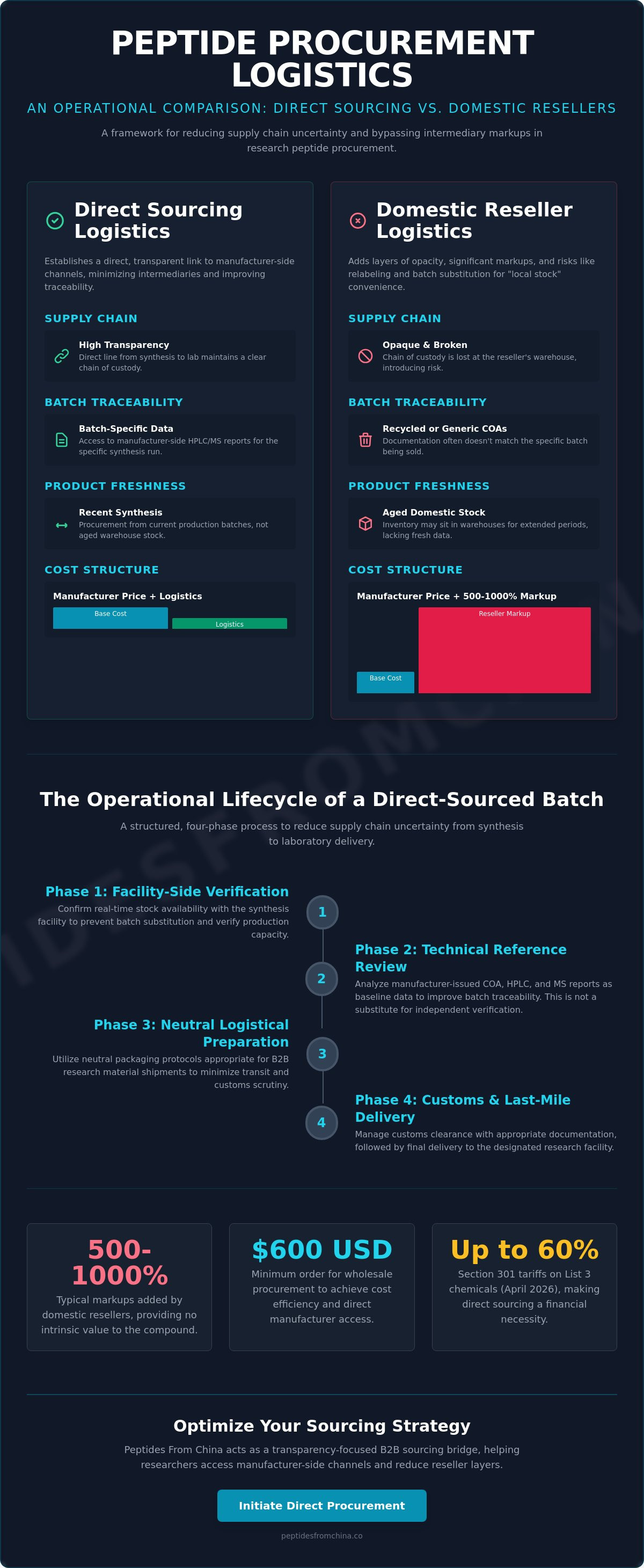
Domestic resellers often justify their existence by offering "in-stock" items, but this convenience comes with significant operational trade-offs. Domestic warehousing frequently adds substantial markups to the base manufacturer price without adding any intrinsic value to the compound itself. Beyond the cost, there is an inherent risk of batch substitution. When a reseller relabels products in a domestic warehouse, the chain of custody is broken, making it difficult to verify if the vial in your hand matches the original manufacturer's synthesis batch. Furthermore, domestic stock is often aged. These items frequently lack recent, batch-specific analytical reference data, leaving researchers to rely on outdated or generic COAs that don't reflect the current reality of the material. By importing research peptides directly and adhering to a $600 minimum order for wholesale efficiency, professional buyers can bypass these logistical pitfalls and regain control over their supply chain traceability.
The Operational Lifecycle of a Direct-Sourced Batch
Successful procurement begins with a methodical approach to the batch lifecycle. When importing research peptides, the process moves through four distinct phases: verification, technical review, logistical preparation, and clearance. This structured progression helps reduce supply chain uncertainty and ensures that the materials arriving at your facility match the synthesis batch you requested.
The first step involves facility-side verification. In the global market, many entities act as brokers, listing inventory they don't physically possess. Real-time stock confirmation prevents the common issue of batch substitution, where a reseller swaps one production run for another to fulfill an order. Once stock is confirmed, we move to the technical reference review. This involves analyzing manufacturer-issued COAs and HPLC data. While these facilities often reference standards similar to 21 CFR Part 211 for the packing and holding of compounds, buyers must treat this documentation as baseline reference data. It improves traceability but isn't a definitive proof of identity or purity. Independent laboratory testing remains a critical final step for the buyer.
The third phase is neutral packaging. For B2B shipments, discreet preparation is essential to avoid the scrutiny often directed at retail-branded products. Finally, the process concludes with customs clearance management and last-mile delivery. By acting as a transparency bridge, Peptides From China helps you navigate these operational hurdles while maintaining a direct link to the synthesis source.
Synthesis and Internal Quality Assurance
During the production phase, facilities generate internal HPLC and Mass Spectrometry (MS) data. This allows for batch traceability from the synthesis reactor to the final vial. It's vital to ensure that the documentation provided isn't a reused template from a previous production year. We've observed that supply chain opacity often stems from resellers who hide the original manufacturer's data. Researchers should use these facility reports as a technical guide to verify that the compound's mass and purity profile align with expected research parameters before the batch leaves the facility.
Neutral Packaging and Global Transit
Shipping options, pricing, and estimated transit times vary by destination and are confirmed during order processing.
Mitigating Risk in International Peptide Procurement
Direct procurement from synthesis facilities is the only method to effectively reduce reseller layers and restore chain-of-custody transparency. When importing research peptides, the most significant risk isn't just a potential customs delay; it's the lack of technical integrity in the documentation provided by domestic middlemen. Many resellers utilize generic manufacturer templates or reused COAs from production runs that occurred months or even years ago. This practice obscures the actual age and synthesis quality of the material currently in stock, leaving the buyer with no real traceability.
The $10 deposit initiates manual request processing and real-time stock verification and is credited toward the final invoice.
Economic Considerations for Research Labs
Calculating the real cost of peptides requires looking beyond the initial sticker price. You must weigh the raw synthesis cost against international logistics and the heavy markups added by domestic distributors who often provide no additional quality control. Consolidating your procurement through a $600 minimum order helps optimize shipping efficiency and reduces the per-vial cost significantly. This minimum threshold is an economic necessity for maintaining professional-grade transit protocols and specialized courier services. For those focused on specific high-volume compounds, understanding the logistics of bulk BPC-157 wholesale provides a clear blueprint for navigating these manufacturer-side channels while maintaining a sustainable research budget.
Addressing Batch Variability and Substitution
In high-demand markets, particularly for GLP-1 peptides like Tirzepatide or Semaglutide, batch substitution is a persistent reality among secondary resellers. When a domestic supplier faces a stockout, they may substitute one manufacturer's product for another without updating the technical documentation or informing the buyer. Direct sourcing helps reduce the probability of receiving relabeled or substituted stock by maintaining a direct link to the production facility. It's also vital to understand the legal framework, such as FDA Research Use Only (RUO) exemptions, which dictate how these materials must be handled and labeled for laboratory use. Even with direct access, a professional procurement strategy always includes independent buyer-side testing. Independent analysis shouldn't be seen as a sign of distrust but as a standard operating procedure that verifies the baseline reference data provided by the manufacturer.
Technical Documentation and Batch Verification Protocols
Professional procurement requires a critical eye toward manufacturer-supplied data. When importing research peptides, the Certificate of Analysis (COA) should be viewed as a baseline starting point for discussion, not a final guarantee of purity. Many researchers make the mistake of treating these PDFs as absolute proof of quality. In reality, they're baseline reference documents that help reduce supply chain uncertainty. A COA is only as reliable as the facility that issued it, and its primary value lies in establishing a technical trail for batch traceability.
Identifying red flags in manufacturer reports is a vital skill for any procurement officer. Common issues include date discrepancies, where the report date doesn't align with the batch synthesis date, or generic templates that lack specific lot numbers. If a technical report looks like a blurry scan or shows signs of digital manipulation, it's a clear indicator of supply chain opacity. We prioritize facilities that provide high-resolution, batch-specific data that can be used as a reference point for your own independent laboratory analysis.
Reading Between the Lines of an HPLC Report
High-Performance Liquid Chromatography (HPLC) is the standard for assessing purity, but the report itself requires technical scrutiny. You should check for consistent baseline noise and standard integration parameters. If the baseline is artificially smoothed or the integration peaks look manually adjusted, the data's integrity is compromised. The report date must align with the batch synthesis date to remain relevant to the material you're purchasing. While peak purity correlates with synthesis quality, it's a theoretical value that requires independent verification to confirm the actual purity of the delivered vials. Before committing to a full procurement cycle, you can access manufacturer-side technical reference data through our transparency-focused bridge.
The Role of Mass Spectrometry in Verification
Mass Spectrometry (MS) serves a different purpose by confirming the molecular weight of the compound against theoretical values. This process helps verify that the synthesized peptide matches the intended sequence, which is critical for complex compounds like Retatrutide or IGF-1 LR3. MS data helps identify potential contaminants or incomplete synthesis products that HPLC might miss. However, MS has limitations; it's excellent for substance identification but less effective at quantifying exact purity levels compared to HPLC. A professional sourcing strategy uses both HPLC and MS as complementary reference data. The $600 total minimum is an operational minimum for orders placed through the PFC sourcing platform and may include multiple catalog products.
Optimizing Your Sourcing Strategy with Peptides From China
PFC operates as a dedicated B2B sourcing agency, positioning itself as a transparency-focused bridge between synthesis facilities and professional buyers. Importing research peptides doesn't have to involve the opacity of domestic middleman markets. Our model focuses on reducing the layers between production and procurement, which helps you eliminate the substantial markups common in retail environments. By establishing a direct-to-manufacturer route, you gain access to the same synthesis channels used by major distributors without the added costs of domestic warehousing and relabeling.
The $10 deposit initiates manual request processing and real-time stock verification and is credited toward the final invoice. PeptidesFromChina currently has a $600 total minimum order. Multiple catalog products can be combined to reach the minimum, with orders starting from one 10-vial kit per product.
The PFC Sourcing Model
PFC coordinates manufacturer-side sourcing and international logistics. Products are subject to the manufacturer’s applicable quality-control procedures and product-specific specifications. Manufacturer-side analytical documentation may be available depending on the product and batch, but PFC is not an independent analytical testing laboratory and does not guarantee a universal documentation package. Buyers requiring independent verification may arrange third-party analytical testing.
Next Steps for Procurement Professionals
You can begin your procurement process by reviewing our available research-grade catalog. We facilitate sourcing for a wide range of compounds, including:
Metabolic Research: Semaglutide, Tirzepatide, and Retatrutide.
Tissue Repair: BPC-157 and TB-500 (Thymosin Beta-4).
Cognitive and Longevity: Selank, Semax, Epithalon, and GHK-Cu.
Growth and Performance: IGF-1 LR3, HGH Fragment 176-191, CJC-1295 without DAC, and Ipamorelin.
Specialized Compounds: Melanotan II, PT-141 (Bremelanotide), and Thymosin Alpha-1.
The $10 deposit initiates manual request processing and real-time stock verification and is credited toward the final invoice. Shipping options, pricing, and estimated transit times vary by destination and are confirmed during order processing.
Strengthening Your Research Procurement Pipeline
Transitioning from a retail-centric mindset to a professional sourcing model is the most effective way to protect your laboratory's operational budget. By prioritizing direct-to-manufacturer transparency, you eliminate the opaque reseller layers that often lead to batch substitution and significant price markups. Successful procurement depends on treating manufacturer-issued COAs and HPLC data as baseline reference material rather than absolute guarantees. This methodical approach to importing research peptides ensures that you maintain a clear chain of custody and improve batch traceability throughout the synthesis lifecycle.
PeptidesFromChina has a $600 total minimum order as an operational minimum for orders placed through its sourcing platform. You can now move beyond the limitations of domestic stock and access manufacturer-side channels with a grounded, data-driven strategy. Begin your direct sourcing request with a $10 deposit to initiate manual request processing and real-time stock verification. Establishing a reliable supply chain is a deliberate process, and it starts with choosing transparency over convenience.
Frequently Asked Questions
How does Peptides From China ensure supply chain transparency?
PFC coordinates manufacturer-side sourcing without relying on anonymous retail-reseller supply chains. Manufacturer-side analytical documentation may be available depending on the product and batch.
Why is there a $600 minimum order for wholesale peptide sourcing?
The $600 total minimum is an operational minimum for orders placed through the PFC sourcing platform. Multiple catalog products may be combined to reach it.
What is the purpose of the $10 sourcing processing deposit?
The $10 deposit initiates manual request processing and real-time stock verification and is credited toward the final invoice.
How are international peptide shipments packaged for transit?
Shipments utilize neutral, discreet packaging designed to minimize unnecessary scrutiny during international transit. We avoid retail-style branding or hyperbolic labels that often trigger customs delays. This logistical protocol is standard for professional research-grade materials moving through global supply chains in 2026.
Can I rely solely on the manufacturer’s COA for purity verification?
No, you should treat a manufacturer’s COA only as baseline technical reference data. While it helps reduce supply chain uncertainty, it isn't definitive proof of product identity or purity. We always advise researchers to conduct independent, third-party testing to verify that the delivered batch matches the provided reference reports.
What happens if a batch does not meet the technical specifications provided?
If a batch deviates from the provided reference data, our role as a sourcing bridge is to facilitate a resolution with the manufacturer. Direct-to-facility channels offer better accountability than anonymous domestic resellers. Having a documented technical trail from the synthesis site makes addressing discrepancies a methodical, evidence-based process.
What are the typical lead times for direct-to-manufacturer sourcing?
Shipping options, pricing, and estimated transit times vary by destination and are confirmed during order processing.
Does Peptides From China provide domestic US warehousing?
PFC coordinates sourcing from established Chinese manufacturing facilities together with international logistics.