
In early 2026, the GHK-Cu market experienced a 24.4% stockout rate, a supply squeeze that forced many researchers to rely on high-priced domestic resellers with questionable documentation. You've likely encountered the industry's common pitfalls, such as reused HPLC reports, batch-to-batch inconsistency, and the lack of a clear chain of custody. Relying on a vendor's self-issued paperwork is rarely enough to ensure material integrity in a landscape where relabeling is standard practice.
This guide explains how to establish a direct-to-manufacturer pipeline for GHK-Cu wholesale China procurement to reduce costs and improve supply chain transparency. we'll outline a methodical verification protocol that treats manufacturer papers as baseline references rather than definitive proof. By understanding the 2026 NMPA regulatory environment and shifting toward wholesale procurement models with a $600 minimum, you can eliminate unnecessary middleman layers and build a more resilient sourcing strategy for large-scale studies. We focus on operational realism, helping you navigate the complexities of manufacturer-side channels while prioritizing independent verification over marketing hype.
Key Takeaways
Learn to bypass reseller markups by establishing direct-to-manufacturer channels that prioritize supply chain transparency and cost efficiency.
Understand why manufacturer-issued HPLC and Mass Spectrometry reports should be treated as baseline references rather than absolute guarantees of purity.
Identify technical markers for GHK-Cu, such as CAS 89030-95-5 profiles and color intensity, to support more effective preliminary quality assessments.
Navigate the logistical requirements for GHK-Cu wholesale China sourcing, including the $600 minimum order threshold and the $10 deposit model.
Implement a robust verification protocol that uses independent testing to mitigate risks like batch substitution and supply chain opacity.
Table of Contents
The GHK-Cu Wholesale Market in 2026: Navigating the China Supply Chain
Understanding GHK-Cu Technical Specs: Purity, Concentration, and Batch Consistency
Sourcing Models Compared: Why Direct-to-Manufacturer Beats Traditional Resellers
Verification Protocols for High-Volume GHK-Cu Procurement
Implementing a Scalable Sourcing Strategy with Peptides From China (PFC)
The GHK-Cu Wholesale Market in 2026: Navigating the China Supply Chain
Sourcing GHK-Cu requires moving past the superficial marketing found on retail platforms. For a foundational GHK-Cu overview, researchers recognize this molecule as a complex of the tripeptide glycyl-L-histidyl-L-lysine and copper, crucial for signal transduction in regenerative studies. By 2026, the standard for GHK-Cu wholesale China procurement has shifted toward operational realism. Professional sourcing now favors direct-to-manufacturer models, like the one facilitated by Peptides From China (PFC), which requires a $600 minimum for wholesale orders. This approach bypasses the "99% purity" claims found on generic directory sites, which often lack batch-specific context and fail to account for variable chelation ratios during large-scale production.
The Role of China in Global Peptide Synthesis
China remains the global epicenter for peptide manufacturing due to massive infrastructure investments. Many facilities have transitioned to ton-scale expansion cycles to meet international demand, contributing to a projected 14.7% growth rate for the domestic peptide complexes market. This scale allows for sophisticated Solid-Phase Peptide Synthesis (SPPS) that smaller regional labs can't replicate at a competitive price point. However, this high-volume environment creates a gap between industrial-grade output and the refined requirements of research-grade batches. Professional buyers must distinguish between manufacturers focused on cosmetic-grade bulk and those capable of maintaining the rigorous analytical standards needed for laboratory applications.
Market Risks: Relabeling and Reseller Markups
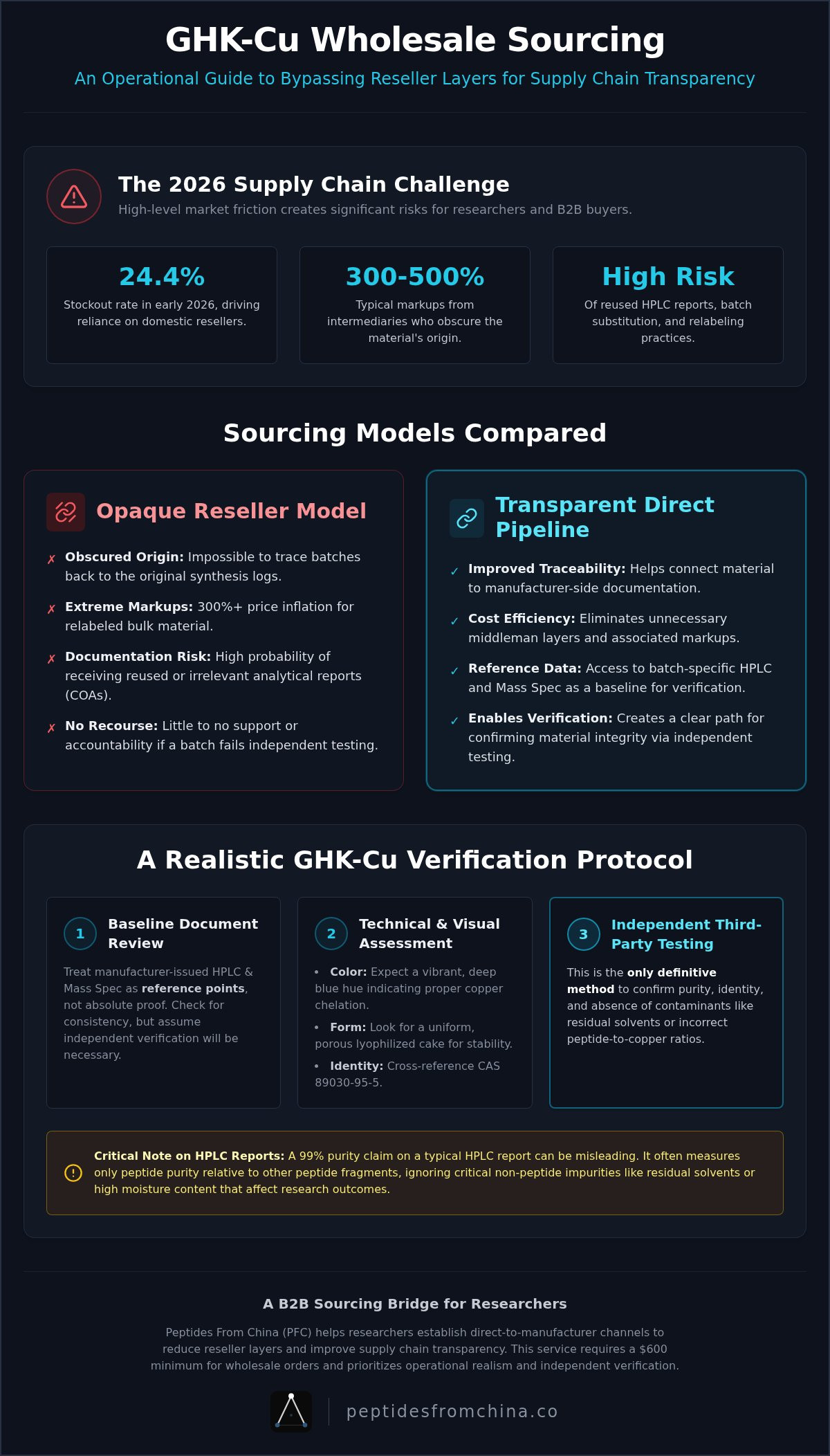
The most significant friction in the supply chain comes from domestic resellers who act as opaque intermediaries. These entities often buy bulk batches from a single manufacturer and apply a 300% to 500% markup before selling to Western labs. This "white-labeling" process obscures the original source, making it impossible to trace a specific batch back to its synthesis logs. If a batch fails an independent purity test, the lack of a direct-to-manufacturer connection leaves the buyer with no recourse. Establishing a transparent chain of custody is non-negotiable. It helps reduce supply chain uncertainty and ensures that the reference analytical data actually matches the material in the vial rather than being a reused document from a previous year.
Understanding GHK-Cu Technical Specs: Purity, Concentration, and Batch Consistency
Procuring GHK-Cu (CAS 89030-95-5) at scale requires a shift from retail-level trust to rigorous technical verification. In the current 2026 landscape of GHK-Cu wholesale China procurement, the vibrant blue color of the lyophilized powder serves as a primary qualitative indicator. This hue isn't just aesthetic; it indicates the presence of the copper(II) ion complexed with the tripeptide. A pale or inconsistent color often suggests incomplete chelation or an improper peptide-to-copper ratio. Beyond visual checks, the lyophilization process itself dictates long-term shelf stability. Properly freeze-dried cakes should be uniform and porous, ensuring rapid reconstitution and protection against moisture-induced degradation during transit.
Chemical Identity and Salt Forms
GHK-Cu is a copper complex of the tripeptide glycyl-L-histidyl-L-lysine with a molecular weight of approximately 403.9 g/mol and a structure defined by the chelation of a copper (II) ion. Maintaining the correct stoichiometric balance between the peptide and copper is essential for biological activity. If the ratio is off, the material may contain "free copper," which increases the risk of oxidation and reduces the batch's research utility. Buyers should also monitor pH levels, as variations can indicate residual trifluoroacetic acid (TFA) from the synthesis phase. Understanding the FDA regulatory status of GHK-Cu is also necessary for labs navigating the transition from raw material procurement to research application.
Purity Metrics Beyond the HPLC Report
A standard HPLC report showing 99% purity can be misleading because it often only measures the peptide's purity relative to other peptide fragments. It frequently ignores non-peptide impurities like residual solvents (acetonitrile) or high moisture content, which can inflate the total weight of the batch without contributing to the actual peptide concentration. High moisture levels don't just dilute the product; they accelerate the breakdown of the peptide bonds over time. In GHK-Cu wholesale China markets, batch-to-batch consistency is often compromised when resellers relabel old stock. To mitigate these risks, many technical buyers access manufacturer-side channels that provide more comprehensive reference analytical data, including Mass Spectrometry, to confirm the molecular weight and batch identity.
Sourcing Models Compared: Why Direct-to-Manufacturer Beats Traditional Resellers
Professional procurement teams often choose between three primary sourcing avenues: domestic resellers, global directory sites, or direct-to-manufacturer channels. Traditional resellers offer the convenience of domestic shipping but often obscure the synthesis source, making it impossible to establish true traceability. Directory sites provide a wider selection but suffer from high noise, where trading companies masquerade as synthesis facilities. For GHK-Cu wholesale China procurement, moving toward a direct-to-manufacturer model is the only way to eliminate the 300% markups common in the retail market while ensuring you have a clear line of communication with the actual production lab.
The Economics of Bulk Peptide Sourcing
Procuring material at the wholesale level requires a shift in how you calculate value. While retail vials are priced for convenience, professional sourcing focuses on the price per gram. Establishing a direct relationship with a synthesis facility through a bridge like Peptides From China helps researchers maintain consistency across multi-month studies. Understanding The Economic Logic of Bulk Peptide Sourcing is critical for labs managing tight budgets. At PFC, we implement a $600 minimum order requirement for wholesale procurement. This threshold ensures that the logistical costs of international shipping and customs clearance are amortized across a sufficient volume of material, keeping your effective cost per milligram as low as possible.
Bypassing the Middleman: A Strategic Advantage
Reducing the number of intermediaries helps improve traceability and reduces the risk of batch substitution. When a reseller relabels a product, the original manufacturer's documentation is often lost or replaced with generic papers. Direct sourcing allows you to obtain reference analytical data straight from the source. This is vital when conducting a scientific review of GHK-Cu's regenerative properties, as even minor impurities can skew research outcomes. Our $10 deposit model allows you to initiate the manufacturer-side verification process without committing to a full order upfront. This protocol acts as a protective filter, ensuring that the manufacturer can meet your specific technical requirements before you finalize the $600 minimum transaction. By positioning PFC as a transparency-focused sourcing bridge, we help you access manufacturer-side channels while maintaining the necessity of independent testing by the buyer.
Verification Protocols for High-Volume GHK-Cu Procurement
In the 2026 peptide market, viewing manufacturer-issued documentation as definitive proof of quality is a significant operational risk. High-purity claims on paper often fail to translate to the material in the vial. For GHK-Cu wholesale China sourcing, documentation like Certificates of Analysis (COAs) must be treated as baseline technical reference material. The industry is currently plagued by reused HPLC reports and falsified Mass Spectrometry data. A "Trust but Verify" protocol isn't just a recommendation; it's a necessity for research laboratories managing high-volume procurement. This approach assumes that no single document fully guarantees product identity or purity without independent confirmation.
Analyzing HPLC and Mass Spectrometry Reports
A legitimate HPLC chromatogram should show a clear, sharp peak for GHK-Cu with minimal baseline noise or secondary peaks indicating impurities. You should verify that the integration table matches the visual data provided in the graph. Mass Spectrometry is equally critical, as it confirms the molecular mass of the peptide complex. For GHK-Cu, the spectrum must align with the expected molecular weight to ensure the copper-peptide chelation is correct. For a deeper look into these technical requirements, see our Peptide Testing and Analysis Guide. These manufacturer papers help reduce supply chain uncertainty, but they don't replace the need for your own laboratory verification.
Independent Lab Verification
Professional buyers must implement blind testing protocols for every batch received. This involves sending samples to a reputable third-party laboratory without disclosing the vendor's identity or the manufacturer's internal test results. This practice helps ensure that the data you receive is unbiased and reflects the actual purity of the GHK-Cu wholesale China batch. While Peptides From China (PFC) helps researchers access manufacturer-side channels and conducts manufacturer audits to improve traceability, we don't act as a guarantor of purity. Our role is to act as a bridge, minimizing the layers of resellers and providing the transparency needed for you to conduct effective verification. For orders meeting our $600 wholesale minimum, this methodical approach ensures operational consistency across your study. To begin establishing a more transparent sourcing route, contact us for manufacturer-side access.
Implementing a Scalable Sourcing Strategy with Peptides From China (PFC)
Sourcing GHK-Cu wholesale China requires a logistical framework that prioritizes batch traceability over marketing promises. Peptides From China (PFC) operates as a transparency-focused B2B sourcing bridge, helping labs bypass the reseller layers that inflate costs and obscure the chain of custody. By focusing on manufacturer-side access, we provide a route for researchers to secure consistent batches for large-scale studies without the 300% markups found in retail channels. This methodical approach ensures that procurement remains grounded in operational reality rather than pharmaceutical marketing hype.
The Sourcing and Verification Process
Our workflow begins with a $10 deposit, which initiates our proprietary sourcing agent protocol. This small commitment allows us to engage directly with synthesis facilities to secure current manufacturer-side papers, including HPLC and MS reports, before you settle a final invoice. This step is a critical filter that helps reduce supply chain uncertainty by verifying that the facility can meet your technical specs for the current batch. Understanding the difference between a Peptide Sourcing Agent vs Platform is essential for procurement professionals who need direct oversight rather than automated directory listings. Once the documentation is reviewed, the $600 wholesale minimum applies to move the order into production and shipping.
Logistics and Compliance for Research Labs
Managing international logistics in 2026 involves navigating evolving shipping standards and ensuring that material remains stable during transit. We utilize neutral packaging to minimize customs friction and provide detailed tracking for every shipment. For labs scaling their operations, maintaining a consistent research supply is paramount. Moving from a single test batch to a long-term supply requires a reliable pipeline that supports independent verification at every stage. If you're also sourcing other compounds, our Bulk BPC-157 Wholesale Guide offers a similar blueprint for direct-to-manufacturer procurement.
Scaling your inventory shouldn't compromise your data integrity. By consolidating your GHK-Cu wholesale China orders with other research peptides, you can more easily meet the $600 threshold while improving the traceability of your entire inventory. This structured process helps researchers navigate the complexities of manufacturer-side supply channels while maintaining the high standards required for professional laboratory work. It's about building a resilient supply chain that values factual integrity and long-term reliability over superficial sales tactics.
Establishing a Resilient GHK-Cu Supply Chain
Transitioning to a direct-to-manufacturer model for GHK-Cu wholesale China is the most effective way to reduce supply chain uncertainty and eliminate the 300% markups common in the retail market. By treating manufacturer-issued HPLC and Mass Spectrometry reports as baseline reference material rather than absolute proof, you protect the integrity of your research data. Implementing a $600 minimum for professional wholesale procurement ensures that logistical overhead is minimized while traceability is maximized.
Peptides From China helps you navigate these complexities by acting as a transparency-focused bridge to synthesis facilities. Our $10 deposit model allows you to review manufacturer-side papers before committing to a full transaction, providing a methodical filter for your procurement process. While we don't act as a guarantor of purity, we provide the access necessary for you to conduct your own independent verification with confidence. Establishing a reliable pipeline now ensures your laboratory maintains consistent material access throughout 2026 and beyond.
Begin your GHK-Cu sourcing verification for $10
Frequently Asked Questions
Is GHK-Cu from China safe for laboratory research?
Safety in a research context depends on independent verification rather than the country of origin. While China is a global hub for large-scale synthesis, quality varies significantly between different facilities. Research-grade GHK-Cu requires rigorous testing for residual solvents and proper chelation ratios. Labs should always implement their own internal verification protocols to confirm that the material matches their specific research standards before beginning a study.
How much GHK-Cu should I buy to qualify for wholesale pricing?
Wholesale pricing for GHK-Cu wholesale China procurement typically becomes operationally viable at the $600 threshold. Buying in bulk reduces the per-milligram cost significantly when compared to single-vial retail purchases. This volume allows for the amortization of international shipping and independent testing costs across a larger quantity of material. It is the preferred model for laboratories and institutions conducting long-term or large-scale studies.
Can I trust the HPLC reports provided by Chinese manufacturers?
Manufacturer-issued HPLC reports should be viewed as baseline technical reference material, not as definitive proof of purity. The peptide industry often struggles with reused or falsified documentation that doesn't accurately reflect the batch in the vial. While these papers provide initial data on the batch identity, they don't replace the necessity of independent third-party testing by the buyer to ensure the material meets laboratory requirements.
What happens if the batch purity does not meet my lab standards?
If independent testing reveals that a batch fails to meet your required specifications, having a direct-to-manufacturer connection is vital. A transparent sourcing route allows for direct communication regarding synthesis logs and batch identity. This is why reducing reseller layers is critical; it helps ensure you have a clear path for resolution. Directly accessing manufacturer-side channels helps reduce supply chain uncertainty when batch inconsistencies occur.
How long does shipping from a Chinese peptide facility take in 2026?
Current 2026 lead times for international shipping generally range between 7 to 14 business days. This duration includes manufacturer processing, customs clearance, and final transit to your facility. While some shipments may arrive faster, procurement professionals should account for these standard windows when planning research timelines. We use neutral packaging to help minimize customs friction and ensure the material arrives within these expected timeframes.
What is the minimum order requirement for Peptides From China?
Peptides From China requires a minimum order amount of $600 for all wholesale procurement. This threshold is established to maintain operational efficiency and ensure that the cost-saving benefits of direct-to-manufacturer sourcing are realized. This minimum applies across our entire catalog, including GHK-Cu wholesale China orders and other research peptides. It helps ensure that shipping and verification costs remain a small percentage of the total investment.
Does GHK-Cu require special storage during international transit?
Lyophilized GHK-Cu powder is stable at ambient temperatures during standard shipping durations. The freeze-drying process is critical for this stability, as it protects the peptide-copper complex from moisture-induced degradation. Once the material arrives at your facility, it should be moved to a controlled, cool environment. For long-term preservation, most laboratories prefer refrigeration or freezing to maintain the integrity and consistency of the peptide bonds over time.
Is the $10 deposit refundable if the manufacturer is not approved?
The $10 deposit is a non-refundable fee that initiates our sourcing agent protocol. This amount covers the administrative overhead of engaging synthesis facilities and securing current manufacturer-side papers for your review. It acts as a protective filter, allowing you to evaluate the technical data before committing to the full $600 minimum order. This model helps improve traceability and reduces the financial risk associated with high-volume procurement.