Domestic peptide suppliers in 2026 are pricing their inventory 200% to 300% higher than international manufacturers, yet this steep premium rarely buys a more secure chain of custody. Most researchers realize that a domestic storefront is often just a middleman for the same offshore synthesis labs. The debate over direct vs reseller peptide sourcing isn't about choosing safety over risk; it's about deciding where the burden of technical verification should lie. You're likely tired of opaque supply chains and HPLC reports that look suspiciously similar across different batches.
This industry insider's guide explores the logistical realities of sourcing directly from manufacturers versus relying on domestic resellers. We'll show you how to identify the pitfalls of white-labeled products and why independent testing is the only baseline for reliability in a market still reeling from the March 2026 closure of major suppliers like PeptideSciences. You'll learn how Peptides From China (PFC) serves as a transparency-focused B2B bridge for wholesale procurement, requiring a $600 minimum to access manufacturer-side channels. We're moving beyond marketing hype to focus on batch traceability and the systematic reduction of intermediary layers.
Key Takeaways
Identify the primary actors in the global supply chain and the operational reality behind "Made in USA" labeling in the research peptide market.
Analyze the financial trade-offs of direct vs reseller peptide sourcing by weighing significant unit cost savings against higher minimum order volumes.
Learn to look beyond domestic storefronts to evaluate synthesis quality through independent verification rather than relying on potentially reused HPLC reports.
Establish a rigorous protocol for manufacturer vetting that includes verifying synthesis capacity and understanding the logistics of B2B processing deposits.
Access a transparency-focused sourcing model that eliminates middleman markups for wholesale orders starting at a $600 minimum.
Table of Contents
The Architecture of the Global Peptide Supply Chain
Direct vs. Reseller Peptide Sourcing: A Comparative Analysis
Deconstructing the 'Domestic Trust' Myth in Research Peptides
Protocols for Managing Direct-to-Manufacturer Sourcing Risks
Navigating Manufacturer-Side Channels with Peptides From China
The Architecture of the Global Peptide Supply Chain
The global peptide supply chain is frequently misunderstood by the end user. Many buyers believe that a domestic shipping address implies domestic manufacturing. In reality, the vast majority of research peptides originate from high-capacity synthesis facilities in China. These labs produce the bulk of the world's Active Pharmaceutical Ingredients (APIs). When evaluating direct vs reseller peptide sourcing, it's vital to recognize that domestic resellers are often just logistics firms. They manage a website and a small inventory but have little control over the actual synthesis process. They're middlemen, not makers.
The Role of Synthesis Facilities
Most large-scale production relies on Chemical peptide synthesis to create specific amino acid sequences like BPC-157 or Tirzepatide. Facilities often run two types of operations: large-scale catalog production for off-the-shelf stock and custom synthesis for specific purity requirements. Standards vary significantly. A single facility might produce different grades of the same peptide depending on the client's budget. This variability is why manufacturer-issued papers should be treated as reference analytical data rather than definitive proof of quality.
Sourcing Agents vs. Traditional Resellers
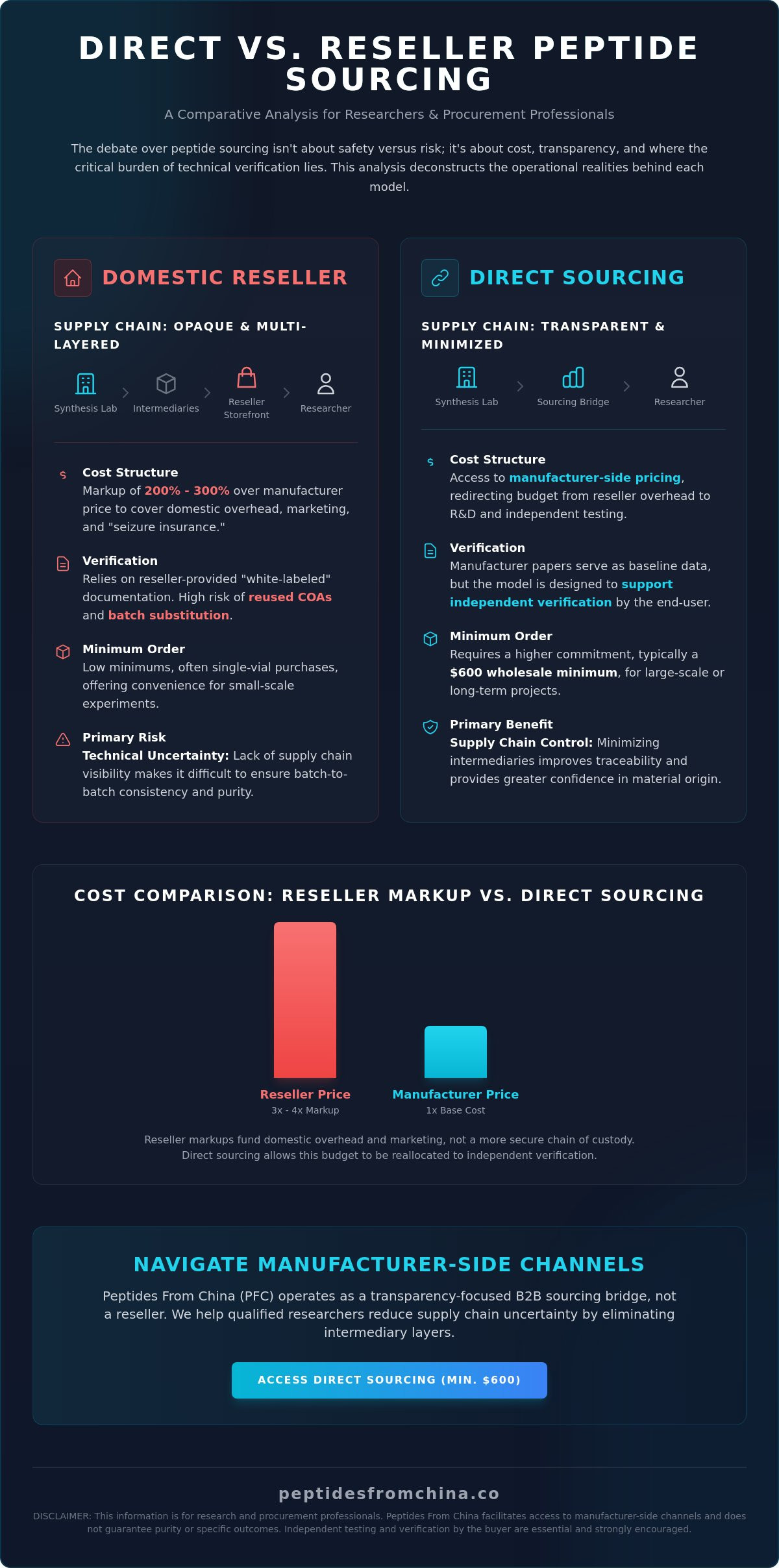
Traditional resellers buy in bulk, relabel the vials, and sell them at a 200-300% markup to cover domestic overhead and marketing. This white-labeling often obscures the original batch traceability. Sourcing agents, such as Peptides From China, operate differently. They act as a B2B sourcing bridge. Instead of holding inventory and adding retail markups, they help researchers access manufacturer-side channels directly. For those meeting a $600 wholesale minimum, this model reduces supply chain uncertainty by removing the middleman layer. This transparency-first approach is a key differentiator when comparing direct vs reseller peptide sourcing models.
The flow of raw powder from the lab to the final lyophilized vial involves multiple hand-offs. Each hand-off increases the risk of batch substitution or the use of reused HPLC reports. Understanding this architecture allows procurement professionals to make informed decisions about where they want their verification efforts to begin. It's not just about the final price. It's about the visibility of the entire process from the synthesis bench to the researcher's lab. Minimizing intermediaries is the most effective way to improve traceability.
Direct vs. Reseller Peptide Sourcing: A Comparative Analysis
Choosing between direct vs reseller peptide sourcing involves a fundamental trade-off between logistical speed and supply chain visibility. Domestic resellers offer the convenience of local shipping and single-vial purchases, but this comes at a significant financial and technical cost. Conversely, sourcing directly from the manufacturer requires a higher minimum commitment but provides a clearer view of the material's origin. For procurement professionals, the decision rests on whether the research project prioritizes immediate availability or long-term batch consistency.
The Economics of Peptide Markups
As of May 2026, domestic peptide suppliers price their inventory 200% to 300% higher than international manufacturers. This steep markup isn't solely for profit; it funds the reseller's domestic warehousing, aggressive marketing campaigns, and the "seizure insurance" built into their retail pricing. When a reseller offers a "guaranteed delivery," they've already factored the cost of potential customs losses into the price you pay per vial. For researchers managing large-scale projects, these costs compound quickly. Moving to a manufacturer-side model eliminates these retail layers, allowing the budget to be redirected toward independent analytical validation rather than middleman overhead.
Quality Control Ownership
In the reseller model, the buyer often relies on "white-labeled" documentation. It's common to see reused HPLC reports or mass spectrometry data that may not correspond to the specific batch in hand. This creates a risk of batch substitution, where a reseller might mix inventory from different synthesis runs to fulfill orders. While the Drug Supply Chain Security Act (DSCSA) outlines strict tracing for commercial pharmaceuticals, the research market remains opaque. Sourcing directly supports independent verification by the end-user. By receiving a single, large batch directly from the source, a lab can perform its own testing once and have confidence in the consistency of that entire lot.
Logistical speed is the primary advantage of the reseller. If a lab needs a single vial of BPC-157 by tomorrow, a domestic vendor is the only viable path. However, if the goal is to secure a stable supply of Tirzepatide or Semaglutide for a multi-month study, the direct route is superior. Accessing manufacturer-side sourcing through a B2B bridge helps reduce supply chain uncertainty. For those ready to meet a $600 wholesale minimum, this approach provides reference analytical data straight from the facility, allowing for a more methodical and cost-effective procurement strategy.
Deconstructing the 'Domestic Trust' Myth in Research Peptides
A domestic shipping address is often a psychological comfort rather than a technical safeguard. Many researchers pay a steep premium assuming the reseller has performed rigorous quality control before the product reaches their bench. In reality, the research peptide market is saturated with domestic vendors who function as high-volume drop-shippers. These entities rarely possess the in-house analytical equipment or the biochemical expertise required to verify synthesis quality. The choice between direct vs reseller peptide sourcing often hinges on this false sense of security provided by a local storefront.
The 'Reseller Buffer' and Its Limitations
The idea of a "perfect chain of custody" is frequently an illusion in the grey market. When a reseller receives a bulk shipment, they often engage in relabeling. This involves stripping the manufacturer's original batch identifiers and replacing them with a retail brand. This process breaks the traceability link. It makes it nearly impossible for the buyer to verify the specific synthesis run or the age of the material. Direct communication with the production source, facilitated by a sourcing bridge, often proves more reliable than a reseller's generic support ticket system. Intermediaries add layers of cost without necessarily adding any technical oversight.
Identifying Red Flags in Reseller Documentation
Opaque supply chains rely on the buyer's willingness to accept reference analytical data at face value. One common red flag is the presence of "cherry-picked" samples. A reseller might send one high-purity vial to a domestic lab for testing while fulfilling orders with a different, untested batch. Buyers should also watch for HPLC reports where the batch number or date appears to be edited or formatted differently than the raw data. These are signs of reused or falsified documentation. Independent third-party testing is the only method that truly supports independent verification of product identity and purity.
Navigating these complexities requires a shift in procurement strategy. Peptides From China acts as a transparency-focused B2B sourcing bridge, helping researchers bypass the domestic retail layer entirely. By meeting a $600 wholesale minimum, labs can access manufacturer-side channels where batch traceability is easier to maintain. This direct model helps reduce supply chain uncertainty by providing access to the original manufacturer-issued papers. These documents serve as a baseline for your own independent validation protocols. Relying on "domestic trust" is no longer a viable strategy in the volatile market following the major supplier closures of early 2026.
Protocols for Managing Direct-to-Manufacturer Sourcing Risks
Operating on the manufacturer side of the supply chain requires a more methodical approach than simply clicking "add to cart" on a retail site. While the economic advantages of direct vs reseller peptide sourcing are clear, the buyer must assume responsibility for operational risk management. This starts with a multi-stage vetting process that treats manufacturer documentation as reference analytical data rather than absolute truth. You're no longer paying a reseller to handle the headaches; you're managing them yourself to secure better margins and batch consistency.
Verification Standards for 2026
In 2026, simply viewing a static PDF is insufficient. Sophisticated procurement professionals now request raw data files from HPLC and Mass Spectrometry runs to ensure they haven't been digitally altered or reused. This level of scrutiny is essential for bulk BPC-157 wholesale procurement. If a manufacturer refuses to provide raw data, it's a signal they may be a sourcing agent masquerading as a factory. Professionalism in this space also means knowing how to handle quality disputes. Instead of emotional support tickets, you provide independent lab results to support your claims and trigger a replacement or credit.
Processing deposits are a standard reality in professional B2B transactions. These funds secure synthesis capacity and raw materials for your specific production run. Unlike retail purchases, these are professional contracts where the timeline depends on the facility's current throughput. It's a grounded, operational reality that helps reduce supply chain uncertainty by locking in your spot in the manufacturing queue. Direct sourcing isn't about instant gratification; it's about strategic planning.
Logistics and Customs Management
International logistics require a robust procurement timeline and a deep understanding of transit risks. Customs management relies on consistent shipping routes and neutral packaging to improve traceability and minimize delays. Direct sourcing is not a "just-in-time" solution. It demands a four to six week lead time to account for synthesis, internal testing, and international transit. If your research depends on a constant supply of Tirzepatide or Semaglutide, you must build a buffer into your inventory management.
Neutral packaging is a technical requirement, not a suggestion. It ensures that sensitive research materials aren't unnecessarily flagged during automated sorting processes. By maintaining a direct relationship with the source, you can specify these requirements and ensure they're followed consistently across every batch. If you're ready to transition to a more professional procurement model, you can access manufacturer-side channels through our B2B bridge for wholesale orders meeting the $600 minimum requirement.
Navigating Manufacturer-Side Channels with Peptides From China
Peptides From China (PFC) operates as a transparency-focused B2B sourcing bridge designed for researchers who have outgrown the retail reseller model. We don't function as a pharmaceutical manufacturer or a testing laboratory. Instead, we act as a methodical filter, helping professional buyers bypass the 200% to 300% markups common in domestic markets. By connecting laboratories directly to high-capacity synthesis facilities, we prioritize batch traceability and operational consistency over traditional marketing flair. This approach is specifically tailored for those who understand that the choice of direct vs reseller peptide sourcing is ultimately about controlling the burden of verification.
Our model is built on wholesale procurement requirements that reflect the realities of industrial supply chains. We require a $600 minimum order to access manufacturer-side pricing and channels. This threshold ensures that we're serving a sophisticated audience of procurement professionals and laboratories rather than retail-focused single-vial buyers. To initiate the sourcing workflow, we utilize a $10 processing deposit. This small, functional fee serves to filter inquiries and begins the process of securing manufacturer-issued papers and current batch data for your specific request.
The PFC Sourcing Workflow
The transition from a domestic reseller to a manufacturer-side bridge follows a structured, logical progression. Once the processing deposit is received, we coordinate with synthesis facilities to provide reference analytical data for the compounds you require, ranging from BPC-157 and TB-500 to GLP-1 analogues like Tirzepatide and Semaglutide. The process moves from initial request to a formal B2B invoice only after the logistical and technical parameters are established. It's important to understand that PFC supports independent verification; we provide the manufacturer's baseline documentation, but we always encourage buyers to perform their own third-party testing to confirm product identity and purity.
Why Professional Labs Choose the Direct Bridge
Professional researchers choose this bridge because it helps reduce supply chain uncertainty. By eliminating multiple intermediary layers, labs can maintain a closer link to the original synthesis run, which improves traceability across multi-month studies. The economic advantages are significant for high-volume research, allowing budgets to be spent on actual materials rather than a reseller's domestic overhead or "seizure insurance" premiums. This model facilitates a realistic understanding of sourcing dynamics, positioning your lab for long-term reliability in an industry where supply chain opacity is the standard. We provide the tools and access; you provide the independent analytical oversight required for high-integrity research.
Optimizing Your Peptide Procurement Strategy
The peptide market in 2026 requires a shift from passive retail purchasing to active procurement management. You've seen that domestic storefronts often obscure the same synthesis sources you can access directly. Deciding between direct vs reseller peptide sourcing is ultimately a choice between paying for a middleman's marketing overhead or investing in your own independent verification protocols. By eliminating the retail markup, your budget can finally support the rigorous testing standards your research deserves.
Peptides From China acts as your B2B sourcing bridge, providing a transparent model that prioritizes batch traceability. We facilitate access to COA-verified batches and direct manufacturer-side pricing for wholesale requirements starting at $600. This approach helps reduce supply chain uncertainty by delivering reference analytical data directly from the facility to your lab. Professionalizing your supply chain is the most effective way to ensure long-term consistency and data integrity. It's time to secure a reliable, manufacturer-direct supply for your laboratory.
Access Direct-to-Manufacturer Peptide Sourcing via Peptides From China
Frequently Asked Questions
Is direct sourcing from China legal for research laboratories?
Direct sourcing for laboratory research is generally permissible provided the compounds are intended for in-vitro or animal studies and are not scheduled substances in your jurisdiction. Laboratories must ensure they comply with local import regulations and institutional safety protocols. It's the buyer's responsibility to verify that the specific research peptides, such as BPC-157 or Tirzepatide, are handled according to all applicable laws.
What is the primary difference in cost between a reseller and a direct manufacturer?
The primary difference lies in the elimination of the 200% to 300% retail markup that domestic vendors charge for convenience and warehousing. Direct manufacturer pricing reflects the actual cost of synthesis and bulk processing. By bypassing the retail layer, laboratories can redirect their budget toward independent analytical validation rather than paying for a middleman's marketing and domestic overhead.
How can I verify the purity of a peptide batch if I source it directly?
Independent third-party testing is the only definitive method for verifying product identity and purity. Direct sourcing allows you to receive a single, large batch of material, making it cost-effective to send a representative sample to a domestic laboratory for HPLC and Mass Spectrometry analysis. This approach supports independent verification and ensures that your research data is based on confirmed material rather than a reseller's generic claim.
Why does Peptides From China require a $600 minimum order?
The $600 minimum order is an operational requirement for wholesale B2B procurement. This threshold allows us to maintain the efficiency of manufacturer-side channels and focus on serving professional researchers and procurement officers. It ensures that the logistical resources are dedicated to high-volume orders that benefit from the transparency and cost savings of direct vs reseller peptide sourcing models.
What happens if a direct-sourced shipment is seized by customs?
In a direct sourcing model, the buyer typically assumes the logistical risk unless specific reshipment terms are established in the B2B contract. Domestic resellers include "seizure insurance" in their high retail prices to cover these losses. Direct sourcing offers lower unit costs because you aren't prepaying for these potential losses, requiring a more strategic approach to inventory and lead times.
Can I trust the HPLC reports provided by Chinese manufacturing facilities?
Manufacturer-issued papers should be treated as baseline technical reference material rather than absolute proof of quality. While these reports provide necessary batch identifiers, the industry's history of reused or generic documentation makes them insufficient on their own. You should use this data to compare against your own independent testing results to ensure batch-to-batch consistency and synthesis accuracy.
What is the role of a sourcing agent like PFC compared to a traditional vendor?
PFC acts as a transparency-focused B2B sourcing bridge that helps researchers access manufacturer-side channels directly. Unlike a traditional vendor who holds inventory and adds a retail markup, we focus on reducing intermediary layers to improve batch traceability. Our role is to facilitate the connection between your lab and the synthesis facility while providing the necessary reference analytical data for your procurement process.
How do I manage the $10 processing deposit when starting a new order?
The $10 processing deposit is a functional step that initiates the sourcing and verification workflow. This small fee filters out non-professional inquiries and allows our team to begin the labor-intensive task of coordinating with facilities to secure current batch logs. Once the deposit is paid, we provide the manufacturer-side data and logistical details required to move forward with a formal B2B invoice.