A single HPLC report doesn't secure a research project; it merely starts the conversation about traceability. As the FDA's Pharmacy Compounding Advisory Committee prepares for its July 2026 review, the landscape for BPC-157 research applications is shifting toward a model that demands absolute supply chain transparency. You've probably noticed that domestic resellers often rely on reused COAs or batch substitution, leaving your laboratory to deal with the fallout of inconsistent synthesis quality. We understand that navigating these opaque channels is the primary bottleneck for professional procurement.
Key Takeaways
Analyze the molecular profile and primary BPC-157 research applications, specifically focusing on angiogenic signaling and collagen organization.
Evaluate the impact of delivery routes on systemic absorption to optimize experimental protocols for multi-organ cytoprotection studies.
Identify common supply chain flaws such as reused COAs and batch substitution to better protect your laboratory's data integrity.
Establish a direct-to-manufacturer procurement strategy that utilizes a B2B sourcing bridge to minimize reseller interference and mark-ups.
Understand the operational requirements for wholesale procurement, including the $600 minimum order threshold for accessing manufacturer-side channels.
Table of Contents
The Molecular Profile of BPC-157 in Modern Research
Primary BPC-157 Research Applications: Mechanisms of Action
Systemic vs. Localized Effects: Analyzing Delivery in Research
Managing Supply Chain Uncertainty in BPC-157 Procurement
Direct Sourcing: Optimizing Large-Scale BPC-157 Research
The Molecular Profile of BPC-157 in Modern Research
Understanding the fundamental chemistry of BPC-157 is the first step in establishing viable experimental protocols. This 15-amino acid pentadecapeptide, specifically defined as a cytoprotective compound with a non-homologous sequence to other gastric peptides, was originally derived from human gastric juice. Its molecular weight typically ranges between 1,400 and 1,600 daltons, a variance primarily dictated by the specific salt form used during the final stages of synthesis. Unlike many standard research proteins that degrade rapidly when exposed to acidic environments, this peptide exhibits remarkable stability in gastric conditions. This inherent resilience is a primary driver for its inclusion in diverse BPC-157 research applications, particularly those investigating multi-organ protection and tissue repair mechanisms.
Chemical Structure and Stability
The sequence of BPC-157 relies on a precise L-Valine to L-Glycine arrangement that dictates its biological activity. Synthesis precision is critical; even minor deviations in the peptide bond sequence can lead to a significant loss of stability or unintended degradation patterns during storage. In a laboratory setting, thermal stability profiles indicate that while the lyophilized powder is relatively robust, it's still sensitive to prolonged heat exposure during shipping. This is why we emphasize that reference analytical data from the manufacturer should be treated as a baseline, not a final guarantee of quality. Domestic resellers often obscure these stability risks by relabeling older batches or reusing outdated HPLC reports, making independent verification a necessity for any serious research project.
Body Protection Compound (BPC) Origins
The term "Body Protection Compound" reflects the historical context of its isolation from gastric protective proteins. The evolution of this peptide from narrow, patent-protected experimental data to its current status in global research has been driven by its unique regenerative profile. It's essential to distinguish between the full 15-amino acid BPC-157 sequence and other "body protection" peptide fragments that may appear in the market. Many of these alternatives lack the specific gastric stability and non-homologous structure that define the original pentadecapeptide. For researchers, identifying the exact molecular footprint is the only way to ensure that BPC-157 research applications yield reproducible data. Sourcing through a B2B bridge like Peptides From China helps reduce supply chain uncertainty by providing direct access to the manufacturing facilities where these precise sequences are synthesized, provided the $600 minimum order requirement is met.
Primary BPC-157 Research Applications: Mechanisms of Action
The core of current BPC-157 research applications lies in its ability to modulate multiple signaling pathways simultaneously. Unlike many single-target compounds, this pentadecapeptide is primarily investigated for its role in upregulating Vascular Endothelial Growth Factor (VEGF), a critical signaling protein for angiogenesis. By promoting the formation of new blood vessels, it provides a unique framework for studying accelerated tissue regeneration in experimental models. Researchers must remain cognizant of the regulatory and safety status of BPC-157; it remains unapproved for human consumption and is strictly classified for laboratory use. This distinction is vital for maintaining the integrity of your procurement protocols.
Beyond vascular responses, the peptide is central to gastrointestinal cytoprotection studies. It's often researched for its ability to maintain mucosal integrity through the "gut-brain axis," offering a technical reference for how gastric-derived proteins influence systemic health. Early-stage research also explores its impact on dopaminergic and serotonergic neurotransmission, suggesting potential neurological protection mechanisms. However, these systemic effects are highly dependent on the precision of the peptide sequence, making independent verification of every batch a standard requirement for professional labs.
Tissue Repair and Collagen Synthesis
In reconstructive research, the mechanism of fibroblast recruitment is a primary focus. BPC-157 is frequently used to analyze collagen organization during the healing of tendons and ligaments. While it shares some regenerative characteristics with other peptides, researchers often conduct comparative analyses between this compound and Thymosin Beta-4. If your project requires a multi-peptide approach, understanding the nuances of TB-500 peptide sourcing is essential for maintaining experimental consistency across different batches.
Nitric Oxide (NO) Pathway Modulation
Vascular homeostasis is another critical research area, specifically regarding how the peptide influences nitric oxide (NO) synthesis. This modulation is vital for regulating blood flow and blood pressure in experimental environments. Maintaining batch consistency is paramount here; any variation in peptide purity can skew measurements of vascular response. To reduce supply chain uncertainty and ensure you're working with manufacturer-direct materials, you can access professional sourcing channels that bypass the typical reseller mark-ups. For those managing high-volume laboratory operations, PFC facilitates this transparency with a $600 minimum order requirement to ensure logistical efficiency and direct-to-manufacturer traceability.
Systemic vs. Localized Effects: Analyzing Delivery in Research
The unique gastric stability of this pentadecapeptide allows for diverse administration routes that are often unavailable for more fragile research proteins. Unlike standard ligands that require complex enteric coating or chemical modification to survive enzymatic breakdown, the specific sequence of BPC-157 remains remarkably resilient in acidic environments. This flexibility is a cornerstone of modern BPC-157 research applications, as it allows investigators to compare oral, subcutaneous, and intramuscular delivery without the immediate risk of peptide degradation. When managing high-volume projects, the choice of delivery route dictates the scale of your procurement strategy and the total batch volume required for study completion.
Systemic absorption patterns observed in multi-organ cytoprotection studies suggest that the peptide's influence isn't limited to the site of administration. Researchers tracking healing metrics in surgical trauma models often find that localized application yields systemic responses, particularly in vascular and neurological markers. This dual-action profile makes it a versatile tool for studying complex injury recovery. However, the operational reality is that different delivery methods require varying concentrations to achieve peak plasma levels. Oral administration in rodent models, for instance, typically demands a higher volume of material than parenteral routes, which directly influences the logistical planning of your laboratory's supply chain.
Oral Bioavailability in Gastric Research
The peptide's ability to resist enzymatic breakdown is a result of its L-Valine to L-Glycine sequence, which prevents rapid proteolysis. This stability is critical for long-term longitudinal studies where consistent dosing over weeks or months is required. Researchers should also consider the stability of reconstituted solutions in different media; while the lyophilized powder is robust, once in solution, the peptide is more susceptible to environmental variables. Using reference analytical data to establish baseline purity helps reduce supply chain uncertainty, but it doesn't replace the need for independent verification of every batch used in your protocols.
Parenteral Administration Metrics
Analyzing peak plasma concentrations in subcutaneous versus intramuscular research provides a clearer picture of half-life considerations in laboratory dosing. In sterile-grade research environments, the purity requirements are significantly higher to avoid confounding variables from synthesis byproducts or contaminants. B2B sourcing through Peptides From China (PFC) helps researchers bypass the relabeling and batch substitution common among domestic resellers. By facilitating direct access to manufacturer-side channels with a $600 minimum order, PFC ensures that high-volume laboratories can maintain a consistent supply of technical-grade material for both systemic and localized research models.
Managing Supply Chain Uncertainty in BPC-157 Procurement
The Problem with Reseller Opacity
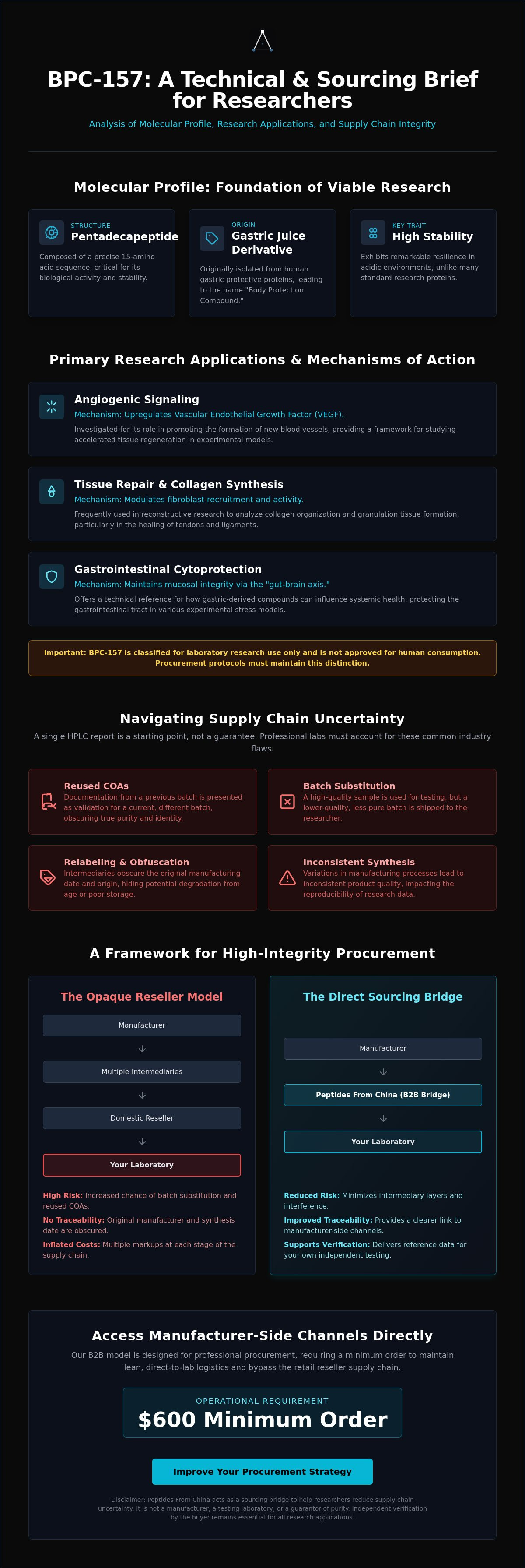
Domestic warehousing is often marketed as a convenience, yet it frequently serves to obscure the true manufacturing origin of the peptide. Resellers prioritize margin over traceability because revealing the source would allow institutional buyers to bypass their mark-ups. This layer of the supply chain adds unnecessary risk; extended storage in non-optimized conditions can lead to quality degradation before the product reaches your laboratory. Institutional procurement teams can mitigate this by moving closer to the synthesis source. By utilizing a B2B sourcing bridge like Peptides From China, researchers can access manufacturer-side channels directly, provided they meet the $600 minimum order threshold required for wholesale logistics.
Technical Verification Protocols
Professional laboratories must approach High-Performance Liquid Chromatography (HPLC) reports with a degree of skepticism. A report showing high purity is secondary to confirming the actual substance in the vial. This makes Mass Spectrometry (MS analysis) essential for confirming the specific 15-amino acid sequence of the pentadecapeptide. We recommend that all institutional buyers incorporate peptide testing as a non-negotiable step in their internal verification process. Budgeting for independent third-party verification is the only way to reduce supply chain uncertainty and ensure that your data isn't skewed by synthesis byproducts or incorrect salt forms.
If you're looking to streamline your procurement and eliminate unnecessary middle-men, you can explore manufacturer-direct sourcing options that prioritize batch traceability over retail marketing flair. Establishing a direct connection to production facilities helps improve traceability and supports the long-term integrity of your BPC-157 research applications by ensuring you receive material that matches your specific technical requirements.
Direct Sourcing: Optimizing Large-Scale BPC-157 Research
Optimizing large-scale BPC-157 research applications demands a move away from the fragmented retail market toward professional-grade procurement structures. When a study moves beyond the pilot phase, the cost and variability of domestic resellers become significant operational hurdles. Peptides From China (PFC) acts as a transparency-focused B2B sourcing bridge, connecting laboratories directly to manufacturer-side channels. By eliminating the multiple layers of domestic intermediaries, institutional buyers can significantly reduce overhead while improving the traceability of their materials. This direct-to-manufacturer approach is structured specifically for high-volume needs, requiring a minimum wholesale order of $600 to ensure logistical efficiency and maintain lean operations.
The transition to wholesale procurement isn't just about cost; it's about securing a consistent supply that matches the technical requirements of long-term studies. Inconsistent batch quality from resellers can lead to data drift, potentially compromising months of laboratory work. Accessing bulk BPC-157 wholesale channels allows for better batch traceability from the synthesis facility directly to the bench. This model helps reduce supply chain uncertainty by providing a clear path for every vial, ensuring that the peptide sequence and salt form remain consistent across the entire duration of the research project.
The PFC Sourcing Model
The PFC model is designed to prioritize factual verification over traditional marketing tactics. The process begins with a $10 processing deposit, which initiates manufacturer-side verification and provides the buyer with access to reference analytical data, including manufacturer-issued papers and COAs. This approach ensures that researchers aren't relying on the claims of a middleman but are viewing the same documentation provided by the production facility. For global labs, PFC utilizes neutral packaging and international tracking logistics. This method minimizes the risk of customs complications and ensures that the focus remains on the technical integrity of the contents rather than superficial branding.
Institutional Procurement Advantages
Establishing a Reliable Framework for Future Research
Effective BPC-157 research applications rely on a procurement strategy that values batch traceability over reseller convenience. We've established that while HPLC reports provide a technical baseline, they don't replace the necessity of independent laboratory verification. By moving closer to the synthesis source, institutional buyers can bypass the inherent opacity of domestic middle-men and secure material that supports long-term data integrity. This methodical approach ensures that your research remains grounded in consistent, manufacturer-verified peptide sequences rather than the variable quality of relabeled batches.
Peptides From China (PFC) facilitates this transition by acting as a B2B sourcing bridge, offering COA-verified batches direct from synthesis facilities. Our model prioritizes operational transparency, providing direct access to manufacturer-side channels and global shipping with neutral, tracked packaging. If you're managing high-volume laboratory requirements and require a streamlined, $600 minimum wholesale order structure, we're ready to support your procurement goals. You can Request a Quote for Wholesale BPC-157 Sourcing to begin reducing your supply chain uncertainty today. We look forward to helping you secure a more reliable foundation for your research.
Frequently Asked Questions
What is the primary mechanism of BPC-157 in tissue repair research?
The primary mechanism in tissue repair research involves the upregulation of Vascular Endothelial Growth Factor (VEGF) and the recruitment of fibroblasts. These biological processes facilitate angiogenesis and collagen organization, which are essential for investigating tendon and ligament recovery models. Unlike single-target ligands, BPC-157 acts through multiple signaling pathways to support tissue-specific regeneration. Researchers often use these mechanisms to study the biological limits of reconstructive healing in preclinical environments.
Can BPC-157 be researched via oral administration?
Yes, BPC-157 is frequently researched via oral administration due to its inherent stability in acidic environments. The peptide's 15-amino acid sequence is resistant to gastric juice degradation, which allows for diverse BPC-157 research applications involving the gut-brain axis and mucosal integrity. This oral bioavailability distinguishes it from many other research peptides that require parenteral delivery to maintain systemic presence and prevent rapid enzymatic breakdown during the digestive process.
How do I verify the purity of a BPC-157 batch from China?
Verifying a batch requires a multi-step approach that begins with manufacturer-issued HPLC and Mass Spectrometry reports as baseline technical references. However, professional laboratories shouldn't treat these documents as definitive proof of purity due to the risk of reused COAs or batch substitution. Independent third-party verification is the only way to confirm the peptide's identity and purity levels. This process helps reduce supply chain uncertainty and ensures the material meets your specific laboratory standards.
What is the difference between BPC-157 and TB-500 in research applications?
The main difference lies in their primary signaling pathways and molecular targets. BPC-157 is primarily investigated for its angiogenic properties and collagen synthesis, while TB-500, or Thymosin Beta-4, is researched for its role in actin sequestration and cell migration. While both are used in tissue repair studies, BPC-157 offers unique gastric stability that TB-500 lacks. Researchers often combine these compounds to analyze synergistic effects in complex wound healing models.
Why do peptide purity reports (COAs) vary between different batches?
COA variations occur due to fluctuations in synthesis precision, differences in the final salt form, and the specific purification methods used by the manufacturer. No single report serves as a permanent guarantee of batch-to-batch identity because every production run involves variable environmental and chemical factors. These discrepancies highlight the necessity of batch traceability and the use of direct-to-manufacturer channels to ensure that reference analytical data remains relevant to the specific lot being utilized.
What are the minimum order requirements for wholesale BPC-157 sourcing?
Wholesale procurement through Peptides From China (PFC) requires a minimum order amount of $600. This threshold is established to ensure logistical efficiency and maintain a lean, direct-to-manufacturer sourcing model that bypasses expensive domestic reseller layers. By focusing on high-volume laboratory needs, this structure helps improve traceability and provides institutional buyers with a more realistic framework for scaling their longitudinal research projects without unnecessary intermediary mark-ups or relabeling risks.
How does BPC-157 influence angiogenesis in laboratory models?
In laboratory models, the peptide influences angiogenesis by promoting the formation of new blood vessels through the modulation of the nitric oxide pathway and VEGF expression. This process is a critical component of many BPC-157 research applications, particularly those focused on vascular homeostasis and multi-organ cytoprotection. By enhancing blood flow to damaged tissues, the peptide provides a technical framework for studying how localized injuries respond to systemic regenerative signaling in controlled experimental settings.
Is BPC-157 stable at room temperature for research shipping?
Lyophilized BPC-157 is relatively stable at room temperature for the duration of standard shipping, but it remains sensitive to prolonged heat exposure. To maintain the integrity of the peptide sequence, professional labs should store the powder in a temperature-controlled environment upon arrival. While the compound is robust compared to other proteins, synthesis byproducts or improper handling during transit can still impact the final research data. This makes manufacturer-side verification and neutral, tracked packaging essential for maintaining consistency.