Why Single Source Peptide Supply Matters for Research

Single source peptide supply is defined as the practice of procuring all batches of a given peptide from one qualified synthesis facility, maintaining unbroken chain-of-custody documentation from raw amino acid inputs through lyophilization and final vialing. For researchers, biohackers, and clinicians, this sourcing model is the primary mechanism for achieving batch-to-batch consistency, traceable quality documentation, and defensible regulatory compliance. When peptide identity, purity, and structural integrity vary across procurement cycles, experimental reproducibility collapses. Understanding why single source peptide supply matters is not an abstract quality philosophy. It is a practical requirement for anyone running controlled research or clinical-adjacent protocols with peptide-based compounds.
Why single source peptide supply matters for traceability and compliance
Supplier qualification is mandated under FDA GMP rules (21 CFR 211.84(a)), requiring documented procedures, audits, quality agreements, and ongoing performance monitoring. This regulatory framework exists because the identity and purity of any incoming material cannot be assumed. It must be verified through a structured qualification process before that material enters a research or manufacturing workflow.
Single sourcing directly supports this framework. When all batches originate from one facility, the qualification burden is concentrated rather than multiplied. Audits, quality agreements, and change control notifications apply to a single relationship. Documentation trails are linear and complete. When a researcher or procurement team works across multiple synthesis vendors, each supplier requires its own qualification cycle, and discrepancies between vendor documentation standards create gaps that FDA inspectors routinely flag.

Unqualified suppliers cause over 30% of drug recalls and FDA warning letters. That figure reflects what happens when incoming material qualification is treated as optional or superficial. For peptide research operating in clinical-adjacent contexts, the consequences of a poorly documented supply chain include batch failures, contaminated materials, and regulatory citations that can halt entire programs.
Key documentation elements that single sourcing makes tractable include:
Batch-specific certificates of analysis (COAs) with HPLC purity data and mass spectrometry confirmation
Quality agreements specifying testing protocols, release criteria, and change notification obligations
Supplier audit records and corrective action documentation
Change control logs covering synthesis route, raw material sourcing, and lyophilization parameters
Pro Tip: Request the synthesis facility’s change control log alongside each COA. A vendor who cannot provide change notifications for the past 12 months is operating without the documentation infrastructure required for defensible single source qualification.
Consistent documentation quality is as important as peptide purity for reliable research outcomes. A 98% HPLC purity result means little if the testing methodology is undisclosed, the lab is unaccredited, or the batch number cannot be traced back to a specific synthesis run.
Single source vs. multi-source peptide supply: what the comparison actually shows
The operational and quality differences between single source and multi-source procurement are not marginal. They compound across every procurement cycle.
Factor Single source supply Multi-source supply Batch consistency High: same synthesis parameters per batch Variable: each vendor uses different protocols Qualification burden One audit, one quality agreement Separate qualification per vendor COA comparability Standardized format and testing methodology Inconsistent formats, variable accreditation Change control visibility Single notification channel Multiple channels, higher risk of missed updates Contamination risk Contained to one facility Multiplied across vendor network Supply disruption response Managed through one relationship Fragmented, slower resolution Regulatory documentation Linear, traceable Complex, gap-prone
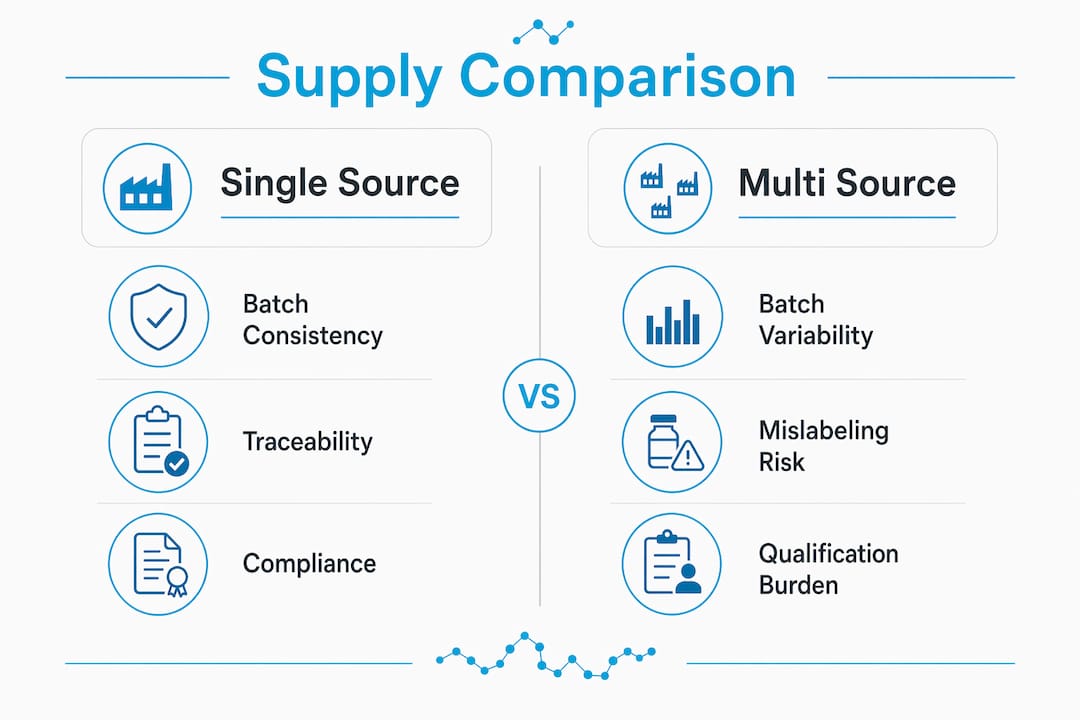
Multiple supplier dependence increases risks of batch inconsistency, contamination, and greater qualification workload. The practical implication for a researcher running a longitudinal peptide study is significant. If BPC-157 batches sourced from two different vendors differ in residual solvent profiles or counterion composition, the experimental variable is no longer just the peptide. It is the peptide plus an undocumented chemical difference.
Multi-source procurement also creates a mislabeling risk that single sourcing reduces. When materials pass through multiple reseller layers before reaching the end user, the chain of custody becomes opaque. Gray-market peptide channels frequently involve dropshipping arrangements where the entity selling the product has never physically handled it or verified its identity. Direct manufacturer relationships and batch traceability are the primary tools for minimizing this supply chain opacity.
The benefits of single source peptides extend beyond compliance. Researchers report faster procurement cycles, more predictable lead times, and lower administrative overhead when working with one qualified vendor. The qualification investment is made once and maintained through periodic review rather than repeated from scratch with each new supplier.
How independent batch testing validates single source peptide quality
Vendor-provided COAs are a necessary starting point, not a sufficient endpoint. In-house testing is a conflict of interest. A synthesis facility testing its own product has both the technical capability and the commercial incentive to present results favorably. Independent, accredited third-party labs remove that conflict entirely.
The standard verification protocol for research-grade peptides involves:
HPLC purity analysis confirming the target peptide represents at least 95% of the detected material
Mass spectrometry confirmation of molecular weight, verifying correct amino acid sequence and absence of truncation products
Residual solvent testing where the peptide will be used in biological assays
Endotoxin testing for any peptide intended for cell culture or in vivo applications
Visual inspection and reconstitution behavior documentation for lyophilized material
Research-grade peptides require HPLC purity at or above 95% with mass spectrometry confirmation. That specification is achievable by competent synthesis facilities, but the key word is confirmation. Without independent verification, purity claims are self-reported marketing data.
The consequences of relying on vendor-only testing are documented. Researchers have encountered peptides with correct HPLC profiles but incorrect molecular weights, indicating synthesis errors that HPLC alone cannot detect. Others have received materials with accurate purity specs but significant endotoxin loads that invalidated cell-based assay results. These failures are preventable through independent batch verification.
Pro Tip: When evaluating a single source vendor, ask specifically which third-party lab conducts their independent testing and verify that lab’s accreditation status. ISO 17025 accreditation is the relevant standard for analytical testing laboratories. A vendor who cannot name their testing partner is not operating with genuine third-party oversight.
Verification of testing lab accreditation is the key step to prevent silent lot differences. Silent lot differences are changes in a peptide batch that fall within specification limits on standard tests but affect biological activity. They are the most difficult quality failures to detect and the most damaging to research reproducibility.
Practical strategies for building a single source peptide supply program
Establishing a functional single source supply program requires more than selecting one vendor. It requires a structured qualification framework that can be maintained and audited over time.
Effective supplier qualification programs include risk assessment, supplier audits, quality agreements, change control, and performance monitoring calibrated to supplier risk level. For peptide sourcing, the risk level is generally high given the biological activity of the materials and the regulatory sensitivity of clinical-adjacent applications.
A practical implementation framework covers the following areas:
Initial qualification: Conduct a technical questionnaire covering synthesis capabilities, quality control procedures, lyophilization and vialing processes, and documentation systems before placing any order
Quality agreement execution: Formalize testing requirements, release criteria, change notification timelines, and dispute resolution procedures in a written agreement
Batch acceptance criteria: Define minimum HPLC purity thresholds, required MS data, and COA format requirements before the first shipment
Performance monitoring: Track on-time delivery rates, COA acceptance rates, responsiveness to technical queries, and any out-of-specification results across all batches received
Annual review: Conduct a formal supplier performance review annually, incorporating all batch data, any quality events, and any changes to the vendor’s manufacturing infrastructure
Ongoing monitoring of supplier performance includes metrics like on-time delivery, COA acceptance, responsiveness, and audit outcomes. Regular formal review is what separates a qualified single source relationship from a preferred vendor arrangement with no accountability structure.
Red flags that indicate a vendor is not suitable for single source qualification include: inability to provide synthesis facility documentation, COAs without identifiable testing lab names, pricing that is significantly below market rates without explanation, and catalogs spanning hundreds of peptides with no apparent specialization. Vendors claiming large catalogs with low pricing often lack the GMP compliance infrastructure required for defensible sourcing. A focused catalog with transparent testing documentation is a stronger signal of manufacturing competence than breadth of product offering.
For risk management, a secondary qualified supplier can be maintained in a qualified but inactive status, ready to be activated if the primary source experiences a supply disruption. This approach preserves the operational benefits of single sourcing while providing continuity protection.
Key takeaways
Single source peptide supply is the most effective framework for achieving batch consistency, traceable documentation, and defensible regulatory compliance in peptide research and clinical-adjacent applications.
Point Details Regulatory foundation FDA 21 CFR 211.84(a) mandates supplier qualification; single sourcing concentrates this burden on one auditable relationship. Documentation integrity Batch-specific COAs with HPLC and MS data from accredited labs are required for defensible quality records. Multi-source risk Multiple vendors multiply qualification burden, batch variability, and contamination risk across every procurement cycle. Independent testing Third-party accredited lab verification removes vendor conflict of interest and detects silent lot differences. Program maintenance Annual supplier reviews and defined performance metrics sustain supply chain integrity over time.
The operational reality most researchers overlook
The conversation around single source peptide supply tends to focus on compliance and purity specs. Those matter. But the more persistent problem in practice is documentation opacity, not outright fraud.
Most researchers working with peptides from gray-market or multi-tier reseller channels are not receiving counterfeit material. They are receiving material of unknown provenance with COAs that cannot be traced to a specific synthesis run, from a testing lab that may or may not exist, with no mechanism for change notification if the vendor switches API manufacturers. The peptide may test at 97% HPLC purity and still be scientifically unreliable because the documentation chain is broken.
Supplier qualification frameworks originally designed for pharmaceutical manufacturing are critical even for clinical-adjacent peptide uses. Assuming that research-grade materials do not require qualification systems creates disproportionate risk in any regulated or clinical workflow. The distinction between research-grade and pharmaceutical-grade is meaningful for regulatory classification, but it does not mean research-grade peptides can be sourced without qualification discipline.
The other underappreciated issue is change control. A synthesis facility that switches from one resin supplier to another, or modifies its cleavage cocktail, may produce a peptide that meets all standard specifications while exhibiting different biological behavior. Without a quality agreement that mandates change notification, the researcher has no way of knowing the material has changed. Single sourcing with a formal quality agreement is the only reliable mechanism for capturing this information.
My observation after working extensively in this space is that the vendors worth trusting long-term are not the ones with the most impressive marketing. They are the ones who can answer specific technical questions about their synthesis process, name their testing partners without hesitation, and provide change control documentation without being asked twice.
— Sam Levin
Manufacturer-Side QC and Buyer-Arranged Verification
PeptidesFromChina operates as a research-focused sourcing platform with direct relationships with established synthesis facilities, not as a reseller moving products through anonymous retail-reseller supply chains. Products are subject to the manufacturer’s applicable quality-control procedures and specifications. Manufacturer-side analytical documentation may be available depending on the product and batch. PeptidesFromChina is not an independent analytical testing laboratory, and buyers may arrange independent third-party testing.
The platform’s sourcing approach is built around the documentation and verification standards described in this article: accredited third-party testing, batch traceability, and transparent supplier relationships. Researchers, procurement teams, and clinicians who need a single qualified source for compounds like Epithalon, GLP-1 agonists, or signaling peptides can review the platform’s quality and sourcing standards before placing any order.
FAQ
What is single source peptide supply?
Single source peptide supply is the practice of procuring all batches of a given peptide from one qualified synthesis facility, maintaining continuous batch traceability and consistent documentation standards across every procurement cycle.
Why does multi-source peptide procurement increase research risk?
Multi-source procurement multiplies qualification burden, introduces batch variability from differing synthesis protocols, and increases the risk of contamination and mislabeling. Each additional vendor requires its own qualification cycle and creates additional documentation gaps.
What should a peptide COA include for it to be reliable?
A reliable COA includes HPLC purity data at or above 95%, mass spectrometry confirmation of molecular weight, the name of the independent testing laboratory, and a traceable batch number linked to a specific synthesis run.
How often should a single source peptide supplier be reviewed?
Formal supplier performance reviews should be conducted at minimum annually, incorporating all batch acceptance data, any out-of-specification events, responsiveness metrics, and any changes to the vendor’s manufacturing or testing infrastructure.
Does research-grade peptide sourcing require formal supplier qualification?
Yes. Assuming research-grade materials do not require qualification systems creates disproportionate risk in regulated or clinical-adjacent workflows. FDA GMP principles under 21 CFR 211.84(a) apply to incoming material qualification regardless of the end-use classification of the product.