Reagent Sourcing Determines Whether a Study Can Be Replicated

Reagent sourcing failures, not flawed hypotheses, are behind a large share of failed replication attempts, because an unverified lot or a misidentified material changes what the assay actually measures. If you run bench work, act now: log every lot number tied to a result, run a functional check on any reagent you did not personally validate, and freeze use of unverified stock until it clears.
Do this before your next experiment:
Pull lot numbers and Certificates of Analysis (COAs) for every reagent in your current protocol.
Flag any reagent purchased through a reseller rather than a manufacturer or authorized distributor.
Run a positive/negative control check on any lot you have not personally validated.
Document supplier, catalog number, and lot for every reagent tied to a publishable result.
Quarantine unverified stock rather than assuming “it’s probably fine.”
Key Takeaways
Reagent sourcing failures, driven by contamination, batch drift, and missing identifiers, cause a substantial share of failed replications, and they are preventable with documented traceability and functional validation.
Point Details Treat lots as variables Validate every new reagent lot with a functional control before using it in an experiment. Demand lot-specific COAs Require Certificates of Analysis tied to the exact lot received, not generic product documents. Authenticate biological materials Run STR profiling and mycoplasma testing on cell lines on a fixed schedule. Report full material metadata Include supplier, catalog number, lot number, and RRID in every methods section. Choose traceable supply PeptidesFromChina documents batch provenance and retains samples to support independent verification.
Table of Contents
Why Reagent Sourcing Affects Study Replication at the Chemical Level
Common Reagent-Driven Causes of Failed Replication
How to Qualify Reagent Suppliers Before They Enter Your Protocol
Lab Workflows That Catch Reagent Variation Before It Reaches Your Data
What Publications Need to Report for Faithful Replication
Supply-Chain Traceability for Complex Reagents Like Peptide APIs
Why I Think Sourcing Deserves the Same Rigor as Protocol Design
Reducing Sourcing Risk With Traceable Peptide Supply
Frequently Asked Questions
Sources
Why Reagent Sourcing Affects Study Replication at the Chemical Level
Reagent purity, concentration, and stability are not fixed properties. They drift, and that drift moves assay outputs in ways that look like biology but are actually chemistry. A peptide stock that has degraded 8% during shipping produces a smaller effect size in a dose-response curve, and nobody sees the degradation, only the weaker curve. An antibody with reduced binding affinity in a new lot generates a dimmer western blot band that gets interpreted as reduced protein expression, when the real story is a manufacturing variance.
Contamination adds a second layer. It arrives through three main routes: synthesis-stage impurities, in-transit temperature excursions that trigger degradation, and handling contamination once a reagent is opened and reused across projects. Each leaves a fingerprint. Endotoxin contamination in a supposedly clean reagent, for instance, can trigger inflammatory signaling that gets misread as a treatment effect.
Batch-to-batch variability compounds all of this. Swapping an antibody lot or changing a media vendor can fundamentally alter experimental outcomes, even when nothing else in the protocol changes.
Statistic callout: In one of the most cited replication efforts in the sciences, direct replications of psychology studies reproduced statistically significant original findings far less often than originally reported. Reagent-dependent fields face an analogous problem: the protocol replicates, but the material does not.
Pro Tip: Treat every new reagent lot as an unproven variable, not a drop-in replacement, until it clears its own functional control.
Common Reagent-Driven Causes of Failed Replication
Most replication failures trace back to a small set of recurring problems, and they tend to hide in plain sight because the protocol on paper looks identical across labs.
Misidentified and cross-contaminated cell lines are the classic case. A line believed to be one tissue type is, on inspection, a different line entirely, or it carries a mycoplasma infection that alters growth rate and metabolic output without visible signs. Authentication and low-passage materials are essential precisely because misidentified or over-passaged lines can render results non-reproducible.

Antibody specificity is another repeat offender. Two lots from the same catalog number can bind different epitopes with different affinity, and most vendors publish thin validation data to catch it.
Kit reformulations and discontinued catalog items round out the list. A vendor quietly changes a buffer formulation, keeps the same product name, and a protocol that worked for three years stops working with no announced change.
Failure mode Typical trigger Downstream effect Misidentified cell line Cross-contamination between cultures Wrong biology attributed to results Antibody lot drift Unvalidated batch-to-batch affinity change False negative or inflated signal Kit reformulation Unannounced vendor formulation change Protocol failure with no clear cause
Variability in essential biological reagents is a primary threat to reproducibility, and it is often invisible until a lab tries to repeat someone else’s result and cannot.
Pro Tip: Before troubleshooting your protocol, ask whether the reagent catalog number you’re using has changed hands, formulation, or manufacturing site since the original study was published.
How to Qualify Reagent Suppliers Before They Enter Your Protocol
Procurement controls are where most of this gets fixed or gets ignored. A supplier evaluation should treat documentation as a testable claim, not a formality.
Require these at minimum:
A current COA tied to the specific lot you are receiving, not a generic product-level document.
Manufacturing site identification and provenance, especially for peptides, antibodies, and custom syntheses.
Stability data covering your actual storage and use window.
Chain-of-custody documentation from synthesis or manufacture through to your bench.
Ask vendors directly about their sample testing policy, whether they retain hold-back samples from each lot, and how they notify customers when a formulation changes. A vendor unwilling to answer any of these is telling you something.
To interpret a COA correctly, check the assay method used (HPLC purity figures mean little without knowing the column and gradient), the reference standard, and the date relative to your receipt date. When a COA looks thin or the vendor cannot produce the underlying chromatogram, commission independent third-party testing before committing.
Confirm lot-specific COA availability before ordering.
Request hold-back sample and retesting policy in writing.
Set documented acceptance criteria (purity threshold, appearance, functional pass/fail) before the shipment arrives, not after.
Reject and document any lot that fails acceptance criteria, rather than adjusting the protocol to accommodate it.
Pro Tip: Negotiate lot retention and reformulation notification into your purchase agreement, not just your quality manual. A supplier that agrees on paper to notify you of formulation changes is a supplier that has already thought about this problem.
Lab Workflows That Catch Reagent Variation Before It Reaches Your Data
Validation belongs at the bench, not just in procurement. Reagent validation and authentication remain frequently overlooked causes of irreproducibility, despite standard protocols existing for validating compounds, antibodies, cell lines, and kits.
Minimum steps for any new lot:
Visual inspection for color, clarity, and particulates against a known reference.
A functional assay run against positive and negative controls before the lot touches an actual experiment.
Spot-check stability if the lot will sit in storage for more than a few weeks before use.
Cell line authentication through STR (short tandem repeat) profiling and routine mycoplasma testing should happen on a fixed schedule, not only when something looks wrong.
Log receipt date, storage condition, and freeze/thaw cycles for every reagent lot.
Run the functional control before the first experimental use.
Archive an aliquot of every verified lot before it is consumed.
Pro Tip: Split every new lot into an experimental aliquot and an archived reference aliquot the day it arrives. When a result looks strange six months later, you will have the exact material to retest against, not a guess.
What Publications Need to Report for Faithful Replication
A materials and methods section that omits catalog number, lot number, and a unique identifier is not a full method. Studies evaluating biomedical articles found that many reported resources cannot be uniquely identified from the methods text, which forces replicating labs to guess at sourcing.
Include, at minimum:
Supplier name and catalog number.
Lot number and RRID (Research Resource Identifier) or equivalent registry ID where one exists.
Storage and handling notes specific to that reagent.
Major funders now recommend authenticated materials and detailed methods reporting as core rigor practices, and COAs or validation data can go in supplemental files or a public repository rather than cluttering the main text.
Pro Tip: Adapt a simple template: “Reagent X, Supplier Y, Cat# Z, Lot #, RRID: [ID], stored at [condition].” Five fields, every reagent, every paper.
Supply-Chain Traceability for Complex Reagents Like Peptide APIs
Peptide active pharmaceutical ingredients (APIs) move through several handoffs before they reach a bench, and each handoff is a place traceability can quietly disappear. The typical flow runs from raw API synthesis, through vialing and lyophilization, to COA generation, and finally through distribution, which may include one or more reseller layers.
Opaque distribution networks obscure API provenance, while direct-from-manufacturer transparency and retained-sample traceability reduce supply-chain risk for high-stakes reagents.
A workable traceability checklist for peptides and similar complex reagents:
Manufacturer lot ID tied to a specific synthesis batch, not a repackaged distributor lot.
Analytical chromatograms (HPLC/MS) available on request, not just a summary purity number.
A retained sample from the same batch, held by the supplier for retesting disputes.
Traceability element What it confirms Manufacturer lot ID Batch originates from a specific, identifiable synthesis run Chromatogram availability Purity claim is independently checkable Retained sample policy Disputes can be resolved against physical material
Independent third-party HPLC or mass spectrometry testing should sit inside your acceptance criteria for any peptide reagent that materially affects your results, not as an occasional audit. Our research peptide quality standards guide walks through how to read a chromatogram against a purity claim.
Pro Tip: When comparing two supply options at similar price, favor the one with a direct manufacturer relationship and documented lot retention over the one with a cheaper price and an opaque origin story. The savings rarely survive the first failed replication.
Why I Think Sourcing Deserves the Same Rigor as Protocol Design
Labs spend enormous effort standardizing pipetting technique and incubation times while treating the reagent bottle as a fixed, trustworthy input. It rarely is. I have seen a single antibody lot swap quietly erase a signal that took a graduate student a year to characterize, and the only reason the team caught it was an archived aliquot from the original lot that let them retest side by side. Traceability is not paperwork. It is the difference between chasing a phantom biological effect and catching a batch problem in an afternoon. Reagents deserve treatment as experiment-critical assets, with the same documentation discipline labs already apply to instrumentation calibration.
Reducing Sourcing Risk With Traceable Peptide Supply
The traceability practices this article recommends only work if your supplier can actually produce the documentation when asked. PeptidesFromChina structures its sourcing around that requirement specifically: direct relationships with synthesis facilities, retained samples tied to each batch, and independent purity verification instead of a reseller’s word for it.
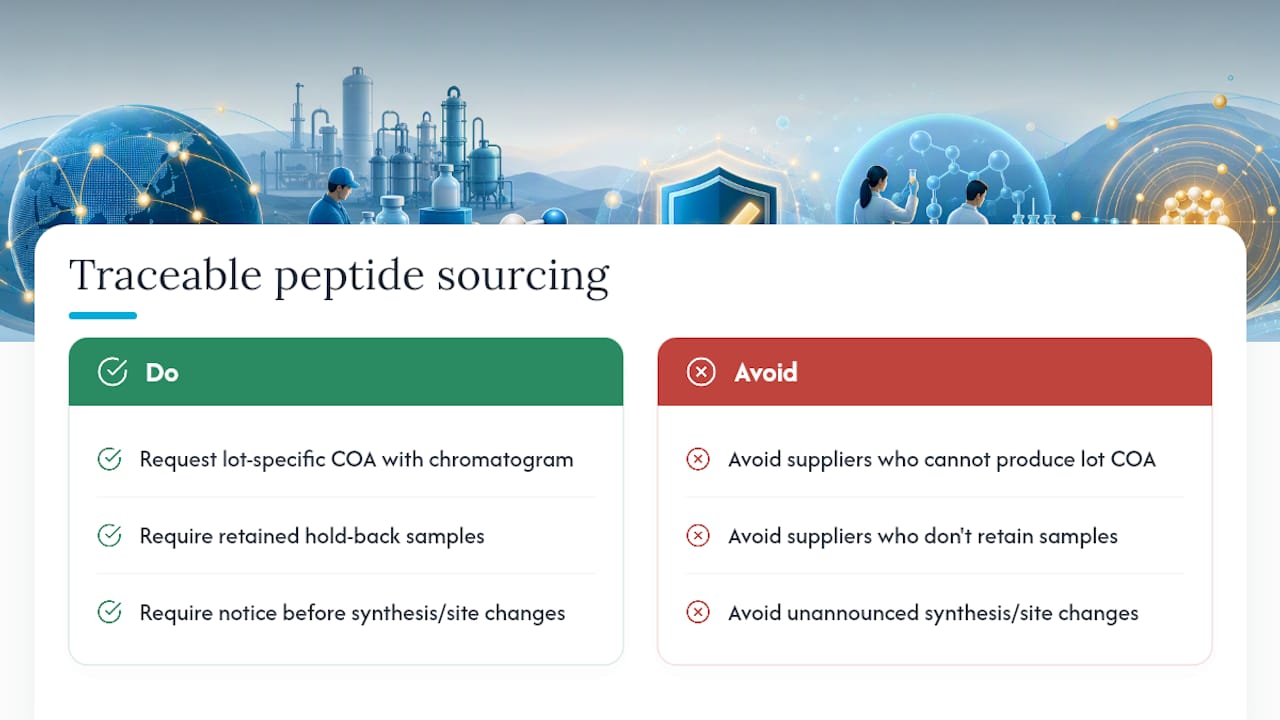
When evaluating any peptide or research compound vendor for a study where reproducibility matters, ask three questions during the RFP process: Can you produce a lot-specific COA with chromatogram data on request? Do you retain hold-back samples for retesting disputes? Will you notify me before any formulation or synthesis-site change? A supplier that hesitates on any of the three is a supply-chain risk you are choosing to accept.
PeptidesFromChina’s research peptide catalog documents batch-level provenance for exactly this reason, and the Epithalon product page shows the COA format you should expect from any comparable supplier. For labs building out a validation SOP, an automated platform like Qualitum can help standardize the acceptance-testing workflow across incoming lots. If reagent-driven variability has cost your lab a replication attempt before, start your next procurement cycle by requesting a lot-specific COA before you commit to an order.
Frequently Asked Questions
Why does reagent sourcing affect study replication so heavily compared to protocol differences?
Protocols can be copied precisely, but a reagent’s chemistry can differ between lots even under an identical catalog number, which means two labs running the same steps can still get different results because the material itself was never the same.
What is the fastest way to check if a reagent lot is reliable?
Run it against a positive and negative control in a small functional assay before committing it to a full experiment. A lot that fails this cheap check saves you from a much more expensive failed replication later.
Do RRIDs actually solve the identification problem?
RRIDs help significantly because they point to a specific, registered resource rather than a generic name, but they only work if authors actually include them, and many published methods sections still omit unique identifiers entirely.
Is buying direct from a manufacturer always better than using a distributor?
Direct sourcing generally improves traceability because provenance and lot data stay intact through fewer handoffs, though a reputable distributor with documented chain-of-custody and lot-specific COAs can still meet the same standard.