Why Peptide Vendor Documentation Supports Grants

Peptide vendor documentation is the primary mechanism by which grant reviewers verify that experimental reagents meet the quality and traceability standards required for funded research. Researchers who understand why peptide vendor documentation supports grants gain a direct competitive advantage: funding bodies at the NIH, NSF, and institutional review boards increasingly treat reagent provenance as a non-negotiable component of the methodology section. A missing or generic Certificate of Analysis (CoA) is no longer a minor oversight. It is a credibility gap that reviewers notice. Integrating batch-specific documentation from qualified suppliers into grant proposals protects data integrity and reduces the risk of post-award compliance failures.
What forms of vendor documentation are most valuable in grant applications?
Certificates of Analysis are the single most important document in modern biomedical research for demonstrating reagent quality and provenance. A batch-specific CoA differs from a generic product specification sheet in one critical way: it reports analytical results from the actual lot shipped to the researcher, not from a representative sample tested months earlier. For grant applications, that distinction matters because reviewers can trace the data back to a specific synthesis run.
The most valuable documentation types for grant support for peptides include:
Batch-specific CoA: Reports purity by HPLC, mass confirmation by ESI-MS or MALDI, and water content by Karl Fischer titration for the exact lot number on the vial.
Lot number traceability: The lot number on a vial must match the CoA exactly. Strong vendors maintain full batch traceability from synthesis through lyophilization and fulfillment.
Vendor certifications: ISO and GMP certifications signal process controls at the synthesis facility. These should be independently verified through the issuing body before vendor approval, not accepted at face value.
Third-party analytical reports: Independent lab testing by facilities outside the supply chain provides orthogonal verification that the vendor’s own CoA cannot supply.
Chain of custody records: Documentation covering raw API sourcing, synthesis, lyophilization, vialing, and shipping confirms that the peptide was handled correctly at every stage.
Pro Tip: Request the CoA before placing an order, not after. If a vendor cannot provide a batch-specific CoA for the lot you will receive, treat that as a disqualifying factor for any grant-backed project.
Vendor certifications require active verification. A supplier listing “GMP-certified” on a website without a certificate number or issuing body reference is making an unverifiable claim. Researchers building supplier qualification files for grant submissions need the actual certificate, not the marketing language.

How does vendor documentation influence grant reviewer confidence?
Grant agencies, IRBs, and journal editors increasingly require documented provenance of reagents as a condition of funding and publication. This shift reflects the broader reproducibility crisis in life sciences research, where undocumented or poorly characterized reagents have contributed to results that cannot be replicated. Reviewers now treat reagent documentation as evidence of methodological rigor, not administrative formality.
The sequence in which documentation affects grant review follows a predictable pattern:
Initial proposal review: Reviewers assess whether the methodology section identifies reagents by vendor, catalog number, lot number, and purity specification. Proposals that list only a compound name without sourcing details raise immediate questions about reproducibility.
Budget justification scrutiny: Funding bodies compare reagent costs against vendor tier. A low-cost peptide from an unverifiable source alongside a high-cost experimental protocol creates an internal inconsistency that reviewers flag.
IRB and compliance review: Institutional review boards examine whether peptides labeled “Research Use Only” are sourced from vendors whose marketing and documentation are consistent with that designation. Regulators evaluate more than labels. They consider marketing channels, sales practices, and documentation consistency.
Post-award audit: Funded labs must maintain records that can be produced during site visits or financial audits. A supplier qualification file with CoAs, certification records, and testing results satisfies this requirement. A folder of invoices does not.
“Proactively integrating vendor documentation into experimental workflows can prevent cascading failures such as retracted publications and revoked grants.” — Health Sciences Forum
The audit scenario is where documentation failures become most costly. A lab that cannot produce a batch-specific CoA for a peptide used in a published, grant-funded study faces the possibility of data integrity questions that extend well beyond the original experiment. Reviewers and auditors understand this risk. Proposals that demonstrate proactive documentation practices signal that the research team has already accounted for it.
What are common pitfalls in peptide vendor documentation?
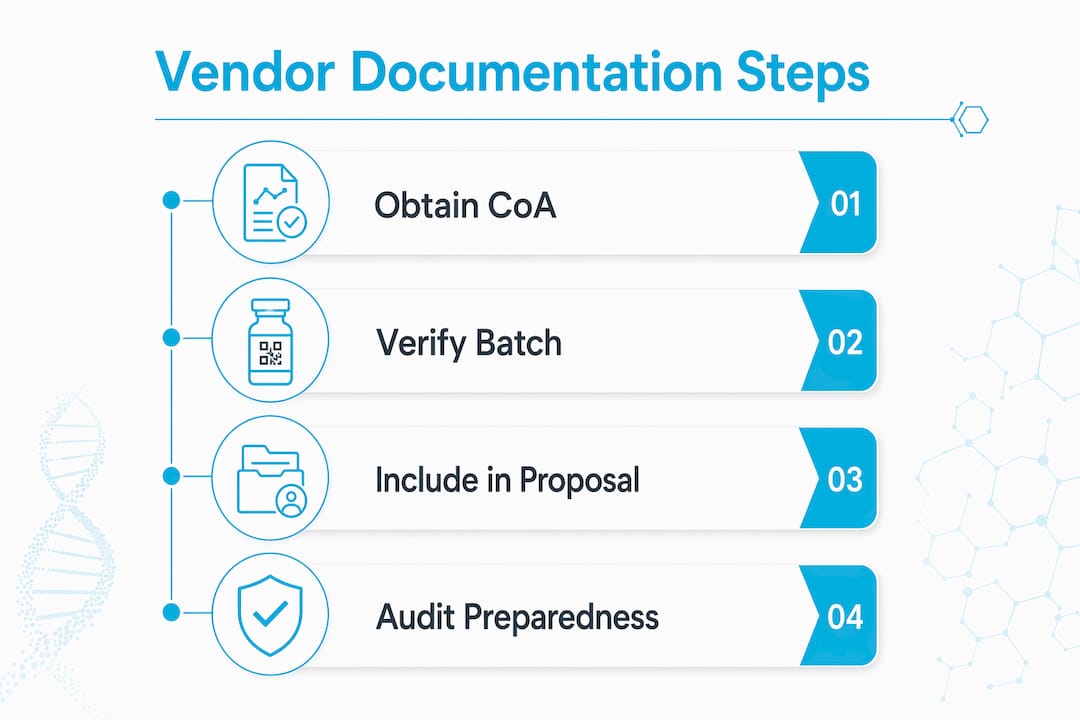
Up to 73% of peptides show purity discrepancies when independently tested against supplier claims. That figure reveals the core problem with relying solely on vendor-supplied CoAs: the document reflects what the vendor measured, not necessarily what the researcher receives. Independent verification is not optional for grant-backed research. It is the control that makes vendor documentation credible.
The table below compares documentation practices that create grant risk against those that support compliance:
Documentation practice Grant risk level Why it matters Generic CoA not tied to a specific lot High Cannot confirm the shipped batch meets stated purity Lot number on vial does not match CoA Critical Breaks the audit trail; data cannot be defended Vendor certification unverifiable High Reviewer cannot confirm process controls exist No independent third-party testing Moderate to high Vendor self-reporting without orthogonal confirmation Batch-specific CoA with independent lab confirmation Low Full traceability and verified purity for grant records
Vendors who mix consumer marketing with research-use peptides create an additional layer of risk. When a supplier markets the same compound through fitness or wellness channels while also selling to research labs, regulatory bodies evaluate the full marketing context. A peptide sold alongside bodybuilding content carries a different regulatory profile than one sold exclusively through research procurement channels, regardless of what the label says.
Pro Tip: Run an orthogonal verification on any new peptide lot before it enters a grant-funded experiment. Send a portion of the vial to an independent analytical lab and compare the results against the vendor CoA. Discrepancies found before data collection are correctable. Discrepancies found during a post-publication audit are not.
Incomplete CoAs are a separate problem from fraudulent ones. A CoA that reports HPLC purity but omits mass confirmation leaves the molecular identity unverified. A CoA that reports mass but omits water content by Karl Fischer titration leaves the effective concentration uncertain. Researchers should define minimum CoA requirements before selecting a vendor, not after receiving the shipment.
How to integrate vendor documentation into your grant proposal and workflow
Successful grant applicants embed vendor verification at the start of the project, partnering with suppliers who provide batch-specific analytical data before experiments begin. The documentation workflow has two phases: pre-submission and post-award.
Pre-submission steps that strengthen grant proposals:
Build a supplier qualification file that includes vendor contact information, ISO or GMP certification copies, representative CoAs, and any independent testing results. This file becomes an appendix resource during review.
Reference the vendor by name, catalog number, and purity specification in the methodology section. Vague references to “commercially available peptides” do not satisfy reproducibility standards.
Include a brief statement on how the lab will verify each peptide lot before use. One sentence describing HPLC confirmation or third-party testing signals methodological discipline to reviewers.
Confirm that the vendor’s documentation practices align with the funding body’s reagent reporting requirements. NIH, for example, has published guidance on antibody and reagent reporting that extends to synthetic peptides in some program areas.
Maintaining a supplier qualification file with certifications, audit reports, testing results, and annual reviews is recognized best practice for both grant compliance and ongoing quality control. That file should be treated as a living document, updated with each new lot received and each independent test conducted.
Post-award documentation practices are equally critical:
Log every peptide lot received with the corresponding CoA, receipt date, storage conditions, and the name of the researcher who accepted the shipment.
Conduct independent purity verification on each new lot before it enters active experiments. Document the results and store them alongside the vendor CoA.
Review vendor certification status annually. A supplier whose ISO certification lapses mid-project creates a documentation gap that auditors will identify.
Communicate documentation standards to all collaborators on the grant. A multi-site study where one lab maintains rigorous records and another does not creates inconsistencies that can undermine the entire dataset.
Researchers sourcing peptides for grant-backed projects should apply a formal vendor qualification checklist before committing to a supplier. The checklist approach converts documentation from a reactive compliance task into a proactive quality control system.
Key Takeaways
Peptide vendor documentation supports grants by providing verifiable batch traceability, independent purity confirmation, and the audit records that funding bodies require to defend data integrity.
Point Details Batch-specific CoA is non-negotiable Generic CoAs not tied to a lot number cannot satisfy grant reviewer or audit requirements. Independent testing closes the verification gap Up to 73% of peptides show purity discrepancies versus supplier claims, making orthogonal testing essential. Lot number traceability protects post-award data The lot number on the vial must match the CoA to maintain a defensible audit trail. Supplier qualification files support compliance Maintaining certifications, test results, and annual reviews satisfies both grant and regulatory review standards. Documentation belongs in the methodology section Naming the vendor, catalog number, and purity specification in grant proposals signals reproducibility discipline to reviewers.
Documentation standards are tightening faster than most labs realize
The reproducibility crisis in life sciences has been discussed for over a decade, but the practical consequences for individual grant applications are accelerating. Funding bodies are not waiting for a consensus solution. They are adding reagent documentation requirements to existing reporting frameworks, and researchers who have not updated their sourcing practices are encountering rejections that feel arbitrary but are not.
The pattern I see repeatedly in grant review contexts is a lab that has excellent science but treats vendor documentation as an afterthought. The methodology describes a sophisticated experimental design, then lists peptides sourced from a supplier with no verifiable batch records. Reviewers who understand the field recognize that gap immediately. The science does not compensate for the documentation failure.
The harder truth is that the peptide supply chain has a genuine quality problem that documentation alone cannot solve. Independent testing consistently reveals purity discrepancies between vendor claims and actual product. That reality makes third-party verification a scientific necessity, not a bureaucratic one. A lab verification guide that treats CoA review and independent testing as standard operating procedure is the only defensible position for grant-funded research in 2026.
Vendors who prioritize transparent batch traceability are not common. The market still contains a significant number of resellers who repackage API from undisclosed sources and attach generic documentation. Researchers who learn to distinguish between a synthesis facility with direct batch records and a reseller with repackaged documentation will make better sourcing decisions and write stronger grant proposals. That distinction is worth building into every supplier qualification process.
— Sam Levin
PeptidesFromChina: documented peptides for grant-backed research
Researchers who need verifiable documentation for grant submissions require more than a catalog listing. They need batch-specific CoAs, confirmed lot numbers, and sourcing transparency that holds up under reviewer and auditor scrutiny.
Products are subject to the manufacturer’s applicable quality-control procedures and specifications. Manufacturer-side analytical documentation may be available depending on the product and batch. PeptidesFromChina is not an independent analytical testing laboratory. The catalog includes compounds suited to a range of grant-funded protocols, from signaling peptides to GLP-1 agonists and longevity compounds. Products are subject to the manufacturer’s applicable quality-control procedures and specifications. Manufacturer-side analytical documentation may be available depending on the product and batch. PeptidesFromChina is not an independent analytical testing laboratory. Researchers can review the full peptide catalog or source specific compounds such as research-grade KPV with complete vendor documentation included.
FAQ
What is a batch-specific CoA and why does it matter for grants?
A batch-specific Certificate of Analysis reports analytical results for the exact lot number shipped to the researcher, not a generic product specification. Grant reviewers and auditors use it to confirm that the peptide used in experiments meets stated purity and identity standards.
How does independent testing differ from a vendor-supplied CoA?
A vendor CoA reflects the supplier’s own measurements. Independent third-party testing by an external analytical lab provides orthogonal verification. Because purity discrepancies between vendor claims and actual product are well documented, independent testing is the standard for grant-backed research.
What documentation should researchers include in a grant methodology section?
The methodology section should identify each peptide by vendor name, catalog number, lot number, and purity specification. A brief statement describing how the lab will verify each lot before use, such as HPLC confirmation or third-party testing, strengthens the reproducibility case for reviewers.
What is a supplier qualification file and when should it be built?
A supplier qualification file contains vendor contact information, certification copies, representative CoAs, independent testing results, and annual review records. Researchers should build this file before submitting a grant proposal, not after receiving funding.
How do vendor marketing practices affect grant compliance?
Regulatory bodies evaluate the full marketing context of a peptide supplier, not just the product label. A vendor selling research peptides through consumer wellness channels creates a documentation and compliance risk that can affect how funding bodies assess the lab’s sourcing practices.