Why Peptide Specification Sheets Matter in Procurement

A peptide specification sheet is the foundational procurement document that defines the exact quality standards, analytical requirements, and product benchmarks a supplier must meet before a purchase order is issued. Without this document, procurement teams operate on assumptions rather than agreed facts. The result is mismatched expectations, unverifiable quality claims, and compliance exposure that compounds with every batch ordered. Understanding why peptide specification sheets matter in procurement is not a bureaucratic exercise. It is the difference between a defensible sourcing decision and one that unravels at goods receipt.
What key information does a peptide specification sheet contain?
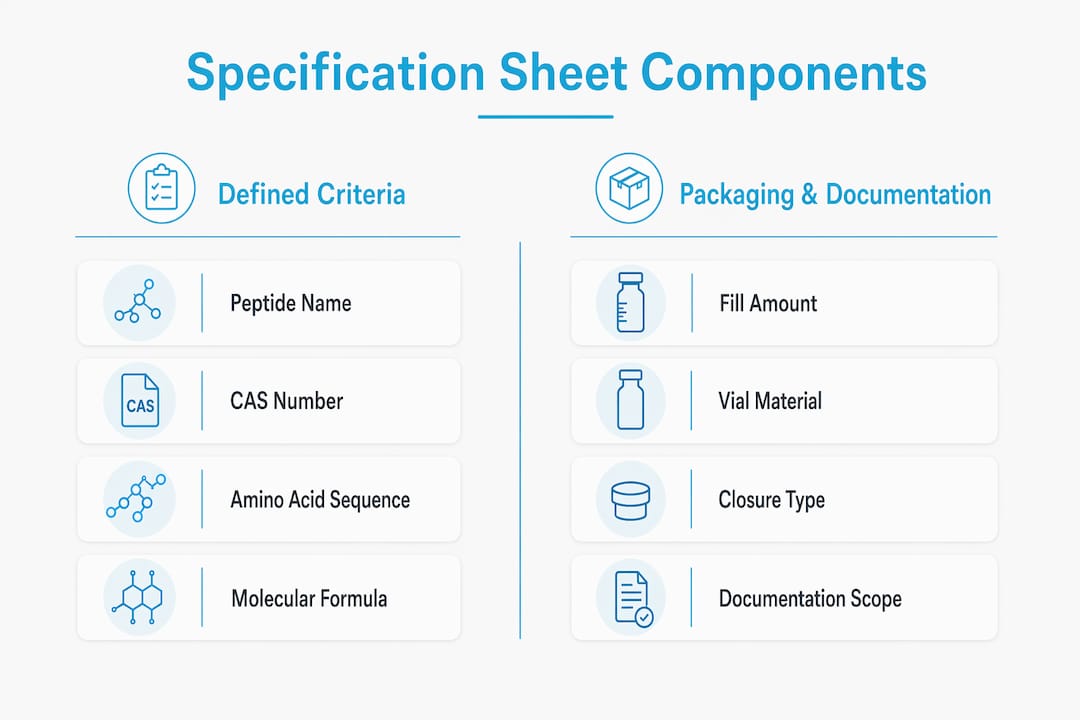
A peptide specification sheet typically includes the peptide name, CAS number, amino acid sequence, molecular formula, molecular weight, purity thresholds, storage conditions, packaging details, and shelf life. Each element carries procurement weight. The sequence confirms identity. The purity threshold sets the minimum acceptable standard. Storage conditions determine cold-chain requirements and shipping costs.
The document also specifies fill amount per vial, vial material, closure type, and the scope of documentation the supplier must provide. These details lock in at least 12 critical variables before a purchase order is placed. That specificity prevents the most common sourcing disputes: wrong vial format, missing documentation, or a purity figure that does not match what was quoted.

Procurement teams should understand the difference between a specification sheet and a Certificate of Analysis (COA). A specification sheet defines what the product must be. A COA reports what a specific batch actually tested as. The COA is only meaningful when compared against a pre-agreed specification sheet. Without the specification sheet, COA data is contextless and cannot be used to accept or reject a batch.
The analytical section of a specification sheet deserves particular attention. Purity is typically expressed as HPLC area percent, but this figure does not equal absolute peptide content. A peptide reported at 98% purity by HPLC may contain only 70–80% actual peptide mass once residual moisture, salts, and counterions are accounted for. The specification sheet should require net peptide content disclosure alongside chromatographic purity.
Key components that a complete specification sheet must address:
Peptide identity: name, CAS number, sequence, molecular formula, and molecular weight
Purity specification: HPLC area percent threshold and net peptide content requirement
Impurity limits: maximum allowable levels for related substances and residual solvents
Physical form: lyophilized powder, fill weight per vial, and vial material
Packaging: closure type, secondary packaging, and labeling requirements
Documentation scope: required analytical reports, batch number format, and testing methodology
Storage and shelf life: temperature range, humidity limits, and expiry dating
Pro Tip: Require net peptide content as a separate line item in the specification sheet, not just HPLC purity. This single addition eliminates the most common dosing miscalculation in research peptide procurement.
How do specification sheets improve compliance and governance?
Regulatory frameworks and institutional governance policies increasingly require documentation to be defined at the request-for-quotation (RFQ) stage, not after goods arrive. Failing to require comprehensive documentation at the RFQ stage creates compliance liabilities and extends procurement timelines. Procurement teams that wait until delivery to request COAs, HPLC reports, mass spectrometry data, and Safety Data Sheets (SDS) face delays and, in some cases, rejection by internal quality assurance functions.
The EMA Synthetic Peptide Guideline serves as the essential benchmark for peptide characterization, even for research-grade materials not subject to regulatory submission. Procurement teams sourcing peptides for institutional research programs benefit from aligning their specification requirements with this framework. It signals to suppliers that documentation standards are non-negotiable and provides a defensible basis for supplier qualification decisions.
A supplier who cannot produce a complete specification sheet before quoting is signaling something important: their internal quality systems may not be mature enough to guarantee batch-to-batch consistency. Documentation gaps are practical signals of supplier quality discipline and traceability readiness. Procurement teams that treat documentation requests as administrative formalities miss this diagnostic value entirely.
Specification sheets also reduce internal friction. When procurement, quality assurance, and end users agree on a specification before sourcing begins, there is no ambiguity at goods receipt. The specification sheet becomes the single reference point for acceptance decisions. This alignment shortens approval cycles and reduces the back-and-forth that typically follows when documentation is incomplete or inconsistent.
Benefits of requiring specification sheets at the RFQ stage:
Satisfies internal governance and institutional compliance requirements before procurement begins
Provides a documented basis for supplier qualification and disqualification
Reduces post-delivery disputes by establishing acceptance criteria in advance
Enables meaningful comparison of supplier quotes against identical product definitions
Signals to suppliers that documentation standards are enforced, not optional
What procurement pitfalls arise without specification sheets?
The most damaging pitfall is accepting purity claims at face value. A supplier quoting “98% purity” without a specification sheet defining the measurement method, the reference standard, and the net peptide content requirement is providing a figure that cannot be verified or compared. Purity percentages alone can mislead dosing calculations due to salt forms and residuals. Procurement teams that do not require net peptide content clarification routinely overpay for product that delivers less active material than expected.
The second major pitfall is comparing non-uniform supplier quotes. Without a specification sheet, each supplier quotes to their own internal standard. One supplier’s “98% pure, 1mg/vial” may use a different HPLC method, a different salt form, and a different vial material than another supplier’s identical-sounding offer. The specification-backed quotation approach eliminates this problem by forcing all suppliers to quote against the same defined product.
Procurement scenario Without specification sheet With specification sheet Purity comparison Suppliers use different methods; figures are not comparable All suppliers quote to the same HPLC and net content standard Vial format Format varies by supplier default Fill weight, vial material, and closure type are fixed COA evaluation COA data has no reference point for acceptance COA is evaluated against pre-agreed specification criteria Batch traceability Batch records may be incomplete or absent Documentation scope is defined and required before order Supplier accountability Disputes resolved by negotiation Disputes resolved by reference to agreed specification
Documentation gaps also compromise batch traceability. When a supplier ships product without a batch-specific COA tied to a pre-agreed specification, there is no audit trail connecting the product in the vial to the synthesis batch, the raw materials used, or the analytical results generated. This gap is not just a compliance risk. It is a research reproducibility risk. Results generated with an unverified batch cannot be reliably replicated.
Pro Tip: When issuing an RFQ, attach the specification sheet as a mandatory response document. Suppliers who return quotes without completing the specification requirements should be deprioritized in the evaluation, regardless of price.
Best practices for applying specification sheets in peptide procurement
Procurement teams that apply specification sheets effectively follow a consistent sequence. The specification is agreed before the RFQ is issued, not after the supplier is selected.
Draft the specification sheet before issuing the RFQ. Define purity thresholds, net peptide content requirements, vial format, documentation scope, and storage conditions. Involve quality assurance and end users in this step to prevent downstream misalignment.
Include the specification sheet as a mandatory attachment in the RFQ. Require suppliers to confirm acceptance of each specification line item in their response. Any deviation must be flagged and justified by the supplier in writing.
Evaluate supplier documentation packages as part of the qualification process. A supplier who provides a complete, well-structured documentation package at the quotation stage demonstrates internal quality discipline. Third-party laboratory verification carries more credibility than in-house analytical reports alone. Require independent testing results where batch values are critical.
Integrate specification sheet compliance into supplier ranking criteria. Score suppliers on documentation completeness, response accuracy, and willingness to provide specification-backed quotations. Use this score alongside price and lead time in the final selection decision.
Align procurement, quality assurance, and research teams on the specification before the purchase order is issued. This coordination prevents the common scenario where a batch is accepted by procurement but rejected by the lab because the specification was never shared with end users.
Review and update specification sheets when product requirements change. A specification sheet is a living document. If the research protocol changes, the specification must change with it. Outdated specifications create the same risks as no specification at all.
A professional procurement checklist for peptide sourcing should treat specification sheet agreement as a gate, not a formality. No purchase order should be issued without a signed or confirmed specification on file.
Key Takeaways
Specification sheets are the single most effective tool for controlling quality, compliance, and supplier accountability in peptide procurement.
Point Details Specification sheet vs. COA The specification sheet defines what a product must be; the COA reports what a batch tested as. Net peptide content Always require net peptide content alongside HPLC purity to avoid dosing miscalculations. RFQ stage documentation Require specification sheets at the RFQ stage to satisfy governance requirements and enable accurate supplier comparison. Supplier qualification signal A supplier who cannot produce a complete specification sheet before quoting signals weak internal quality systems. Third-party verification Independent lab results carry more weight than in-house analytical reports in supplier evaluation.
Specification sheets reveal more than quality data
The procurement teams I have observed struggle most with peptide sourcing share a common pattern: they treat the specification sheet as a delivery document rather than a procurement tool. They request it after the supplier is selected, sometimes after the order is placed. By that point, the specification has no leverage. The supplier has already quoted to their own standard, and the buyer has no contractual basis to reject product that does not meet unstated requirements.
What I find consistently true is that a supplier’s response to a specification sheet request tells you more about their operation than any marketing material. A supplier who pushes back on net peptide content disclosure, who cannot confirm vial material specifications, or who provides a COA without a corresponding specification reference is showing you the ceiling of their quality system. That ceiling matters more than their quoted price.
The COA misconception is also worth addressing directly. Many procurement professionals treat a COA as a quality guarantee. It is not. A COA is a performance record for a specific batch. It tells you what happened, not what was required. The specification sheet is the evaluation framework that gives the COA meaning. Without it, a COA with excellent numbers is just a document with no context.
The direction procurement is heading in 2026 is toward greater documentation scrutiny and supply chain transparency. Institutions are tightening their vendor qualification requirements. Specification-backed sourcing is becoming the baseline expectation, not a differentiator. Teams that build this discipline now will have a significant advantage when those requirements become mandatory.
For guidance on supplier contract negotiation that incorporates specification standards, the process starts with the same document: a clear, complete specification sheet agreed before any commercial terms are discussed.
— Sam Levin
PeptidesFromChina and specification-backed peptide sourcing
Products are subject to the manufacturer’s applicable quality-control procedures and specifications. Manufacturer-side analytical documentation may be available depending on the product and batch. PeptidesFromChina is not an independent analytical testing laboratory. The platform’s sourcing model is built on direct relationships with established synthesis facilities, not gray-market reseller channels.
Products are subject to the manufacturer’s applicable quality-control procedures and specifications. Manufacturer-side analytical documentation may be available depending on the product and batch. PeptidesFromChina is not an independent analytical testing laboratory. Buyers may confirm available specifications and documentation for a product and batch before committing to an order. Learn more: research-grade peptide catalog. Learn more: VIP research peptide range.
FAQ
What is a peptide specification sheet?
A peptide specification sheet is a procurement document that defines the agreed quality standards, analytical requirements, and product details a supplier must meet before a purchase order is issued. It typically includes purity thresholds, net peptide content, vial format, storage conditions, and required documentation.
How does a specification sheet differ from a COA?
A specification sheet defines what the product must be; a COA reports what a specific batch actually tested as. The COA is only interpretable when evaluated against a pre-agreed specification sheet.
Why does HPLC purity differ from net peptide content?
HPLC area percent measures chromatographic purity, which does not account for residual moisture, salts, or counterions. A peptide at 98% HPLC purity may contain only 70–80% actual peptide mass, making net peptide content a critical separate specification.
When should a specification sheet be requested in the procurement process?
Specification sheets should be agreed before the RFQ is issued, not after a supplier is selected. Requiring them at the RFQ stage enables accurate supplier comparison and satisfies institutional governance requirements.
What does a supplier’s response to a specification sheet request reveal?
A supplier’s ability to confirm or complete a detailed specification sheet signals the maturity of their internal quality systems. Suppliers who cannot provide specification-backed quotations are less reliable partners for long-term procurement relationships.