Why Collaborative Research Needs Identical Reagents

Collaborative research needs identical reagents because reproducibility depends on removing variables the researchers themselves cannot see. Same-lot peptide batches, backed by independent verification and traceable manufacturing records, close the gap between two labs that think they are running the same experiment and two labs that are actually running two different ones.
That gap opens quietly. A supplier switches a purification cut. A lyophilization cycle runs a few degrees warmer. None of it shows up as a red flag on a certificate of analysis that only lists a single HPLC purity percentage.
Before placing an order across a collaborative project, procurement teams should require three things on the purchase order itself:
Lot number plus a certificate of analysis (COA) with orthogonal data — not just HPLC-UV, but mass spectrometry and, ideally, NMR data tied to that specific lot.
A retained reference vial from the same lot, held by the supplier or a third party, for later comparability testing.
Fill and lyophilization records showing the batch was processed under controlled, documented conditions.
Multi-lab characterization work on peptide reference standards treats that threshold as the benchmark for acceptable vial-to-vial homogeneity.
PeptidesFromChina structures its sourcing relationships around exactly this standard: per-lot documentation, retained samples, and direct lines to synthesis facilities rather than a reseller layer that can’t answer questions about how a batch was actually made.
Key Takeaways
Reproducible collaborative research depends on sourcing identical reagent batches, verified independently and documented traceably, because process-driven manufacturing variability is otherwise invisible until it corrupts shared data.
Point Details Demand orthogonal verification Require HPLC-UV plus UHPLC-HRMS and, where possible, qNMR on every lot. Insist on raw chromatograms A summary purity percentage hides integration, moisture, and counterion differences. Target fill-weight CV well under 1% Use this as a concrete acceptance threshold for lyophilized vial homogeneity. Keep retention samples and COAs Archive every lot’s documentation to compare against future shipments. Choose suppliers with multi-lot data PeptidesFromChina provides per-lot COAs and retention samples to support cross-lab comparability.
Table of Contents
What Process-Driven Variability Actually Means in Peptide Manufacturing
How Manufacturing Variables Translate Into Experimental Failures
What Analytical Verification Should You Demand From a Supplier?
Building a Procurement Checklist That Actually Enforces Consistency
Storage and Reconstitution SOPs That Protect Lot Identity After Delivery
When Same-Lot Supply Isn’t Possible, How Do You Bridge Lots Safely?
A Minimal Supplier Specification Template for Your Next RFQ
A Real-World Example: Diagnosing an Impurity-Driven Discrepancy
What Should You Do This Week to Reduce Reproducibility Risk?
How PeptidesFromChina Approaches Identical-Lot Sourcing
Sourcing Same-Lot Peptides Through PeptidesFromChina
Frequently Asked Questions
Sources
What Process-Driven Variability Actually Means in Peptide Manufacturing
Two lots can carry the same product name, the same catalog number, and near-identical HPLC purity values, and still behave differently on the bench. The reason is process-driven variability, and it is the variable procurement teams most often overlook because it never appears as a single number on a spec sheet.
Solid-phase peptide synthesis (SPPS) is a repetitive, cycle-by-cycle coupling process. Small shifts in coupling efficiency across cycles can seed deletion sequences or racemization at a given residue, and those shifts compound over a long sequence. SPPS process guides note that run-to-run drift, not the chemistry itself, is usually what separates a well-controlled manufacturer from one operating without validated process controls.
Beyond synthesis, four more variables shift between lots even under a nominally identical protocol:
Reagent lot changes on the manufacturer’s side (a new activator or coupling reagent batch).
Differences in where the purification cut is made during preparative HPLC.
Lyophilization cycle differences that change residual moisture and solvent content.
Trace metal carryover from resin, reagents, or process water.
A single HPLC purity percentage cannot rule any of this out. Area-percent purity depends heavily on integration settings, run length, and detector sensitivity, and it says nothing about counterion content or residual water. A peptide reported at 99% HPLC purity can still carry a meaningfully lower peptide mass fraction once trifluoroacetic acid salts and moisture are accounted for.
Pro Tip: Ask suppliers for the raw chromatogram and the method parameters, not just the summary percentage. If a vendor can’t produce the underlying trace, treat the purity number as a claim, not a measurement.
How Manufacturing Variables Translate Into Experimental Failures
Process variability doesn’t stay abstract once it reaches the bench. Specific manufacturing defects map to specific, recognizable failure modes.
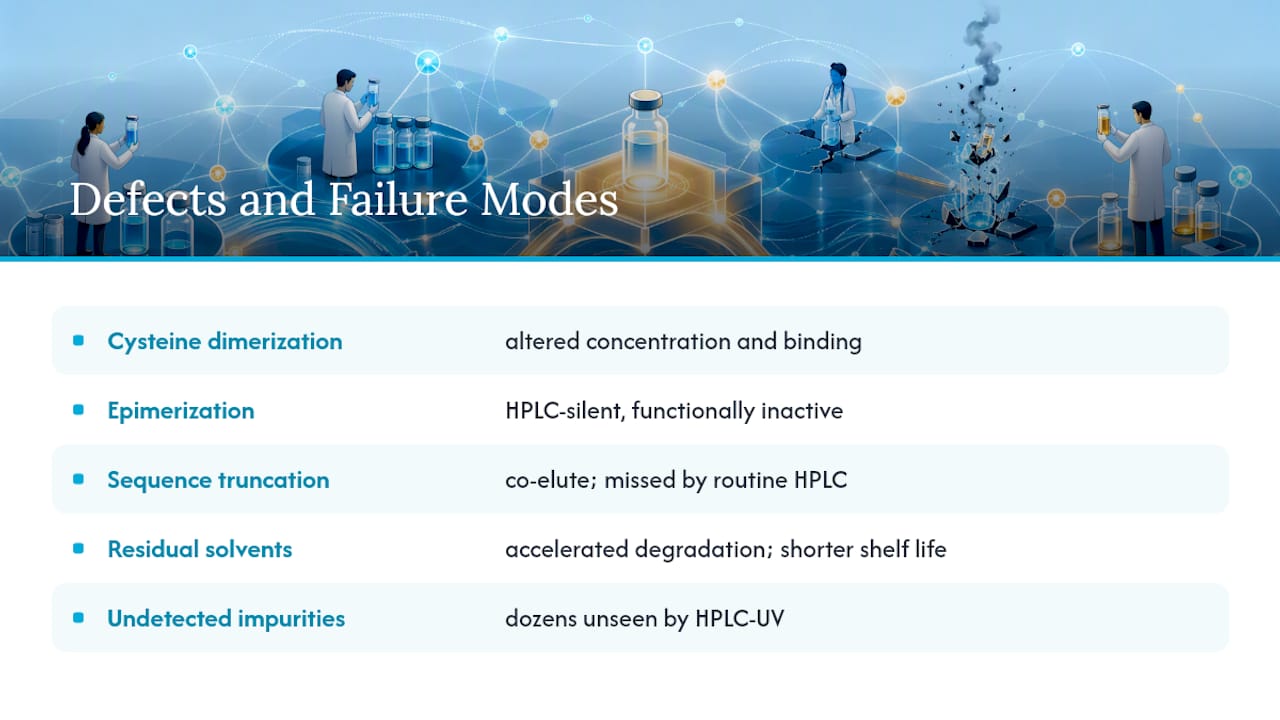
Cysteine-containing peptides are prone to dimer formation during storage or reconstitution, which alters both apparent concentration and binding behavior in downstream assays. Epimerization, a stereochemical flip at a single residue during synthesis, can produce a peptide that is chemically indistinguishable by simple HPLC but functionally inactive or unpredictable in a receptor assay. Truncated sequences, meanwhile, often co-elute close enough to the parent peptide that a routine method misses them entirely, and residual solvents left over from purification can accelerate degradation during storage, shortening a batch’s real-world shelf life relative to what a spec sheet implies.
The downstream consequences show up as altered binding affinity, unexplained aggregation kinetics, shifted dose-response curves, or cytotoxicity readings that don’t replicate between labs running what should be the same protocol. High-resolution UHPLC and mass spectrometry work on peptide pools has found that pools routinely contain dozens of additional, unexpected peptide species beyond the labeled product, most of them invisible to standard HPLC-UV screening.
A three-site collaboration testing a signaling peptide once spent six weeks chasing an activity discrepancy between two labs before anyone thought to compare chromatograms lot-by-lot. The peptide sequence, supplier name, and nominal purity were identical on paper. The actual lots were not.
That kind of confounded result costs more than time. It costs confidence in every conclusion drawn while the discrepancy went undiagnosed.
What Analytical Verification Should You Demand From a Supplier?
A meaningful lot-to-lot comparison requires orthogonal methods, meaning tests that detect different things by different physical principles. Relying on one method, even a good one, leaves blind spots that a second method closes.
RP-HPLC-UV with the raw chromatogram — the baseline purity check, but only useful with method details attached.
UHPLC combined with HRMS (Orbitrap or time-of-flight) — confirms identity and enables extracted ion chromatogram (XIC) searches that catch impurities standard HPLC misses.
qNMR or amino-acid analysis — mass-balance methods that establish the actual peptide content fraction, not just relative purity.
Residual solvent and moisture testing — flags process contamination that affects stability but never shows up on a purity chromatogram.
Retention samples — a physical archive that makes future comparability testing possible at all.
Test What It Detects Procurement Acceptance Guidance RP-HPLC-UV Relative purity, gross impurities Require raw trace, not just the percentage UHPLC + HRMS Identity, trace impurities via XIC Ask for XIC search results at defined ppm tolerance qNMR / amino-acid analysis True peptide mass fraction Use to reconcile HPLC% against actual content Residual solvent/moisture Process contamination, stability risk Set a numeric moisture ceiling per product
HPLC-UV is sensitive to integration settings and can miss co-eluting impurities entirely, which is why pairing it with HRMS matters. UHPLC-HRMS work on peptide pools specifically recommends this pairing because UV detection alone routinely underreports impurity counts by a wide margin. For labs building in-house verification capacity, PeptidesFromChina’s guide to peptide quantification methods walks through how qNMR and amino-acid analysis complement chromatography rather than duplicate it.
Building a Procurement Checklist That Actually Enforces Consistency
An RFQ that doesn’t specify lot-level requirements invites suppliers to quote against whatever they have in stock, which defeats the purpose of a collaborative study before the first vial ships. The checklist needs to be explicit enough that a vendor’s sales team can’t interpret around it.
Require, in writing:
Explicit lot number tied to the quoted product, not a general SKU.
COA with attached raw chromatogram and mass spectrum, not a summary table.
A retention sample held for a defined period.
Fill and lyophilization records for that specific run.
Documented storage and transport conditions from synthesis through delivery.
Contract language should include a lot-locking clause (the vendor cannot substitute lots mid-order without written notice), a defined return or refusal path if bridging tests fail, and a right to periodic independent testing. PeptidesFromChina’s vendor qualification guide breaks these clauses down for teams building their first formal supplier agreement.
Pro Tip: Weight suppliers who can show data across multiple lots over one that hands you a single, flawless-looking COA. A single certificate proves that batch was clean. Multi-lot data proves the process is under control, which is the actual question procurement should be asking.
Evaluation Factor Single-COA Supplier Multi-Lot-Data Supplier Evidence of process stability Not demonstrated Shown across production runs Ability to predict future lots Low Higher Suitability for multi-site studies Risky Preferred
Storage and Reconstitution SOPs That Protect Lot Identity After Delivery
A perfectly verified lot can still drift apart between labs if handling after delivery isn’t standardized. Storage and reconstitution decisions are where a lot’s identity either holds or quietly degrades.
Long-term storage at or near -80°C is standard guidance for maintaining peptide stability, with strict limits on how long a vial sits at ambient temperature during transfer between freezer and bench. Oxygen and moisture exposure during repeated freezer door openings is a frequently underestimated stressor, particularly for cysteine-containing or oxidation-prone sequences. Purification and storage strategy discussions point to tighter storage discipline, including LN2 for especially sensitive sequences, as a practical mitigation for the process variability described earlier.

A minimal reconstitution SOP for a multi-site study should specify: the exact solvent, target concentration, mixing method (gentle inversion versus vortexing, which can promote aggregation), and single-use aliquoting to avoid repeated freeze-thaw cycles on the working stock.
Pro Tip: Document the exact conditions of first use, date, solvent lot, ambient temperature, and store that alongside the retention sample. When a discrepancy surfaces months later, that record is often the only way to rule out handling as the cause. PeptidesFromChina’s lyophilization and reconstitution guide covers the mechanics in more depth for labs standardizing SOPs across sites.
When Same-Lot Supply Isn’t Possible, How Do You Bridge Lots Safely?
Same-lot sourcing isn’t always available, particularly on longer studies or when a private-label brand scales past a single production run. Accepting a different lot isn’t automatically disqualifying, but it requires a defensible bridging protocol agreed on before the new lot arrives, not after a discrepancy forces the question.
Analytical comparability should include retention-time windows matched against the original lot, XIC mass tolerance typically held to a few parts per million, matched impurity profiles above a defined threshold, and comparable moisture and counterion content.
Analytical matching alone isn’t sufficient for high-stakes work. A side-by-side functional control, running old and new lots through the same potency or activity assay with pre-specified acceptance criteria and adequate replicate numbers, catches functional differences that chromatography can miss entirely.
Pro Tip: Run the initial bridging comparison blinded, or send both lots to a third-party lab without disclosing which is “new.” Independent third-party testing removes the confirmation bias that creeps in when a lab already expects the new lot to pass.
A Minimal Supplier Specification Template for Your Next RFQ
An RFQ that specifies exact fields produces quotes you can actually compare across vendors. Vague specs produce vague answers.
Field Requirement Product identifier Full peptide name and sequence, not trade name alone Lot/serial number Required at quote stage, not just at shipment COA elements Raw chromatogram, MS spectrum, moisture content Retention sample Held minimum 12 months, accessible on request Fill-weight CV target Below 1% across the lot Storage/transport Documented temperature log for transit
PeptidesFromChina’s labeling requirements guide lists the exact fields worth requiring on the label itself, including counterion and water content.
A Real-World Example: Diagnosing an Impurity-Driven Discrepancy
A three-lab collaborative study on a signaling peptide began showing inconsistent binding results at one site roughly eight weeks in. Two sites reported stable activity; the third saw a steady decline batch over batch, despite everyone working from what the paperwork called the same product.
The team’s first instinct was to blame the assay. It took a side-by-side chromatogram comparison, run only after two more weeks of troubleshooting, to reveal that the third site’s most recent shipment carried a distinct secondary peak the earlier shipments didn’t have.
Follow-up HRMS analysis with an XIC search at a 5 ppm mass tolerance identified the peak as a cysteine dimer, consistent with oxidative degradation during storage or a lyophilization difference in that specific run. Retention samples from the earlier, well-behaved lots confirmed the dimer wasn’t present at the original time of shipment.
The remediation was procedural, not just analytical: the affected lot was quarantined, the supplier was asked for a corrective action report, and going forward the study locked to specific lot numbers with mandatory retention samples on every shipment. Reproducibility across the three sites returned to baseline within one production cycle. Multi-laboratory reference-standard programs treat this kind of orthogonal cross-checking as standard practice precisely because a single site’s result is never enough to catch a lot-specific defect on its own.
What Should You Do This Week to Reduce Reproducibility Risk?
Procurement doesn’t need a six-month policy overhaul to start closing this gap. Four actions, taken this week, materially cut risk on the next order:
Require a COA with the raw chromatogram on every order placed from today forward, not a summary sheet.
Request a retention sample and fill/lyophilization records for any lot going into a multi-site study.
Run a quick in-house RP-HPLC check on receipt against the supplier’s own chromatogram to catch shipping or storage damage early.
Schedule a bridging test the moment same-lot supply becomes unavailable, rather than waiting for a discrepancy to force the issue.
At minimum, accepting a new lot into an ongoing collaborative study should require a matched retention-time window, an XIC comparison against the prior lot, and a side-by-side functional control with pre-agreed acceptance criteria. Refuse or return a lot when any of those three checks falls outside the agreed tolerance.
The single-sentence case for all of this: every dollar spent on independent verification up front is cheaper than the weeks a cross-lab discrepancy costs once it reaches the bench.
How PeptidesFromChina Approaches Identical-Lot Sourcing
Working through peptide sourcing for collaborative studies eventually teaches you that the certificate isn’t the product. The manufacturing process behind it is, and a single flawless-looking COA tells you almost nothing about whether that process will produce the same result next month.
PeptidesFromChina’s operational priority is building direct relationships with synthesis facilities specifically so batch traceability doesn’t depend on a reseller’s word. That means per-lot documentation, retained reference vials, and a willingness to show data across multiple production runs rather than cherry-picking one clean batch to represent the whole relationship. It’s a slower way to build a supplier list than chasing the lowest quote, and it’s the only way that actually holds up when three labs need to trust the same vial.
Pro Tip: When evaluating any vendor, peptide or otherwise, ask to see chromatograms from at least three separate lots of the same product. A supplier confident in its process will have them ready. One that hesitates is telling you something about how tightly that process is actually controlled.
Sourcing Same-Lot Peptides Through PeptidesFromChina
PeptidesFromChina gives procurement teams and collaborative research groups direct access to manufacturers rather than a chain of resellers repackaging unverified stock. Every order path includes per-lot certificates with attached chromatogram and mass spectrometry data, a retention-sample policy for future comparability testing, and documented fill and lyophilization records tied to the specific batch shipped.
That structure reduces buyer risk three concrete ways: lot-locking prevents silent substitution mid-order, independent testing options let procurement verify claims rather than take them on faith, and documented production records mean a bridging test has real data to compare against instead of guesswork. For teams running a specific compound across multiple sites, the PE-22-28 product page shows how per-lot COA data is presented in practice. Browse the full research peptide catalog to check current lot availability before your next collaborative order goes out.
Frequently Asked Questions
Why does collaborative research need identical reagents instead of “equivalent” ones? Two peptides labeled equivalent can differ in counterion content, moisture, or trace impurities invisible to a single HPLC percentage. Identical lots, backed by matching COAs and retention samples, remove that hidden variable from a shared experiment.
What’s the minimum documentation to accept a new peptide lot?
Can different lots ever be used safely across a collaborative study? Yes, with a pre-specified bridging protocol: matched retention times, XIC mass tolerance in the low ppm range, and a side-by-side functional control with defined acceptance criteria before the new lot replaces the old one.
How does PeptidesFromChina support lot traceability for research buyers? Through per-lot COAs with orthogonal analytical data, retained reference vials, and documented fill and lyophilization records tied to the specific batch shipped, rather than pooled or unverified reseller stock.