What Is Just in Time Peptide Sourcing for Researchers

Just-in-time (JIT) peptide sourcing is defined as the procurement or production of peptide materials precisely when needed to match downstream synthesis schedules, eliminating excess inventory and minimizing lead-time risk. In practice, this means synchronizing critical inputs such as non-canonical amino acids (NCAAs) with solid-phase peptide synthesis (SPPS) timelines rather than stockpiling materials in advance. Organizations like Sinopep and GenScript have demonstrated that this model reduces supply chain vulnerabilities while improving manufacturing efficiency. For researchers and procurement professionals, understanding JIT peptide sourcing is the foundation for building a supply chain that delivers consistent quality and predictable availability across every study phase.
What is just-in-time peptide sourcing and how does it work?
JIT peptide sourcing aligns the procurement or production of critical starting materials (CSMs) strictly with the immediate requirements of the peptide synthesis schedule. The model eliminates the traditional practice of holding large pre-synthesized batches, replacing it with tightly coordinated supply windows that match each production run. This approach is most clearly demonstrated in the integration of enzymatic NCAA production with downstream SPPS workflows.
The operational sequence follows a defined logic:
Map the SPPS schedule and identify all CSMs required at each synthesis stage.
Qualify suppliers or establish in-house biocatalytic capacity to produce NCAAs on demand.
Set procurement triggers based on synthesis milestones rather than calendar-based reorder points.
Confirm batch quality and stereochemical purity before each synthesis run begins.
Adjust procurement windows dynamically as synthesis timelines shift during development.
In-house biocatalytic synthesis of NCAAs enables JIT manufacturing by providing controlled, stereochemically pure CSMs synchronized to the SPPS schedule. This model removes dependence on third-party chemical suppliers, which is the most common source of unplanned delays in peptide programs. When a CDMO or research facility produces NCAAs internally, it controls both the timing and the quality of the input, eliminating the inventory buffers that traditional sourcing requires.
Supply chain security in peptide manufacturing begins at enzymatic NCAA production, which cannot be effectively outsourced without increasing risk. This is a structural reality, not a preference. Outsourcing this step introduces a single point of failure that JIT models are specifically designed to avoid.
Pro Tip: Before adopting a JIT model, map every CSM to its sole-source supplier. Any input with only one qualified external vendor is a single point of failure. Address these dependencies first, either by qualifying a second supplier or establishing in-house production capacity.
What are the benefits and challenges compared to traditional sourcing?
Late-stage peptide development prioritizes supply reliability and timeline risk over cost minimization, which is the core reason JIT sourcing has gained traction in advanced programs. Traditional bulk inventory sourcing offers simplicity but introduces its own risks: material degradation during storage, capital tied up in unused stock, and quality drift across long-held batches. JIT sourcing addresses each of these directly.
Factor JIT sourcing Traditional bulk sourcing Inventory cost Low; materials procured on demand High; large batches held in storage Supply reliability High when synchronized correctly Moderate; dependent on batch shelf life Lead-time risk Reduced through schedule alignment Higher; delays affect entire stockpile Quality consistency Controlled per synthesis run Variable across stored batches Scalability Requires precise coordination Easier to scale with pre-built stock Regulatory exposure Lower with in-house production Higher with multiple external vendors
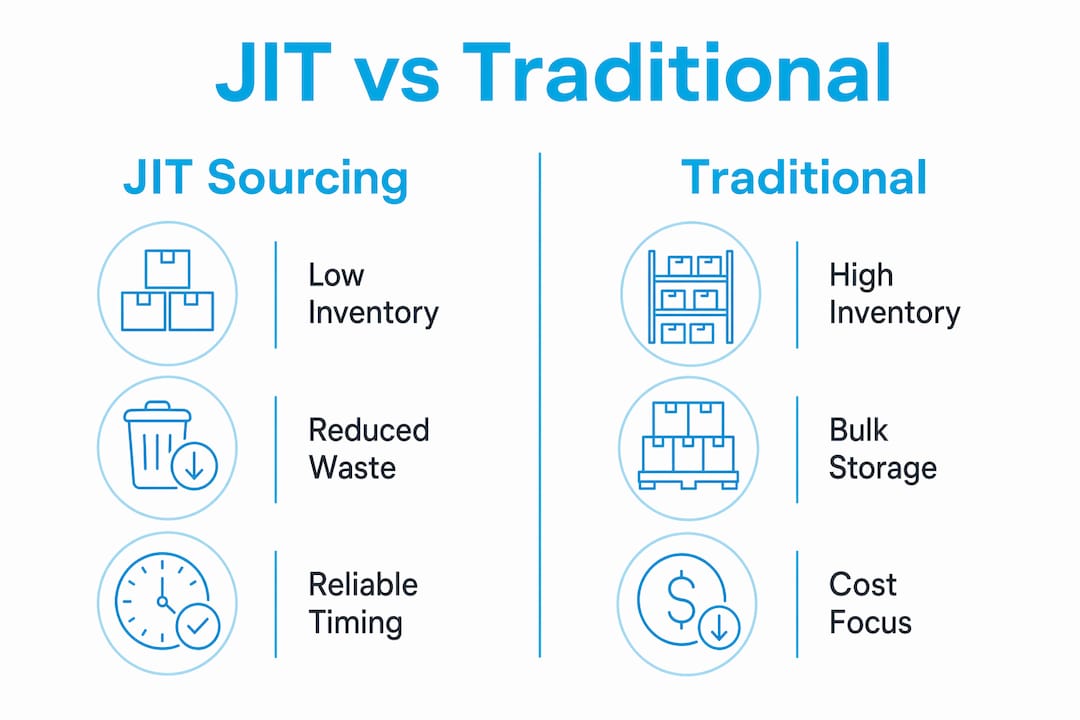
The benefits are clear for programs with defined synthesis schedules. JIT sourcing reduces inventory carrying costs, improves batch-to-batch consistency, and shortens the gap between material availability and synthesis execution. For procurement teams managing multiple peptide programs simultaneously, these advantages compound across the portfolio.
The challenges are equally real. JIT sourcing depends on timing accuracy at every stage. A delay in NCAA delivery of even 48 hours can halt an SPPS run, creating downstream schedule failures that are difficult to recover from. Upstream supply risks, including vendor capacity constraints and raw material shortages, become more consequential when there is no inventory buffer to absorb them.
Peptide synthesis strategy choices directly impact cost, supply reliability, and commercial timelines, with risks escalating for longer and more complex peptides. This means JIT sourcing is not universally appropriate. Programs involving highly complex sequences with elevated batch failure risk may require hybrid approaches that combine JIT procurement for standard inputs with strategic buffering for high-risk CSMs.
Pro Tip: For programs where a single CSM has no qualified backup supplier, maintain a minimum 30-day safety stock for that input only. Apply JIT principles to all other materials. This hybrid buffer strategy preserves the efficiency gains of JIT while protecting against the highest-consequence failure points.
Which peptide manufacturing strategies align best with JIT sourcing?
The synthesis method selected for a peptide program determines how well JIT sourcing can be integrated. Three primary approaches exist: solid-phase peptide synthesis (SPPS), liquid-phase peptide synthesis (LPPS), and hybrid synthesis combining elements of both.
Synthesis method JIT compatibility Key advantage Primary limitation SPPS High Modular, step-by-step synthesis aligns with JIT input timing Batch failure risk increases with peptide length LPPS Moderate Cost-effective for shorter sequences Less modular; harder to synchronize with JIT windows Hybrid SPPS/LPPS Highest Fragment-level quality control; reduces batch failure risk Greater coordination complexity
SPPS is the most widely used method and aligns naturally with JIT sourcing because each synthesis cycle requires a defined set of protected amino acids at a specific time. This modularity makes procurement scheduling straightforward. However, escalating peptide length and complexity significantly increases batch failure risk in SPPS, which means longer sequences require more precise input quality control to protect the JIT schedule.

Hybrid peptide synthesis, which combines SPPS and LPPS, offers advantages in purity, scalability, and sustainability that align directly with JIT sourcing needs. By synthesizing peptide fragments separately and then coupling them, hybrid methods allow quality verification at the fragment level before final assembly. This reduces the risk of a full-batch failure caused by a single defective input, which is the most costly failure mode in JIT manufacturing.
Integrated manufacturing strategies for peptide programs emphasize scale, speed, supply security, and sustainability to meet evolving development demands. For procurement professionals evaluating CDMOs, the critical question is whether the CDMO controls its own CSM production or relies on external vendors for NCAAs and other specialized inputs. A CDMO that sources NCAAs externally introduces the same single-point-of-failure risk that JIT sourcing is designed to eliminate.
What steps should researchers take to implement JIT peptide sourcing?
Implementing JIT peptide sourcing requires a structured assessment of the existing supply chain before any procurement changes are made. The goal is to identify where the current model introduces risk and where JIT synchronization can replace it.
Audit all CSMs used in active peptide programs and map each to its current supplier, lead time, and quality record.
Identify single-source dependencies, particularly for NCAAs and other specialized inputs that cannot be rapidly substituted.
Evaluate whether in-house biocatalytic production of NCAAs is feasible given program scale and facility capabilities.
Qualify at least two suppliers for every high-risk input where in-house production is not viable.
Establish synthesis-milestone-based procurement triggers to replace calendar-based reorder systems.
Implement supply chain monitoring tools that provide real-time visibility into vendor lead times and batch release status.
Verify that all suppliers meet applicable quality standards. Researchers and procurement teams must verify peptide origins and manufacturing methods to avoid risks associated with non-approved or grey-market materials.
Document the JIT procurement schedule as part of the program’s quality management system to support regulatory submissions.
The quality verification process applied to each incoming batch is as important as the timing of procurement. A material that arrives on schedule but fails purity specifications causes the same schedule disruption as a late delivery. Full-sequence validation and certificate of analysis review must be built into the JIT workflow, not treated as optional steps.
Demand forecasting tools, including ERP systems with synthesis-schedule integration, reduce the coordination burden on procurement teams managing multiple programs. The objective is to automate procurement triggers wherever possible, reserving manual oversight for high-risk inputs and exception management.
Key takeaways
JIT peptide sourcing delivers supply reliability and batch consistency only when procurement is synchronized with synthesis schedules and every critical starting material has a qualified, verified supply pathway.
Point Details JIT definition Procurement of peptide materials timed precisely to synthesis schedules, eliminating excess inventory. NCAA synchronization In-house biocatalytic NCAA production is the most reliable enabler of true JIT supply alignment. Synthesis method matters Hybrid SPPS/LPPS offers the highest JIT compatibility for complex, late-stage peptide programs. Single points of failure Every sole-source CSM supplier represents a structural risk that must be addressed before JIT adoption. Quality verification Batch purity validation must be integrated into the JIT workflow, not treated as a separate process.
Why JIT sourcing deserves more strategic attention in 2026
I have watched procurement teams in peptide research treat sourcing as a logistics function rather than a scientific one. That framing is the root cause of most supply chain failures I have seen in this field. When a synthesis run stalls because an NCAA shipment is delayed or a batch fails purity on arrival, the downstream cost is not just financial. It is weeks of lost experimental time and, in commercial programs, potential regulatory timeline slippage.
What strikes me about the JIT model is that it forces a discipline that most procurement teams avoid: mapping dependencies before they become failures. The organizations that implement JIT sourcing well are the ones that have already done the hard work of qualifying their supply base and understanding exactly where their synthesis schedules are vulnerable. The JIT model does not create that discipline. It reveals whether it already exists.
The emerging role of biocatalytic NCAA production as a JIT enabler is the development I find most significant in 2026. When a facility can produce stereochemically pure NCAAs on a defined schedule tied directly to its SPPS calendar, it removes the most unpredictable variable in the entire supply chain. That is not a marginal improvement. It is a structural change in how peptide manufacturing risk is managed.
My recommendation for procurement professionals evaluating their sourcing models: do not adopt JIT as a cost-reduction strategy. Adopt it as a quality and reliability strategy. The inventory savings are real, but they are secondary to the primary benefit, which is a supply chain that does not fail at the worst possible moment.
— Samir
How Peptidesfromchina supports reliable peptide sourcing
PFC coordinates sourcing from established Chinese manufacturing facilities together with international logistics. Every peptide in the research catalog is backed by full-sequence validation and a certificate of analysis, giving procurement teams the documentation they need to integrate sourcing into a JIT workflow without additional verification overhead. Products like Epithalon and SNAP-8 are available with consistent batch quality and delivery timelines aligned to research schedules. For teams that cannot afford supply disruptions, PFC coordinates sourcing from established Chinese manufacturing facilities together with international logistics.
FAQ
What is just-in-time peptide sourcing?
Just-in-time peptide sourcing is the practice of procuring or producing peptide materials precisely when needed to match synthesis schedules, eliminating excess inventory and reducing lead-time risk. It typically involves synchronizing critical starting materials such as NCAAs with the SPPS production timeline.
How does JIT sourcing differ from traditional peptide procurement?
Traditional procurement holds large pre-synthesized batches in storage, while JIT sourcing triggers procurement based on synthesis milestones. JIT reduces inventory costs and improves batch consistency but requires precise supply chain coordination and qualified suppliers.
What is the biggest risk in JIT peptide sourcing?
The primary risk is a single point of failure at the CSM level, particularly for NCAAs sourced from a sole external vendor. In-house biocatalytic production of these inputs is the most effective way to eliminate this vulnerability.
Which synthesis method works best with JIT peptide delivery?
Hybrid synthesis combining SPPS and LPPS offers the highest compatibility with JIT sourcing because it allows fragment-level quality control and reduces full-batch failure risk. SPPS alone is suitable for shorter, less complex sequences.
How should procurement teams verify peptide quality in a JIT model?
Teams must verify manufacturing origin and quality systems for every supplier and require a certificate of analysis for each incoming batch. Quality verification must be built into the JIT procurement workflow, not conducted as a separate downstream step.