Types of Peptide Reference Standards: A Lab Guide

Peptide reference standards are well-characterized materials used to validate assays, calibrate instruments, and anchor quality control decisions in peptide research. The types of peptide reference standards fall into two overlapping classification systems: a hierarchical tier system (primary, secondary, and in-house working standards) and a chemical classification system (native, stable isotope-labeled, and impurity standards). Research scientists who conflate these two frameworks, or who rely solely on chromatographic purity figures, routinely introduce dosing errors and reproducibility failures that are difficult to trace back to their source.
1. The three hierarchical types of peptide reference standards
Peptide reference standards fall into three tiers: primary, secondary (working), and in-house working standards, each with distinct roles in quality control. This hierarchy is not arbitrary. It reflects the cost, scarcity, and analytical burden associated with each tier.
Primary standards carry the highest level of characterization. They are assigned an absolute peptide content value using multiple orthogonal methods, including quantitative amino acid analysis (qAAA) and quantitative NMR (qNMR). These materials serve as the calibration anchor for everything downstream.

Secondary standards, also called working standards, are qualified by direct comparison to the primary standard through formal bridging studies. Routine daily QC testing should use secondary or in-house working standards to preserve primary standards, which are too expensive and limited in quantity for repeated daily use.
In-house working standards sit at the base of the hierarchy. Labs prepare these internally from bulk peptide lots and qualify them against the secondary standard. They handle the volume of routine testing without depleting higher-tier materials.
2. Native peptides as unmodified reference materials
Native peptides are unmodified sequences that match the naturally occurring or target molecule exactly. They are the most common chemical type used in binding assays, receptor pharmacology, and immunoassay calibration. Their value lies in structural authenticity: they behave in biological matrices the same way the endogenous molecule does.
The limitation of native peptides as reference materials is quantification accuracy. Without absolute content determination, a native peptide standard labeled “98% purity” may contain significantly less actual peptide by weight than the label implies. This matters most in molar dosing experiments where concentration accuracy directly affects outcome interpretation.
3. Stable isotope-labeled peptides for LC-MS quantification
Stable isotope-labeled (SIL) peptides are essential for LC-MS based quantification. SIL peptides incorporate heavy isotopes, typically deuterium, carbon-13, or nitrogen-15, into one or more residues. This shifts the mass of the labeled peptide by a predictable amount without altering its chromatographic behavior.
The practical result is a near-perfect internal standard. Because the SIL peptide co-elutes with the native analyte and responds identically to ionization conditions, it corrects for matrix effects and instrument variability in a way that external calibration curves cannot. SIL standards are the method of choice for biomarker quantification, pharmacokinetic studies, and any LC-MS workflow where absolute concentration accuracy is required.
Pro Tip: When ordering SIL peptides, confirm the isotope incorporation site and the number of labeled residues. A single labeled residue at the C-terminus is common but may be insufficient for long peptides where fragmentation patterns matter.
4. Impurity standards for synthesis-related variant identification
Impurity standards represent known synthesis byproducts: deletion sequences, oxidized residues, deamidated variants, and racemized amino acids. They are not contaminants in the pejorative sense. They are characterized materials used to identify and quantify those same variants in production lots.
Impurity standards help identify synthesis byproducts and are critical for method development in quality control workflows. Without them, a laboratory cannot distinguish between a clean peptide lot and one carrying a biologically active impurity that could confound assay results.
The demand for impurity standards has grown as regulatory expectations around peptide drug substance characterization have tightened. ICH Q6B and related guidance documents require manufacturers to identify and control impurities above defined thresholds.
5. How purity thresholds vary by application
Purity requirements for reference standards are not uniform. Purity thresholds vary by application, with greater than 95% purity standard for structural and quantitative studies, 90–95% for immunoassays, and less than 80% acceptable for screening assays. Each tier reflects the tolerance for background interference in that assay format.
The more important distinction is between chromatographic purity and absolute peptide content. Certificates of Analysis claiming 98% purity usually reflect chromatographic area percentage, not absolute peptide content, which may be 70–80% after accounting for residual water, counterions, and synthesis-related impurities. This gap is not a vendor error. It is a reporting convention that most researchers do not account for when preparing stock solutions.
Greater than 95% purity: required for quantitative binding studies, pharmacokinetic assays, and primary standard qualification
90–95% purity: acceptable for immunoassay calibration and most cell-based assays
Less than 80% purity: used only for initial screening where hit identification matters more than quantitative accuracy
GMP-grade materials: require full ICH-compliant testing including sterility (USP <71>), endotoxin (LAL), and heavy metals (ICP-MS)
GMP-grade peptides undergo comprehensive testing costing substantially more than research-use-only (RUO) materials. That cost difference reflects real analytical work, not margin inflation.
Pro Tip: Always request the peptide content figure separately from the HPLC purity figure on a Certificate of Analysis. If a vendor cannot provide both, treat the purity claim as chromatographic area percentage only and adjust your stock concentration calculations accordingly.
6. Analytical methods that verify peptide reference standards
Verification of a peptide reference standard requires more than a single HPLC trace. Orthogonal analytical techniques like high-resolution mass spectrometry (HRMS), qNMR, and amino acid analysis are critical for quantifying peptide reference standards accurately. Multiple independent methods must be used to defend comparability in regulatory submissions.
The standard analytical panel for a well-characterized reference standard includes:
Reversed-phase HPLC (RP-HPLC): establishes chromatographic purity and detects co-eluting impurities
LC-MS or HRMS: confirms molecular identity and detects sequence variants, oxidation, and deamidation
Quantitative amino acid analysis (qAAA): determines absolute amino acid composition and net peptide content
Quantitative NMR (qNMR): provides an independent absolute content value traceable to SI units
Endotoxin testing (LAL, USP <85>): required for any standard used in cell-based or in vivo assays
Sterility testing (USP <71>): required for GMP-grade materials
Heavy metals (ICP-MS): required for pharmaceutical applications
A minimal credible Certificate of Analysis should include HPLC purity, mass spec identity, peptide content, and endotoxin levels. Anything less leaves critical quality attributes unverified.
The role of orthogonal verification is not redundancy for its own sake. Each method interrogates a different physical or chemical property. HPLC detects co-eluting impurities. Mass spec confirms sequence identity. qAAA measures actual amino acid content. No single method covers all failure modes.
7. Endotoxin documentation as a non-negotiable quality attribute
Endotoxin levels are a common but often overlooked source of biological assay irreproducibility. Standards used in in vivo applications should have documented endotoxin levels below 5 EU/vial per USP <85> guidelines. Many research peptides lack this documentation entirely.
The consequence of undocumented endotoxin is not just a failed experiment. It is a failed experiment with no clear cause. Endotoxin activates innate immune pathways at sub-nanogram concentrations. In cell-based assays, it can mimic or mask the biological activity of the peptide being studied. In animal studies, it confounds dose-response relationships in ways that are nearly impossible to separate from the peptide’s own pharmacology.
Researchers sourcing peptide standards for biological assays should treat endotoxin documentation as a minimum requirement, not an optional add-on.
8. Traceability and bridging studies across the standard hierarchy
A hierarchical traceability system from primary to in-house standards with formal bridging studies is critical for regulatory compliance and reproducibility. A bridging study is a formal analytical comparison that establishes the relationship between two tiers of the standard hierarchy. Without it, the secondary standard has no defensible connection to the primary.
Establishing a formal chain of custody with bridging studies among primary, secondary, and working standards is a GMP expectation essential for audit readiness. For labs transitioning from RUO to regulated work, this chain of custody is the first documentation gap that auditors identify.
The practical implication for laboratory professionals is straightforward. Every time a new lot of working standard is prepared, a bridging study must be run and documented before the new lot enters routine use. This is not bureaucratic overhead. It is the mechanism that keeps QC data comparable across months and years of testing.
9. How to choose the right peptide standard for your experiment
Selecting among the different peptide standards requires matching the standard’s tier and chemical type to the specific demands of the assay. The decision framework is not complicated, but it requires honest assessment of what the assay actually needs.
For primary calibration and regulatory submissions: use a primary standard with qAAA-confirmed absolute content and full orthogonal characterization
For routine QC and inter-assay normalization: use a secondary standard qualified by bridging study against the primary
For high-throughput screening: an in-house working standard with HPLC purity greater than 90% is sufficient
For LC-MS quantification: SIL peptides are the correct chemical type regardless of tier
For impurity profiling and method development: characterized impurity standards are required
Batch traceability and supplier documentation are as important as the analytical data itself. A well-characterized peptide from an unverifiable source provides no regulatory defensibility and limited scientific reproducibility.
Pro Tip: When evaluating a new peptide standard supplier, request the raw analytical data files, not just the formatted Certificate of Analysis. HPLC chromatograms, mass spectra, and qAAA reports should be available on request. Suppliers who cannot provide raw data are reporting results they cannot fully support.
Key takeaways
Peptide reference standards require hierarchical classification, chemical type selection, and absolute purity verification to deliver reliable, reproducible results across assay formats.
Point Details Three-tier hierarchy Primary, secondary, and in-house working standards each serve distinct roles; use secondaries for routine QC to preserve primary materials. Chemical type determines method fit Native peptides suit biological assays; SIL peptides are required for accurate LC-MS quantification; impurity standards enable synthesis variant identification. Chromatographic purity is not absolute content A 98% HPLC purity figure may reflect only 70–80% net peptide content; always request a separate peptide content value from the vendor. Endotoxin documentation is non-negotiable Standards used in cell-based or in vivo assays must carry documented endotoxin levels below 5 EU/vial per USP <85>. Bridging studies maintain traceability Every new working standard lot requires a formal bridging study before entering routine use to preserve data comparability across time.
What the CoA doesn’t tell you: a field perspective
The most persistent problem in peptide reference standard selection is not a lack of options. It is a lack of critical reading. Researchers accept chromatographic purity figures as functional purity figures, and the two are not the same thing. A peptide with 98% HPLC area purity can have a net peptide content of 72% by weight. That 26-point gap is not a rounding error. It is a systematic dosing error that compounds across every experiment in a study.
I’ve seen labs spend months troubleshooting assay variability that traced back to a single lot of working standard where the peptide content was never independently verified. The HPLC trace looked clean. The mass spec confirmed the right sequence. But the actual molar concentration in the stock solution was off by nearly a third because nobody ran qAAA.
The second issue is supply chain opacity. Many peptide standards sold for research use come from resellers who have no commercial relationship with the synthesis facility. Batch records exist, but they are not accessible. When a lot fails mid-study, there is no path to root cause analysis because the manufacturing data never existed in a retrievable form. Sourcing high-quality peptides with verifiable batch records is not a premium service. It is a baseline requirement for reproducible science.
The fix is not complicated. Require raw analytical data from every supplier. Run qAAA or qNMR on primary standards before assigning content values. Document every bridging study. Treat endotoxin testing as mandatory for any standard entering a biological assay. These are not heroic measures. They are the minimum practices that separate a defensible QC system from one that looks defensible on paper.
— Sam Levin
PeptidesFromChina and research-grade peptide sourcing
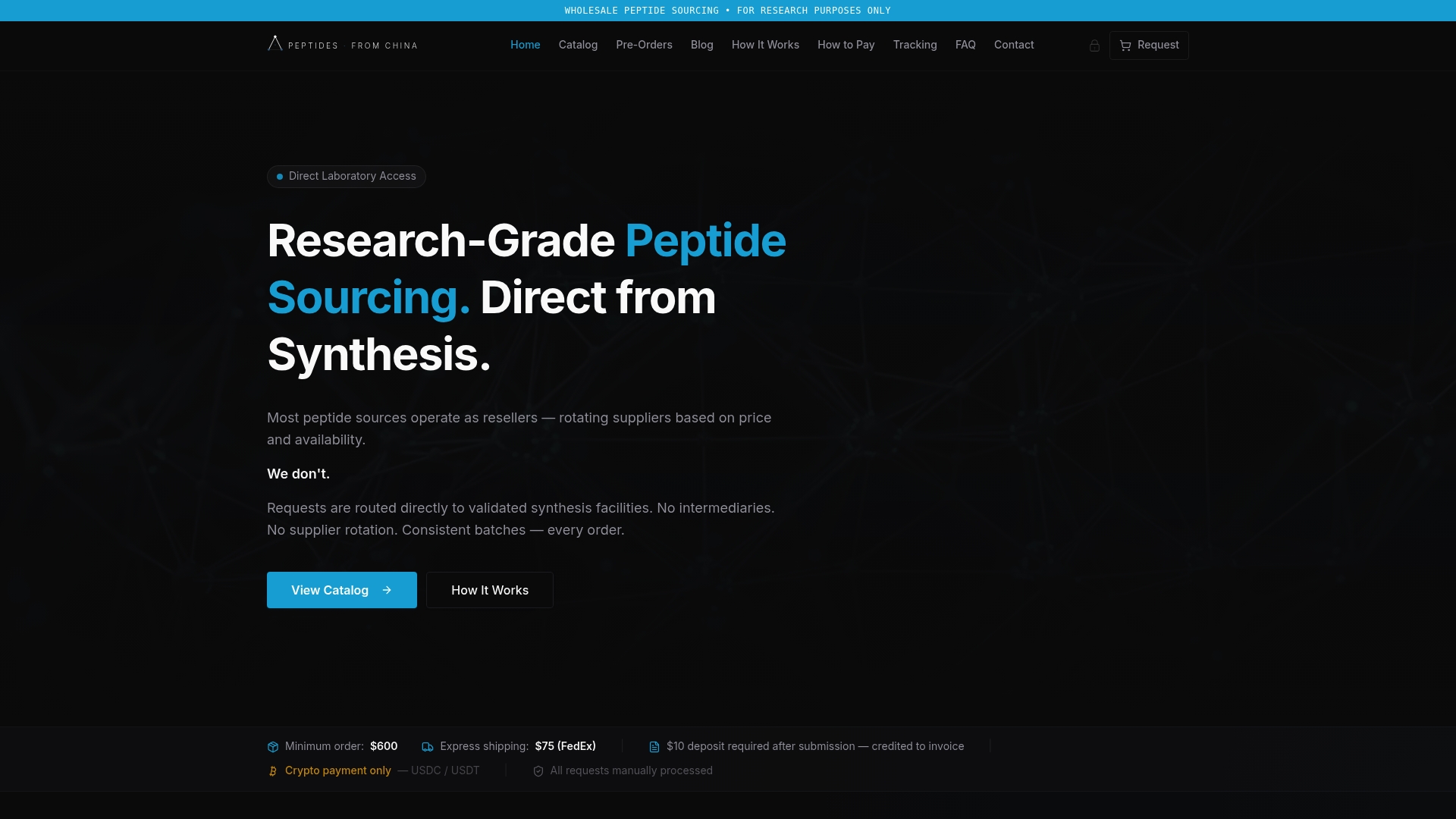
Products are subject to the manufacturer’s applicable quality-control procedures and specifications. Manufacturer-side analytical documentation may be available depending on the product and batch. PeptidesFromChina is not an independent analytical testing laboratory. Buyers seeking peptide reference standards should confirm the available specifications and documentation for the specific product and batch.
The peptide catalog covers research-grade materials across multiple peptide classes, with CoA documentation available for each lot. For labs with more demanding verification requirements, verified research-grade peptides with full analytical support are available through the VIP catalog tier.
FAQ
What are the main types of peptide reference standards?
Peptide reference standards classify into three hierarchical tiers (primary, secondary, and in-house working standards) and three chemical types (native, stable isotope-labeled, and impurity standards). Each tier and chemical type serves a distinct role in assay calibration, QC, and method development.
Why does HPLC purity not equal absolute peptide content?
HPLC purity reflects chromatographic area percentage, not net peptide mass by weight. Residual water, counterions, and synthesis impurities reduce actual peptide content, which may be 70–80% even when the HPLC trace shows 98% purity.
When should I use a stable isotope-labeled peptide standard?
SIL peptides are required for any LC-MS quantification workflow where absolute concentration accuracy matters, including biomarker assays and pharmacokinetic studies. They correct for matrix effects and ionization variability in a way that external calibration curves cannot.
What endotoxin level is acceptable for peptide standards used in biological assays?
Standards used in in vivo or cell-based assays should carry documented endotoxin levels below 5 EU/vial per USP <85> guidelines. Many research peptides lack this documentation, which is a common source of unexplained assay variability.
How do bridging studies support peptide standardization across experiments?
A bridging study formally establishes the analytical relationship between two tiers of the standard hierarchy, allowing secondary and working standards to be traced back to the primary standard. This traceability is required for regulatory compliance and is the mechanism that keeps QC data comparable across long-running studies.