Types of Bioactive Peptides for Skincare: 2026 Guide

Bioactive peptides for skincare are functional protein fragments that signal skin cells to activate repair, hydration, and structural maintenance pathways. The types of bioactive peptides for skincare fall into four primary functional categories: signal, carrier, neurotransmitter-inhibiting, and enzyme-inhibitor peptides. Over 102 commercially available peptides exist in the cosmetic market today, the majority produced through synthetic or biotechnological processes. Each category targets a distinct biological mechanism, which means selecting the right peptide type depends on the skin concern being addressed and the formulation context.
1. What are the types of bioactive peptides for skincare?
Cosmetic peptides are classified into four functional categories based on how they interact with skin biology. Signal peptides trigger collagen and matrix protein synthesis. Carrier peptides transport trace metals to enzymatic sites. Neurotransmitter-inhibiting peptides reduce muscle contraction at the neuromuscular junction. Enzyme-inhibitor peptides block degradative enzymes that break down structural proteins.
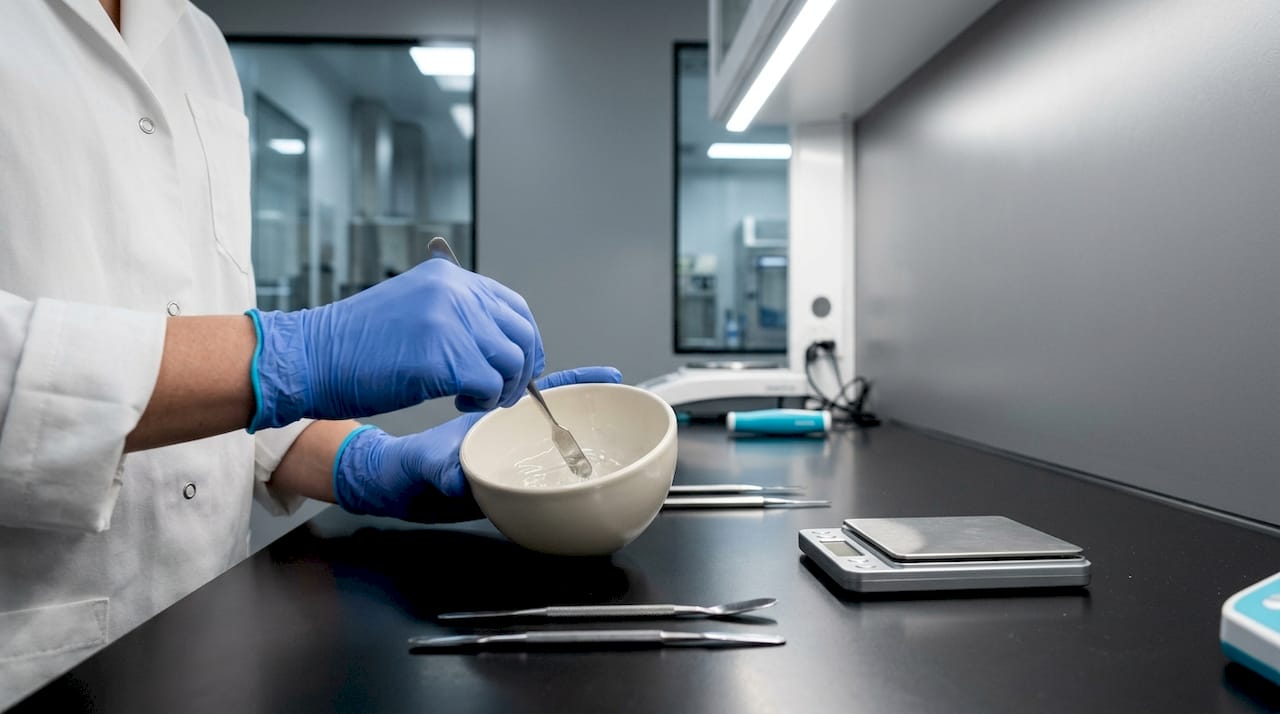
This classification system is not just academic. It directly informs formulation decisions, because combining peptides from different categories addresses multiple aging pathways simultaneously. A signal peptide and a carrier peptide in the same formula, for example, can stimulate new collagen while also supporting the enzymatic crosslinking that makes that collagen structurally durable.
Peptides work not by delivering proteins to the skin but by signaling cells to activate endogenous repair processes. That distinction matters for setting realistic expectations about what topical peptide products can and cannot do.
2. Signal peptides and collagen synthesis
Signal peptides are the most clinically substantiated category in cosmetic formulations. They mimic fragments of the extracellular matrix (ECM) to trigger fibroblast activity, which in turn drives production of collagen types I, III, and IV, fibronectin, and hyaluronic acid.
Palmitoyl pentapeptide-4, widely marketed as Matrixyl, is the most studied signal peptide in commercial skincare. GHK (glycine-histidine-lysine) is another well-characterized signal peptide with documented fibroblast-stimulating activity. Both have been used in clinical studies demonstrating measurable wrinkle depth reduction over 8–12 weeks of consistent application.
Key mechanisms of signal peptides include:
Binding to fibroblast receptors to upregulate collagen gene expression
Stimulating hyaluronic acid synthesis for improved hydration
Promoting fibronectin production, which supports skin structural integrity
Reducing visible wrinkle depth through matrix remodeling
Pro Tip: Palmitoyl pentapeptide-4 performs best in formulations with a pH between 4.5 and 6.5. Outside that range, the palmitoyl lipid chain can hydrolyze, reducing bioavailability before the peptide reaches the dermis.
Signal peptides are also well-suited for combination with retinoids or vitamin C, provided formulation pH is managed carefully. Their mild mechanism makes them appropriate for sensitive skin types where high-strength actives cause irritation.
3. Carrier peptides and trace metal delivery
Carrier peptides function as molecular chaperones, binding trace metal ions and transporting them to sites where enzymatic reactions depend on those metals. Without adequate metal cofactors, key skin repair enzymes cannot function at full capacity.
GHK-Cu is the most studied carrier peptide in cosmetic science. It delivers copper ions to three critical enzymes: lysyl oxidase, which crosslinks collagen and elastin fibers; superoxide dismutase, which neutralizes free radicals; and tyrosinase, which is involved in melanin regulation. Copper deficiency at the tissue level impairs all three processes, which is why GHK-Cu has attracted significant research interest in wound healing and skin remodeling contexts.
Carrier peptide benefits in skincare formulations include:
Supporting collagen crosslinking for improved skin firmness
Activating antioxidant defense through superoxide dismutase
Promoting wound healing and tissue remodeling
Complementing signal peptides by making newly synthesized collagen structurally stable
Pro Tip: GHK-Cu is sensitive to oxidation. Formulators should use airless packaging and avoid combining it with high-concentration ascorbic acid, which can destabilize the copper complex and reduce efficacy.
Products are subject to the manufacturer’s applicable quality-control procedures and specifications. Manufacturer-side analytical documentation may be available depending on the product and batch. PeptidesFromChina is not an independent analytical testing laboratory. The platform’s focus on batch traceability is relevant because GHK-Cu quality can vary across manufacturers. Learn more: GHK-Cu research peptide.
4. What role do neurotransmitter-inhibiting peptides play?
Neurotransmitter-inhibiting peptides reduce the intensity of repetitive muscle contractions that cause expression lines. They do not paralyze muscles. They modulate the signaling cascade that triggers acetylcholine release at the neuromuscular junction.
Argireline (acetyl hexapeptide-8) is the most recognized peptide in this category. It interferes with the SNARE complex, a protein assembly required for neurotransmitter vesicle fusion. SNAP-8 (acetyl octapeptide-3) is a longer variant of the same sequence, developed to extend the inhibitory effect. Both peptides show visible wrinkle reduction in 4–8 weeks under controlled conditions.
Key facts about neurotransmitter-inhibiting peptides:
Target the SNARE complex to reduce acetylcholine release
Most effective on dynamic wrinkles caused by repeated facial movement
Visible results typically appear within 4–8 weeks of consistent use
Efficacy depends heavily on concentration and delivery vehicle
Topical penetration to the neuromuscular junction remains a subject of ongoing debate
The penetration debate is real and worth acknowledging. The neuromuscular junction sits deep in the dermis, and most topically applied peptides face significant absorption barriers due to molecular size and polarity. Percutaneous absorption limits how much of any topical peptide reaches its biological target. Formulators using Argireline or SNAP-8 should prioritize delivery systems that improve dermal penetration, not just peptide concentration.
5. Enzyme inhibitor peptides and collagen protection
Enzyme inhibitor peptides protect existing collagen and elastin by blocking matrix metalloproteinases (MMPs). MMPs are enzymes that degrade structural proteins in the dermis. Their activity increases with UV exposure, inflammation, and chronological aging.
Soy-derived and rice bran peptides are the most cited examples of MMP-inhibiting peptides in cosmetic research. Soy peptides, in particular, have demonstrated inhibition of MMP-1 (collagenase) in in vitro models. Rice bran peptides show similar activity against MMP-2 and MMP-9.
The evidence base for enzyme inhibitor peptides is primarily in vitro and ex vivo. That does not make them ineffective, but it does mean clinical translation is less established than for signal or carrier peptides. The protective mechanism is still valuable: slowing collagen degradation is a legitimate anti-aging strategy, even if it is less visible than stimulating new synthesis.
Peptide type Primary action Evidence level Signal peptides Stimulate collagen and ECM synthesis Strong clinical data Carrier peptides Deliver metal ions to repair enzymes Strong clinical data Neurotransmitter-inhibiting Reduce muscle contraction intensity Moderate, penetration debated Enzyme inhibitor Block MMPs to prevent collagen breakdown Primarily in vitro
Enzyme inhibitor peptides are most useful as part of multi-peptide formulations that address both synthesis and degradation simultaneously. A formula that stimulates collagen production while also blocking the enzymes that degrade it creates a more complete anti-aging effect than either approach alone.
6. Practical formulation guidance for bioactive peptides
Topical peptide efficacy depends as much on formulation science as on peptide selection. Molecular size and polarity are the primary barriers to percutaneous absorption. Most bioactive peptides are too hydrophilic to cross the stratum corneum without assistance.
Lipid-based delivery systems, including liposomes, nanostructured lipid carriers, and certain surfactant complexes, significantly improve dermal penetration. Delivery vehicle choice is more determinative of clinical outcome than peptide concentration alone. A well-formulated 5 ppm GHK-Cu in a lipid carrier will outperform a 50 ppm GHK-Cu in a basic aqueous gel.
Stability considerations for peptide formulations:
Maintain pH within the peptide’s stability range (typically 4.5–6.5 for most cosmetic peptides)
Use airless, opaque packaging to prevent oxidation and light-induced degradation
Avoid combining peptides with high-concentration acids or oxidizing agents without stability testing
Store finished products below 25°C to prevent thermal degradation
Peptide stability depends on packaging as much as formulation chemistry
Pro Tip: When building a multi-peptide formula, test each peptide individually for stability at your target pH before combining them. Incompatibilities between peptide sequences are not always predictable from structure alone.
Peptides are an excellent complement in multi-active regimens because they deliver measurable stimulation without the irritation risks of high-strength retinoids or acids. They also pair well with clear skin supplements that support skin health from within, particularly those containing zinc, copper, and amino acid precursors that feed the same repair pathways peptides activate topically.
Realistic timelines matter for both formulators and end users. Visible skin improvements from peptide use require consistent application for 8–12 weeks at minimum. Products that claim faster results without supporting clinical data should be evaluated critically.
Key takeaways
Signal and carrier peptides have the strongest clinical evidence, making them the most reliable choices for anti-aging formulations targeting collagen synthesis and structural repair.
Point Details Four functional categories Signal, carrier, neurotransmitter-inhibiting, and enzyme-inhibitor peptides each target distinct skin mechanisms. Signal peptides lead in evidence Palmitoyl pentapeptide-4 and GHK have strong clinical data supporting collagen and ECM stimulation. Delivery vehicle is critical Lipid-based carriers improve dermal penetration more than increasing peptide concentration alone. Results require 8–12 weeks Consistent application over two to three months is the minimum for measurable skin improvement. Multi-peptide formulas outperform singles Combining peptide types addresses both collagen synthesis and degradation for a more complete effect.
The evidence gap that most peptide marketing ignores
The peptide skincare market has matured considerably since the early Matrixyl era. Formulators now work with multifunctional complexes that combine signal, carrier, and enzyme-inhibitor peptides in a single product. That is genuine progress. But the evidence gap between categories is still not discussed honestly enough in commercial contexts.
Signal and carrier peptides have real clinical backing. Neurotransmitter-inhibiting peptides have plausible mechanisms but face legitimate questions about topical penetration depth. Enzyme inhibitor peptides are mostly supported by in vitro data. Treating all four categories as equally proven is a formulation error, not just a marketing one.
Sourcing quality also matters more than most formulators acknowledge. Batch-to-batch variation in peptide purity directly affects clinical reproducibility. A signal peptide with 85% purity will not perform the same as one at 98% purity, even at the same concentration. Independent certificate of analysis (COA) verification from a third party, not just the manufacturer, is the standard that separates reliable sourcing from gray-market supply.
The next frontier worth watching is autophagy-activating peptides and mitochondrial signaling peptides. Early research suggests these could address cellular aging mechanisms that current cosmetic peptides do not reach. The evidence is preliminary, but the mechanistic rationale is sound. Professionals who understand the four existing categories will be better positioned to evaluate these emerging classes when clinical data arrives.
— Sam Levin
Research-grade peptides for skincare formulation
Products are subject to the manufacturer’s applicable quality-control procedures and specifications; PFC is not an independent analytical testing laboratory. Buyers requiring independent verification may arrange third-party analytical testing. The catalog includes GHK-Cu, signal peptides, and a range of compounds relevant to cosmetic and dermatological research.

For formulators and research teams who need consistent, traceable supply, the platform’s direct sourcing model eliminates the intermediary layers that introduce batch inconsistency. The peptide catalog covers skincare-relevant compounds including KPV, Epithalon, and GHK-Cu, each with COA documentation. Teams sourcing for private label or clinical research can review GHK-Cu dosage and benefits before placing orders to confirm the peptide fits their formulation parameters.
FAQ
What are the four types of bioactive peptides in skincare?
The four types are signal, carrier, neurotransmitter-inhibiting, and enzyme-inhibitor peptides. Each targets a distinct skin mechanism, from collagen synthesis to MMP inhibition.
How do bioactive peptides work in skincare products?
Bioactive peptides signal skin cells to activate endogenous repair processes rather than delivering proteins directly. They bind to fibroblast receptors, transport metal ions, or interfere with neuromuscular signaling depending on their category.
Which peptide type has the strongest clinical evidence?
Signal and carrier peptides currently have the strongest clinical evidence. Palmitoyl pentapeptide-4 and GHK-Cu are the most studied examples with documented effects on collagen synthesis and skin remodeling.
How long do peptides take to show results?
Visible skin improvements from topical peptides require consistent application for 8–12 weeks at minimum. Results depend on peptide type, concentration, delivery vehicle, and individual skin biology.
Can different peptide types be combined in one formula?
Yes. Multi-peptide formulations that combine signal, carrier, and enzyme-inhibitor peptides address multiple aging pathways simultaneously and generally outperform single-peptide products in clinical settings.