Therapeutic Peptide Classification: A 2026 Research Guide

Therapeutic peptide classification is the systematic categorization of peptide drugs based on their biological function, molecular structure, and mechanism of action. The field now catalogs over 58,583 compounds across 15 major functional categories and 47 subcategories, a scale that reflects how central classification has become to computational drug discovery. Researchers use these frameworks to navigate multifunctionality, predict pharmacokinetics, and align sourcing decisions with evidence-based clinical standards. Understanding what is therapeutic peptide classification means understanding the organizing logic behind modern peptide drug development, from antimicrobial peptides to GLP-1 agonists to longevity compounds.
What is therapeutic peptide classification and why does it matter?
Therapeutic peptide classification is defined as the structured grouping of short amino acid chains (typically 2–50 residues) by their biological activity, structural form, and clinical evidence base. The Peptide Association calls for mechanism-based classification over marketing labels, a distinction that matters because the same compound can appear under multiple commercial names while belonging to a single, well-defined functional category.
Classification serves three concrete purposes in biomedical research. First, it organizes large compound libraries so researchers can filter by therapeutic target without manually reviewing individual sequences. Second, it aligns research priorities with regulatory status, since over 80 peptide therapeutics carry FDA approval and most fall into ten core functional categories. Third, it provides a shared vocabulary across synthesis, pharmacology, and clinical teams, reducing the risk of misidentifying a compound’s mechanism during procurement or protocol design.

The standard industry term for this discipline is “peptide taxonomy,” though “therapeutic peptide classification” is the phrase most commonly used in research databases and drug discovery literature. Both terms refer to the same organizing framework. Researchers working across peptide ingredient applications benefit from understanding both terms when searching compound databases or reviewing regulatory filings.
What are the main functional categories of therapeutic peptides?
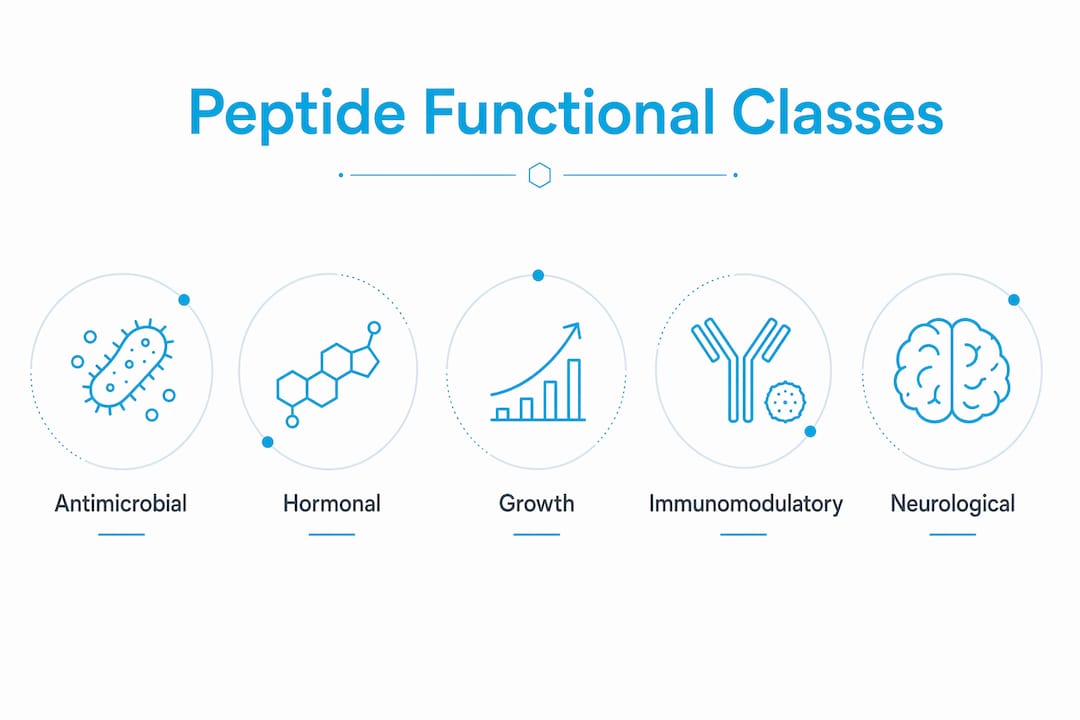
Functional classification groups peptides by the biological system they act on and the therapeutic outcome they produce. The current dataset, published in july 2025, organizes 58,583 compounds into 15 major categories. That breadth reflects decades of discovery across endocrinology, immunology, oncology, and infectious disease.
The most clinically active categories include:
Antimicrobial peptides (AMPs): Disrupt bacterial membranes through direct lytic action. AMPs represent one of the largest and most studied categories, with applications in antibiotic-resistant infection research.
Immunoactive peptides: Modulate innate and adaptive immune responses. This group includes thymic peptides and checkpoint-modulating sequences relevant to autoimmune and oncology research. Researchers studying immune response peptides frequently work within this category.
Metabolic regulatory peptides: Act on insulin signaling, glucagon pathways, and lipid metabolism. GLP-1 agonists are the most commercially prominent subcategory.
Growth hormone secretagogues (GHS): Stimulate endogenous GH release via ghrelin receptor agonism. Tesamorelin is a documented example in this group.
Neuropeptides: Modulate neurotransmitter release and central nervous system signaling.
Longevity and cytoprotective peptides: Act on telomere maintenance, mitochondrial function, and cellular repair pathways.
A critical feature of this classification system is multifunctionality. The same dataset identifies 21,130 multifunctional peptides that belong to more than one category simultaneously. That figure is not a data quality issue. It reflects genuine biological pleiotropy, where a single peptide sequence acts through multiple physiological systems at once.
Functional category Representative example Primary mechanism Antimicrobial Defensins Membrane disruption GLP-1 agonists Semaglutide GLP-1 receptor activation Growth hormone secretagogues Tesamorelin Ghrelin receptor agonism Immunoactive Thymosin alpha-1 T-cell modulation Longevity/cytoprotective Epithalon Telomerase activation
Tesamorelin illustrates the multifunctionality problem directly. It is classified under both growth hormone secretagogues and visceral-metabolic categories because it acts through multiple systems simultaneously. Researchers must check multiple functional profiles before designing a protocol around any pleiotropic compound.
How do structural features influence peptide classification?
Structural classification runs parallel to functional classification and addresses a different set of research questions. Where functional grouping tells you what a peptide does, structural grouping tells you how stable it is, how long it circulates, and whether it will survive the route of administration you intend to use.
The primary structural distinction is linear versus cyclic. Cyclic peptides provide superior enzymatic resistance and bioavailability compared to linear sequences. That advantage comes from the constrained conformation, which reduces the surface area accessible to proteases. Linear peptides are easier to synthesize and modify but degrade faster in biological environments.
Structural modifications extend the utility of both forms:
PEGylation: Attaches polyethylene glycol chains to extend circulating half-life and reduce immunogenicity.
D-amino acid substitution: Replaces L-amino acids with their mirror-image counterparts to resist protease cleavage.
Cyclization: Forms head-to-tail or side-chain bridges to lock the peptide in a stable conformation.
Lipidation: Adds fatty acid chains to improve membrane permeability and extend half-life, as seen in long-acting GLP-1 analogs.
Pro Tip: When evaluating a peptide for research use, check whether the sequence has been modified with D-amino acids or cyclization before assuming the pharmacokinetic data from the native linear form applies. Modified and native sequences behave differently in vivo.
Structural classification directly affects sourcing decisions. A lyophilized linear peptide and a cyclized analog of the same sequence require different storage conditions, reconstitution protocols, and stability testing. Researchers working with lyophilized peptide formats should confirm which structural form they are ordering before designing assays around published stability data.
What are computational approaches to peptide classification?
Machine learning has changed how researchers classify and predict peptide function at scale. The most significant development is the application of convolutional neural network (CNN) classifiers trained on large peptide sequence databases. These models predict functional category from amino acid sequence alone, without requiring structural data from X-ray crystallography or cryo-EM.
A CNN classifier trained on 54,655 therapeutic peptides achieves a 79.9% micro F1 score across functional categories. More practically, the same model reduces false positive rates from over 60% to 2.1%. That reduction matters because false positives in high-throughput screening waste synthesis resources and delay lead identification.
The key methodological advances enabling this performance are:
Augmented negative sampling: Generates high-quality negative examples (non-therapeutic sequences) to prevent the model from learning trivially separable patterns. Without this step, classifiers overfit to sequence length or amino acid composition rather than functional motifs.
Ensemble modeling: Combines predictions from multiple classifiers trained on different data subsets, reducing variance and improving generalization to novel sequences.
Conserved motif capture: CNN architectures identify short sequence patterns that recur across functionally related peptides, even when overall sequence identity is low.
Computational tools also accelerate generative design pipelines. Researchers can now generate candidate sequences, classify them computationally, and prioritize only high-confidence candidates for synthesis. This approach compresses the early-stage discovery cycle significantly and reduces the number of compounds that need to be physically produced before a lead is identified.
How does evidence grading affect therapeutic peptide classification?
Evidence grading adds a clinical validity layer to functional and structural classification. The Peptide Association’s framework assigns each peptide category a tier based on the quality of supporting clinical data. This grading system is distinct from regulatory approval status, though the two correlate closely.
The four evidence tiers are:
Strong: Supported by randomized controlled trials and, in most cases, FDA approval. GLP-1 agonists and several antimicrobial peptides fall here.
Moderate: Supported by controlled studies but lacking full regulatory approval or with approval limited to specific indications.
Limited: Supported by observational data, case series, or small trials without replication.
Emerging: Supported by mechanistic rationale, in vitro data, or early-phase human data only.
Evidence grading frameworks classify peptides by clinical proof, from strong randomized controlled trials to emerging mechanistic data, guiding researchers and clinicians in assessing therapeutic validity. Strong evidence corresponds to FDA approval; emerging is early data or rationale only.
The practical value of this framework is that it separates mechanism-based classification from marketing claims. A peptide marketed aggressively may carry only emerging evidence, while a less commercially visible compound may have strong trial data. The Peptide Association’s taxonomy explicitly calls for standardized evidence summaries per category, aligned with chemical databases and clinical definitions rather than commercial positioning.
Distinguishing peptide hormones from other therapeutic peptides is also relevant here. Peptide hormones act systemically and carry different safety protocols than locally acting antimicrobial or cytoprotective sequences. Evidence grading helps researchers apply the correct safety framework by making that distinction explicit within the classification record.
Key Takeaways
Therapeutic peptide classification organizes compounds by function, structure, and clinical evidence to guide research design, regulatory alignment, and sourcing decisions.
Point Details Functional classification covers 15 categories Over 58,583 peptides are organized across 15 functional categories and 47 subcategories in current datasets. Multifunctionality is the rule, not the exception 21,130 peptides in the dataset are multifunctional; always check multiple functional profiles before protocol design. Structural type determines stability Cyclic peptides resist enzymatic degradation better than linear forms; modifications like PEGylation extend half-life. CNN classifiers reduce false positives Sequence-based models cut false positive rates from over 60% to 2.1%, accelerating high-throughput screening. Evidence grading separates claims from data The Peptide Association’s four-tier framework aligns classification with clinical trial quality and regulatory status.
The classification problem researchers underestimate
The classification frameworks described here are genuinely useful, but they are also genuinely incomplete in ways that matter for day-to-day research decisions.
The multifunctionality problem is the one I see researchers handle poorly most often. A compound like Tesamorelin gets pulled from a database under one functional label, and the protocol gets designed around that single classification. The pleiotropy gets ignored. That is how you end up with unexpected off-target effects in animal models that were entirely predictable from the compound’s secondary classification profile.
The structural classification problem is subtler. Researchers often treat linear and cyclic as binary categories, but the real spectrum includes partially constrained sequences, stapled peptides, and lipidated analogs that sit between those poles. The pharmacokinetic assumptions you carry from one structural class do not transfer cleanly to the next.
The evidence grading problem is the most commercially distorted. The peptide market generates a large volume of content that presents emerging-evidence compounds as if they carry strong clinical support. Researchers who do not check the actual evidence tier before designing a study waste resources on compounds that cannot yet support the conclusions they are trying to draw.
The practical fix is straightforward: use the Peptide Association’s taxonomy as a starting filter, cross-reference against the structural classification, and verify the evidence tier before committing to a synthesis order. Computational classifiers are now accurate enough to serve as a preliminary screen for novel sequences. The tools exist. The discipline to use them consistently is what separates reproducible research from noise.
— Sam Levin
Research-grade peptides from PeptidesFromChina
PeptidesFromChina coordinates sourcing of research-grade peptides through established manufacturing facilities. Products are subject to the manufacturer’s applicable quality-control procedures and specifications. Manufacturer-side analytical documentation may be available depending on the product and batch. PeptidesFromChina is not an independent analytical testing laboratory. The catalog is organized by functional category. Learn more: KPV. Learn more: Epithalon. Learn more: research peptide catalog.
FAQ
What is therapeutic peptide classification?
Therapeutic peptide classification is the systematic grouping of short amino acid chains by biological function, molecular structure, and clinical evidence. Current databases organize over 58,583 compounds across 15 functional categories and 47 subcategories.
How are peptides classified by structure?
Peptides are classified as linear or cyclic based on their backbone conformation. Cyclic peptides offer superior enzymatic resistance and bioavailability; linear peptides are more synthetically accessible but degrade faster in biological environments.
What does multifunctionality mean in peptide classification?
Multifunctionality means a single peptide acts through more than one physiological system simultaneously. Over 21,130 peptides in current datasets are classified under multiple functional categories, requiring researchers to review all relevant profiles before protocol design.
How does evidence grading relate to peptide therapy classification?
Evidence grading assigns clinical validity tiers (Strong, Moderate, Limited, Emerging) to peptide categories based on trial quality. Strong evidence typically corresponds to FDA approval; emerging evidence reflects early mechanistic or in vitro data only.
Can machine learning classify therapeutic peptides accurately?
CNN classifiers trained on over 54,000 therapeutic peptide sequences achieve a 79.9% micro F1 score and reduce false positive rates to 2.1%. These models predict functional category from amino acid sequence alone, accelerating high-throughput screening pipelines.