The Role of Peptides in Product Efficacy Claims

Peptides are defined as short chains of amino acids that function as bioactive signaling molecules in both therapeutic and cosmetic formulations. The role of peptides in product efficacy claims is grounded in their capacity to interact with cellular receptors, modulate collagen synthesis, and influence tissue remodeling at a measurable biological level. Regulatory frameworks such as EU Regulation 655/2013 require that these claims be substantiated with documented clinical evidence, not ingredient listings alone. For researchers and product developers, understanding what separates a defensible efficacy claim from a marketing assertion is the core challenge in 2026.
What scientific evidence supports peptides’ impact on product efficacy?
The evidence base for peptide efficacy in formulations is real but uneven. A 2026 meta-analysis aggregating data from 1,341 participants confirmed that peptide-based formulations improve skin hydration, brightness, and wrinkle depth significantly compared to placebo. That finding validates the general category but does not apply equally to every peptide class or concentration.
Signal peptides carry the strongest human trial evidence. Palmitoyl pentapeptide-4, marketed under the name Matrixyl, is the clearest example. A 2005 double-blind RCT involving 93 women aged 35–55 demonstrated statistically significant improvements in skin firmness and wrinkle appearance over 12 weeks. That study design, placebo-controlled and peer-reviewed, sets the standard that most other peptide classes have not yet matched.

Neurotransmitter-inhibitor peptides occupy a weaker position in the evidence hierarchy. Acetyl hexapeptide-3, for instance, showed a 17% wrinkle depth reduction after 28 days at 10% concentration in a split-face study. That result is measurable but limited in scope. A single split-face study at a high concentration does not generalize to finished products at lower use levels.
Topical peptides typically require consistent daily use for 4 to 12 weeks to show measurable improvements such as reduced fine lines and increased firmness. That timeframe matters for study design and for claim language. Efficacy claims built on shorter observation windows are scientifically weaker and more likely to attract regulatory scrutiny.
Three points define the current evidence landscape:
Signal peptides like palmitoyl pentapeptide-4 have the most robust human RCT data.
Neurotransmitter inhibitors and enzyme inhibitors have limited clinical documentation.
Industry-funded trials dominate the literature, which requires careful interpretation of reported effect sizes.
Pro Tip: When evaluating a peptide’s clinical evidence, check whether the study used the same concentration and delivery vehicle as the finished product. Ingredient-level data does not automatically transfer to formulation-level performance.
How do formulation and delivery influence peptide efficacy claims?
Formulation science is where most peptide efficacy claims either hold up or fall apart. Peptides are hydrophilic molecules. The stratum corneum is a lipid-rich barrier. Without deliberate formulation strategies, most topical peptides do not reach the dermal layers where they need to act.
In vitro studies showing collagen stimulation in fibroblast cultures do not guarantee topical delivery of peptides capable of producing clinical effects. That distinction is critical. A peptide can stimulate collagen production in a cell culture dish and still fail to penetrate skin at a meaningful concentration when applied topically. Delivery mechanism and bioavailability are the differentiators between mechanism and efficacy.
Palmitoylation is the most documented solution to this problem. Lipid conjugation enhances peptide lipophilicity, and listing a peptide name on an ingredient label is insufficient proof of efficacy without confirmed formulation precision. Palmitoyl pentapeptide-4 works partly because the palmitoyl group improves skin penetration. A non-conjugated version of the same peptide sequence would not perform equivalently.
Other delivery strategies used in peptide technology in product formulation include:
Nanoparticle encapsulation to protect peptides from enzymatic degradation before they reach target tissue.
Penetration enhancers such as propylene glycol or ethanol to transiently disrupt the stratum corneum.
Liposomal carriers that improve both stability and dermal absorption.
pH optimization, since peptide stability and charge state vary significantly with formulation pH.
The gap between in vitro evidence and clinical efficacy is a known problem in the field. Researchers reviewing peptide ingredient applications should prioritize studies that tested the finished formulation, not the isolated peptide in a buffer solution.
Pro Tip: Request the formulation-specific study data, not just the ingredient dossier. If a supplier cannot provide penetration data for the finished product matrix, the efficacy claim rests on incomplete evidence.
What regulatory considerations shape credible peptide efficacy claims?
Claim language determines regulatory classification. A product claiming to “improve the appearance of fine lines” is a cosmetic. A product claiming to “rebuild collagen” is making a drug-level claim that triggers FDA approval requirements in the United States. The active ingredient can be identical. The claim wording is what changes the regulatory category.
This distinction has direct consequences for product developers. Overstated claims expose products to enforcement action, market withdrawal, and reputational damage. The regulatory boundary is not a technicality. It reflects a fundamental difference in what the product is asserting it can do to the body.
Under EU Regulation 655/2013, cosmetic claims must be substantiated with evidence mapped in a Product Information File. That file must include study methodology, statistical data, and evidence matching the peptide concentration in the marketed product. Authorities increasingly require raw data transparency, not just supplier marketing dossiers.
Common regulatory pitfalls in peptide marketing include:
Using terms like “repairs,” “rebuilds,” or “regenerates” without clinical evidence at the finished product level.
Citing ingredient-level studies when the formulation concentration differs from the studied dose.
Relying on supplier-provided dossiers without verifying that the data matches the actual product matrix.
Failing to document the claim substantiation process in a format that satisfies the Product Information File standard.
Claims stating peptides “rebuild collagen” are inappropriate for cosmetics and imply drug effects. Evidence-based language should accurately reflect the peptide’s biological role, such as “supports the appearance of firmer skin” or “visibly reduces the look of fine lines over 12 weeks.” That framing is both scientifically accurate and regulatory-compliant.
How should researchers and developers apply peptide data to support efficacy claims?
Applying peptide data to product efficacy claims requires a structured approach. Ingredient listing is not evidence. The presence of palmitoyl pentapeptide-4 in a formula at 0.001% does not justify the same claim as a study conducted at 3% concentration. Concentration, delivery vehicle, and study design all determine whether the evidence transfers.
A practical framework for researchers and developers:
Prioritize peptides with well-documented human RCTs. Palmitoyl pentapeptide-4 and palmitoyl tripeptide-1 have the strongest published records. Start with these before building claims around less-documented classes.
Match study concentrations to finished product concentrations. If the clinical study used 3% active and the formula contains 0.5%, the claim must be scaled accordingly or a new study is required.
Combine peptide classes with complementary mechanisms. Signal peptides that stimulate collagen synthesis can be paired with enzyme inhibitors that slow collagen degradation, creating a more defensible multi-mechanism claim.
Use biological function language in claims. “Supports skin’s structural protein production” is more accurate and more defensible than “rebuilds collagen.” The former describes a biological process. The latter implies a drug effect.
Verify batch consistency before building claims. A claim built on one batch of peptide at 98% purity does not hold if subsequent batches arrive at 85% purity. Batch traceability is a prerequisite for reproducible efficacy.
Sourcing quality matters more than most product developers acknowledge. Low-purity batches introduce variables that invalidate study results and undermine claim substantiation. Reviewing common quality issues in the peptide supply chain is a necessary step before committing to a formulation strategy.
Pro Tip: Build your claim substantiation file before launch, not after a regulatory inquiry. Document the study, the concentration, the delivery vehicle, and the batch used in testing. That file is your defense.
Key takeaways
Peptide efficacy claims require clinical evidence at the finished formulation level, not ingredient-level data alone.
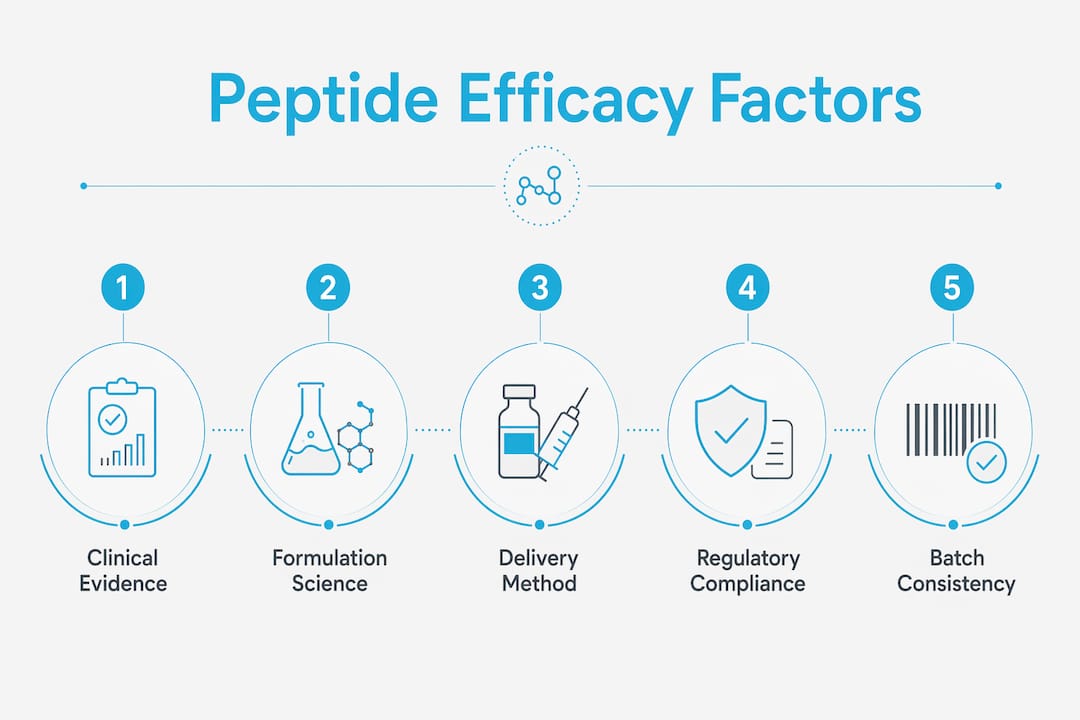
Point Details Evidence hierarchy matters Signal peptides like palmitoyl pentapeptide-4 have the strongest human RCT data; other classes have limited documentation. Formulation determines delivery Lipid conjugation and nanoparticle encapsulation are required for meaningful peptide penetration through the stratum corneum. Claim language sets regulatory category Phrases like “rebuilds collagen” trigger drug classification; use biological function language to stay within cosmetic boundaries. Concentration must match the study Efficacy data from a 3% concentration study does not transfer to a finished product at 0.5%. Batch consistency underpins claims Reproducible efficacy requires verified batch purity at every production run, not just during initial testing.
What I’ve learned about peptide claims that most developers get wrong
Working through the evidence base for peptide efficacy, the pattern that stands out most is not the science. The science on signal peptides is reasonably solid. What consistently fails is the translation from ingredient data to finished product claim.
Developers routinely source a peptide, confirm its identity with a certificate of analysis, and then write claims based on published studies that used different concentrations, different delivery vehicles, and different study populations. That is not claim substantiation. It is ingredient association. Regulators and informed consumers are increasingly able to tell the difference.
The industry’s over-reliance on in vitro data compounds the problem. A fibroblast study showing collagen stimulation is a mechanism indicator, not an efficacy proof. The gap between cell culture and clinical outcome is wide, and formulation variables determine whether a peptide crosses that gap at all.
The realistic path forward is narrower than most marketing teams want to hear. Defensible claims require formulation-specific studies, transparent concentration data, and claim language that reflects biological function rather than therapeutic outcomes. That standard is achievable, but it requires investment in study design and supply chain verification that many brands currently skip.
Researchers who want to build credible efficacy claims should start with peptide efficacy measurement frameworks that account for formulation variables, not just ingredient identity. The regulatory environment in 2026 is moving toward greater documentation requirements, and the brands that build that infrastructure now will be better positioned than those that retrofit it after enforcement.
— Sam Levin
PeptidesFromChina for research-grade peptide sourcing
Researchers and product developers building efficacy claims need peptide batches that are consistent and traceable, with manufacturer-side quality-control procedures and specifications. A claim built on one clean batch that cannot be reproduced across subsequent lots is not a defensible claim.

Products are subject to the manufacturer’s applicable quality-control procedures and specifications. Manufacturer-side analytical documentation may be available depending on the product and batch. PeptidesFromChina is not an independent analytical testing laboratory. The research peptide catalog covers signal peptides, GLP-1 agonists, mitochondrial compounds, and longevity peptides. Learn more: research peptide catalog. Learn more: VIP research tier.
FAQ
What is the role of peptides in product efficacy claims?
Peptides function as bioactive signaling molecules that influence collagen synthesis, skin remodeling, and tissue repair. Efficacy claims are substantiated when clinical studies at the finished product concentration demonstrate measurable outcomes such as reduced wrinkle depth or improved firmness.
Are peptides effective in skincare formulations?
Signal peptides like palmitoyl pentapeptide-4 have strong human RCT evidence supporting their efficacy in skincare. Effectiveness depends on peptide class, concentration, and delivery vehicle, not ingredient listing alone.
How long do topical peptides take to show results?
Topical peptides typically require 4 to 12 weeks of consistent daily use to produce measurable improvements in fine lines and skin firmness. Studies with shorter observation windows produce weaker evidence for efficacy claims.
What claim language keeps a peptide product classified as a cosmetic?
Claims describing biological function, such as “supports the appearance of firmer skin,” remain within cosmetic classification. Claims asserting structural changes, such as “rebuilds collagen,” imply drug effects and require FDA approval in the United States.
Why does batch consistency matter for peptide efficacy claims?
A claim substantiated with one batch at 98% purity does not hold if subsequent batches arrive at lower purity. Batch traceability and independent verification are prerequisites for reproducible efficacy across production runs.