
A "clean" HPLC report in your inbox is no longer a reliable benchmark for quality. In 2026, it's often just the first layer of a sophisticated marketing facade that hides recycled data and batch-to-batch inconsistency. Most professional buyers have realized that the process of vetting peptide manufacturers must evolve beyond simple document review into a rigorous, methodical evaluation of technical facility standards and direct-to-source logistics. You're likely tired of the "black box" nature of international sourcing where multiple middlemen inflate costs while obscuring the actual origin of the synthesis.
It's a frustrating reality that documentation alone cannot guarantee product identity or purity. This guide provides a technical framework to help you navigate these complexities and ensure batch consistency through true supply chain transparency. You'll learn how to leverage the May 2026 NMPA regulatory updates to your advantage and implement a procurement strategy that prioritizes direct-to-facility access. We'll analyze how to verify raw analytical data and establish a sourcing bridge that reduces reseller layers, ultimately improving your batch traceability and lowering operational risks.
Key Takeaways
Move beyond static document review by evaluating a manufacturer's industrial-scale technical infrastructure and real-time synthesis protocols.
Identify the critical role of Solid Phase Peptide Synthesis (SPPS) and building block purity in maintaining consistent batch quality across high-volume production cycles.
Implement a strategic framework for vetting peptide manufacturers that bypasses "white-label" resellers to eliminate supply chain opacity and the risk of recycled documentation.
Learn to treat manufacturer-issued HPLC and Mass Spectrometry reports as baseline reference material while developing the skills to spot common red flags and inconsistencies.
Streamline your procurement process by utilizing a B2B sourcing bridge for direct facility access, requiring a $600 minimum for professional wholesale orders.
Table of Contents
The Landscape of Global Peptide Manufacturing in 2026
Technical Synthesis Protocols: From SPPS to Lyophilisation
Strategic Vetting: Bypassing Resellers for Direct Access
Analytical Verification: Evaluating HPLC and Mass Spectrometry Reports
Implementing a Direct Sourcing Model with Peptides From China
The Landscape of Global Peptide Manufacturing in 2026
The Rise of Industrial Synthesis Hubs
The shift toward centralized manufacturing in China drives global research affordability. Modern facilities utilize automated Solid Phase Peptide Synthesis (SPPS) to ensure high throughput and consistency. These Peptide Synthesis Protocols involve the systematic addition of amino acids to a solid resin; it's a process that has become highly refined in industrial settings. Automation reduces human error but doesn't eliminate the need for independent verification. For a deeper look at the mechanics of these facilities, see our Peptides Production: An Operational Guide to Large-Scale Synthesis and Sourcing. Accessing these manufacturer-side channels directly via a B2B bridge like Peptides From China helps buyers reduce reseller layers. Professional wholesale procurement through these channels typically requires a minimum order of $600, which helps reduce supply chain uncertainty by connecting researchers closer to the source.
Research-Grade vs. Clinical GMP Standards
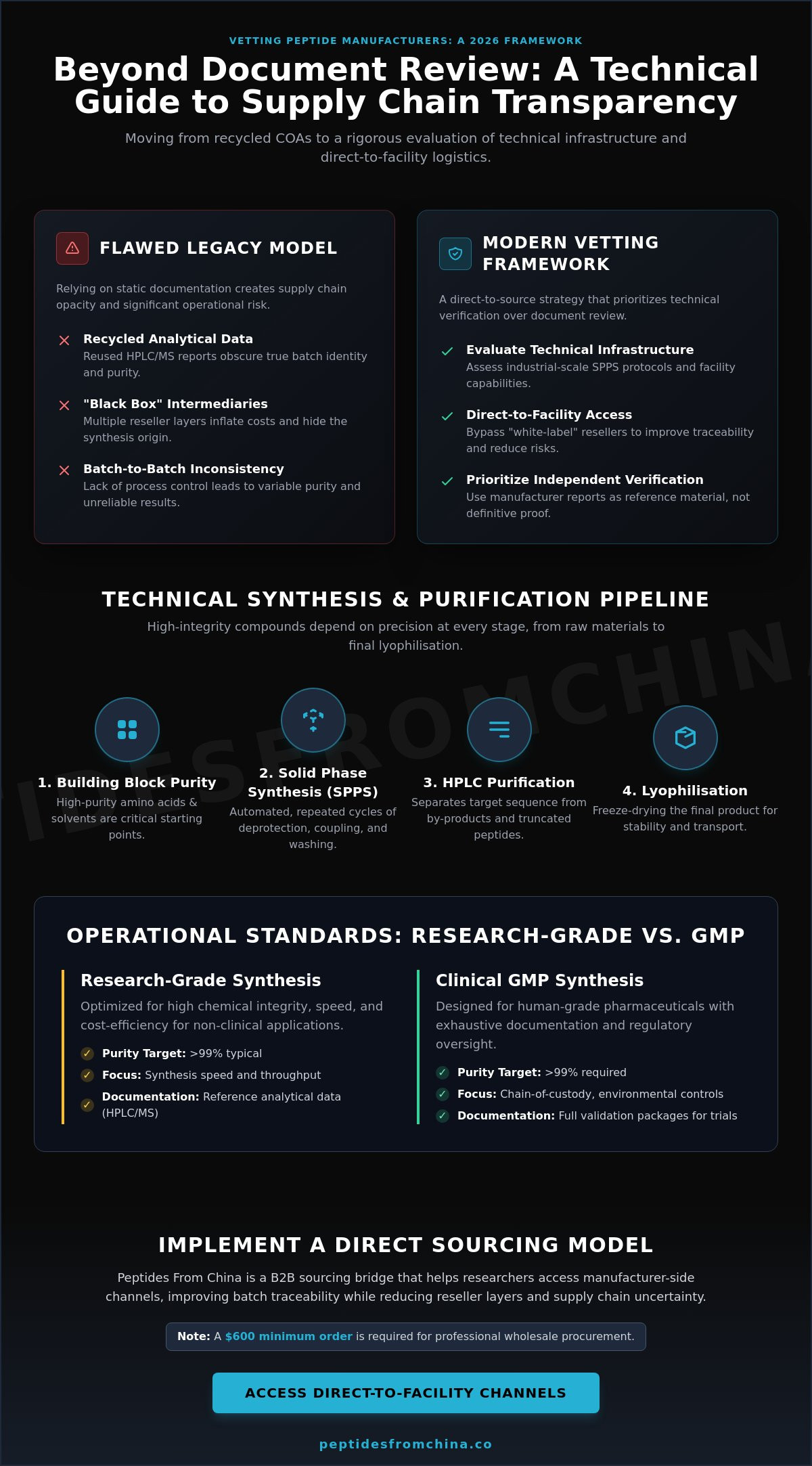
There's a sharp operational distinction between research-grade synthesis and pharmaceutical Good Manufacturing Practice (GMP) manufacturing. Most laboratory protocols utilize high-purity research-grade compounds. These often reach purity levels of >99%, matching the chemical profile of clinical-grade material without the prohibitive costs of regulatory certification. Vetting peptide manufacturers requires knowing which standard your protocol demands. GMP facilities focus on documented chain-of-custody and environmental controls required for human-grade pharmaceuticals, which adds significant lead time and expense.
In contrast, research-grade production prioritizes synthesis speed and cost-efficiency while maintaining high chemical integrity. The technical trade-off is often found in the documentation. Research-grade batches rely on reference analytical data rather than the exhaustive validation packages required for clinical trials. Professionals must evaluate these facilities based on their ability to provide consistent batch-to-batch purity rather than just a logo on a certificate. Independent testing remains the only way to support the data provided by the facility.
Technical Synthesis Protocols: From SPPS to Lyophilisation
Most industrial facilities utilize Solid Phase Peptide Synthesis (SPPS) as their primary production method. This process is a repeated cycle of deprotection, coupling, and washing. It begins by deprotecting the N-terminus of an amino acid bound to a solid resin, followed by the coupling of the next amino acid in the sequence. The integrity of this cycle depends heavily on the purity of the starting building blocks, specifically the Fmoc or Boc protecting groups. If the initial amino acids contain even trace impurities, those errors compound with every added link in the chain. This is why vetting peptide manufacturers requires an audit of their raw material procurement and the quality of the solvents used during the washing phases.
Once the synthesis is complete, the crude peptide must be cleaved from the resin and purified. Preparative HPLC (High-Performance Liquid Chromatography) is the critical stage where the target sequence is separated from truncated sequences and chemical by-products. This isn't a simple automated step; it requires technical expertise to calibrate the mobile phase and flow rates for maximum resolution. A facility's ability to execute precise purification is what differentiates a high-integrity compound from a "crude" batch that might pass a basic test but contains significant synthesis artifacts.
The Purification Challenge
Analytical Equipment in the Vetted Facility
A reliable facility must have in-house Mass Spectrometry (MS) for immediate identity verification. While HPLC provides a purity profile, MS confirms that the synthesized mass actually matches the target sequence. According to the FDA Guidance on Synthetic Peptides, thorough characterization of impurities is essential for ensuring compound quality. Facility-side MS data is a non-negotiable prerequisite for any sourcing request, as it serves as the primary "fingerprint" for the batch. Analytical HPLC then provides the final purity percentage by measuring the area under the curve for the main peak versus impurities.
The final step in the manufacturing process is lyophilisation, or freeze-drying. This removes solvents and water under a vacuum, turning the liquid peptide into a stable, white powder. This step is vital for long-term stability and ensures the peptide doesn't degrade during transit. If you're looking to bypass resellers and access these manufacturing standards directly, you can explore direct-to-facility sourcing options through a B2B bridge, where professional wholesale orders start at a $600 minimum to ensure supply chain transparency.
Strategic Vetting: Bypassing Resellers for Direct Access
Strategic vetting of peptide manufacturers requires an understanding of the global supply chain's tiered structure. Most domestic "US-based" or "EU-based" peptide companies don't operate synthesis facilities. Instead, they function as logistical intermediaries, purchasing bulk batches from industrial hubs in China and relabeling them for research use. This white-label model introduces significant supply chain opacity. When you buy from a reseller, you're often receiving a batch with a recycled Certificate of Analysis (COA) or reference analytical data that doesn't correspond to the specific vial in your hand. Bypassing these layers helps reduce supply chain uncertainty and improves traceability by establishing a direct line to the production source.
Batch-jumping is a common risk in the reseller market. This occurs when a distributor uses a single, high-quality test report to sell multiple subsequent batches of varying quality. Without direct access to the manufacturer, the buyer has no way to verify if the synthesis protocols remain consistent over time. Direct sourcing supports independent verification because the buyer controls the sampling process from a known source. This approach to vetting peptide manufacturers focuses on minimizing the number of hands touching the product, which preserves the integrity of the batch from the lyophilizer to the lab bench.
The Reality of Reseller Markups
The price disparity between direct sourcing and domestic warehousing is often substantial. Resellers must account for international shipping, import duties, domestic storage, and significant marketing overhead. For laboratories with high-volume requirements, these markups represent a major drain on procurement budgets. Analyzing these costs reveals that domestic companies are frequently just logistical buffers rather than quality control filters. A case study on this economic shift can be found in our guide on Bulk BPC-157 Wholesale: The 2026 Research Guide to Direct Sourcing, which details how direct access changes the cost-benefit analysis for researchers.
Direct Sourcing Logistics and Customs
Managing logistics when sourcing from China involves longer lead times than domestic shipping, but the trade-off is improved batch traceability. Professional B2B shipping utilizes neutral packaging and dedicated tracking to ensure safe transit. Direct routing ensures that the product isn't sitting in an unverified third-party warehouse where temperature fluctuations or cross-contamination could occur. Peptides From China acts as a transparency-focused B2B bridge, helping researchers navigate these logistical hurdles. By facilitating manufacturer-side access, we help you avoid the hidden pitfalls of the reseller market, provided you meet the $600 minimum for professional wholesale procurement.
Analytical Verification: Evaluating HPLC and Mass Spectrometry Reports
Manufacturer-issued reports should be viewed as baseline reference material, not absolute proof of quality. When vetting peptide manufacturers, it's a mistake to accept a High-Performance Liquid Chromatography (HPLC) or Mass Spectrometry (MS) report at face value. The peptide industry frequently sees the reuse of "clean" reports across multiple disparate batches. In some cases, documentation is even falsified to hide synthesis errors or low yields. You must treat these papers as a starting point for your own internal verification process rather than a final guarantee of purity.
Identifying red flags in technical documentation requires a methodical eye. Researchers should look for mismatched dates between the synthesis log and the analytical run. Cropped headers, generic filenames like "Report1.pdf," or inconsistent fonts often indicate that a report has been tampered with or recycled from a previous client's order. It's also common for resellers to provide a report from a "representative batch" rather than the specific material you're receiving. No single document can fully guarantee product identity or purity, which is why independent, third-party testing by the buyer remains a non-negotiable step in professional procurement.
Interpreting the HPLC Chromatogram
Understanding the HPLC chromatogram involves more than just glancing at a percentage on a table. The main peak area must be compared against the integration table to see how the software calculated the purity. In many lower-quality reports, the baseline noise is high or secondary peaks are intentionally excluded from the integration to artificially inflate the purity score. A "99% purity" claim serves only as a reference point for independent verification. If the chromatogram shows significant "shoulders" on the main peak or multiple unexplained spikes in the baseline, the batch likely contains truncated sequences or residual solvents that require further purification.
Mass Spectrometry: Confirming Sequence Identity
Mass Spectrometry is the only way to confirm that the synthesized batch actually matches the theoretical molecular mass of the peptide. Identity verification must always be the first step before you even consider assessing purity levels. If a manufacturer cannot provide clear MS data, there's no way to prove you aren't receiving a different, cheaper sequence or a heavily degraded compound. Researchers should compare MS results against the theoretical mass of the target peptide to ensure the sequence has been synthesized correctly.
By establishing a direct link to the synthesis facility, you can request raw data files that are harder to manipulate than simple PDFs. Utilizing a transparency-focused B2B bridge like Peptides From China helps you access this manufacturer-side reference data directly. This level of transparency is essential for professional buyers meeting the $600 minimum for wholesale procurement, as it provides the necessary technical foundation for vetting peptide manufacturers before the product ever reaches your laboratory.
Implementing a Direct Sourcing Model with Peptides From China
Implementing a direct sourcing model is the logical conclusion of the vetting peptide manufacturers process. While retail-focused blogs suggest purchasing single vials from domestic resellers, professional laboratories require a more robust and transparent approach. Peptides From China (PFC) operates as a transparency-focused B2B sourcing bridge, connecting researchers directly to industrial synthesis facilities. This model eliminates the significant markups associated with white-label resellers who often provide little more than a domestic shipping label and a recycled COA. By routing procurement directly to the manufacturer, you improve batch traceability and gain access to facility-side reference analytical data.
Professional wholesale procurement through PFC requires a $600 minimum order. This threshold ensures that the logistical effort is concentrated on serious research requirements rather than retail-level distribution. To initiate the manufacturer verification process, we utilize a $10 sourcing deposit. This small fee acts as an operational filter, allowing us to dedicate technical resources to retrieving current batch data and facility-side documentation for your specific request. It's a methodical step that prioritizes factual integrity over superficial sales tactics, ensuring that the vetting peptide manufacturers process is grounded in real-time data.
The PFC Sourcing Protocol
The PFC protocol facilitates batch verification by providing reference analytical data straight from the lab that performed the synthesis. Before any final invoice settlement, we ensure that the manufacturer stock is approved based on the requested specifications. This process helps reduce supply chain uncertainty by confirming that the batch exists and meets the necessary technical benchmarks. PFC focuses exclusively on professional researchers and B2B procurement, explicitly avoiding the retail market to maintain a streamlined, manufacturer-side channel that bypasses traditional middleman structures.
Strategic Procurement Planning
Strategic planning is necessary to optimize international shipping and meet the $600 minimum requirement. Consolidating orders for compounds like Tirzepatide, Semaglutide, or BPC-157 into a single shipment helps reduce the per-vial cost of logistics. This approach supports independent verification by allowing you to test a representative sample from a larger, consistent batch. Long-term research projects benefit from this consistency, as it minimizes the variable synthesis quality often found when switching between different reseller-sourced batches. If you're ready to establish a direct-to-source pipeline, you can Request a direct sourcing quote for your laboratory requirements.
Securing Your Research Through Direct Manufacturer Access
Success in 2026 depends on a shift from passive document review to active supply chain management. By focusing on the technical mechanics of synthesis and the logistical reality of industrial hubs, you can move past the limitations of white-label resellers. Effective vetting peptide manufacturers requires treating every COA as a baseline technical reference that supports, but doesn't replace, your own independent verification protocols.
Establishing a direct sourcing model helps reduce supply chain uncertainty and eliminates the layers that often obscure batch origin. Peptides From China facilitates this transition by acting as a B2B bridge, providing reference analytical data direct from manufacturing facilities while utilizing a transparent $10 sourcing deposit model to initiate verification. This direct routing effectively removes reseller markups and improves traceability for your laboratory operations. Access direct-to-manufacturer peptide sourcing for your lab to streamline your wholesale procurement with our $600 minimum requirement. Taking control of your supply chain is the most reliable way to ensure the long-term consistency and factual integrity of your research.
Frequently Asked Questions
What are the common red flags when vetting a peptide manufacturer?
The most significant red flag is a facility's refusal to provide raw data files or chromatograms with full headers. When vetting peptide manufacturers, you should be skeptical of companies that only offer "representative" batch reports or those that lack in-house Mass Spectrometry equipment. If a manufacturer can't explain their specific purification protocols for complex sequences, it's likely they're a reseller rather than a synthesis facility.
How can I verify if an HPLC report actually belongs to the batch I received?
You can't definitively verify a report's authenticity without independent third-party testing. While matching batch numbers on vials to the report is a baseline step, labels are easily swapped in the reseller market. Professional buyers cross-reference retention times and peak integration tables with known standards to identify anomalies. These documents remain reference analytical data that helps reduce supply chain uncertainty but don't replace independent verification.
Why is there a $600 minimum order for wholesale peptide sourcing?
The $600 minimum order requirement for professional wholesale procurement reflects the operational costs of industrial-scale logistics and manufacturer-side verification. Sourcing direct from the facility involves significant overhead in customs clearance, neutral packaging, and batch tracking. This threshold filters for serious researchers and B2B buyers, allowing for a streamlined sourcing model that bypasses expensive retail markups and improves batch traceability.
What is the difference between solid-phase and liquid-phase synthesis in 2026?
Solid-phase peptide synthesis (SPPS) is the industry standard for sequences up to 50 amino acids due to its speed and automation. Liquid-phase synthesis is typically reserved for very short sequences or massive production runs where solubility is the primary concern. Most high-volume facilities in 2026 favor automated SPPS for compounds like Tirzepatide because it allows for efficient deprotection and coupling cycles with high throughput.
Can I rely solely on manufacturer-provided documentation for research?
No, relying solely on manufacturer-provided documentation is a high-risk practice for any professional laboratory. While these reports provide a baseline for vetting peptide manufacturers, they don't account for errors in the bottling stage or degradation caused by improper handling. Professional procurement protocols always include independent sampling and analysis to support the data provided by the synthesis facility and ensure operational consistency.
How does international shipping from China affect peptide stability?
International shipping from China doesn't inherently compromise stability if the peptide has been properly lyophilized. Lyophilisation turns the compound into a stable solid that resists degradation from temperature fluctuations during transit. Utilizing professional B2B shipping routes with neutral packaging ensures the material remains protected. Once received, however, the peptide should be stored in a controlled environment according to its specific stability requirements.
What is the typical lead time for a large-scale peptide synthesis order?
Large-scale synthesis orders typically require a lead time of 14 to 21 days for production and purification. This timeline accounts for the sequential SPPS cycles, preparative HPLC purification, and the final lyophilisation process. Shipping and customs clearance can add another 7 to 10 days. A total turnaround of approximately one month is a realistic expectation for researchers navigating manufacturer-side supply channels.
Why do prices vary so much between direct manufacturers and resellers?
Price variation stems from the elimination of domestic reseller markups and the reduction of intermediary layers. Resellers incur costs for domestic warehousing, retail marketing, and single-vial distribution, which are passed on to the buyer. Direct sourcing through a B2B bridge connects you to facility-side pricing. In this model, the cost is dictated by raw material purity and synthesis scale rather than retail branding or middleman profits.