Procurement KPIs for Peptide Sourcing: 2026 Guide

Procurement KPIs for peptide sourcing are defined as the measurable indicators that track supplier quality, supply chain risk, and operational efficiency across the peptide supply chain. Unlike general biochemical procurement, peptide sourcing carries specific risks: batch-to-batch variability, opaque documentation chains, and the gap between supplier-reported purity and independently verified results. Pharmaceutical companies report that 30% have experienced significant quality events linked to material suppliers in the past three years. That figure reflects a systemic failure to track the right performance indicators, not just a vendor selection problem. Procurement teams in biotech and pharma need KPIs calibrated to peptide-specific realities, including HPLC purity thresholds, certificate of analysis (CoA) authenticity, and audit coverage rates.
1. Which KPIs best measure peptide supplier quality?
Supplier quality KPIs are the foundation of any peptide procurement performance framework. They measure whether a supplier’s output consistently meets the purity and documentation standards required for research or clinical use.
The core quality indicators to track include:
HPLC purity rate per batch: Research-grade peptides require a minimum of 98% HPLC-confirmed purity. Any supplier delivering below 95% on injectable compounds represents a disqualifying event, not a negotiation point.
CoA completeness rate: The percentage of batches accompanied by a full CoA, including HPLC chromatogram, mass spectrometry data, and endotoxin results. A CoA missing any of these three elements is incomplete by industry standard.
Third-party testing match rate: The percentage of independently tested batches where results fall within ±1–2% of the supplier’s reported purity. Independent lab testing for new suppliers costs $150–$350 per compound. That cost is the cheapest insurance available against receiving off-spec material.
Templated CoA detection rate: The frequency with which CoAs show identical purity percentages across different batches. Identical purity figures across batches signal fabricated or templated documentation, which is a critical disqualification criterion.
Supplier audit completion rate: The percentage of critical peptide API suppliers that have completed a formal audit, whether on-site or document-based, within the current review cycle.
Pro Tip: Request CoAs from at least three separate batches before onboarding any new supplier. If the reported purity percentages are identical across all three, treat the documentation as unreliable regardless of the stated values.
Procurement teams that track these five indicators gain a clear picture of whether a supplier’s quality system is real or performative. The distinction matters because a supplier can pass a single spot-check while failing systematically across production runs.

2. How can procurement KPIs track supply chain risk?
Risk-based sourcing KPIs shift the focus from individual batch results to systemic supplier behavior over time. These indicators identify which suppliers require intensive oversight and which can operate under lighter monitoring.
A practical risk monitoring framework uses the following sequence:
Supplier risk tier assignment rate: The percentage of active suppliers formally classified into risk tiers (critical, standard, low-risk) based on peptide type, batch volume, and documentation history. Unclassified suppliers default to the highest monitoring intensity.
On-site audit coverage for critical suppliers: Risk management standards require full on-site audits for critical peptide APIs. The KPI measures what percentage of critical-tier suppliers received an on-site audit versus a documentation-only review in the past 12 months.
Quality event frequency per supplier: The number of documented quality deviations, failed batches, or CoA discrepancies attributed to each supplier per quarter. Rising frequency is an early warning signal before a supply disruption occurs.
Supply disruption incidence rate: The number of sourcing interruptions per supplier per year, including delayed shipments, batch rejections, and reformulation failures.
Supplier quality agreement compliance rate: The percentage of suppliers operating under a current, signed quality agreement that specifies purity thresholds, testing requirements, and deviation reporting obligations.
Pro Tip: Apply the Pareto principle directly to your audit schedule. 80% of supply chain risk originates from 20% of suppliers. Concentrate on-site audit resources on that 20% and use document reviews for the remainder.
Risk KPIs work best when reviewed quarterly rather than annually. A supplier’s risk profile can shift rapidly after a manufacturing change, a raw material substitution, or a personnel change at the synthesis facility.
3. What operational KPIs optimize peptide sourcing efficiency?
Operational KPIs measure the mechanics of procurement execution. They answer whether the supply chain is functioning at the speed and accuracy the research or production schedule requires.
The most useful operational indicators are:
Purchase order cycle time: The average number of days from order placement to confirmed shipment. Cycle time variability, not just average time, is the more informative metric because it reveals process instability.
On-time delivery rate: The percentage of orders delivered within the agreed lead time window. For peptide procurement, a rate below 90% creates downstream scheduling risk in research programs.
Lead-time variability index: The standard deviation of delivery times across a supplier’s orders. Modern procurement frameworks weight lead-time variability and defect rates equally with cost metrics when assessing supplier value.
Cost variance against market benchmarks: The percentage difference between contracted unit prices and current market reference prices for equivalent peptide specifications. This KPI tracks value, not just spend.
Supplier responsiveness rate: The average time a supplier takes to respond to technical queries, deviation reports, or documentation requests. Slow responsiveness correlates with poor quality system maturity.
Operational KPI Target Threshold Risk Signal Purchase order cycle time Under 10 business days Consistent delays above 15 days On-time delivery rate 90% or above Below 85% in any quarter Lead-time variability index Low standard deviation High variance across consecutive orders Cost variance vs. benchmark Within ±10% Prices significantly below market Supplier responsiveness Under 48 hours Queries unanswered beyond 72 hours
Price deserves specific attention here. Extremely low prices suggest corner-cutting in synthesis or testing. A cost variance KPI that flags prices significantly below market benchmarks is more useful than one that simply rewards the lowest bid.
4. How do these KPIs integrate into a peptide procurement strategy?
Individual KPIs generate data. A procurement strategy converts that data into supplier decisions, contract terms, and monitoring schedules. The integration layer is where most procurement teams underperform.
The table below maps KPI categories to their strategic functions:
KPI Category Primary Function Review Frequency Quality (HPLC purity, CoA completeness) Supplier qualification and disqualification Per batch Risk (audit coverage, quality event rate) Supplier tier assignment and escalation Quarterly Operational (cycle time, delivery rate) Contract performance and renegotiation Monthly Documentation (third-party match rate) Ongoing verification and fraud detection Per new batch or supplier
Supplier segmentation is the most direct application of combined KPI data. A supplier scoring well on quality metrics but poorly on delivery rate occupies a different risk category than one with documentation gaps and pricing anomalies. Segmentation allows procurement teams to apply the right oversight intensity to each relationship without spreading audit resources uniformly.
KPI data also informs contract negotiations directly. Procurement performance indicators tied to delivery rates, purity thresholds, and deviation reporting obligations give procurement teams measurable grounds for price adjustments, volume commitments, or contract termination.
Continuous monitoring requires a defined cadence. Batch-level quality KPIs need review at receipt. Risk KPIs need quarterly aggregation. Operational KPIs benefit from monthly tracking to catch trends before they become disruptions. Teams that review all KPIs on the same annual cycle lose the early warning value entirely.
Vendor qualification criteria should be revisited whenever a supplier changes their synthesis facility, raw material source, or testing laboratory. These events reset the risk profile regardless of prior performance history.
For ongoing suppliers, randomized third-party testing of approximately one in every four to five batches maintains long-term consistency verification without excessive testing costs. That 20–25% sampling rate is the standard practice for balancing oversight with operational efficiency.
Adapting KPIs to market conditions is not optional. The peptide supply landscape shifts with regulatory changes, raw material availability, and synthesis technology developments. A KPI framework built in 2023 and left unchanged through 2026 will have blind spots that a current-year review would catch.
Key takeaways
Effective procurement KPIs for peptide sourcing require tracking quality verification, supplier risk, and operational performance as an integrated system rather than isolated metrics.
Point Details HPLC purity is the baseline quality KPI Require ≥98% HPLC-confirmed purity per batch; below 95% is a disqualification threshold. CoA authenticity requires active verification Identical purity figures across batches signal templated documentation and warrant supplier review. Risk-based audits concentrate resources correctly Focus on-site audits on the 20% of suppliers generating 80% of supply chain risk. Third-party testing validates supplier claims Independent testing of 20–25% of ongoing batches maintains consistency without excessive cost. Price is a weak quality proxy Use cost variance against market benchmarks, not unit price alone, to assess supplier value.
The KPI that most procurement teams ignore
Most procurement teams I have worked with track delivery rates and unit costs without question. Those metrics are easy to pull and easy to report. The harder metrics, the ones that actually predict supply failures, get deferred because they require more effort to collect.
The third-party testing match rate is the most underused KPI in peptide procurement. Teams will accept a supplier’s CoA at face value for years, then discover a purity problem only when a research program produces anomalous results. By that point, the cost is not $150–$350 for an independent test. It is months of lost research time and the full cost of re-sourcing.
The documentation authenticity check is equally neglected. I have seen CoAs from suppliers that reported 98.7% purity across six consecutive batches of different peptides. That level of consistency does not occur in real synthesis operations. It occurs when someone fills in a template. Procurement teams that do not track CoA variation patterns across batches will miss this signal entirely.
My practical advice: build your KPI framework around what can go wrong, not what you hope will go right. The peptide supply chain has enough real complexity without adding the risk of unverified documentation. Price optimization is a secondary concern. Verification is the primary one.
— Sam Levin
Manufacturer-Side QC and Buyer-Arranged Verification
Procurement teams that track quality KPIs need suppliers who make verification straightforward rather than difficult.
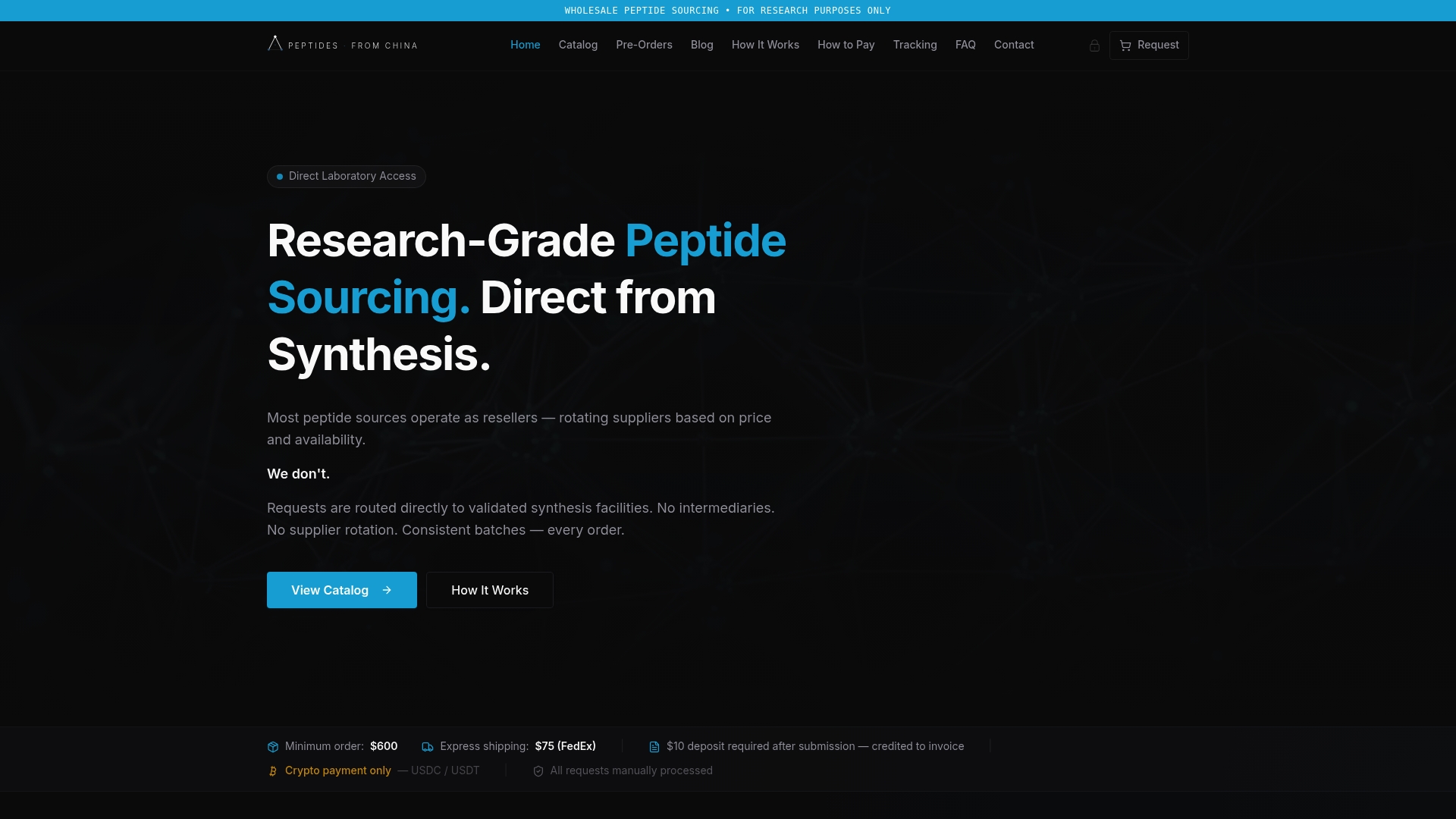
PeptidesFromChina may provide manufacturer-side analytical documentation depending on the product and batch. The platform maintains direct commercial relationships with established synthesis facilities. Buyers requiring independent verification may arrange third-party analytical testing. Learn more: research-grade peptide options. Learn more: peptide catalog. Learn more: quality verification standards.
FAQ
What is the minimum acceptable purity KPI for research peptides?
Research-grade peptides require HPLC-confirmed purity of at least 98%. Purity below 95% is a disqualification threshold for injectable compounds.
How often should procurement teams run third-party testing on peptide batches?
Independent testing of all initial batches from new suppliers is standard practice. For ongoing suppliers, randomized testing of approximately one in every four to five batches (20–25%) maintains consistency verification at manageable cost.
What makes a CoA a red flag in peptide procurement?
Identical purity percentages reported across multiple batches of the same or different peptides indicate templated or fabricated documentation. A complete CoA must include HPLC chromatogram, mass spectrometry data, and endotoxin results.
Should unit price be a primary procurement KPI for peptides?
Unit price is a weak quality proxy for peptide sourcing. Prices significantly below market benchmarks signal corner-cutting in synthesis or testing. Cost variance against market benchmarks is a more reliable KPI than absolute unit price.
How does the Pareto principle apply to peptide supplier audits?
80% of supply chain risk originates from 20% of suppliers. Procurement teams should concentrate on-site audit resources on that high-risk 20% and apply document-based reviews to lower-risk suppliers.