Peptides in Proteomics Research: 2026 Methods Guide
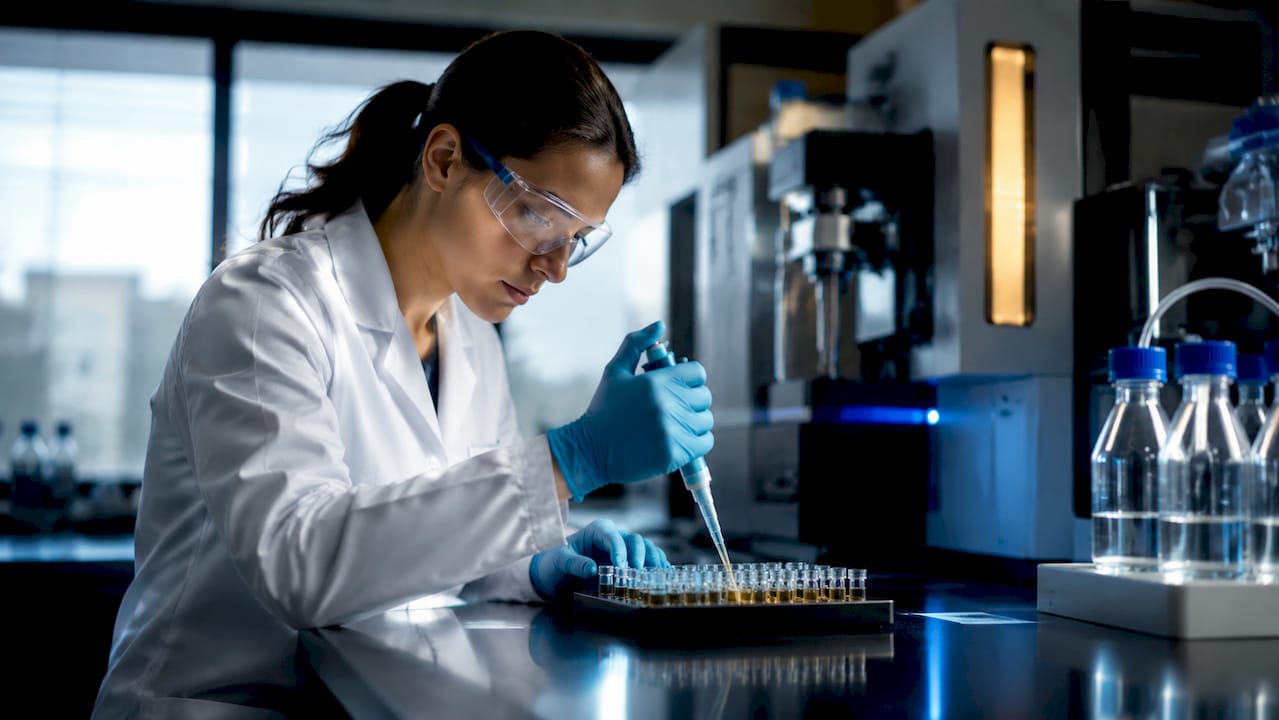
Peptides are the primary analytical units in proteomics research, serving as measurable surrogates for proteins that cannot be directly sequenced at scale by mass spectrometry. The role of peptides in proteomics research centers on proteolytic digestion: proteins are enzymatically cleaved into peptides, which are then identified by tandem mass spectrometry and mapped back to their parent proteins. This workflow underpins virtually every large-scale protein identification study, from basic cell biology to clinical biomarker discovery. Reference frameworks like PeptideAtlas and GENCODE, combined with tools like Spectronaut and MaxQuant, have formalized how peptide libraries are built, curated, and deployed across high-throughput experiments.
How are peptides generated and identified in proteomics workflows?
Proteolytic digestion is the entry point for every bottom-up proteomics experiment. Trypsin remains the default protease because it cleaves reliably at lysine and arginine residues, generating peptides in the 7–25 amino acid range that are well-suited for liquid chromatography separation and tandem MS fragmentation. However, trypsin alone covers only a fraction of the proteome sequence space.
Sample preparation variability is one of the largest sources of irreproducibility in proteomics. Incomplete digestion, off-target cleavages, and peptide loss during cleanup all reduce the number of identifiable sequences. These issues compound when working with low-input samples such as laser-capture microdissected tissue or single-cell preparations.
Tandem mass spectrometry data acquisition falls into two primary modes: data-dependent acquisition (DDA) and data-independent acquisition (DIA). DDA selects the most abundant precursor ions for fragmentation, which introduces stochastic undersampling. DIA fragments all precursors within defined isolation windows, producing more complete and reproducible datasets. Spectral libraries, either from public repositories or user-defined collections, are required to interpret DIA data with high confidence.
Peptide identification from MS/MS spectra is probabilistic by design. De novo sequencing accuracy reaches only approximately 4.1% on complex benchmarks even with state-of-the-art algorithms. That figure reflects the genuine difficulty of reconstructing full sequences from fragment ion series without a reference database. Database-dependent search tools like Mascot, SEQUEST, and MSFragger improve practical identification rates substantially, but they are constrained by the completeness of the reference proteome.
Key steps in a standard bottom-up proteomics workflow include:
Protein extraction and denaturation
Reduction and alkylation of cysteine residues
Enzymatic digestion (trypsin, Lys-C, Glu-C, or combinations)
Peptide desalting and fractionation
LC-MS/MS data acquisition in DDA or DIA mode
Database search or spectral library matching
Statistical filtering and protein inference
Pro Tip: Use at least two complementary proteases, such as trypsin paired with Glu-C or Asp-N, to increase sequence coverage. Complementary protease strategies yield two to three times more high-confidence amino acid sequences compared to single-protease digestion.
What challenges do peptides present in proteomics?

Shared peptides are a persistent technical problem in protein quantification. A peptide sequence present in multiple protein isoforms or gene family members cannot be assigned to a single parent protein without additional evidence. Shared peptides complicate quantitation by creating ambiguity between parent proteins, potentially biasing relative abundance estimates in label-free experiments. This is particularly problematic in studies of protein families with high sequence homology, such as histones or cytokines.
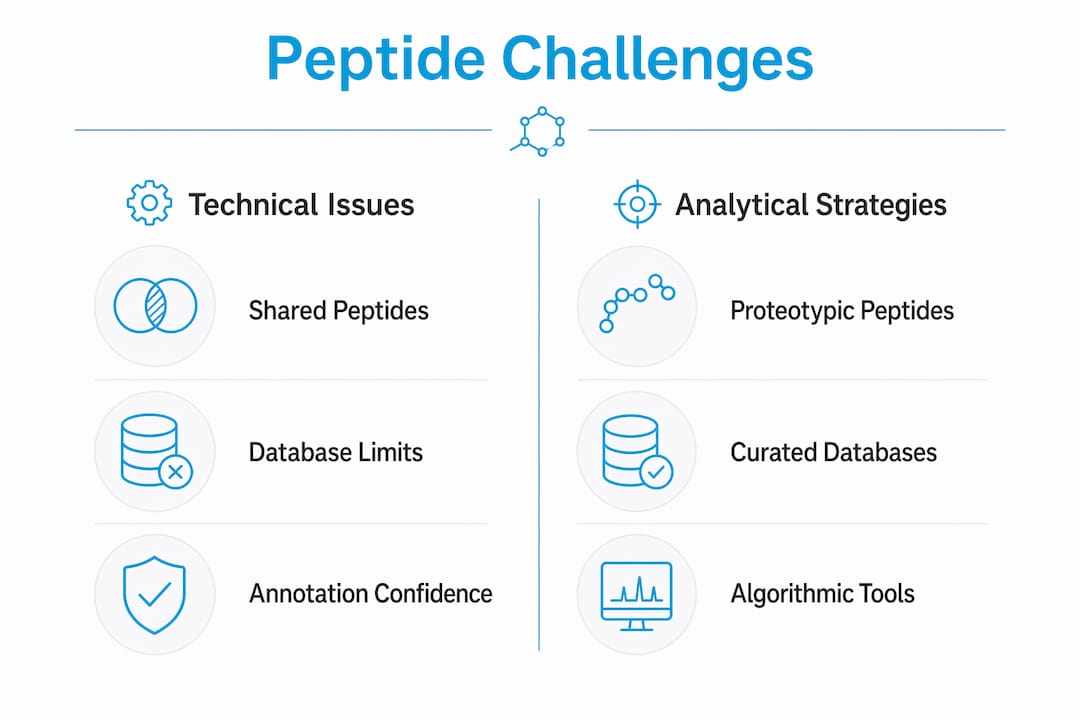
Non-canonical open reading frames (ncORFs) present a separate challenge. These genomic regions were historically excluded from proteomics databases because they were not predicted to encode proteins. A large-scale analysis of 7,264 ncORFs across 95,520 proteomics experiments found that approximately 25% yielded detectable peptides. That result substantially expands the recognized complexity of the human proteome and requires updated database annotations to capture these microproteins and peptideins.
The table below summarizes the primary challenges in peptide-based proteomics and the strategies used to address them:
Challenge Strategy Shared peptides biasing quantitation Use proteotypic peptides unique to a single protein; apply protein inference algorithms Incomplete sequence coverage Combine complementary proteases; optimize digestion conditions Non-canonical peptide detection Expand reference databases with ncORF annotations from resources like GENCODE Low-abundance peptide identification Deploy user-defined, disease-specific spectral libraries with DIA acquisition Probabilistic MS identification errors Apply strict false discovery rate thresholds; validate with orthogonal methods
High-confidence peptide annotation depends on curated databases and rigorous statistical filtering. The PeptideAtlas project provides a community resource of experimentally observed peptides with associated confidence scores, helping researchers distinguish reliably detected sequences from single-observation artifacts. Without this kind of curation, proteomics datasets accumulate false positives that propagate through downstream analyses.
Advanced algorithms are narrowing the gap between raw MS output and confident protein identification. Tools like DiNovo combine mirror protease digestion with deep learning to improve de novo sequencing accuracy. The practical implication is that researchers working on non-model organisms or novel proteoforms, where reference databases are incomplete, now have more reliable options than they did three years ago.
How does peptide-based proteomics drive drug discovery?
Proteomics in drug discovery has shifted from static protein catalogs to functional characterization of protein activity under disease conditions. Proteogenomics integrates genome sequencing with protein quantification to validate drug targets at the functional level, not just the genomic level. A gene mutation identified by sequencing does not confirm that the corresponding protein is dysregulated. Peptide-level quantification closes that gap.
Immunopeptidomics is one of the most active application areas. Tumor cells present peptide fragments on HLA molecules, and identifying these neoantigens is central to personalized cancer immunotherapy. Generic spectral libraries miss many of these rare, patient-specific sequences. User-defined peptide libraries tailored to individual HLA types and tumor profiles improve neoantigen detection from melanoma and renal cell carcinoma cell lines, enabling more precise target selection for therapeutic development.
Multimodal profiling is gaining traction as a strategy for mechanism-of-action studies. Combining phenotypic assays with unbiased peptide detection improves the identification of how candidate compounds alter protein networks, not just whether they bind a target. This approach reduces the rate of late-stage clinical failures caused by incomplete target characterization.
Peptide biomarkers in medicine represent another translational output of proteomics workflows. Plasma and tissue peptide profiles can stratify patients by disease subtype, predict treatment response, and monitor pharmacodynamic effects. Detailed guidance on peptide biomarker applications in disease detection illustrates how proteomics data moves from discovery to clinical utility.
Key application areas where peptide-based proteomics is delivering measurable research value include:
Neoantigen identification for cancer immunotherapy
Drug target validation through proteogenomics
Toxicity profiling across multiple organ systems
Biomarker discovery in plasma and tissue proteomes
Systems pharmacology modeling of protein network responses
Pro Tip: When designing peptide libraries for personalized medicine applications, incorporate HLA-specific allele frequencies and tumor mutation burden data from the patient cohort. Personalized library design using adaptive focused acoustics for sample preparation reduces stochasticity from tissue heterogeneity and improves neoantigen recovery.
What 2026 advances are improving peptide analysis?
High-throughput proteomics workflows have crossed a practical threshold in 2026. Narrow-window DIA combined with optimized sample preparation identifies over 7,400 proteins on a 2-minute LC gradient, processing 96 tissue samples within 5 hours. That throughput makes multi-organ toxicity studies and large clinical cohort analyses feasible within standard laboratory timelines.
The table below summarizes key 2026 technological advances and their practical impact on peptide analysis:
Technology Advance Practical Impact Narrow-window DIA Reduced precursor co-isolation Higher peptide identification specificity Mirror protease + deep learning (DiNovo) 2–3x more high-confidence sequences Better coverage of non-tryptic and modified peptides User-defined spectral libraries Disease-specific HLA libraries Detection of peptides at 0.1 fmol levels Single-molecule sequencing Proteoform-level resolution Direct detection without digestion artifacts Adaptive focused acoustics Reproducible tissue lysis Reduced sample-to-sample variability
User-defined, disease-specific peptide libraries have redefined sensitivity benchmarks. Detection at 0.1 fmol levels with recovery exceeding 75% of expected sequences for libraries containing more than 10,000 peptides demonstrates that library design is now as important as instrument performance. Generic spectral libraries from public repositories cannot match this sensitivity for rare or patient-specific sequences.
The field is also moving toward single-molecule sequencing approaches. Proteoform diversity and structure-function mapping are driving convergence on high-throughput methods that do not require proteolytic digestion, which would eliminate many of the ambiguities introduced by shared peptides and incomplete cleavage. Nanopore-based protein sequencing remains early-stage, but the trajectory is clear.
Peptide research in immune contexts is also benefiting from these advances. The intersection of immunopeptidomics and high-throughput DIA is detailed further in this 2026 guide to peptides in immune response research, which covers HLA peptide presentation and T-cell epitope mapping in depth.
Pro Tip: Combine narrow-window DIA acquisition with a user-defined spectral library built from matched RNA-seq data to maximize coverage of both canonical and non-canonical peptides. Consistent reagent quality across digestion batches is as important as instrument configuration for reproducible results.
Key takeaways
Peptides are the functional core of proteomics workflows, and the quality of peptide identification determines the reliability of every downstream protein-level conclusion.
Point Details Peptides as protein surrogates Proteolytic digestion converts proteins into measurable peptides that serve as analytical proxies in MS-based workflows. Complementary proteases increase coverage Using two or more proteases yields 2–3x more high-confidence sequences than trypsin alone. Shared peptides bias quantitation Proteotypic peptide selection and protein inference algorithms are required to avoid abundance estimation errors. User-defined libraries improve sensitivity Disease-specific spectral libraries enable detection at 0.1 fmol and recover over 75% of expected sequences. Proteogenomics validates drug targets Integrating peptide quantification with genomic data confirms functional protein dysregulation, not just genetic alteration.
Peptides in proteomics: what the data actually tells us
The proteomics field has accumulated enough methodological data to draw some firm conclusions, and a few of them cut against common practice.
The most underappreciated variable in peptide-based proteomics is digestion consistency, not instrument resolution. Researchers routinely invest in newer mass spectrometers while using the same trypsin protocol they have run for a decade. The data from DiNovo and related studies shows that protease complementarity has a larger effect on high-confidence sequence yield than incremental MS hardware upgrades. That is a resource allocation argument worth making to any lab director planning a capital equipment purchase.
The expansion of the human proteome through ncORF-derived microproteins is also more consequential than the field has fully absorbed. Finding that 25% of analyzed ncORFs produce detectable peptides means that standard database-dependent searches are systematically missing a meaningful fraction of the proteome. Any study claiming comprehensive protein coverage without updated ncORF annotations is working from an incomplete map.
On the drug discovery side, the shift toward multimodal profiling is the right direction, but it requires peptide reagents with batch-to-batch consistency that many sourcing arrangements cannot guarantee. A personalized neoantigen library built on peptides with variable purity across synthesis batches will produce irreproducible results regardless of how sophisticated the bioinformatics pipeline is. Reagent quality is not a procurement afterthought. It is a scientific variable.
The trajectory toward single-molecule sequencing is real, but the timeline for replacing bottom-up proteomics in clinical workflows is longer than conference presentations suggest. For the next several years, the practical gains will come from better library design, complementary digestion strategies, and tighter quality control on the peptide reagents entering the workflow.
— Sam Levin
Research-grade peptides for proteomics workflows
Proteomics experiments depend on peptide reagents that perform consistently across batches. Buyers requiring independent verification may arrange third-party analytical testing. Each lot is lyophilized under controlled conditions and documented with certificates of analysis, so researchers can confirm identity and purity before the peptide enters a digestion or library preparation workflow. For teams building user-defined spectral libraries or validating candidate biomarkers, reagent reproducibility is not optional. Browse the research peptide catalog to find synthesis-grade peptides matched to proteomics research specifications, with sourcing documentation that supports reproducible experimental design.
FAQ
What is the role of peptides in proteomics research?
Peptides serve as analytical surrogates for proteins in mass spectrometry-based proteomics. Proteins are digested into peptides, which are identified by tandem MS and mapped back to parent proteins to infer identity, abundance, and modification state.
Why is trypsin the standard protease in proteomics?
Trypsin cleaves reliably at lysine and arginine residues, generating peptides in a size range optimal for LC-MS/MS analysis. Its predictable cleavage specificity simplifies database searching and peptide identification.
How do shared peptides affect protein quantification?
Shared peptides create ambiguity between proteins with homologous sequences, biasing relative abundance estimates. Selecting proteotypic peptides unique to a single protein resolves most of this ambiguity.
What are user-defined peptide libraries and why do they matter?
User-defined libraries are spectral collections built from disease-specific or patient-specific peptide sequences. They enable detection at 0.1 fmol levels and recover over 75% of expected sequences, outperforming generic public libraries for rare or neoantigen targets.
How is proteomics used in drug discovery?
Proteomics in drug discovery validates targets by quantifying protein dysregulation at the functional level. Proteogenomics integrates genomic and peptide-level data to confirm that a mutated gene produces an altered protein, increasing the biological confidence of target selection.