Peptides in Muscle Recovery Products: 2026 Guide
Peptides are defined as short chains of amino acids that act as biological signals, directing tissue repair, hormone release, and inflammation control in skeletal muscle. The role of peptides in muscle recovery products has grown significantly as research identifies specific sequences that target collagen synthesis, growth hormone secretion, and post-exercise tissue regeneration. A 2026 randomized controlled trial demonstrated that athletes supplementing with 15g of bioactive collagen peptides daily for 12 weeks achieved a 29.8% increase in intramuscular collagen type I compared to placebo. That finding positions collagen peptides as one of the most evidence-backed options in the muscle recovery supplement category. Understanding which peptides work, how they work, and where the evidence stops is what separates informed athletes from those chasing unverified claims.
How do peptides biologically aid muscle recovery and repair?
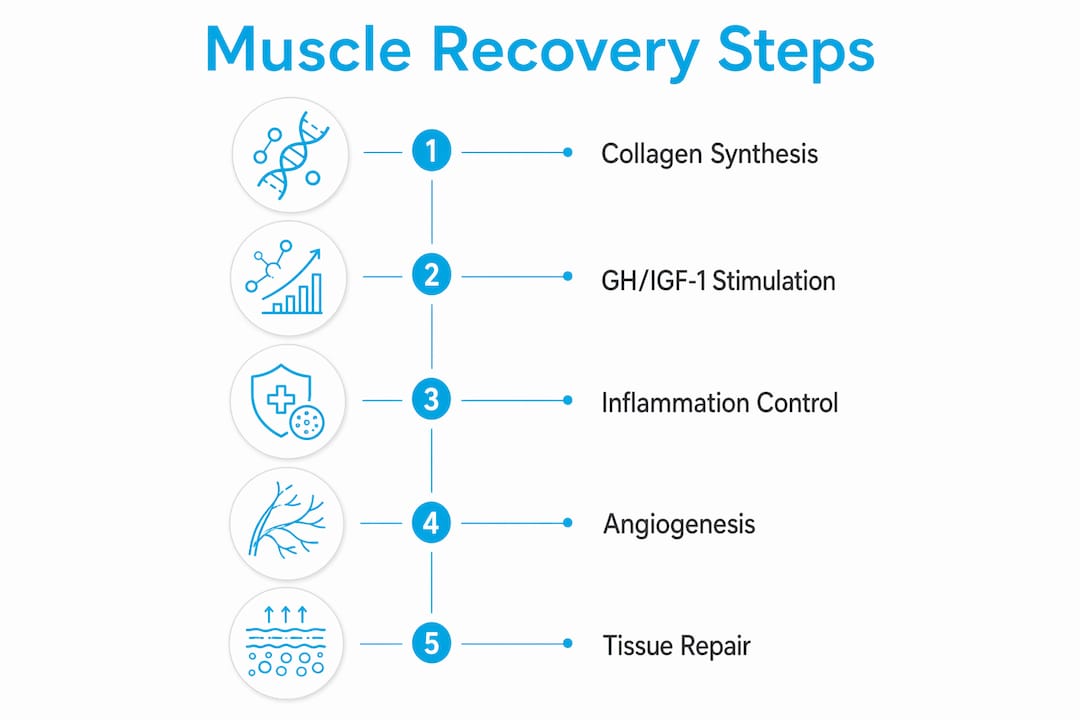
Peptides influence muscle recovery through at least three distinct biochemical pathways: collagen synthesis, growth hormone signaling, and inflammation modulation. Each pathway targets a different phase of the repair cycle, which is why peptide-based recovery products often outperform single-mechanism supplements.
Collagen synthesis and connective tissue repair
Collagen peptides supply proline and glycine, the two amino acids most critical for rebuilding tendons, ligaments, and the extracellular matrix surrounding muscle fibers. When athletes consume collagen peptides alongside vitamin C, the combination activates fibroblast activity and accelerates collagen cross-linking in connective tissue. This is not a minor effect. Tendons and ligaments have poor blood supply and slow natural repair rates, so targeted peptide delivery meaningfully shortens recovery windows.

GH/IGF-1 axis stimulation
Growth hormone secretagogues like ipamorelin stimulate endogenous GH and IGF-1 release, which drives muscle protein synthesis in skeletal muscle. IGF-1 activates the mTOR pathway, the primary anabolic signaling cascade responsible for muscle fiber hypertrophy and repair. The mechanistic rationale is well established. Dedicated human trials confirming post-exercise recovery benefits from ipamorelin specifically remain limited as of 2026.
Inflammation control and angiogenesis
BPC-157, a synthetic peptide derived from a gastric protein, shows consistent acceleration of tissue repair in animal models. Its proposed mechanisms include upregulation of growth factor receptors and promotion of angiogenesis, the formation of new blood vessels that supply oxygen and nutrients to damaged tissue. Over 100 preclinical studies document these effects, though convincing human clinical data for musculoskeletal healing remains absent.
Collagen peptides: rebuild extracellular matrix and connective tissue
Ipamorelin: stimulates GH and IGF-1 for muscle protein synthesis
BPC-157: promotes angiogenesis and growth factor signaling in preclinical models
MGF (mechano growth factor): an exercise-induced endogenous signal for muscle repair, though exogenous supplementation in humans is unstudied
Pro Tip: Pair collagen peptides with at least 50mg of vitamin C approximately 60 minutes before training. The combination activates fibroblast collagen synthesis at a higher rate than collagen peptides alone.
What scientific evidence supports peptides in muscle recovery products?
The evidence base for peptides in muscle repair is uneven. Nutritional peptides like collagen have strong human trial data. Experimental injectable peptides have compelling preclinical data but thin human evidence.
Collagen peptide trials: the strongest human data
The 2026 randomized controlled trial cited above used a 15g daily dose over 12 weeks in resistance-trained athletes. The result was a statistically significant increase in intramuscular collagen type I (p = 0.026). A separate body of research shows that 15g pre-workout with vitamin C improves explosive power through better tendon efficiency, while 20g daily reduces soreness and speeds functional recovery. These are not marginal effects. They represent measurable performance and structural improvements in trained athletes.
Synthetic peptides: early but notable results
The synthetic peptide Myoki demonstrated improvements in muscle mass, walking speed, and grip strength after 12 weeks of intervention by blocking pathways that lead to muscle atrophy. This is relevant primarily for sarcopenia models, but the mechanism, blocking atrophy signaling, applies broadly to recovery contexts where muscle preservation matters.
Peptide type Evidence level Key outcome Human trial data Bioactive collagen peptides High 29.8% increase in collagen type I Yes (2026 RCT) Collagen + vitamin C Moderate-high Improved tendon efficiency, reduced soreness Yes Myoki (synthetic) Moderate Muscle mass and function improvement Yes (12-week trial) Ipamorelin / GH secretagogues Low GH/IGF-1 stimulation Mechanistic only BPC-157 Low Tissue repair acceleration Preclinical only
“While anecdotal claims and early animal studies suggest peptides promise accelerated muscle healing and strength gains, robust large-scale human trials remain scarce as of 2026.”
The distinction between dietary peptides with supplement status and experimental injectable peptides is not a minor regulatory technicality. It defines what athletes can safely use, what carries doping risk, and what has actual outcome data behind it.
What are the safety, regulatory, and sourcing challenges?
The peptide recovery market contains products that range from well-studied nutritional supplements to unverified injectable compounds with no human safety data. Athletes need to understand that category difference before selecting any product.
Regulatory and doping risks
TB-500, a synthetic fragment of thymosin beta 4, is banned by anti-doping agencies and may differ structurally from the parent molecule, meaning its actual biological effects are unpredictable. Athletes subject to testing face disqualification risk from products that are openly sold online without clear labeling. Orthopaedic experts urge caution on peptide use for tendon and muscle injuries, citing the absence of standardized dosing, frequency guidelines, and long-term safety data.
Manufacturing quality and batch reliability
The reliability of any peptide product depends heavily on manufacturing process controls. Lyophilization, vialing, and packaging each introduce quality variation between raw peptide APIs and finished products. A peptide that tests at 99% purity as a raw API may degrade significantly if lyophilization is performed incorrectly or if storage conditions are not maintained. Batch traceability and independent purity verification are the two controls that separate reliable suppliers from gray-market resellers.
Avoid products without a certificate of analysis (COA) from an independent third-party lab
Confirm whether the supplier is an API manufacturer or a reseller with no direct synthesis relationship
Check ingredient labeling for sequence accuracy, concentration, and excipient disclosure
Do not use peptide stacks marketed as “wolverine stacks” or similar combinations. These lack clinical validation and carry unknown interaction risks
Verify anti-doping status before using any injectable peptide in a competitive context
Pro Tip: Request batch-specific HPLC and mass spectrometry data from any peptide supplier before purchasing. A supplier that cannot provide these documents on request is not operating with the transparency that research-grade sourcing requires.
How can athletes practically incorporate peptides into their recovery regimen?
Practical peptide use for recovery starts with the compounds that have human clinical data and ends with clear dosing protocols. Athletes should not begin with injectable peptides when nutritional peptides have stronger evidence and lower risk.
Start with collagen peptides. Use 15–20g daily, with 15g taken approximately 60 minutes before training alongside vitamin C. This timing aligns with the dosing protocols from the 2026 RCT and the pre-workout collagen research. The pre-workout window primes fibroblasts during the post-exercise repair phase.
Maintain consistent daily dosing. Collagen peptides require 8–12 weeks of consistent use to produce measurable structural changes. Sporadic use does not replicate the outcomes seen in controlled trials.
Add vitamin C to every collagen dose. Vitamin C is a required cofactor for hydroxylation of proline and lysine, the chemical steps that stabilize collagen triple-helix structure. Without it, collagen synthesis is incomplete regardless of peptide dose.
Evaluate injectable peptides against your risk profile. Athletes in tested sports should review the BPC-157 vs TB-500 comparison and confirm anti-doping status before use. Neither compound has approved human clinical protocols as of 2026.
Monitor outcomes with objective markers. Track grip strength, tendon soreness scores, and functional movement quality across an 8-week minimum. Subjective “feeling better” is not a reliable outcome measure for peptide efficacy.
Source from verified suppliers. Amino acids and collagen peptides from suppliers with batch traceability and independent COAs deliver consistent outcomes. Products from unverified online sources introduce purity and concentration variables that make outcome tracking meaningless.
Key takeaways
Collagen peptides are the most evidence-backed option in muscle recovery supplementation, with a 29.8% increase in intramuscular collagen type I demonstrated in a 2026 randomized controlled trial at 15g daily over 12 weeks.
Point Details Collagen peptides have the strongest evidence A 2026 RCT confirmed a 29.8% increase in collagen type I at 15g daily over 12 weeks. Timing and vitamin C matter Take 15g collagen peptides with vitamin C 60 minutes before training to maximize fibroblast activation. Injectable peptides carry real risks BPC-157 and TB-500 lack human clinical data and may violate anti-doping rules in competitive sports. Manufacturing quality determines outcomes Batch traceability, independent COAs, and lyophilization controls separate reliable products from gray-market ones. Peptide stacking is unvalidated Combining multiple peptides without clinical protocols introduces unknown interaction risks and unpredictable outcomes.
The evidence gap athletes should take seriously
I have spent years reading peptide research and watching the gap between preclinical excitement and human clinical reality play out repeatedly. BPC-157 is the clearest example. The preclinical data is genuinely impressive. Over 100 animal studies, consistent tissue repair signals, plausible mechanisms. Then you look for human trials and find almost nothing. That gap is not a minor footnote. It is the entire story for athletes making sourcing decisions.
The collagen peptide data, by contrast, is unusually clean for a nutritional supplement category. The 2026 RCT used resistance-trained athletes, not sedentary populations. The outcome measure was intramuscular collagen type I, not a self-reported soreness scale. That is the kind of evidence that should drive purchasing decisions.
What concerns me about the current market is the normalization of injectable peptide stacks without any clinical framework. The “wolverine stack” concept circulates widely in biohacking communities. Nobody has studied it. Nobody knows the interaction profile. Athletes are essentially running uncontrolled experiments on themselves while paying premium prices for products with no batch verification.
The sourcing reality matters as much as the science. A peptide that is 85% pure due to poor lyophilization is not the same compound studied in a clinical trial. Manufacturing transparency is not a marketing claim. It is the variable that determines whether the product you are using resembles the one in the research.
— Sam Levin
Research-grade peptides for muscle recovery from PeptidesFromChina
Athletes and research teams who need verified peptide materials for muscle recovery work require suppliers with direct synthesis relationships, not resellers operating through gray-market channels.

Products are subject to the manufacturer’s applicable quality-control procedures and specifications. Manufacturer-side analytical documentation may be available depending on the product and batch. PeptidesFromChina is not an independent analytical testing laboratory. The peptide catalog includes compounds relevant to muscle-recovery research. Learn more: SS-31.
FAQ
What is the role of peptides in muscle recovery products?
Peptides accelerate muscle recovery by stimulating collagen synthesis, activating growth hormone signaling through the GH/IGF-1 axis, and modulating post-exercise inflammation. Collagen peptides have the strongest human clinical evidence, with a 2026 RCT confirming a 29.8% increase in intramuscular collagen type I at 15g daily.
How many grams of collagen peptides should athletes take daily?
Clinical research supports 15–20g daily, with 15g taken 60 minutes before training alongside vitamin C for tendon efficiency benefits, and 20g daily for soreness reduction and functional recovery.
Are injectable peptides like BPC-157 safe for athletes?
BPC-157 has strong preclinical data but lacks convincing human clinical trials for musculoskeletal healing. Orthopaedic experts urge caution due to absent standardized dosing protocols, and some injectable peptides like TB-500 are banned by anti-doping agencies.
What makes one peptide product more reliable than another?
Batch traceability, independent COAs from third-party labs, and verified lyophilization processes determine product reliability. A raw API at 99% purity can degrade significantly if manufacturing steps are not controlled, making supplier transparency the critical variable.
Do peptide stacks improve recovery outcomes?
No validated clinical evidence supports peptide stacking protocols. Combinations marketed as recovery stacks lack standardized dosing, known interaction profiles, and human trial data, making outcome prediction unreliable.