Peptides in Immune Response Research: 2026 Guide

Peptides are defined as short amino acid chains that function as primary bioactive regulators of both innate and adaptive immunity, governing processes from antigen presentation to inflammatory signal transduction. The role of peptides in immune response research has expanded substantially as immunopeptidomics, computational epitope prediction, and precision therapeutic design have matured into reproducible laboratory disciplines. Researchers now recognize peptides not as passive fragments but as functional mediators that activate dendritic cells, modulate T cell receptor (TCR) recognition, and regulate cytokine networks with sequence-level specificity. Categories spanning antimicrobial peptides (AMPs) such as cathelicidins and defensins, immunosuppressive peptide analogs, and cytokine mimetics each occupy distinct mechanistic niches. Understanding these distinctions is prerequisite to designing experiments that yield translatable data rather than artifact-laden results.
What is the role of peptides in immune response research?
Peptides mediate immune recognition through two primary antigen presentation pathways: MHC class I and MHC class II. MHC class I molecules present peptides of 8 to 10 amino acids derived from intracellular proteins, directing CD8+ cytotoxic T lymphocyte responses. MHC class II molecules present longer peptides of 13 to 25 amino acids from extracellular antigens, activating CD4+ helper T cells. This length constraint is not arbitrary. It reflects the physical dimensions of the peptide-binding groove and directly determines which T cell populations are recruited.
Peptide transporters and processing machinery shape which fragments reach the cell surface. The transporter PEPT2, for instance, influences intracellular peptide availability in immune-relevant tissues. Immunopeptidomics advances in antigen identification now enable high-throughput LC-MS profiling of MHC-bound peptides across cancer and fibrosis models, with fibrosis-specific epitopes like MAF116-124 confirmed to activate human cytotoxic T lymphocytes. This level of resolution was not achievable a decade ago.
Downstream of receptor engagement, peptides modulate several intracellular signaling cascades:
MAPK pathway activation, influencing cell proliferation and cytokine production
NF-κB pathway modulation, regulating transcription of pro-inflammatory genes
NLRP3 inflammasome activation or suppression, controlling IL-1β and IL-18 maturation
Chemokine receptor signaling, directing immune cell trafficking and tissue infiltration
SARS-CoV-2 spike protein-derived peptides demonstrate how sequence-specific peptides can selectively deplete immune cells such as plasmacytoid dendritic cells and T cells at 10 to 20 µM concentrations, without affecting spheroidal monocytes or neutrophils. This selectivity confirms that peptide function in immunity is not a blunt instrument. It is sequence-dependent and cell-type-specific.
Pro Tip: When designing peptide-based antigen presentation assays, include flanking residues of at least 4 to 6 amino acids on each side of the core epitope. Flanking residues significantly influence MHC-II presentation and TCR recognition accuracy, and omitting them introduces systematic discrepancies in immunogenicity readouts.

What categories of peptides drive immunological activity?
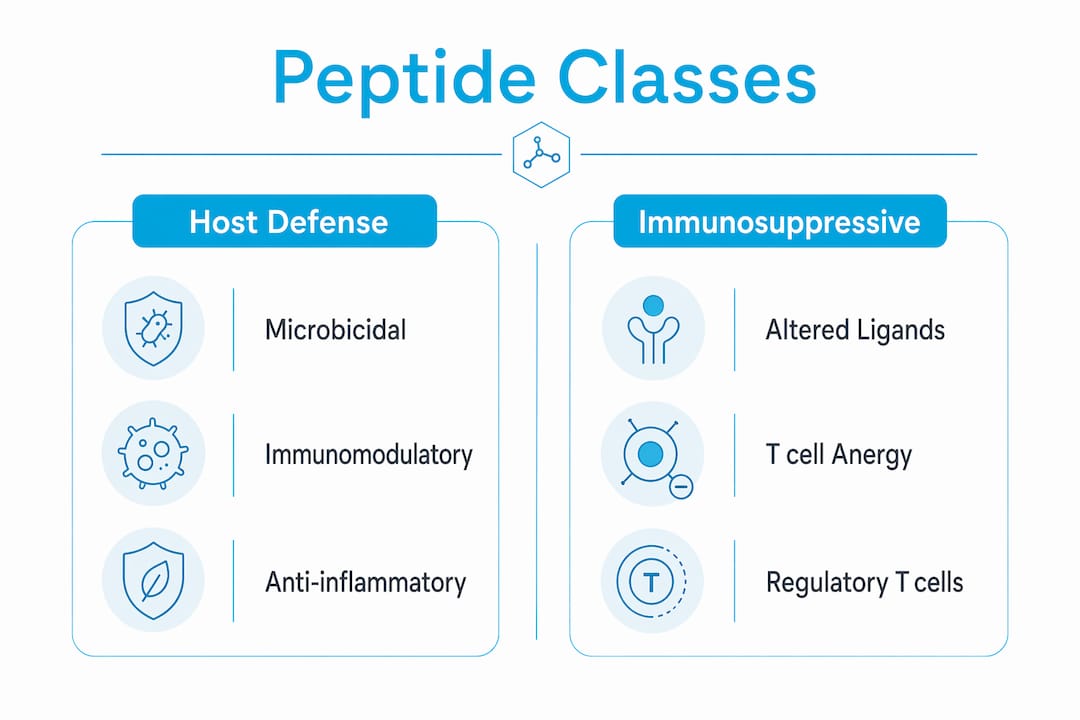
Immunologically active peptides divide into functional classes with distinct mechanisms and therapeutic implications. Host defense peptides represent the most studied category, with cathelicidins (including LL-37 in humans) and defensins serving dual roles as direct antimicrobials and immune cell activators. LL-37 recruits neutrophils, activates plasmacytoid dendritic cells, and promotes wound healing through receptor-mediated signaling. The distinction between receptor-mediated signaling and biophysical membrane disruption is mechanistically critical. Antimicrobial peptides like LL-37 may act through either mechanism, and the therapeutic accessibility of each differs substantially. Receptor targeting is pharmacologically tractable; physical membrane disruption is not.
Immunosuppressive peptides include altered peptide ligands (APLs) designed to induce T cell anergy or regulatory T cell expansion. Glatiramer acetate, used in multiple sclerosis treatment, exemplifies this class. Immunostimulatory peptides, by contrast, amplify responses through adjuvant-like mechanisms or direct cytokine induction.
Peptide class Primary function Representative examples Host defense peptides Microbicidal and immune activation LL-37, defensins, cathelicidins Immunosuppressive peptides Tolerance induction, T cell anergy Glatiramer acetate, APLs Cytokine mimetics Receptor agonism or antagonism IL-2 mimetics, TNF inhibitor peptides Chemokine receptor modulators Immune cell trafficking control CXCR4 antagonists (e.g., AMD3100 analogs) Inflammasome-targeting peptides NLRP3 suppression, IL-1β reduction WPAW tetrapeptide, synthetic NLRP3 blockers
Palmitoylethanolamide (PEA), while technically a lipid amide rather than a classical peptide, illustrates the broader principle of broad-spectrum immunomodulatory agents acting through PPAR-α to inhibit NF-κB and MAPK pathways across microglia and mast cells. This cross-pathway activity reinforces the argument that immunomodulatory compounds, including peptides, should be evaluated as systemic regulators rather than single-target agents.
Peptides functioning as cytokine mimetics or receptor antagonists represent a growing therapeutic frontier. CXCR4 antagonist peptides disrupt the CXCL12-CXCR4 axis, which governs hematopoietic stem cell retention and tumor immune evasion. Blocking this interaction with short peptide sequences alters immune cell distribution in ways that broad cytokine blockade cannot replicate with the same spatial precision.
How do researchers identify and characterize immune peptides?
Methodology determines the quality of peptide immunology data. The following approaches represent the current standard for peptide identification and characterization in immune research:
LC-MS immunopeptidomics: Liquid chromatography coupled with mass spectrometry enables unbiased, high-throughput profiling of MHC-bound peptides directly from cell lysates or tissue samples. This approach identifies naturally processed epitopes without prior sequence assumptions.
Computational MHC binding prediction: Tools including NetMHCpan and MHCflurry predict peptide-MHC binding affinity from sequence data alone. These computational prediction tools accelerate neoantigen discovery for personalized cancer vaccines by narrowing the candidate peptide pool before experimental validation.
TCR repertoire sequencing: High-throughput TCR sequencing maps the clonal T cell response to specific peptide-MHC complexes, providing functional context for epitope identification.
Peptide-MHC multimer technologies: Fluorescently labeled pMHC multimers allow direct enumeration and phenotyping of antigen-specific T cells by flow cytometry or mass cytometry (CyTOF).
Micropeptide discovery: Non-canonical open reading frames in lncRNAs and circRNAs encode micropeptides with immune regulatory functions, challenging the classical definition of immunologically relevant peptides and expanding the discovery space considerably.
Methodology Application Key limitation LC-MS immunopeptidomics MHC-bound peptide profiling Requires high cell input; low-abundance peptides missed NetMHCpan / MHCflurry Binding affinity prediction Allele coverage gaps; false positives require wet-lab validation TCR repertoire sequencing Clonal T cell response mapping Does not directly identify cognate peptide-MHC pairs pMHC multimers Antigen-specific T cell detection Multimer production is technically demanding and allele-specific
Pro Tip: Flanking residue inclusion is not optional in immunopeptidomics workflows. Peptide flanking residues directly affect MHC-II loading efficiency and downstream TCR contact geometry. Designing synthetic peptides for assay validation without flanking sequences produces binding data that does not reflect in vivo antigen processing.
How are peptides applied in therapeutic immune modulation?
Peptide-based therapeutic strategies in immunology span tolerance induction, infection control, oncology, and metabolic immune regulation. Each application demands a different peptide design logic and raises distinct manufacturing considerations.
Peptide vaccines using defined epitopes or neoantigen sequences drive antigen-specific T cell responses in cancer immunotherapy. Personalized neoantigen peptide vaccines require synthesis of patient-specific sequences at research or clinical grade, placing direct demands on batch purity and sequence fidelity.
Altered peptide ligands for tolerance induction, exemplified by glatiramer acetate in multiple sclerosis, work by shifting T cell responses from pro-inflammatory Th1 toward regulatory or Th2 phenotypes. The mechanism depends on partial TCR agonism, which is exquisitely sensitive to peptide sequence and concentration.
AMPs as immunomodulators extend beyond pathogen killing. LL-37 activates toll-like receptor signaling and promotes type I interferon production, positioning it as a candidate for adjuvant applications in vaccine formulations.
Peptide drug conjugates and bispecific peptide-MHC engagers represent more recent engineering approaches, linking cytotoxic payloads or T cell-recruiting domains to antigen-specific peptide scaffolds.
DPEP2-mediated immunometabolism offers a distinct angle. DPEP2 controls hyperinflammation in sepsis through metabolic reprogramming of macrophages, and lipid nanoparticle-mediated mRNA delivery of Dpep2 is protective in murine sepsis models. This positions peptide-adjacent metabolic targets as viable intervention points in hyperinflammatory disease.
Manufacturing quality directly constrains translational utility. Peptides intended for immune response studies require verified sequence identity, purity above 95% by HPLC, and documented endotoxin levels. Endotoxin contamination in research-grade peptides is a persistent confound in immunology experiments because LPS activates NF-κB and NLRP3 through the same pathways under investigation. Batch-to-batch consistency is equally critical. Researchers relying on peptide testing and analysis protocols that include independent third-party verification reduce the risk of attributing endotoxin artifacts to peptide-specific mechanisms.
Pro Tip: For inflammation pathway studies, always request a certificate of analysis that includes both HPLC purity and LAL endotoxin testing. A peptide with 98% HPLC purity but uncontrolled endotoxin levels will produce unreliable NF-κB and cytokine data regardless of experimental design.
Key takeaways
Peptides function as sequence-specific modulators of immune recognition, inflammatory signaling, and therapeutic targeting, with research utility dependent on synthesis quality, flanking residue inclusion, and validated characterization methods.
Point Details MHC presentation specificity Peptide length (8-25 aa) and flanking residues determine MHC binding and TCR recognition fidelity. Signaling pathway coverage Immune response peptides modulate MAPK, NF-κB, and NLRP3 pathways with sequence-dependent selectivity. Methodology drives discovery LC-MS immunopeptidomics and NetMHCpan together enable high-throughput epitope identification for neoantigen research. Therapeutic class diversity AMPs, APLs, cytokine mimetics, and metabolic regulators like DPEP2 each require distinct design and sourcing logic. Manufacturing quality is a research variable Endotoxin contamination and batch inconsistency directly confound immune pathway data in peptide experiments.
Why peptide immunology still gets the fundamentals wrong
The field has accumulated substantial mechanistic knowledge, yet a recurring problem persists in published immunology research: peptides are treated as interchangeable reagents rather than precision tools with sequence-specific, context-dependent behavior. Having reviewed immunopeptidomics datasets and peptide-based assay designs across multiple research programs, the pattern is consistent. Flanking residues are omitted, endotoxin controls are absent, and synthetic peptides sourced from unverified suppliers introduce batch variability that invalidates cross-study comparisons.
The emerging integration of peptide biology with immune cell metabolism, particularly through targets like DPEP2 and related immunometabolic nodes, represents a genuinely productive direction. It moves beyond cytokine blockade toward upstream metabolic control of inflammatory phenotypes. But this sophistication at the pathway level is undermined when the peptide reagents themselves are not characterized to the standard the experiments demand.
There is also a tendency to conflate pharmacological and biophysical peptide mechanisms, particularly with AMPs. Whether LL-37 acts through receptor-mediated signaling or membrane disruption in a given experimental context determines whether the result is therapeutically interpretable or simply a cytotoxicity artifact. Researchers designing local vs systemic peptide delivery studies face this exact ambiguity and rarely address it explicitly in their methods sections.
The path forward requires treating peptide sourcing, characterization, and experimental design as a unified quality system rather than separable concerns. Micropeptides encoded by non-canonical RNAs add another layer of complexity that most labs are not yet equipped to address systematically. The field is more capable than its average experimental practice suggests.
— Sam Levin
Research-grade peptides for immunology studies

Immunology research demands peptides with verified sequence identity, documented purity, and controlled endotoxin levels. Buyers requiring independent verification may arrange third-party analytical testing. The peptide catalog includes compounds relevant to immune response studies, including VIP for inflammation pathway modulation, KPV for NF-κB-targeted research, and Thymosin Alpha-1 for innate immune balance studies. Each product is supported by HPLC and mass spectrometry data. Researchers requiring consistent, traceable peptide supply for immunopeptidomics or cytokine assay work can review available compounds and specifications directly through the catalog.
FAQ
What is the role of peptides in immune response research?
Peptides function as antigen presentation substrates, signaling modulators, and immunomodulatory agents in immune response research. They mediate MHC-restricted T cell recognition, regulate inflammatory pathways including NF-κB and NLRP3, and serve as templates for therapeutic vaccine and tolerance-induction strategies.
How do peptide flanking residues affect immunogenicity studies?
Flanking residues influence MHC-II loading efficiency and TCR contact geometry. Excluding them from synthetic peptides used in assays produces binding and activation data that does not accurately reflect in vivo antigen processing, leading to reproducibility failures across laboratories.
What methodologies are used to identify immune response peptides?
LC-MS immunopeptidomics, computational tools such as NetMHCpan and MHCflurry, TCR repertoire sequencing, and peptide-MHC multimer staining are the primary methods. Each addresses a different aspect of peptide identification, from unbiased epitope discovery to functional T cell enumeration.
How does endotoxin contamination affect peptide immunology experiments?
Endotoxin activates NF-κB and NLRP3 through the same pathways that many immune response peptides target. Contaminated peptide batches produce false-positive cytokine and signaling data that cannot be distinguished from genuine peptide-mediated effects without rigorous LAL testing controls.
What peptides are most relevant to inflammation research?
Peptides targeting MAPK and NF-κB pathways, including synthetic NLRP3 inhibitors and host defense peptides like LL-37, are directly relevant to the role of peptides in inflammation research. DPEP2-related metabolic peptides represent an emerging category for hyperinflammatory disease models such as sepsis.