Peptide Supplier Contract Negotiation Tips for Procurement

Peptide supplier contract negotiation is defined as the structured process by which biotech and pharmaceutical procurement teams secure binding supply agreements that address the technical, regulatory, and operational realities of peptide manufacturing. Unlike standard API sourcing, negotiating peptide supply contracts requires fluency in synthesis-specific risks: batch variability, lyophilization failures, purity drift across production runs, and the concentration of manufacturing capacity in a small number of facilities globally. Contract managers who treat peptide agreements like commodity chemical contracts routinely encounter costly scope disputes, ambiguous IP ownership, and supply disruptions with no contractual remedy. The strategies in this guide address those gaps directly.
What are the best peptide supplier contract negotiation tips for procurement?
Effective peptide supplier contract negotiation tips begin with a single principle: technical understanding precedes commercial leverage. A procurement team that cannot distinguish between linear, cyclic, and stapled peptide synthesis capabilities cannot accurately assess whether a supplier’s quoted price reflects genuine capacity or aspirational capability. That distinction determines whether a contract delivers on its terms or generates change orders from the first batch.
Vendor evaluation in this context is not a checkbox exercise. Formal on-site audits remain the industry standard for GMP-regulated activities, specifically because they reveal actual production capacity versus the paper capacity that questionnaires and capability decks routinely overstate. A supplier may claim multi-kilogram annual output for a given peptide class while running a single synthesis train at 70% utilization for existing clients.
The evaluation framework should cover five dimensions before any commercial discussion begins:
Technical depth: Confirmed experience with the specific peptide class required, including synthesis route, protecting group strategy, and purification method.
Regulatory history: FDA inspection records, warning letters, and any manufacturing site changes in the past five years.
Financial stability: Ownership structure, revenue concentration, and any recent acquisition activity that could affect operational continuity.
Performance history: Batch acceptance rates, on-time delivery records, and quality deviation frequency from prior clients where obtainable.
Working dynamics: Communication responsiveness, escalation behavior, and technical transparency during the evaluation process itself.
Pilot projects and in-depth audits reveal working dynamics and communication approaches that no questionnaire captures. Running a small-scale feasibility batch before contract execution gives procurement teams real data on cycle time, deviation handling, and documentation quality.
Pro Tip: Request a redacted batch record from a comparable synthesis project during the audit. A supplier unwilling to share anonymized process documentation under NDA is signaling something about their quality culture.
How should procurement teams structure peptide contract negotiations?
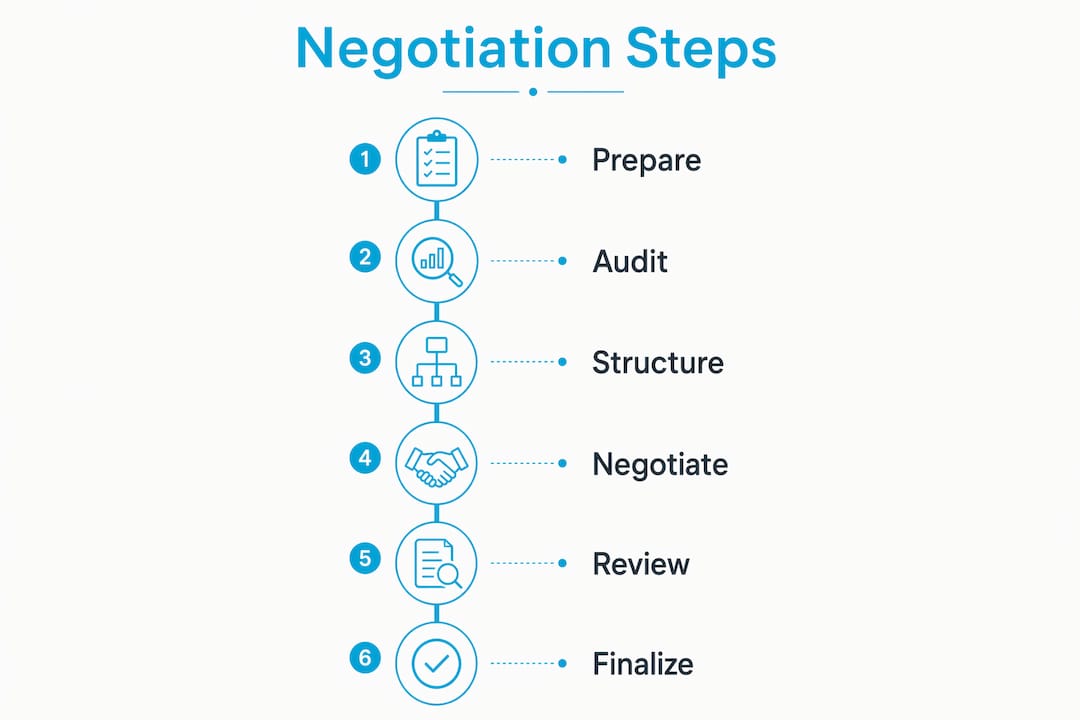
The most common structural error in peptide supplier agreement negotiations is involving legal counsel before commercial terms are aligned. Once lawyers are drafting, the negotiation shifts from problem-solving to position defense, and costs escalate on both sides.

Executing a non-binding business term sheet before formal contract drafting aligns all internal stakeholders and preserves negotiating leverage. The term sheet covers volumes, pricing structures, payment milestones, and forecasting obligations without creating binding commitments. It functions as a shared framework that both parties can adjust before legal language locks positions in place.
A phased negotiation structure reduces friction and keeps discussions productive:
Align internally first. Cross-functional alignment between procurement, R&D, regulatory affairs, and finance must precede any supplier-facing discussion. Misalignment discovered mid-negotiation signals weakness and invites commercial pressure.
Negotiate commercial terms on the term sheet. Pricing tiers, volume commitments, minimum order quantities, and payment schedules belong in this phase. Financial modeling of termination scenarios and scope change costs should happen here, not during legal drafting.
Move to quality and technical annexes. Specifications, testing protocols, batch release criteria, and deviation handling procedures require technical input and should be negotiated as a separate workstream from commercial terms.
Finalize legal and IP provisions last. Change-of-control clauses, IP ownership, force majeure, and termination rights are addressed once commercial and technical terms are settled.
Pro Tip: Model the financial consequences of a mid-program termination before the first negotiation session. Knowing your walk-away cost gives procurement teams a concrete anchor for termination fee discussions.
Procurement professionals remain essential in complex peptide supply negotiations because automated systems cannot manage the pricing nuances, supplier relationship dynamics, and strategic trade-offs that define these agreements. The phased approach described above is a framework, not a script. Experienced negotiators adapt it to the supplier’s size, regulatory status, and the program’s risk profile.
What contract terms require special attention in peptide supplier agreements?
Peptide supplier agreements contain several clause categories that generic pharmaceutical supply contracts handle inadequately. Procurement teams that rely on boilerplate language in these areas create contractual gaps that suppliers will exploit, intentionally or otherwise.
IP ownership and springing licenses
IP ownership in peptide supply contracts requires active management across three distinct categories: background IP (what the supplier owned before the engagement), foreground IP (what is created during the engagement), and derivative IP (modifications or improvements to either). Each category requires separate licensing terms. The most operationally critical provision is the springing license, which grants the buyer rights to the supplier’s manufacturing know-how upon a defined triggering event, such as supplier insolvency, regulatory action, or change of control. This protects manufacturer-switch rights without requiring full IP transfer upfront.
Quality KPIs with financial consequences
A KPI without attached consequences is a reporting requirement only, not a performance incentive. Contracts must specify thresholds, measurement periods, and financial consequences for each metric. The table below compares weak and strong KPI formulations:
KPI Type Weak formulation Strong formulation On-time delivery “Supplier will endeavor to deliver on schedule” “95% OTD within agreed lead time; credit of X% per late batch after 5 business days” Batch acceptance rate “Supplier will maintain quality standards” “Minimum 92% batch acceptance rate per rolling 12-month period; corrective action plan triggered at 88%” CAPA cycle time “Deviations will be addressed promptly” “Root cause analysis delivered within 15 business days; CAPA closure within 60 days or financial penalty applies”
Termination and geopolitical risk provisions
Geopolitical risks including tariffs, regulatory changes, and ownership shifts have become material contract risks for peptide CDMOs with manufacturing in China or India. Force majeure clauses must now specify transition funding obligations, technology transfer cost allocation, and triggering events tied to geopolitical changes. Termination for convenience provisions should include defined notice periods, wind-down cost caps, and data package delivery requirements that allow a new supplier to resume manufacturing without starting from zero.
What best practices ensure supply reliability across the contract lifecycle?
Signing a well-structured contract is the starting point, not the endpoint. Supply reliability in peptide programs depends on active contract management throughout the supplier relationship.
Supplier scorecards for peptide contracts should limit metrics to five to seven key indicators. Tracking On-Time Delivery, Batch Acceptance Rate, Quality Deviation frequency, CAPA Cycle Time, and Audit Compliance covers the performance dimensions that matter most without creating administrative overhead that neither party sustains. Including too many metrics dilutes focus and reduces the scorecard’s utility as a management tool.
Practical best practices for the contract lifecycle include:
Quarterly business reviews. Formal reviews with supplier leadership, not just operational contacts, maintain strategic alignment and surface capacity or regulatory issues before they become supply disruptions.
Annual on-site audits. Paper-based compliance reviews are insufficient for peptide suppliers. Annual audits of synthesis facilities, quality systems, and documentation practices provide ground-truth data that scorecards alone cannot capture.
Corrective action request protocols. Contracts should define a tiered escalation pathway: informal notification, formal corrective action request, and supplier qualification review. Each tier should have defined response timelines and consequences for non-compliance.
Total cost of ownership modeling. Procurement teams that focus exclusively on per-gram pricing routinely underestimate the cost of batch failures, re-synthesis, regulatory delays, and program timeline extensions. A supplier charging 15% above market rate with a 97% batch acceptance rate is frequently cheaper than the lowest bidder at 85%.
Dual-sourcing for critical programs. Where program risk justifies the investment, qualifying a second supplier during the primary supplier relationship provides negotiating leverage and genuine supply continuity protection.
Strong vendor evaluation frameworks incorporate both quantitative scorecards and qualitative assessments of cultural fit and strategic alignment. The best long-term supplier relationships are collaborative, not adversarial. Suppliers who understand a program’s scientific objectives and regulatory pathway are better positioned to flag risks early and propose solutions proactively.
Key takeaways
Effective peptide supplier contract negotiation requires technical fluency, phased commercial structuring, and enforceable quality provisions with financial consequences attached to every performance metric.
Point Details Evaluate technical depth first Assess specific peptide class experience and on-site capacity before any commercial discussion begins. Use a term sheet before legal drafting Align commercial terms across internal stakeholders on a non-binding document to reduce legal friction and preserve leverage. Define KPIs with consequences Every quality and delivery metric must specify thresholds, measurement periods, and financial penalties to function as a real incentive. Protect IP with springing licenses Secure manufacturer-switch rights through springing license provisions tied to defined triggering events. Manage total cost of ownership Factor batch failure rates, CAPA cycles, and regulatory risk into supplier cost comparisons, not per-gram price alone.
What the standard negotiation playbook gets wrong
Most procurement training treats supplier negotiation as a pricing exercise. In peptide supply, that framing produces contracts that look favorable on paper and fail in practice. The real leverage in these negotiations is technical knowledge, not commercial pressure.
Suppliers know when a procurement team cannot evaluate their synthesis claims. A team that asks about HPLC purity specifications, residual solvent testing, and lyophilization cycle validation signals a different level of scrutiny than one focused on unit price and lead time. That signal changes how suppliers respond to every subsequent request in the negotiation.
The other consistent mistake is treating IP provisions as standard boilerplate. Background, foreground, and derivative IP distinctions matter enormously when a program advances to clinical stages and a manufacturer change becomes necessary. Springing licenses are not exotic legal constructs. They are practical tools that procurement teams in this space should request as a baseline, not as a concession.
Pricing fixation on the lowest per-gram cost often leads to cost recovery through change orders and scope disputes. Suppliers who underbid to win programs make up the margin elsewhere. Understanding that dynamic before the first session changes the negotiation entirely.
The contracts that hold up through program scale-up, regulatory submissions, and supplier audits are built on realistic expectations, measurable commitments, and relationships where both parties understand what the other needs to succeed. That outcome requires procurement professionals who understand peptide manufacturing well enough to negotiate beyond the price line.
— Sam Levin
Manufacturer-Side QC and Buyer-Arranged Verification
Contract managers evaluating peptide suppliers need more than a catalog. They need documentation, batch traceability, and direct access to synthesis facility data before committing to a supply agreement.
PeptidesFromChina operates through direct relationships with established synthesis facilities. Products are subject to the manufacturer’s applicable quality-control procedures and specifications. Manufacturer-side analytical documentation may be available depending on the product and batch. PeptidesFromChina is not an independent analytical testing laboratory. Procurement teams should evaluate sourcing, testing, and documentation separately when assessing supplier reliability.
FAQ
What is a peptide supplier term sheet?
A peptide supplier term sheet is a non-binding commercial document that aligns both parties on pricing, volumes, payment milestones, and forecasting obligations before legal contract drafting begins. It reduces negotiation friction and prevents costly legal redlines on unresolved commercial issues.
How many KPIs should a peptide supply contract include?
Peptide supplier scorecards should track five to seven key indicators, including On-Time Delivery, Batch Acceptance Rate, Quality Deviation frequency, CAPA Cycle Time, and Audit Compliance. Tracking more metrics dilutes focus and increases administrative burden without improving supplier performance.
What is a springing license in a peptide CDMO contract?
A springing license grants the buyer rights to a supplier’s manufacturing know-how upon a defined triggering event such as insolvency, regulatory action, or change of control. It protects manufacturer-switch rights without requiring full IP transfer at contract signing.
Why does on-site auditing matter more than supplier questionnaires?
On-site audits reveal actual synthesis capacity, quality system maturity, and operational culture in ways that paper-based questionnaires cannot. For GMP-regulated peptide activities, formal audits are the industry standard for risk mitigation before contract execution.
How should procurement account for geopolitical risk in peptide contracts?
Force majeure clauses in peptide supply agreements must now specify transition funding obligations, technology transfer cost allocation, and triggering events tied to tariffs, regulatory changes, or ownership shifts affecting manufacturing sites in China or India.