Peptide Selectivity Explained for Researchers

Peptide selectivity is defined as the preferential binding of a peptide to a specific receptor subtype over structurally related alternatives, producing targeted biological effects while minimizing off-target interactions. This property sits at the core of both experimental biochemistry and therapeutic peptide engineering. Researchers working with G protein-coupled receptors (GPCRs), ion channels, or enzyme active sites depend on selectivity to isolate receptor-specific signals from background noise. The affinity ratio, calculated as the dissociation constant (Kd) of the primary receptor divided by the Kd of an off-target receptor, is the standard quantitative expression of what is peptide selectivity explained in practical terms.
What is peptide selectivity and how is it quantified?
Selectivity is measured numerically using the affinity ratio. A 100-fold selectivity value means the peptide binds its intended receptor 100 times more strongly than a related off-target receptor. That ratio gives researchers a concrete, reproducible benchmark for comparing peptide candidates across experiments.
Quantification relies on several complementary methods:
Radioligand displacement assays: A labeled reference ligand competes with the test peptide at a defined receptor. The resulting inhibition constant (Ki) feeds directly into affinity ratio calculations.
Surface plasmon resonance (SPR): Measures real-time binding kinetics, yielding both association and dissociation rate constants. The ratio of these rates produces the Kd without requiring radioactive tracers.
Fluorescence polarization: A faster, plate-based alternative suited to high-throughput screening of peptide libraries against receptor panels.
Receptor panel screening: Competitive binding assays run across a broad set of receptor subtypes simultaneously, generating a full selectivity profile rather than a single ratio.
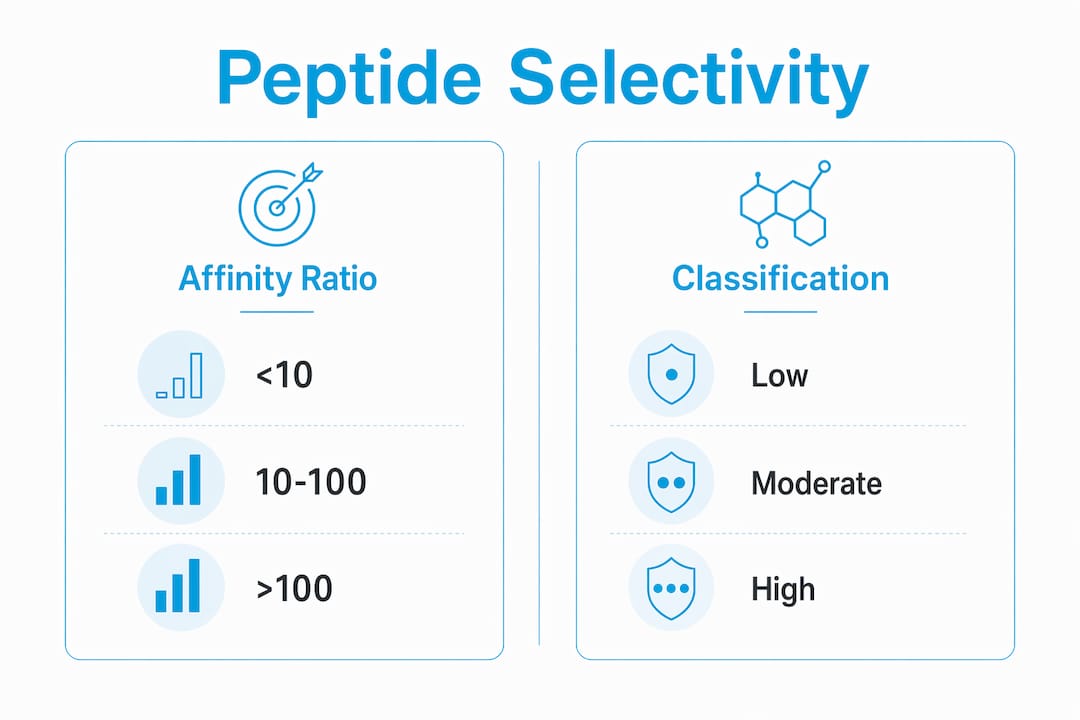
The table below illustrates how affinity ratio values translate into practical selectivity classifications used in pharmacological profiling.
Affinity ratio (Kd off-target / Kd primary) Selectivity classification Typical research use Less than 10-fold Non-selective Broad-spectrum tool compounds 10–100-fold Moderate selectivity Lead optimization candidates 100–1,000-fold High selectivity Receptor-specific mechanistic studies Greater than 1,000-fold Ultra-high selectivity Clinical candidate profiling
Receptor panel data matters because a peptide can appear highly selective in a single-receptor assay yet show meaningful off-target activity when tested against a full family of related subtypes. Pharmacological profiling across panels catches those interactions early, before they confound downstream experiments or safety evaluations.
What molecular mechanisms drive peptide selectivity?
Peptides achieve selectivity through a fundamentally different binding geometry than small molecules. Peptides engage larger binding interfaces on protein surfaces, which lets them contact multiple receptor-specific residues simultaneously. Small molecules typically occupy a single binding pocket, making it harder to discriminate between closely related receptor subtypes with conserved active sites.
Several structural factors govern how well a peptide discriminates between receptor subtypes:
Sequence specificity: Each amino acid side chain contributes to shape complementarity with the receptor surface. A single residue substitution can shift selectivity by an order of magnitude.
Conformational rigidity: Flexible linear peptides sample many conformations, some of which fit off-target receptors. Cyclic or stapled peptides lock the peptide into its bioactive conformation, reducing off-target binding and improving affinity ratios.
Orthosteric vs. allosteric binding: Orthosteric ligands compete directly with endogenous ligands at the primary binding site. Allosteric peptides bind a distinct site, often achieving greater subtype selectivity because allosteric pockets are structurally less conserved across receptor families.
Chemical modifications: N-methylation, D-amino acid substitution, and PEGylation alter backbone geometry and charge distribution. These modifications tune receptor contact points without changing the core sequence, offering a precise way to shift selectivity profiles.
Pro Tip: When designing a cyclic peptide for selectivity, vary the ring size and the position of the cyclization bond before committing to a single scaffold. Small changes in ring geometry can produce large differences in receptor subtype discrimination.
Therapeutic peptide engineering now targets antibody-like selectivity with single-digit picomolar affinities while keeping molecular size small enough for tissue penetration. That combination, high selectivity plus favorable pharmacokinetics, is what separates modern therapeutic peptides from earlier generations of less specific compounds.

How does peptide selectivity affect research and therapeutic outcomes?
Selectivity determines whether an experiment produces interpretable data. High selectivity reduces confounding signals, allowing researchers to attribute observed biological effects to a specific receptor subtype rather than to a mixture of receptor activations. This is especially critical in GPCR families, where receptor subtypes share high structural similarity and overlapping expression patterns.
The practical consequences of selectivity in research and drug development follow a clear sequence:
Mechanistic clarity: A selective peptide tool compound lets researchers assign a phenotype to one receptor subtype. Without that selectivity, the same phenotype could arise from activation of two or three related subtypes, making causal attribution impossible.
Reduced off-target toxicity: Peptides with superior selectivity versus small molecules avoid systemic effects like hepatotoxicity and nephrotoxicity that arise from binding to unintended targets in metabolic organs.
Improved therapeutic index: A higher affinity ratio between the target receptor and off-target receptors widens the dose range between efficacy and toxicity. That wider window is a primary goal in therapeutic peptide classification and clinical candidate selection.
Cleaner safety profiles in combination studies: When multiple peptides are used in the same experimental system, high individual selectivity prevents cross-receptor interference that would otherwise make dose-response interpretation unreliable.
Faster lead optimization: Quantitative selectivity data from early receptor panel screens eliminates low-selectivity candidates before costly in vivo studies, compressing the development timeline.
One limitation researchers must account for: high selectivity does not eliminate all adverse effects. Potent activation of the intended target can produce on-target toxicity through exaggerated pharmacological effects. GLP-1 agonists are a well-documented example, where highly selective compounds still cause significant nausea through their intended mechanism of action. Selectivity is necessary but not sufficient for a clean therapeutic profile.
For a detailed look at how researchers quantify these effects experimentally, the peptide efficacy measurement guide covers affinity and potency ratio methodologies in depth.
What are functional selectivity and species differences?
Binding affinity ratios capture only part of the selectivity picture. Functional selectivity, also called biased agonism, describes a ligand’s ability to stabilize receptor conformations that favor specific downstream signaling pathways over others. A peptide can bind selectively to its target receptor yet activate only a subset of the receptor’s signaling outputs, producing a distinct pharmacological profile compared to a non-biased ligand at the same receptor.
This distinction matters because receptors are conformational machines with multiple active states. Each state couples preferentially to different intracellular effectors, such as G proteins versus beta-arrestins. A biased peptide that drives G protein signaling while avoiding beta-arrestin recruitment may produce therapeutic effects with fewer desensitization-related side effects. Distinguishing binding selectivity from functional selectivity is therefore critical for predicting therapeutic outcomes and side effect risks.
Additional nuances that affect selectivity interpretation:
Species differences in receptor sequence: Peptides highly selective for human receptor subtypes may lose that specificity in rodent models due to sequence divergence at the binding interface. Species differences in receptor expression patterns compound this problem, making direct extrapolation from animal data to human outcomes unreliable.
In vitro vs. in vivo selectivity gaps: Cell-free binding assays measure affinity under controlled conditions. In vivo, receptor density, membrane composition, and competing endogenous ligands all shift the effective selectivity profile.
Pathway-specific assay requirements: Measuring functional selectivity requires pathway-specific assays such as cAMP accumulation, beta-arrestin recruitment, or calcium flux, not just binding displacement. Relying solely on binding data misses the signaling dimension entirely.
Pro Tip: Always run at least one functional assay alongside binding data when characterizing a new peptide. A peptide with a 500-fold binding selectivity ratio can still show unexpected pathway bias that changes its experimental or therapeutic behavior.
Translating selectivity data across species and assay formats requires explicit documentation of assay conditions, receptor expression systems, and the signaling endpoints measured. Researchers who treat affinity ratios as the final word on selectivity routinely encounter surprises when moving from cell-based assays to animal models.
Key Takeaways
Peptide selectivity is the quantitative, mechanistically grounded property that determines whether a peptide produces clean experimental data and a viable therapeutic profile.
Point Details Affinity ratio is the core metric Divide off-target Kd by primary receptor Kd; values above 100-fold indicate high selectivity. Structural rigidity improves selectivity Cyclic and stapled peptides lock bioactive conformations, reducing off-target binding. Functional selectivity extends beyond binding Signaling pathway bias must be measured separately from binding affinity ratios. Species differences complicate translation Human receptor selectivity data does not automatically transfer to rodent models. On-target toxicity remains a risk High selectivity reduces off-target effects but does not prevent exaggerated target-mediated side effects.
Why affinity ratios alone will mislead you
Researchers entering peptide selectivity work for the first time almost always anchor on the affinity ratio. That number is clean, comparable, and easy to report. The problem is that it answers only one question: how much more strongly does this peptide bind receptor A versus receptor B under these specific assay conditions?
What it does not answer is whether that binding difference survives in a living system, whether the peptide drives the same signaling outputs at both receptors, or whether the rodent model used to validate the compound even expresses the same receptor variant as the human target. I have seen research programs built on 1,000-fold selectivity ratios collapse at the animal model stage because the selectivity was real in the assay and irrelevant in vivo.
The more productive framing is to treat the affinity ratio as a necessary filter, not a sufficient one. A low ratio eliminates candidates quickly. A high ratio earns the right to run functional assays, species-matched receptor panels, and eventually in vivo pharmacology. Each step narrows the gap between what the number says and what the biology actually does.
AI-driven peptide design is starting to change this by predicting functional selectivity profiles alongside binding affinities, but those predictions still require experimental validation. The researchers who get the most out of selectivity data are the ones who treat it as a starting point for a question, not the answer itself. Sourcing peptides with documented batch traceability and independent purity verification is the prerequisite for any of this to work. Selectivity data generated from an impure or misidentified compound is worse than no data at all.
— Sam Levin
Research-grade peptides for selectivity-driven studies
Selectivity research depends on peptide identity and purity being exactly what the certificate of analysis states. Batch-to-batch variability in sequence, purity, or counterion content shifts binding data in ways that look like real selectivity differences but are actually manufacturing artifacts.
Products are subject to the manufacturer’s applicable quality-control procedures and specifications. Manufacturer-side analytical documentation may be available depending on the product and batch. PeptidesFromChina is not an independent analytical testing laboratory. The peptide catalog covers a broad range of receptor-targeting compounds. Learn more: peptide catalog. Learn more: VIP peptide catalog.
FAQ
What is the peptide selectivity definition in simple terms?
Peptide selectivity is the degree to which a peptide preferentially binds one receptor subtype over structurally related alternatives. It is expressed quantitatively as an affinity ratio comparing binding strength at the target receptor versus off-target receptors.
How does peptide selectivity work at the molecular level?
Selectivity arises from shape complementarity and sequence-specific contacts between the peptide and receptor binding interface. Structural modifications like cyclization or stapling lock the peptide into a conformation that fits the target receptor more precisely than related subtypes.
What affects peptide selectivity in experimental settings?
Assay format, receptor expression system, membrane composition, and competing endogenous ligands all shift measured selectivity. Species differences in receptor sequence also cause selectivity values obtained in rodent models to diverge from human receptor data.
What is functional selectivity and why does it matter?
Functional selectivity, or biased agonism, describes a peptide’s ability to activate specific downstream signaling pathways at a receptor rather than all pathways equally. A peptide can show high binding selectivity yet produce different therapeutic or side effect profiles depending on which signaling outputs it engages.
What is the importance of peptide selectivity in drug development?
High selectivity reduces off-target toxicity, widens the therapeutic index, and produces cleaner mechanistic data in receptor studies. Selectivity does not eliminate on-target toxicity, so functional profiling alongside binding data is required for a complete safety assessment.