Peptide Procurement Cost Reduction Strategies: 2026 Guide

Peptide procurement cost reduction strategies are systematic approaches to lower sourcing expenses while maintaining quality and supply reliability in life sciences research. Procurement teams face pressure from rising synthesis costs, variable lead times, and documentation requirements that inflate total spend well beyond the per-vial quoted price. The most effective cost management in peptide sourcing combines supplier evaluation discipline, volume purchasing aligned to actual assay schedules, and supply chain resilience built around dual sourcing and automated ordering. This article covers each of those levers in practical terms, with metrics and frameworks procurement teams can apply immediately.
What are the most effective peptide procurement cost reduction strategies?
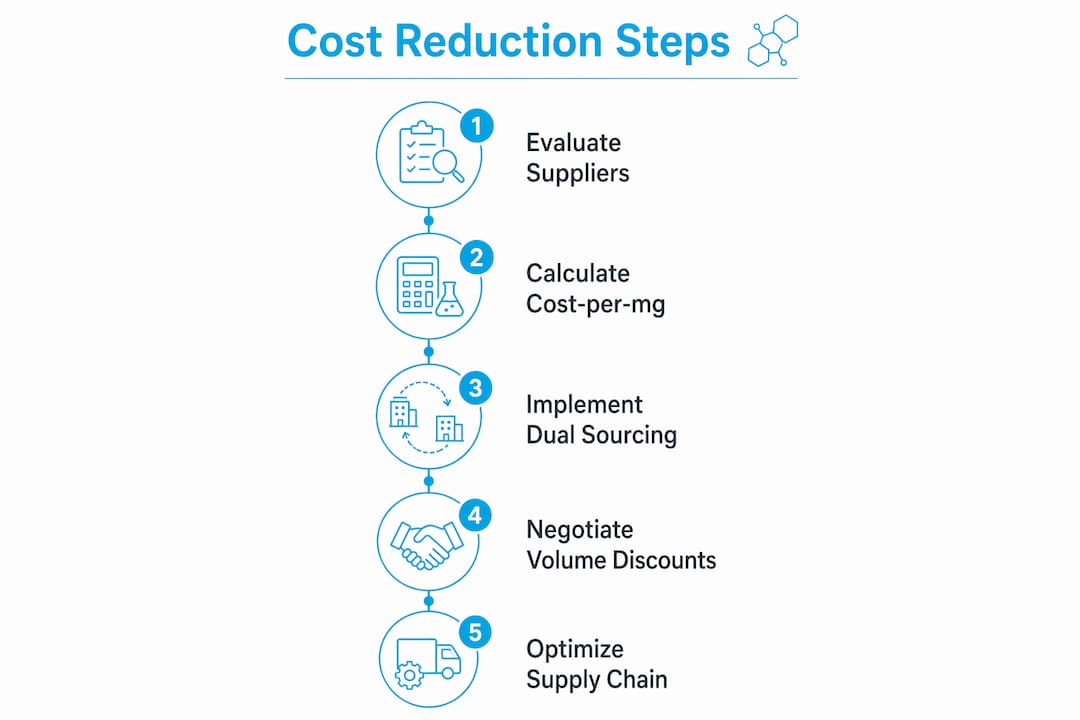
The single most reliable cost reduction method is replacing simple price comparison with a cost-per-verified-milligram metric. This metric divides the quoted price by the COA-confirmed mass, accounting for purity and independent verification rather than label claims alone. A vial priced lower per unit can cost significantly more per usable milligram if purity is 85% versus 98%. Procurement teams that skip this calculation routinely overpay.
Supplier evaluation must extend beyond price to include documentation quality, batch traceability, and lead time consistency. A structured comparison spreadsheet covering purity verification method, COA type, minimum order quantity, and landed cost gives procurement teams an objective basis for decisions. The table below outlines the core evaluation categories.

Evaluation category What to assess Purity verification HPLC and mass spectrometry data on batch-specific COA Documentation quality Batch number, synthesis date, storage conditions, and expiry Lead time reliability Quoted versus actual delivery across multiple orders Landed cost Per-vial price plus customs, cold-chain shipping, and re-testing fees Supplier qualification Audit history, backup capacity, and annual re-qualification batches
Third-party independent batch verification adds a layer of assurance that internal COA review alone cannot provide. Requesting a batch-specific COA rather than a generic certificate is the minimum standard. Periodic re-qualification of approved suppliers, at least annually, catches quality drift before it affects research outcomes.
Pro Tip: Build a supplier scorecard that weights cost-per-verified-milligram at 40%, documentation completeness at 30%, and lead time reliability at 30%. Update scores after every order cycle to catch performance changes early.
Domestic peptide API manufacturing in North America and Western Europe carries a 35–65% cost premium over international manufacturers. That premium is not always unjustified, but procurement teams must calculate whether the reduction in disruption risk offsets the price difference for each compound category.
How do volume discounts work in peptide sourcing?
Volume discounts become financially meaningful only when the discount threshold exceeds 20%. Orders of 5–10 units typically target 20–30% discounts, while orders of 50 or more units can reach 30–50% reductions. Those thresholds justify bulk investment only when usage rates and shelf life align with the purchase volume.
Lyophilized peptides stored at -20°C have a shelf life of 2–5 years. That range sounds generous, but procurement teams must align bulk purchase volumes strictly to 12 or more months of expected consumption to avoid stock obsolescence. Over-purchasing is a direct financial loss, not a theoretical risk.
Fit-for-purpose purity specification is another underused cost lever. Unnecessarily high purity adds cost and extends lead times without improving research outcomes when the assay does not require it. A cell viability screen does not need the same purity grade as a receptor binding study. Procurement teams should work with research leads to define the minimum acceptable purity for each application before placing orders.
Key practices for disciplined bulk buying:
Confirm 12-month consumption forecasts with research leads before committing to large volumes.
Verify peptide shelf life under your specific storage conditions, not manufacturer defaults.
Specify fit-for-purpose purity in the purchase order to avoid automatic upselling to higher-cost grades.
Negotiate staged delivery schedules within a single purchase agreement to reduce storage risk.
Track actual usage against forecast quarterly and adjust future order volumes accordingly.
Pro Tip: Request split shipments on large orders. Pay for the full volume discount upfront but take delivery in two or three installments timed to your assay schedule. Many manufacturers accommodate this with a simple written agreement.
Reviewing lab supply best practices for inventory management can also reduce waste from expired stock and misaligned ordering cycles.
How does supply chain efficiency reduce total peptide sourcing costs?
Supply chain efficiency in peptide procurement is defined by the ability to maintain uninterrupted supply at predictable cost, without relying on emergency spot buys. Emergency sourcing consistently costs more per unit and introduces quality uncertainty. The most direct way to prevent it is qualifying at least two backup suppliers for every critical raw material.
Dual sourcing and annual qualification batches reduce dependency on a single manufacturer and preserve negotiating leverage. Running a small annual test batch with a secondary supplier keeps that relationship active and the qualification current. This practice costs less than a single emergency order.
Automated procurement platforms reduce administrative cycle time by 60–80%, saving over $100,000 annually for mid-size distributors processing 200 orders monthly. Manual procurement consumes 15–20 hours of staff time per order. Automation eliminates most of that overhead and reduces order errors that cause delays and re-work costs.
Supply chain resilience practices that reduce total cost of ownership:
Qualify a minimum of two approved suppliers for each peptide compound used in ongoing research programs.
Implement rolling 90-day forecasts updated monthly and share them with primary suppliers.
Commit to quarterly purchase volumes in writing to reduce manufacturer risk and stabilize pricing.
Consolidate shipments where possible to reduce cold-chain freight costs per unit.
Maintain complete import documentation packages to prevent customs delays that cost more than the initial savings.
Run annual qualification batches with secondary suppliers to keep backup options active.
Stable forecasting and procurement commitments reduce supplier risk and often yield more favorable, predictable pricing than chasing the lowest per-unit quote on each order. The Total Cost of Ownership approach treats price stability as a procurement outcome, not just unit cost reduction. Teams that adopt rolling forecasts and quarterly commitments report fewer supply disruptions and more consistent pricing over time.
For teams evaluating direct versus reseller sourcing channels, the tradeoffs in global supply chain management affect both cost and documentation reliability in ways that per-unit price comparisons do not capture.
What are landed costs and how do they affect peptide procurement decisions?
Landed cost is the total expense of receiving a peptide at your facility, including customs preparation, cold-chain shipping, re-testing fees, and documentation preparation. Poor documentation causes customs delays that can cost more than the initial savings from a lower quoted price. Procurement teams that evaluate only per-vial price routinely underestimate true sourcing expenses by a significant margin.
Requesting a batch-specific COA rather than a generic certificate of analysis changes the cost structure of a quote. Manufacturers that provide batch-specific documentation invest more in quality control processes, and that investment shows up in the price. The alternative is a lower quote with higher re-testing costs on arrival, which procurement teams absorb internally.
Lead time variability has a direct cost implication that most procurement budgets do not account for explicitly. A supplier with a 4-week quoted lead time that regularly delivers in 6–8 weeks forces emergency spot buys or research delays. Both outcomes cost more than the price difference between that supplier and a more reliable alternative. Evaluating supplier lead time reliability as a procurement KPI prevents this pattern.
Packaging specifications, shipping method, and lab testing expectations must be defined in writing before a purchase order is placed. Ambiguity in these areas generates surprise fees at delivery. Cold-chain requirements for lyophilized peptides shipped internationally are non-negotiable. Dry ice quantity, transit time limits, and temperature logging requirements should appear in the purchase order, not in a post-delivery dispute.
Pro Tip: Create a landed cost worksheet for each supplier that itemizes customs fees, freight, cold-chain surcharges, and internal re-testing costs. Compare suppliers on total landed cost per verified milligram, not on quoted price per vial. The difference often reverses the apparent ranking.
Procurement teams building a formal checklist can reference peptide research standards to align documentation requirements with current quality benchmarks before finalizing supplier agreements.
Key Takeaways
Effective peptide procurement cost reduction requires combining supplier evaluation discipline, fit-for-purpose purity specifications, dual sourcing, and landed cost analysis into a single integrated purchasing framework.
Point Details Use cost-per-verified-milligram Divide quoted price by COA-confirmed mass to compare suppliers objectively. Align bulk orders to usage forecasts Match purchase volumes to 12-month consumption to avoid degradation and waste. Qualify two backup suppliers Dual sourcing prevents emergency spot buys that consistently cost more per unit. Automate procurement workflows Automation reduces administrative time by 60–80% and eliminates costly order errors. Calculate landed cost, not list price Include customs, cold-chain freight, and re-testing fees in every supplier comparison.
The cost trap most procurement teams fall into
The most common procurement mistake in peptide sourcing is treating unit price as the primary decision variable. I have seen teams switch suppliers repeatedly to capture a 10% per-vial saving, only to absorb that saving and more in re-testing costs, customs delays, and emergency orders when the new supplier’s lead times proved unreliable.
The procurement teams that consistently reduce costs year over year do something different. They build supplier relationships around predictable volume commitments, share rolling forecasts, and treat documentation quality as a non-negotiable baseline. They also involve QA and research leads in purity specification decisions, which prevents the common pattern of ordering arbitrarily high purity grades that add cost without improving data quality.
Hybrid peptide synthesis techniques, which combine solid-phase peptide synthesis (SPPS) and liquid-phase peptide synthesis (LPPS), are beginning to reduce material input requirements by 3–4 times at commercial scale. That shift will eventually change cost structures for certain compound categories. Procurement teams that track manufacturing method changes in their supplier base will be better positioned to capture those savings as they materialize.
The practical advice is straightforward. Build a procurement checklist that covers supplier qualification, purity specification review, landed cost calculation, and dual sourcing status for every active compound. Review it quarterly. The teams that do this spend less time on emergency sourcing and more time on research.
— Sam Levin
PeptidesFromChina: research-grade peptides with supply chain transparency
PeptidesFromChina operates as a research-focused sourcing platform with direct relationships with established synthesis facilities, not as a gray-market reseller. Products are subject to the manufacturer’s applicable quality-control procedures and specifications; PFC is not an independent analytical testing laboratory. Buyers requiring independent verification may arrange third-party analytical testing.
The platform’s research peptide catalog covers signaling peptides, GLP-1 agonists, mitochondrial compounds, and longevity peptides. Products are subject to the manufacturer’s applicable quality-control procedures and specifications. Manufacturer-side analytical documentation may be available depending on the product and batch. PeptidesFromChina is not an independent analytical testing laboratory. Learn more: research-grade peptide catalog. Learn more: peptide catalog.
FAQ
What is cost-per-verified-milligram in peptide procurement?
Cost-per-verified-milligram is calculated by dividing the total purchase price by the COA-confirmed usable mass. It accounts for purity and independent verification, making it a more accurate supplier comparison metric than per-vial list price.
How much can automation reduce peptide procurement costs?
Automated procurement platforms reduce administrative cycle time by 60–80%, saving over $100,000 annually for mid-size distributors processing 200 orders monthly. Manual processing consumes 15–20 hours of staff time per order.
What purity grade should procurement teams specify for research peptides?
Purity specifications should be fit-for-purpose, matched to the requirements of the specific assay rather than set arbitrarily high. Unnecessarily high purity adds cost and extends lead times without improving research outcomes.
Why does dual sourcing reduce peptide procurement costs?
Qualifying at least two backup suppliers prevents emergency spot buys, which consistently cost more per unit and introduce quality uncertainty. Annual qualification batches with secondary suppliers keep backup options active at low cost.
What costs should be included in a peptide landed cost calculation?
Landed cost includes the per-vial quoted price, customs preparation fees, cold-chain shipping charges, temperature logging, and internal re-testing costs on arrival. Poor documentation alone can generate customs delays that exceed the savings from a lower quoted price.