Peptide Ingredient Quality Testing Products: 2026 Guide

Peptide ingredient quality testing products are defined as the analytical tools, assay kits, and third-party laboratory services used to verify the identity, purity, and biological safety of peptide raw materials before they enter research or clinical workflows. In the peptide supply chain, these products sit between synthesis and application, and their output determines whether a batch is fit for use. For researchers working with GLP-1 agonists, signaling peptides, or longevity compounds, the quality of this testing layer is as consequential as the synthesis itself. A Certificate of Analysis (COA) from an independent lab, backed by HPLC chromatograms and mass spectrometry data, is the minimum credible documentation standard.
What are the critical quality parameters for peptide ingredients?
Peptide quality assessment covers five distinct parameters, and each requires a separate analytical method. No single test covers all of them. Researchers who rely on purity alone are missing at least four other failure points.
The five core parameters are:
Purity: Measured by reverse-phase HPLC, reported as a percentage of the UV-absorbing fraction attributed to the target peptide. Research-grade peptides require greater than 95% HPLC purity for general biological assays and greater than 98% for quantitative dose-response and in vivo studies. That threshold exists because impurities at even low percentages can confound receptor binding data or trigger off-target biological effects.
Identity: Confirmed by mass spectrometry, specifically LC-MS or MALDI-TOF. HPLC alone cannot confirm molecular identity. A peptide can show 99% chromatographic purity and still be the wrong sequence.
Net peptide content: The actual mass of peptide in a vial after accounting for residual trifluoroacetic acid (TFA), counterion salts, and moisture. HPLC purity percentages measure the UV-absorbing fraction of the target peptide, but actual peptide mass can be only 70–80% after accounting for TFA, salts, and moisture. This is critical for dosing calculations in pharmacology.
Endotoxin levels: Measured by the Limulus Amebocyte Lysate (LAL) assay. Quality control for injectable-grade peptides sets the threshold at less than 1 EU/mg. A peptide can pass HPLC and mass spec while still carrying endotoxin loads that would invalidate any in vivo result.
Sterility: Tested per USP <71> for any peptide intended for injection or cell culture use. Sterility testing requirements are separate from purity testing and require dedicated microbiological assays.
Pro Tip: When reviewing a COA, check whether endotoxin and sterility data appear on the same document as HPLC and mass spec results. If they do not, the supplier likely ran different test panels on different batches, which undermines traceability.
UPLC offers speed and sharper peaks but does not replace safety or absolute content testing. Advanced chromatographic equipment on a COA does not confirm that endotoxin or sterility testing was performed. Researchers should not conflate analytical sophistication with comprehensive safety coverage.
How do you select peptide ingredient quality testing products?
Choosing the right testing products and services requires evaluating four criteria: independence from the supplier, accreditation of the testing laboratory, turnaround time, and completeness of the test panel.

The table below compares the key attributes researchers should assess when evaluating testing options:
Criterion What to Look For Red Flag Independence Third-party lab with no commercial relationship to the supplier Supplier-run in-house testing only Accreditation ISO 17025 accreditation for analytical methods No listed accreditation or vague “certified lab” language Turnaround time HPLC and LC-MS results within 12–48 hours Results promised in under 6 hours without explanation Test panel HPLC, LC-MS, LAL assay, residual solvents, sterility Panel limited to HPLC purity only COA format Batch-specific, includes raw chromatogram and analyst signature Generic PDF with round-number purity claims
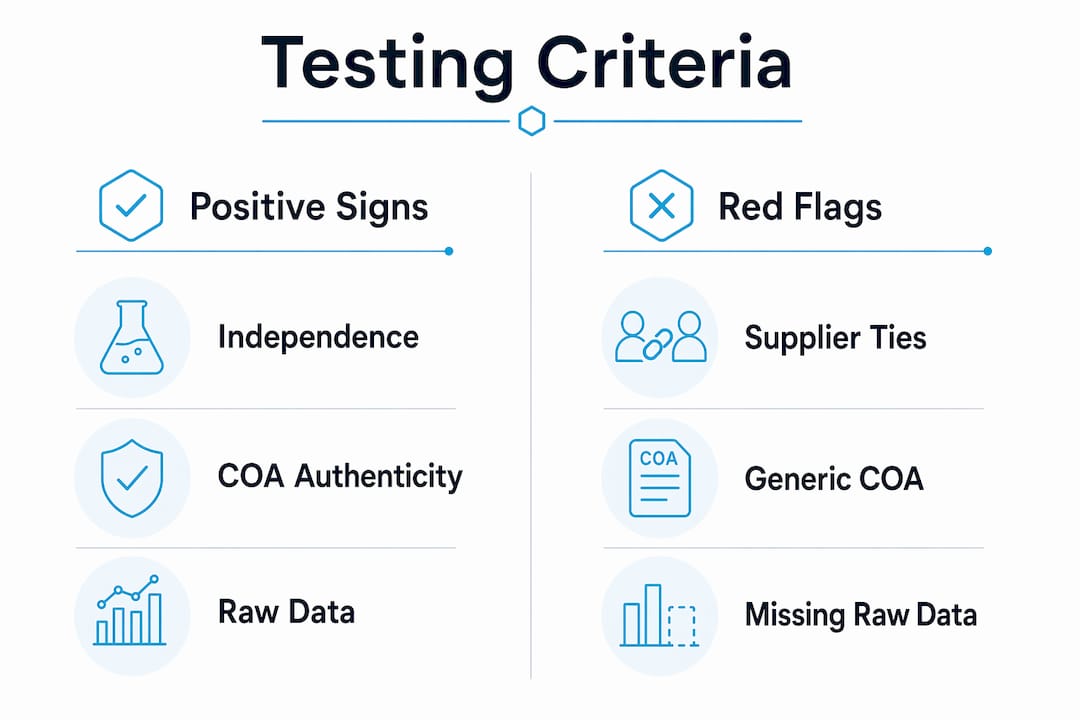
COA authenticity is the most direct indicator of whether a supplier’s testing is real. A valid COA must be batch-specific, include chromatograms, mass spectrum, and analyst signature. Documents without these elements are not quality records. They are marketing materials formatted to look like quality records.
Identical round-number purity figures across batches indicate fabricated or generic COAs. Authentic analytical instruments produce irregular, precise purity values reflecting real output. A supplier showing 98.00% purity across five consecutive batches of different peptides has almost certainly not run real HPLC on each one.
Pro Tip: Request the raw chromatogram file, not just the printed chart. Authentic HPLC data includes retention time, peak area, and integration parameters. A supplier who cannot provide the raw file likely does not have it.
For researchers sourcing peptides internationally, vendor qualification criteria should include a requirement for COA online verification, where a QR code or batch number links to a hosted analytical record. This creates an auditable chain between the physical vial and the test data.
How to interpret peptide quality data in research workflows
Reading test results accurately requires a structured approach. The following steps reflect how analytical data should move from raw output to research-ready confirmation.
Confirm molecular identity first. Check the mass spectrum for the expected monoisotopic or average molecular weight of the target peptide. A mass error of more than 0.1 Da on a small peptide warrants rejection or re-testing. Identity confirmation precedes any purity interpretation.
Read HPLC purity in context. A purity figure of 97% means 97% of the UV-absorbing signal at 214 nm belongs to the target peak. It does not mean 97% of the vial’s mass is peptide. Non-UV-absorbing impurities, including residual solvents and salts, are invisible to this method.
Apply net peptide content to dosing. If a COA reports 98% HPLC purity but the net peptide content is 75%, a nominal 1 mg dose contains approximately 0.75 mg of active peptide. Researchers who skip this adjustment introduce systematic dosing errors across every experiment in a series.
Review endotoxin data before any biological application. An LAL assay result above 1 EU/mg disqualifies a batch for in vivo use regardless of purity. This threshold is not arbitrary. Endotoxin contamination at sub-visible levels activates innate immune pathways and confounds cytokine, inflammation, and receptor studies.
Cross-reference supplier COA against independent results. Blind independent verification by sending samples to third-party labs is the only reliable method to confirm supplier COA results and ensure peptide integrity across batches. This step is not optional for publication-grade research.
Document everything. Retain the raw COA, the independent test report, batch numbers, and receipt dates. Regulatory submissions and peer-reviewed publications increasingly require this documentation chain.
The table below summarizes how each data type maps to a specific research decision:
Data Type Method Research Decision Molecular identity LC-MS or MALDI-TOF Accept or reject the batch Chromatographic purity Reverse-phase HPLC Assess impurity profile Net peptide content Amino acid analysis or NMR Calculate accurate dose Endotoxin level LAL assay Clear for biological use Sterility USP <71> Clear for injection or cell culture
For a detailed breakdown of HPLC, LC-MS, and NMR methods as applied to peptide identity and purity verification, the analytical distinctions between these techniques matter when selecting a testing panel for a specific application.
What common mistakes occur in peptide quality testing?
Several recurring errors undermine the value of even well-designed testing programs. Recognizing them before they affect a study is more efficient than troubleshooting after data collection.
Treating HPLC purity as absolute peptide content. This is the most common quantitative error in peptide research. The distinction between chromatographic purity and net peptide content is not a technicality. It directly affects dose accuracy and reproducibility across labs.
Accepting non-batch-specific COAs. A COA that does not reference a specific lot number and synthesis date cannot be traced to the vial in hand. It may reflect testing done on a different batch, a different peptide, or no real testing at all.
Overlooking endotoxin despite high purity. Endotoxin contamination does not correlate with HPLC purity. A peptide synthesized in a facility with poor environmental controls can pass chromatographic testing while carrying endotoxin loads that invalidate biological results.
Ignoring batch-to-batch variability. A small decrease in coupling efficiency during synthesis greatly reduces theoretical peptide yield and batch-to-batch consistency. This means a supplier’s first batch may genuinely meet spec while subsequent batches do not, even from the same facility.
Misreading advanced equipment as comprehensive testing. A COA featuring UPLC data looks authoritative. It is not evidence that endotoxin, sterility, or residual solvent testing was performed.
Inadequate sample handling before testing. Peptides shipped without temperature control or exposed to humidity before testing can degrade in ways that affect purity readings. A test result is only as valid as the sample condition at the time of analysis.
“Researchers should not mistake advanced analytical equipment on COAs for guaranteed safety testing; critical tests like endotoxin and sterility must still be verified independently.” — Northern Compound Analytical Methods Glossary
The most consequential mistake is depending entirely on supplier-provided documentation. Supplier COAs reflect the supplier’s interest in selling product. Independent verification reflects the researcher’s interest in reproducible data. These are not the same interest, and the documentation should not be treated as equivalent.
Key takeaways
Reliable peptide quality testing requires independent verification of identity, purity, net content, endotoxin levels, and sterility, not purity alone.
Point Details Purity thresholds matter Use greater than 95% HPLC purity for general assays and greater than 98% for in vivo work. COA authenticity is verifiable Batch-specific COAs with raw chromatograms and analyst signatures are the only credible format. Net peptide content affects dosing HPLC purity does not equal peptide mass; account for TFA, salts, and moisture in all dose calculations. Independent testing is non-negotiable Blind third-party verification is the only method that confirms supplier COA accuracy. Endotoxin and sterility are separate tests High HPLC purity does not indicate a clean endotoxin or sterility result.
The testing layer most researchers underestimate
After reviewing how peptide quality data moves through sourcing and research workflows, one pattern stands out. Most researchers focus heavily on purity percentages and almost entirely ignore the net peptide content figure. That gap is where dosing errors accumulate.
A supplier can deliver a vial labeled 5 mg at 98% HPLC purity, and the actual peptide mass present may be closer to 3.5 mg once TFA counterions and moisture are accounted for. Across a 12-week study with multiple cohorts, that discrepancy compounds. The data looks clean, the statistics pass, and the results are still not reproducible because the effective dose was never what the researcher calculated.
The second underestimated issue is the COA verification gap. Independent testing services exist precisely because supplier documentation has a structural conflict of interest. Sending a sample to a third-party lab before committing to a batch is not excessive caution. It is the minimum standard for any work intended for publication or regulatory submission.
The peptide industry in 2026 has more analytical tools available than at any prior point. The limiting factor is not technology. It is the willingness to use those tools independently of the supplier relationship. Buyers requiring independent verification may arrange third-party analytical testing.
Researchers who treat quality documentation as a procurement checkbox rather than a scientific input will continue to produce results that cannot be replicated. The testing layer is not administrative overhead. It is part of the experimental design.
— Sam Levin
Verify quality before you source: PeptidesFromChina
Products are subject to the manufacturer’s applicable quality-control procedures and specifications. Manufacturer-side analytical documentation may be available depending on the product and batch. PeptidesFromChina is not an independent analytical testing laboratory. Buyers requiring independent verification may arrange third-party analytical testing.
PFC coordinates sourcing from established Chinese manufacturing facilities together with international logistics. For researchers sourcing compounds like Epithalon, KPV, or VIP for in vivo or cell culture applications, the platform provides the laboratory verification guidance needed to assess documentation before committing to a batch. Turnaround on analytical documentation is aligned with standard independent testing timelines.
FAQ
What purity level is required for in vivo peptide research?
Research-grade peptides require greater than 98% HPLC purity for quantitative dose-response and in vivo studies. Batches below this threshold introduce impurities that can confound biological results.
What does a valid peptide COA include?
A valid COA must be batch-specific and include a raw HPLC chromatogram, mass spectrum, and analyst signature. COAs missing these elements are not reliable quality records.
Why does HPLC purity not equal actual peptide content?
HPLC purity measures the UV-absorbing fraction of the target peptide, not total mass. Residual TFA, counterion salts, and moisture reduce actual peptide content to 70–80% of the nominal weight in many batches.
How do i verify a supplier’s COA independently?
Send a blind sample to an ISO 17025-accredited third-party laboratory for HPLC and LC-MS analysis. Blind independent verification is the only method that confirms whether supplier documentation reflects real analytical output.
What is the endotoxin threshold for injectable peptides?
The LAL assay threshold for injectable-grade peptides is less than 1 EU/mg per standard quality control requirements. Endotoxin contamination above this level can activate immune pathways and invalidate in vivo study results regardless of HPLC purity.