Peptide Ingredient Labeling Requirements: 2026 Guide

Peptide ingredient labeling requirements are defined as the set of FDA, USP, and DSHEA-mandated specifications governing how peptide compounds must be identified, characterized, and disclosed on product labels. These requirements span ingredient identity, purity documentation, allergen disclosure, structure-function claim substantiation, and sterility testing protocols. Regulatory professionals and formulators working with peptides face increasing FDA scrutiny, particularly as compounded GLP-1 analogs and research-grade peptides enter commercial channels. Getting labeling right is not optional. It is the primary defense against enforcement action, product recalls, and drug misclassification.
Top 10 peptide ingredient labeling requirements for regulatory compliance
1. Accurate chemical naming using IUPAC and amino acid conventions
Peptide labels must identify the active ingredient using accepted scientific nomenclature, including IUPAC-based naming or standard three-letter amino acid sequence codes. Generic or trade names alone are insufficient for regulatory purposes. For complex peptides, the sequence notation must reflect the correct stereochemistry, cyclization, and any post-translational modifications. Ambiguous naming creates traceability gaps that FDA inspectors flag during label reviews.

2. Purity disclosure with chromatographic data
A purity claim without HPLC chromatogram data is considered incomplete under current regulatory expectations. Chromatographic integration parameters directly affect reported purity values, meaning a stated 98% purity figure can mask significant variation depending on how peaks are integrated. Labels and accompanying documentation must reference the analytical method used, the instrument platform, and the integration criteria applied. Purity figures without this context are not defensible in an audit.
3. Certificate of Analysis with batch traceability
Certificates of Analysis must include batch-specific identity, purity, and potency data verified by independent or ISO 17025 accredited laboratories to satisfy FDA and USP standards. A COA that lists only summary purity without raw chromatogram or mass spectrometry data is a red flag, not a compliance document. Batch numbers on the COA must match the physical product lot. Any discrepancy between the COA batch number and the product label constitutes a documentation failure.
Pro Tip: Request the full chromatogram file, not just the printed report. Laboratories can adjust integration parameters after the fact; the raw data file is the only tamper-resistant record.
4. Allergen declaration per FALCPA and the FASTER Act
Dietary supplement peptide labels must declare all major allergens as defined by the Food Allergen Labeling and Consumer Protection Act (FALCPA) and the FASTER Act. Sesame became the ninth major allergen under December 2025 FDA guidance, and labels not updated to reflect this are now out of compliance. Peptides derived from milk, egg, wheat, soy, or tree nut sources require explicit allergen statements. Formulators sourcing peptides from animal-derived hydrolysates must verify the source material and disclose accordingly.
5. Supplement Facts panel for dietary supplement peptides
Dietary supplement labels must comply with 21 CFR Part 101, which mandates nine required elements including a Supplement Facts panel, serving size, and quantity per serving. For peptide ingredients, the panel must list the peptide by its accepted name, the amount per serving in milligrams or micrograms, and the percent daily value where applicable. Labels that list only the proprietary blend weight without disclosing individual peptide quantities are non-compliant. FDA has increased enforcement on this specific point as peptide supplement sales have grown.
6. Structure-function claim wording and FDA disclaimers
Structure-function claims for peptides must be truthful, substantiated, and not misleading, and must carry the full FDA-mandated disclaimer linked via asterisk. Claims such as “supports joint flexibility” or “promotes muscle recovery” are permissible when substantiated. Claims that reference disease states, such as “reduces inflammation associated with arthritis,” convert the product into an unapproved drug under FDA’s interpretation. Notification to FDA within 30 days of first marketing is required for any structure-function claim. Failure to notify is a separate compliance violation from the claim language itself.
7. Salt form, counterion, and net peptide content disclosure
Peptide content by mass may be only 75 to 90 percent of total powder weight due to the presence of TFA or acetate counterions and residual moisture from lyophilization. Labels must reflect the net peptide content, not the gross powder weight, to avoid dosing inaccuracies. A product labeled as “5 mg peptide” must contain 5 mg of actual peptide, not 5 mg of peptide salt. This distinction is frequently mishandled by formulators who rely on supplier-reported weights without accounting for salt form corrections.
8. Sterility and endotoxin testing for compounded pharmaceutical peptides
Compounded peptide pharmaceuticals require sterility testing per USP <71>, endotoxin testing per USP <85>, and particulate matter evaluation per USP <788>. USP <797> governs beyond-use dating and requires empirical stability data, not default dating tables. Every compounded batch must be tested for potency, purity, and identity before release. Pharmacies sourcing bulk peptide APIs must verify that suppliers are FDA-registered and operating under cGMP conditions. Batch testing is not optional; it is a release criterion.
9. Avoiding disease claims that trigger drug classification
FDA uses 21 CFR 201.128 to assess intended use based on total product presentation, not label language alone. A research-use-only disclaimer does not override surrounding marketing copy that implies therapeutic benefit. Labeling language referencing weight loss, glucose regulation, or tissue repair in the context of a specific peptide will be evaluated against the full product presentation, including website content, social media, and sales materials. This is the mechanism by which FDA has reclassified multiple peptide products as unapproved drugs in recent enforcement cycles.
Pro Tip: Conduct a full product presentation audit before launch. Review the label, website, third-party retailer listings, and any influencer content simultaneously. FDA does not evaluate these in isolation.
10. Documentation and record-keeping for ingredient sourcing
Regulatory-grade documentation for peptide ingredients includes supplier qualification records, cGMP compliance verification, batch testing results, and chain-of-custody records from synthesis to finished product. FDA requires pharmacies to audit suppliers regularly and maintain records demonstrating FDA registration and cGMP compliance for all bulk ingredients. For dietary supplement formulators, supplier qualification records support both label accuracy and defense against adulteration claims. Records must be retained for a minimum period consistent with the product’s shelf life plus two years.
How peptide ingredient documentation supports labeling compliance
Documentation is the foundation of defensible labeling. Without it, label claims are assertions rather than verified facts. The following practices define a functional documentation system for peptide ingredients.
Verify COA authenticity by matching batch and lot numbers to physical product labels before accepting any shipment. Generic or template COAs without raw chromatogram or mass spectrometry data are inadequate for compliance purposes.
Source from FDA-registered, cGMP-compliant manufacturers rather than resellers. Resellers often cannot provide the synthesis-level documentation that regulators require because they do not have direct access to manufacturing records.
Use multi-method analytical confirmation. HPLC establishes chromatographic purity; mass spectrometry confirms molecular identity. Neither method alone is sufficient for a complete identity and purity profile.
Maintain stability and sterility test records that support beyond-use dating and label shelf-life claims. Stability data must be product-specific, not borrowed from structurally similar compounds.
Conduct periodic re-testing of raw peptide materials throughout the supply chain, not only at initial receipt. Degradation during storage is a documented failure mode for lyophilized peptides stored outside validated conditions.
Pro Tip: When evaluating a new supplier, request testing from an ISO 17025 accredited third-party laboratory rather than relying solely on the supplier’s in-house COA. Independent verification is the only way to confirm that reported purity data reflects actual batch composition.
How labeling requirements differ: dietary supplements vs. compounded pharmaceuticals
The regulatory framework for peptide labeling diverges significantly depending on whether the product is classified as a dietary supplement or a compounded pharmaceutical. The table below summarizes the key distinctions.
Requirement Dietary supplement peptides Compounded pharmaceutical peptides Label panel format Supplement Facts panel per 21 CFR Part 101 Drug Facts or compounding label per USP and state pharmacy board rules Purity and potency testing Ingredient listing accuracy; COA recommended Mandatory batch testing for potency, purity, and identity per USP Sterility requirements Not required unless sterile dosage form USP <71> sterility, USP <85> endotoxin, USP <788> particulates Beyond-use dating General shelf-life based on stability data Empirical stability data required per USP <797> Claim language Structure-function claims with DSHEA disclaimer No disease or therapeutic claims; drug labeling rules apply Allergen disclosure FALCPA and FASTER Act mandatory Ingredient disclosure per compounding label requirements
The practical implication is that a peptide moving from research supply into a compounded pharmaceutical context requires a complete documentation rebuild. Supplement-grade COAs do not satisfy USP <71> or <85> release criteria. Formulators who attempt to use dietary supplement documentation to support compounded pharmaceutical labeling create a compliance gap that FDA inspectors identify quickly.
Common pitfalls in peptide branding that create labeling compliance risk
Marketing decisions made outside the regulatory team frequently create labeling problems that compliance professionals must then resolve. The following patterns represent the most common failure modes.
Relying on research-use-only disclaimers as a sole defense. FDA’s intended use standard under 21 CFR 201.128 evaluates the full product presentation. An RUO disclaimer on a label surrounded by therapeutic claims does not provide regulatory protection.
Bundling peptides with injection accessories such as syringes or bacteriostatic water. This type of product bundling implies human injection intent and supports FDA’s case for drug classification, regardless of label language.
Publishing unsubstantiated mechanistic claims on product websites or social media. These claims become part of the product’s intended use record even when they do not appear on the physical label.
Reporting purity percentages without corroborating analytical data. A stated 99% purity figure that cannot be supported by a traceable chromatogram is a misrepresentation under FDA’s labeling accuracy standards.
Using falsified or template COAs from suppliers who cannot provide raw data. This practice increases both regulatory risk and the probability of releasing a product with inaccurate label claims.
Labeling compliance is not a one-time review at product launch. It is an ongoing process that must account for changes in marketing materials, supplier documentation, and regulatory guidance throughout the product lifecycle.
Key takeaways
Compliant peptide ingredient labeling requires accurate chemical identification, batch-verified purity documentation, allergen disclosure, substantiated claim language, and testing protocols matched to the product’s regulatory classification.
Point Details Purity claims require data HPLC chromatograms and mass spectrometry must support every purity figure on a label. Salt form affects net content Peptide powder weight includes counterions and moisture; labels must reflect actual peptide content. RUO disclaimers are insufficient FDA evaluates total product presentation, not label language alone, when determining intended use. Supplement vs. pharma standards diverge Compounded peptides require USP <71>, <85>, and <797> compliance; supplement COAs do not satisfy these criteria. Documentation is a release criterion Supplier qualification records, batch COAs, and stability data must be complete before a product ships.
The compliance gap most formulators underestimate
The most consistent failure pattern in peptide labeling compliance is not ignorance of the rules. It is the assumption that documentation from a supplier is equivalent to verified documentation. These are not the same thing.
Suppliers, particularly resellers operating between synthesis facilities and finished product manufacturers, routinely provide COAs that reflect the manufacturer’s internal testing rather than independent verification. The batch number may match. The purity figure may look correct. But without access to the raw chromatogram file and confirmation that the testing laboratory is independent and accredited, that COA is an unverified assertion.
The second underestimated gap is the salt form correction. Formulators who label a product based on the gross powder weight provided by a supplier, without accounting for TFA or acetate counterion content and residual moisture, are systematically overstating peptide content. This is not a minor rounding issue. A peptide with 15 percent counterion and moisture content labeled at face weight delivers 15 percent less active compound than stated. That is a labeling accuracy failure with real dosing consequences.
The third gap is the marketing review. Regulatory teams that approve label language but do not review website copy, distributor materials, and social media content are leaving the most significant intended-use risk unaddressed. FDA enforcement actions on peptides in recent years have consistently cited off-label marketing as the primary basis for drug classification, not the physical label itself.
— Sam Levin
How PeptidesFromChina supports compliant peptide sourcing
Regulatory professionals sourcing peptide ingredients for compliant product development need documentation that holds up under scrutiny, not summary reports from unverified suppliers.
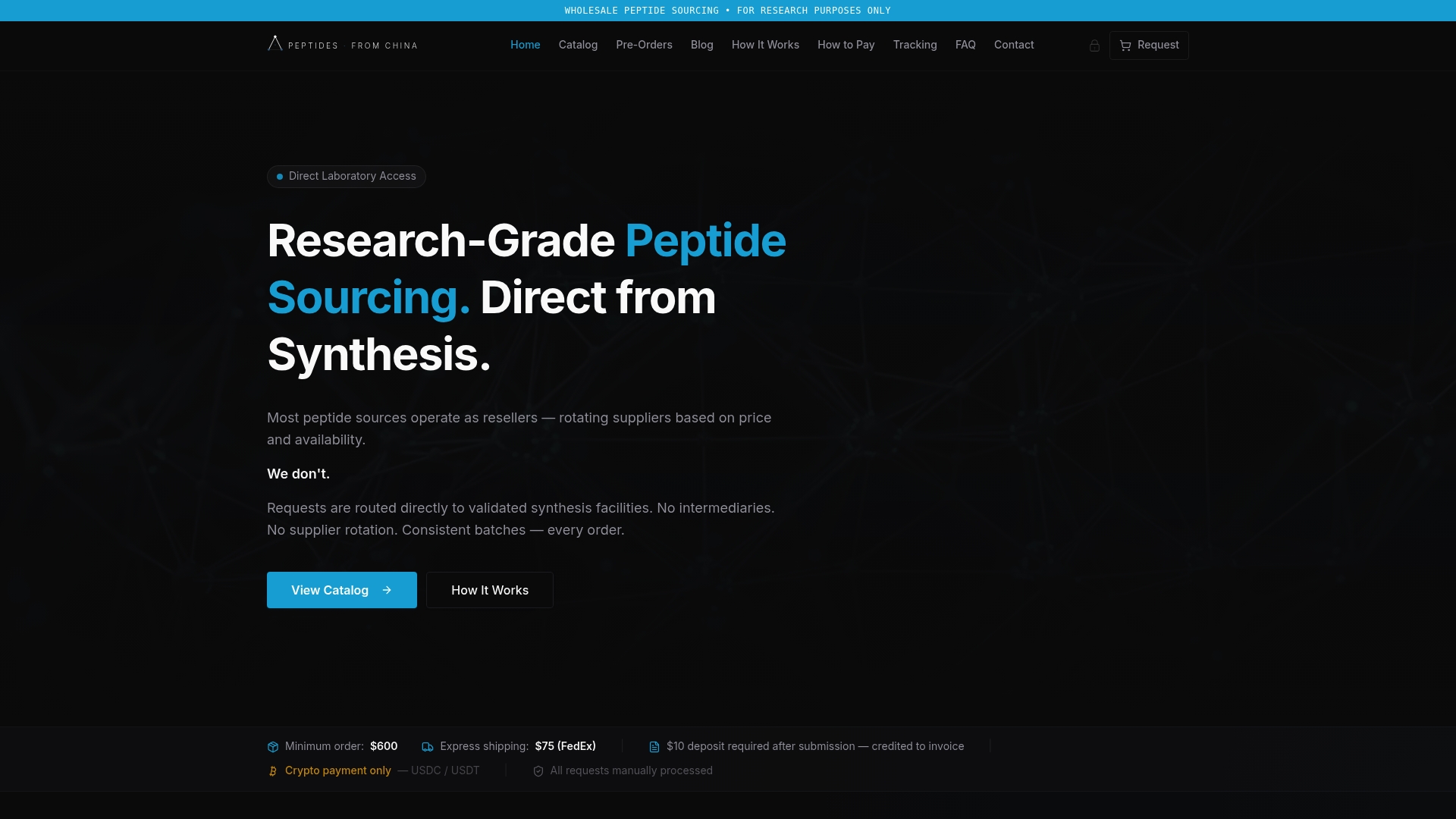
PeptidesFromChina provides research-grade peptides with batch-specific Certificates of Analysis, independent purity verification, and full chromatographic data for every lot. The platform maintains direct relationships with synthesis facilities, enabling traceability from raw API through lyophilization and vialing. Procurement teams and formulators can access the full peptide catalog to review available compounds alongside their supporting documentation. For teams working on compliance-sensitive projects, this level of supply chain transparency is the starting point for defensible labeling, not an optional add-on.
FAQ
What must a peptide label include under 21 CFR Part 101?
Dietary supplement peptide labels must include a Supplement Facts panel, serving size, ingredient quantities, allergen disclosures, and a structure-function claim disclaimer linked via asterisk. Sesame is now required as the ninth major allergen per December 2025 FDA guidance.
Why is a purity percentage alone insufficient for labeling compliance?
Chromatographic purity figures depend on integration parameters that can be adjusted to produce higher reported values. A purity claim requires the accompanying HPLC chromatogram and method description to be considered complete and verifiable.
What is the difference between a supplement COA and a pharmaceutical-grade COA?
A pharmaceutical-grade COA for compounded peptides must include batch-specific sterility, endotoxin, and potency testing per USP <71>, <85>, and <797>. Supplement COAs typically document identity and purity but do not satisfy these release criteria.
How does net peptide content differ from total powder weight?
Peptide powder weight includes counterions such as TFA or acetate salts and residual moisture from lyophilization. Actual peptide content may be only 75 to 90 percent of total powder weight, meaning labels must reflect the corrected net peptide figure to avoid dosing inaccuracies.
Can a research-use-only disclaimer protect a peptide product from FDA drug classification?
No. FDA assesses intended use based on the total product presentation under 21 CFR 201.128, including website content, marketing materials, and product bundling. An RUO disclaimer does not override surrounding evidence of therapeutic intent.