Peptide Ingredient Exclusivity: What It Means in 2026

Peptide ingredient exclusivity is defined as the set of proprietary protections, including patents, regulatory exclusivity periods, and contractual rights, that restrict access to specific peptide molecules or formulations within the market. Understanding peptide ingredient exclusivity matters for anyone making decisions about R&D investment, product positioning, or ingredient sourcing. The landscape in 2026 is shaped by two distinct forces: formal regulatory frameworks like the Biologics Price Competition and Innovation Act (BPCIA) and the Inflation Reduction Act (IRA), and commercial strategies ranging from molecular patents on defensin peptides to contractual distribution arrangements like those used for Lactium®. Knowing which type of exclusivity applies to a given peptide determines whether you can source it freely, license it, or need to build around it.
What is peptide ingredient exclusivity and why does it matter?
Peptide ingredient exclusivity refers to any legal, regulatory, or contractual mechanism that limits who can manufacture, sell, or use a specific peptide molecule or formulation. The term is not a single regulatory category. It covers at least three distinct layers: molecular patents on the peptide sequence itself, regulatory exclusivity periods granted by agencies like the FDA, and commercial agreements that restrict distribution or use to specific partners.
The distinction matters because each layer creates a different kind of barrier. A molecular patent blocks all competitors from synthesizing the protected sequence. Regulatory exclusivity blocks biosimilar or generic applications for a defined period, even if no patent exists. A commercial exclusivity contract restricts market access without necessarily preventing synthesis. Researchers and formulators who conflate these three types often make sourcing or development decisions based on incomplete information.

The practical consequence is that understanding peptide exclusivity directly affects product development timelines, licensing costs, and competitive positioning. A formulator who sources a peptide without verifying its exclusivity status risks entering a market where a competitor holds enforceable rights.
What regulatory exclusivity protections apply to therapeutic peptides?
Regulatory exclusivity for therapeutic peptides is primarily governed by the BPCIA and, since 2022, shaped by the IRA. These two frameworks together define the commercial window available to peptide drug developers before generic or biosimilar competition enters.
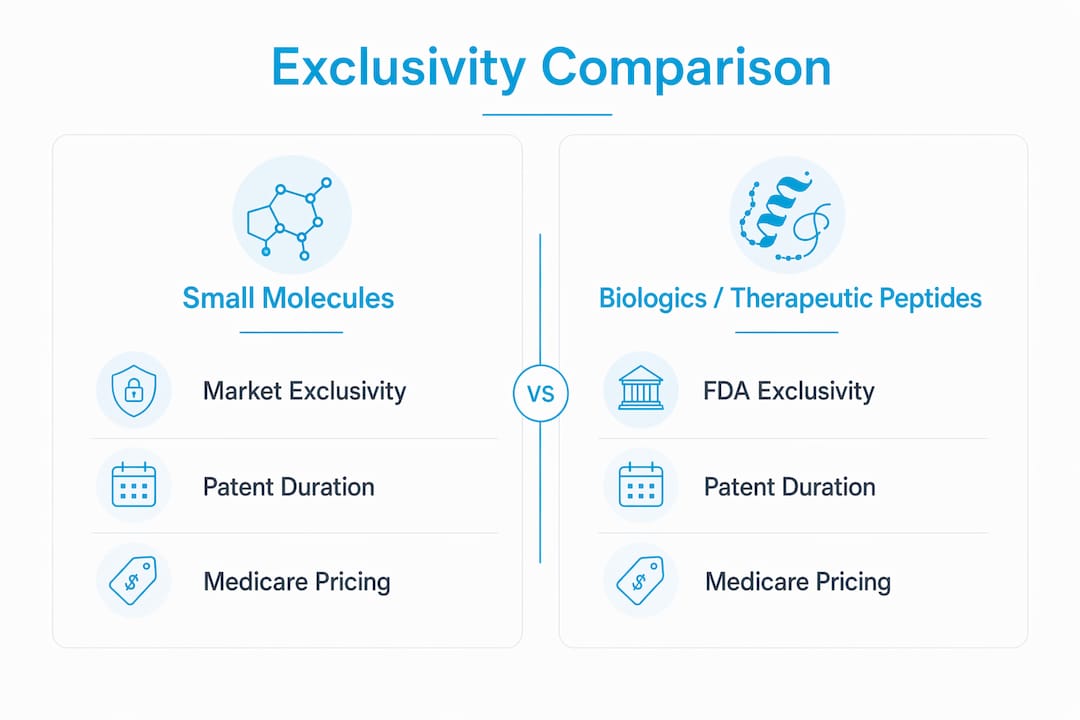
Under the BPCIA, the FDA grants 12 years of reference product exclusivity for approved biological products. This exclusivity blocks biosimilar application submissions for the first four years and prevents biosimilar approvals for the full 12-year period. For therapeutic peptides classified as biologics, this creates a substantial protected commercial window from the date of first approval.
The IRA adds a separate dimension. Biologics, including most therapeutic peptides, receive 13 years before Medicare price negotiation begins, compared to 9 years for small molecules. That 4-year advantage is not trivial. It extends the period during which a peptide therapeutic can command market pricing without government-negotiated price reductions, directly affecting revenue projections and return on investment calculations for development programs.
The distinction between biologics and small molecules in exclusivity duration is also driving pipeline decisions. Shorter exclusivity for small molecules is pushing pharmaceutical companies toward peptide and biologic development to capture longer commercial windows. This is a structural shift in how R&D capital is being allocated across the industry.
Exclusivity Type Small Molecules Biologics / Therapeutic Peptides FDA Market Exclusivity 5 years (NCE) 12 years (BPCIA RPE) Biosimilar/Generic Submission Ban 5 years 4 years from approval IRA Medicare Negotiation Timeline 9 years 13 years Patent Term Extension Eligibility Yes Yes Typical Total Protected Window 9–13 years 13–17 years
Pro Tip: When evaluating a therapeutic peptide’s commercial window, calculate from the FDA approval date, not the patent filing date. Patent term and regulatory exclusivity run on different clocks, and the overlap determines your actual protected period.
How do molecular exclusivity and formulation exclusivity differ?
Molecular exclusivity and formulation exclusivity represent two fundamentally different competitive strategies in the peptide industry. Conflating them leads to both overestimating and underestimating competitive barriers.
Molecular exclusivity is a patent or proprietary right on the peptide’s amino acid sequence or structural configuration. No other manufacturer can legally synthesize or sell that molecule without a license. Defensin peptides are the clearest current example. Defensin peptides are patented, fully synthetic, and unavailable to any other brand, making DefenAge the sole commercial source. This is true molecular exclusivity. It is rare, difficult to achieve, and highly defensible.
Formulation exclusivity operates differently. The peptide molecule itself may be freely available, but the delivery system, stabilization method, or trade secret formulation is protected. Delivery mechanisms like nasal sprays or micro-indexed auto-injectors create practical exclusivity independent of the peptide sequence. A competitor can synthesize the same peptide but cannot replicate the delivery format without infringing on separate IP. This approach is more accessible for most formulators and increasingly common as peptide sequences become commoditized.
By contrast, generic cosmetic peptides like Matrixyl and Syn-Coll are distributed by suppliers including Sederma, DSM, and Lucas Meyer to hundreds of brands simultaneously. These peptides carry no molecular exclusivity. Any differentiation must come from formulation, clinical validation, or delivery engineering.
Attribute Molecular Exclusivity Formulation Exclusivity What is protected Peptide sequence or structure Delivery system, stabilization, trade secrets Legal mechanism Patent on molecule Patent on formulation, trade secret Competitor access to peptide Blocked Available Typical duration Patent life (20 years from filing) Variable, often trade secret indefinite Example DefenAge defensin peptides Stabilized co-solvency delivery systems Market applicability Therapeutic, select cosmeceutical Cosmetic, nutraceutical, research
Pro Tip: When assessing a competitor’s “exclusive” peptide claim, check whether the exclusivity covers the molecule or only the formulation. Patent databases like the USPTO or Espacenet can confirm molecular claims in under 30 minutes.
What commercial exclusivity strategies are used in the cosmetic peptide market?
Commercial exclusivity in the personal care and cosmetic peptide market rarely involves molecular patents. Most strategies rely on contractual arrangements, formulation engineering, and clinical data ownership to create defensible market positions.
Contractual exclusivity is the most common approach. Exclusive geographic distribution rights, such as those used for Lactium® in Italy, restrict which brands can sell a peptide ingredient in a given market without restricting synthesis. This creates regional competitive advantage without requiring a molecular patent. The limitation is that the underlying peptide remains accessible elsewhere, so the exclusivity is geographic rather than absolute.
Proprietary formulation engineering is the second major strategy. End-to-end peptide formulation solutions including custom co-solvency techniques and advanced delivery technology partnerships offer durable competitive advantage. A brand that develops a stabilized co-solvency pre-solution for a peptide complex owns that formulation even if the peptides themselves are generic. Replicating it requires reverse engineering, which is both time-consuming and legally risky.
The third strategy involves clinical data exclusivity. Funding and owning clinical studies on a generic peptide creates a defensible position based on evidence rather than IP. Competitors can use the same peptide but cannot reference your clinical data without licensing it.
The numbered list below outlines the primary commercial tactics used to build exclusivity in peptide product launches:
Secure exclusive geographic or channel distribution contracts with ingredient suppliers before product launch.
Develop proprietary delivery systems or stabilization methods that are independently patentable.
Commission and own clinical validation studies on the formulation, not just the peptide.
Use trade secret protection for co-solvency ratios, excipient combinations, and processing parameters.
Build supplier relationships that include first-access or co-development agreements for novel peptide variants.
One risk that formulators frequently underestimate is gray market exclusivity claims. Gray market “exclusive” blends often hide inconsistent manufacturing and poor-quality ingredients behind marketing language. Exclusivity language in supplier materials does not constitute legal protection. Verify the basis of any exclusivity claim before building a product strategy around it.
Pro Tip: Request the specific IP documentation behind any “exclusive” ingredient claim from a supplier. A legitimate exclusivity arrangement will have a patent number, a licensing agreement, or a registered trade secret. Vague marketing language is not a substitute.
How does exclusivity shape peptide sourcing and research collaborations?
Exclusivity status is a primary variable in peptide ingredient sourcing decisions, yet it is frequently treated as secondary to price and availability. This ordering is a common error in procurement strategy.
When a peptide carries active molecular exclusivity, sourcing options are binary: license from the patent holder or develop an alternative molecule. There is no gray area. Researchers who source patented peptides through third-party suppliers without verifying licensing status expose their institutions or companies to infringement liability. Custom peptide sourcing decisions must account for exclusivity status before any other evaluation criterion.
For generic peptides with no molecular exclusivity, the sourcing decision shifts to quality, batch traceability, and supply chain reliability. These factors determine whether a formulation is reproducible across development stages and commercial scale. Independent batch verification and certificates of analysis are not optional for research-grade work. They are the minimum standard for any exclusivity-adjacent claim about ingredient quality.
The following factors define how exclusivity affects sourcing and collaboration decisions in practice:
Patent status of the target peptide sequence must be confirmed before initiating synthesis or procurement.
Licensing terms from patent holders vary significantly. Some offer non-exclusive research licenses at low cost; others require royalty-bearing commercial agreements.
Collaborative R&D models, including co-development agreements with synthesis facilities, can generate jointly owned IP that creates new exclusivity positions.
Supply chain transparency is more critical for proprietary peptides than for generics. A single batch inconsistency in an exclusive formulation can invalidate clinical data or regulatory filings.
Exclusivity periods affect product development timelines. Launching a biosimilar or generic peptide formulation requires tracking the originator’s regulatory exclusivity expiration, not just patent expiration.
Vetting peptide manufacturers for their ability to maintain batch consistency and provide traceable documentation is a prerequisite for any exclusivity-dependent formulation program.
Competitive peptide lines increasingly emphasize proprietary formulation engineering and clinical validation rather than molecule access alone. This shift means that sourcing strategy and exclusivity strategy are converging. The formulator who controls the delivery system and owns the clinical data holds a defensible position even when the peptide molecule is generic.
Key takeaways
Peptide ingredient exclusivity is most defensible when it combines molecular patents, proprietary delivery systems, and owned clinical data rather than relying on any single protection layer.
Point Details Regulatory exclusivity duration Biologics receive 12 years under BPCIA plus a 4-year IRA advantage over small molecules. Molecular vs. formulation exclusivity Molecular exclusivity blocks synthesis; formulation exclusivity protects delivery and stabilization methods. Gray market risk Exclusivity claims without patent documentation or licensing agreements carry no legal weight. Sourcing due diligence Patent status must be confirmed before procurement; batch traceability is non-negotiable for exclusive formulations. Commercial strategy Contractual distribution rights, clinical data ownership, and delivery system patents are the primary tools in cosmetic peptide markets.
The exclusivity claim problem nobody talks about
The most persistent problem in this space is not the complexity of regulatory frameworks. It is the gap between what suppliers claim and what is actually protected.
In my experience reviewing ingredient documentation across dozens of peptide sourcing decisions, the majority of “exclusive” claims in the cosmetic and research peptide market refer to distribution arrangements, not molecular patents. A supplier offering an “exclusive peptide complex” is usually describing a pre-mixed formulation they sell under a branded name, not a patented molecule. The peptide sequences inside that blend are often available from Sederma, DSM, or any number of synthesis facilities in China.
This matters because formulators who build product strategies around these claims discover their “exclusivity” evaporates the moment a competitor sources the same peptides and creates a similar blend. The regulatory exclusivity frameworks under BPCIA and the IRA are genuinely protective, but they apply to approved therapeutics, not cosmetic ingredients.
The real battleground in 2026 is formulation engineering. Delivery system patents, stabilized co-solvency techniques, and owned clinical data are where durable competitive positions are built. These are harder to replicate than a peptide sequence and harder to challenge than a distribution contract.
My practical advice: treat any exclusivity claim as unverified until you have seen the patent number or the licensing agreement. Build your competitive position on what you own and can document, not on what a supplier tells you is exclusive. The peptide industry rewards transparency and verification. It punishes assumptions.
— Sam Levin
Source your peptides with exclusivity in mind
PeptidesFromChina maintains a research peptide catalog. Products are subject to the manufacturer’s applicable quality-control procedures and specifications. Manufacturer-side analytical documentation may be available depending on the product and batch. PeptidesFromChina is not an independent analytical testing laboratory. For formulators and researchers who need to build around exclusivity constraints, the platform supports custom sourcing inquiries that account for patent status, batch traceability, and supply chain documentation. Whether you are working with widely available signaling peptides or evaluating options for a proprietary formulation program, PeptidesFromChina provides the sourcing transparency that exclusivity-dependent work requires. Explore the catalog or contact the team directly to discuss custom sourcing arrangements.
FAQ
What is peptide ingredient exclusivity in simple terms?
Peptide ingredient exclusivity is any legal or contractual protection that limits who can manufacture, sell, or use a specific peptide molecule or formulation. It covers molecular patents, FDA regulatory exclusivity periods, and commercial distribution agreements.
How long does regulatory exclusivity last for therapeutic peptides?
Under the BPCIA, FDA grants 12 years of reference product exclusivity for approved biologics, including therapeutic peptides, with a 4-year ban on biosimilar application submissions. The IRA extends the Medicare price negotiation timeline to 13 years for biologics.
What is the difference between molecular and formulation exclusivity?
Molecular exclusivity protects the peptide sequence itself through a patent, blocking all competitors from synthesizing it. Formulation exclusivity protects the delivery system or stabilization method, leaving the peptide molecule accessible but the specific formulation protected.
Are cosmetic peptides like matrixyl or syn-coll exclusive?
No. Generic cosmetic peptides including Matrixyl and Syn-Coll are distributed by multiple suppliers such as Sederma, DSM, and Lucas Meyer to hundreds of brands simultaneously. They carry no molecular exclusivity.
How can formulators verify whether a peptide is truly exclusive?
Check patent databases such as the USPTO or Espacenet for the peptide sequence, and request the specific patent number or licensing agreement from the supplier. Marketing language describing a peptide as “exclusive” without documentation does not constitute legal protection.