Peptide Encapsulation Methods: A 2026 Research Guide

Peptide encapsulation is defined as the process of enclosing therapeutic peptide molecules within protective matrices or carrier systems to preserve their stability, enable controlled release, and improve bioavailability in drug delivery applications. Encapsulated particles typically range from 1 μm to several hundred micrometers in size, depending on the carrier type and fabrication method. The primary goals are protection from enzymatic degradation, including gastric proteases and low pH environments, and the delivery of peptides to target tissues at therapeutically relevant concentrations. For researchers working in biotechnology and pharmaceutical formulation, understanding what is peptide encapsulation method and how to select the right approach is foundational to translating peptide candidates from bench to clinical application.
What is the peptide encapsulation method and how does it work?
Peptide encapsulation works by physically entrapping peptide molecules within a carrier structure through non-covalent interactions. Physical encapsulation strategies rely on hydrophobic interactions, van der Waals forces, hydrogen bonding, and electrostatic interactions to load peptides into carriers such as liposomes, polymeric nanoparticles, solid lipid nanoparticles, and hydrogels. Because no covalent bonds are formed, the peptide’s primary structure and bioactivity remain intact. This is the defining advantage of physical encapsulation over chemical conjugation approaches.
The carrier architecture determines the release profile. A liposome releases its payload when the lipid bilayer destabilizes, while a polymeric nanoparticle releases peptide through matrix erosion or diffusion. Hydrogels provide a three-dimensional network that releases peptide in response to swelling or enzymatic cleavage. Each mechanism produces a distinct pharmacokinetic outcome, which is why carrier selection cannot be separated from therapeutic goal setting.
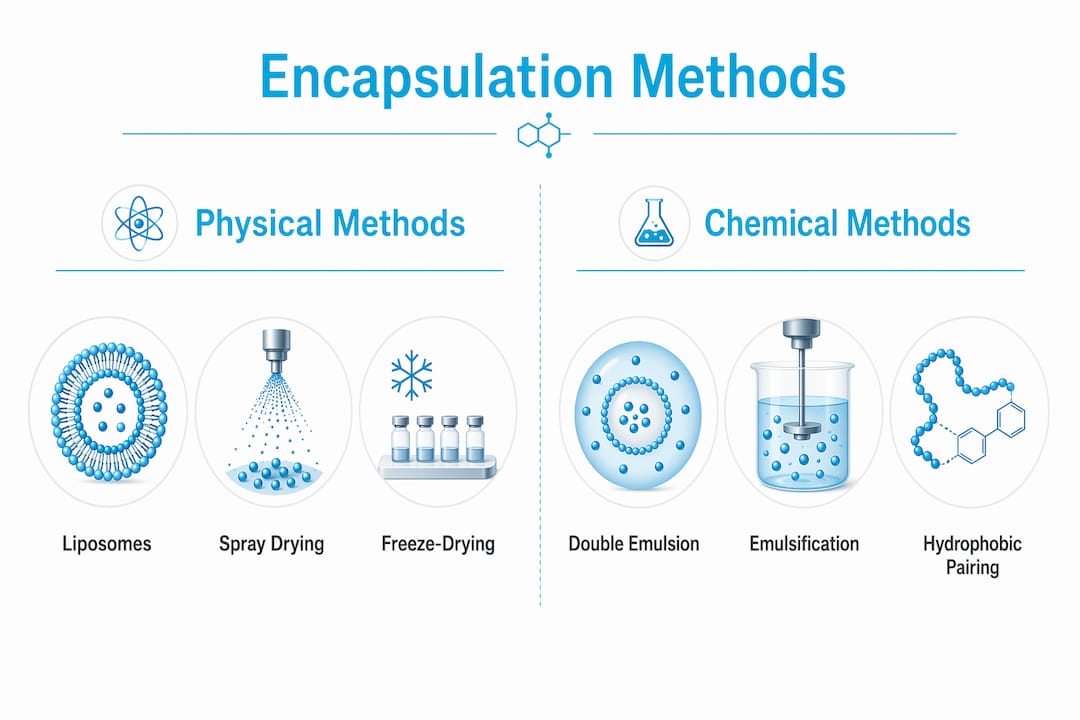
Common industry-standard encapsulation methods include liposomes, spray drying, double emulsion, freeze-drying, emulsification-gelation, and ionic gelation. Each method suits different peptide profiles and manufacturing contexts.
Method Particle size range Encapsulation efficiency Stability Scalability Liposomes 50–500 nm Moderate Moderate Moderate Spray drying 1–100 μm Moderate to high High (dry form) High Double emulsion 200 nm–10 μm Moderate Low to moderate Moderate Freeze-drying Varies by carrier High High (dry form) Moderate Emulsification-gelation 100 nm–1 mm Moderate to high Moderate Low to moderate Ionic gelation 100–800 nm Moderate Moderate Moderate
Spray drying produces dry powder formulations with good shelf stability and is well suited to large-scale manufacturing. Double emulsion is the standard approach for hydrophilic peptides that cannot partition into hydrophobic polymer matrices without assistance. Ionic gelation, commonly used with chitosan, forms particles through electrostatic crosslinking and avoids organic solvents, which reduces denaturation risk.
How does peptide physicochemistry influence encapsulation method selection?
The physicochemical profile of a peptide determines which encapsulation technique will deliver adequate loading efficiency and acceptable release kinetics. Three variables dominate method selection: hydrophilicity, molecular weight, and net charge. A highly hydrophilic peptide will partition poorly into a hydrophobic polymer core, resulting in low encapsulation efficiency unless the formulation strategy accounts for this mismatch. Large macromolecular peptides face additional steric barriers during loading.
Net charge affects both loading and release. Cationic peptides interact favorably with anionic carriers such as alginate or hyaluronic acid gels, enabling high loading through electrostatic attraction. Anionic peptides require cationic carriers or alternative loading strategies. Charge-neutral peptides depend primarily on hydrophobic or van der Waals interactions for entrapment.
Key formulation considerations based on peptide properties:
Hydrophilic peptides: require double emulsion, ionic gelation, or hydrophobic ion pairing to achieve adequate encapsulation efficiency
Hydrophobic peptides: load efficiently into lipid-based carriers and polymeric nanoparticles through direct hydrophobic interaction
High molecular weight peptides: benefit from hydrogel matrices that accommodate larger molecular volumes without steric exclusion
Charged peptides: match carrier charge to peptide charge for electrostatic loading; mismatched charge leads to premature release
Sequence-specific instability: certain amino acid sequences are prone to oxidation, deamidation, or aggregation under processing conditions
Targeted linkers add another layer of selectivity. Peptide-drug conjugates and peptide-based nanocarriers can incorporate site-specific release triggers such as lysosomal acidity or enzyme-cleavable sequences. These linkers allow the carrier to circulate intact and release payload only at the target tissue. This approach is particularly relevant for oncology applications where off-target release carries significant toxicity risk.
Stabilizers and lyoprotectants also play a formulation role that extends beyond the encapsulation step itself. Peptide-based excipients function as surfactants and permeation enhancers, stabilizing the peptide payload during both production and storage. Sucrose and trehalose are the most widely used lyoprotectants in peptide formulation, particularly when freeze-drying is part of the manufacturing process.
Pro Tip: Assess sequence-specific degradation risks, including oxidation-prone methionine residues and asparagine deamidation sites, before selecting an encapsulation method. These risks often determine whether a dry-form process like spray drying or freeze-drying is preferable to a solution-phase approach.
What are the practical challenges in peptide encapsulation formulation?
Formulation development for peptide encapsulation consistently encounters four core problems: premature peptide leakage, burst release, low encapsulation efficiency, and particle size distribution variability. Each problem has a distinct cause and requires a targeted mitigation strategy rather than a generic adjustment to process parameters.
Burst release occurs when a large fraction of the peptide payload releases within the first few hours after administration. This typically results from peptides adsorbed to the carrier surface rather than entrapped within the matrix. Emulsifier choice directly controls particle size monodispersity and the burst release profile. Small changes in emulsifier concentration shift the particle size distribution and alter the surface-to-volume ratio, which in turn changes the fraction of surface-adsorbed peptide.
Hydrophobic ion pairing (HIP) addresses the low encapsulation efficiency problem for hydrophilic peptides. HIP complexes peptides with oppositely charged surfactants, increasing their liposolubility and affinity for hydrophobic polymer cores. The result is a measurable improvement in encapsulation efficiency without altering the peptide’s primary structure. HIP is now a standard formulation tool for hydrophilic peptide candidates that fail to load adequately through conventional double emulsion.
Freeze-drying introduces its own set of challenges. The drying process creates mechanical and osmotic stresses that can collapse nanoparticle structures and induce peptide aggregation. Lyoprotectants like sucrose and trehalose prevent aggregation and maintain nanoparticle integrity during lyophilization. Researchers working with lyophilized peptide formulations should treat lyoprotectant selection as a critical formulation variable, not an afterthought.
Formulation variable Effect on performance Mitigation strategy Emulsifier concentration Controls particle size and burst release Iterative experimental optimization Lyoprotectant type and concentration Prevents aggregation during freeze-drying Sucrose or trehalose at optimized ratios HIP surfactant selection Improves hydrophilic peptide loading Match surfactant charge to peptide charge Polymer molecular weight Affects matrix erosion rate and release kinetics Select grade based on target release duration Homogenization speed Determines particle size distribution Calibrate to target size range per batch
Pro Tip: Theoretical formulation design is a starting point, not a final answer. Encapsulation efficiency and release profiles must be validated experimentally for each peptide-carrier combination, because small differences in peptide sequence produce measurable differences in formulation behavior.
How are lipid-polymer hybrid nanoparticles advancing peptide delivery?
Lipid-polymer hybrid nanoparticles (LPHNs) represent the most significant structural advance in peptide delivery systems over the past decade. LPHNs combine polymer stability with lipid biocompatibility to produce carriers that outperform either liposomes or polymeric nanoparticles alone on encapsulation efficiency, stability, and sustained release. The architecture typically consists of a polymer core surrounded by a lipid shell, with the lipid layer providing a biocompatible interface and the polymer core controlling release kinetics.
Preparation techniques for LPHNs include solvent evaporation, emulsification, nanoprecipitation, and microfluidics. Microfluidics offers the tightest control over particle size distribution and is increasingly used in formulations intended for clinical translation, where batch-to-batch consistency is a regulatory requirement. Solvent evaporation and nanoprecipitation remain the most common laboratory-scale approaches due to their lower equipment requirements.
Key advantages of LPHNs over conventional carriers:
Higher encapsulation efficiency for both hydrophilic and hydrophobic peptides compared to liposomes alone
Reduced burst release due to the polymer core acting as a diffusion barrier
Improved physical stability during storage, particularly in lyophilized form
Compatibility with surface functionalization for targeted delivery
Tunable release kinetics through polymer grade and lipid composition selection
Protein and peptide denaturation during LPHN fabrication remains a real concern. Organic solvents and high-shear homogenization steps can disrupt secondary structure. Stabilizers such as serum albumin or poloxamers are incorporated during fabrication to protect peptide integrity. Researchers sourcing peptides for encapsulation formulation work should verify that the starting material meets purity and structural integrity standards before beginning LPHN development, since formulation cannot compensate for a degraded API.
Scale-up of LPHN manufacturing introduces additional complexity. Microfluidic processes that work at milliliter scales require significant engineering adaptation for liter-scale production. Quality control at scale must include particle size distribution, zeta potential, encapsulation efficiency, and peptide integrity assays on every batch. Regulatory agencies increasingly expect quality-by-design documentation for nanoparticle-based drug products, which means formulation parameters must be defined and justified with experimental data.
Key Takeaways
Peptide encapsulation method selection requires matching carrier architecture to peptide physicochemistry, because no single technique delivers adequate efficiency, stability, and release control across all peptide classes.
Point Details Definition and size range Encapsulation encloses peptides in protective matrices ranging from 1 μm to several hundred micrometers for stability and controlled release. Method selection criteria Hydrophilicity, molecular weight, and net charge determine which encapsulation technique delivers adequate loading and release performance. HIP for hydrophilic peptides Hydrophobic ion pairing improves encapsulation efficiency by increasing hydrophilic peptide affinity for polymer cores. Lyoprotectants in freeze-drying Sucrose and trehalose prevent aggregation and nanoparticle collapse during lyophilization, preserving peptide bioactivity. LPHNs as advanced carriers Lipid-polymer hybrid nanoparticles outperform conventional liposomes and polymeric nanoparticles on efficiency, stability, and release control.
Why emulsifier selection deserves more attention than it gets
The formulation literature covers carrier architecture and peptide properties in detail. What gets underweighted is the role of emulsifiers and stabilizers in determining whether a formulation actually works at the bench level.
Emulsifier selection critically affects particle size, physical stability, and encapsulation efficiency. Researchers often treat emulsifier concentration as a secondary variable and focus optimization effort on polymer grade or lipid composition. That prioritization is wrong. A formulation with the right polymer and the wrong emulsifier will produce a polydisperse particle population with unpredictable release kinetics. The relationship between emulsifier concentration and particle size is nonlinear, which means small concentration changes require full experimental re-evaluation rather than simple interpolation.
The same logic applies to stabilizers throughout the formulation lifecycle. Peptide stabilizers act as both coat and buffer across production, lyophilization, storage, and reconstitution. Treating them as optional additives rather than core formulation components leads to batch failures that are difficult to diagnose after the fact. Researchers considering lyophilization process design should build lyoprotectant and stabilizer selection into the initial formulation screen, not the troubleshooting phase.
The broader point is that quality-by-design principles apply to peptide encapsulation just as they do to small molecule formulation. Defining the design space experimentally, rather than assuming theoretical parameters will translate to bench results, is the only reliable path to a reproducible formulation. Analytical verification at each stage, including peptide integrity assays after encapsulation and after lyophilization, is not optional. It is the only way to confirm that the encapsulated peptide retains the structure and activity the therapeutic application requires.
— Sam Levin
PeptidesFromChina and research-grade peptides for encapsulation work
Encapsulation formulation work depends on starting material quality. A peptide with batch-to-batch purity variability will produce inconsistent encapsulation efficiency and release data, making it impossible to distinguish formulation variables from API variables.
Manufacturer-side analytical documentation may be available depending on the product and batch. It is not guaranteed with every order and is not independent verification by PFC. Buyers may arrange third-party analytical testing when required.
FAQ
What is the peptide encapsulation method in drug delivery?
Peptide encapsulation is the process of enclosing therapeutic peptides within protective carrier matrices, ranging from 1 μm to several hundred micrometers, to shield them from enzymatic degradation and enable controlled release at target sites.
What are the main types of peptide encapsulation techniques?
The primary encapsulation techniques for peptides are liposomes, spray drying, double emulsion, freeze-drying, emulsification-gelation, and ionic gelation, each suited to different peptide physicochemical profiles and manufacturing requirements.
How does hydrophobic ion pairing improve encapsulation efficiency?
Hydrophobic ion pairing complexes hydrophilic peptides with oppositely charged surfactants, increasing their affinity for hydrophobic polymer cores and producing measurably higher encapsulation efficiency than conventional double emulsion alone.
Why are lyoprotectants necessary in freeze-dried peptide formulations?
Lyoprotectants such as sucrose and trehalose prevent nanoparticle collapse and peptide aggregation during lyophilization by forming a protective amorphous matrix around the carrier structure during the drying process.
What advantage do lipid-polymer hybrid nanoparticles offer over liposomes?
Lipid-polymer hybrid nanoparticles combine the biocompatibility of lipid shells with the structural stability of polymer cores, delivering higher encapsulation efficiency, reduced burst release, and better storage stability than conventional liposomes.