Peptide Bulk Ordering Cost Benefits: 2026 Guide

Peptide bulk ordering cost benefits are defined as the measurable reduction in effective cost per milligram achieved through volume-scaled pricing, consolidated shipping, and documentation efficiencies. Bulk purchasing of peptides reduces cost per milligram by 20–50% compared to retail, with the deepest discounts appearing at 50–100 unit orders. For researchers and procurement professionals managing recurring peptide spend, understanding where those savings originate and what operational risks can erode them is the difference between a well-structured procurement strategy and a budget that looks good on paper but fails in practice. This guide covers volume discount mechanics, order consolidation, quality documentation costs, and the hidden operational factors that determine whether bulk ordering actually delivers.
1. How volume discounts drive peptide bulk ordering cost benefits
Volume discounts are the primary mechanism behind bulk peptide purchasing advantages. Synthesis facilities price peptides on a cost-per-gram basis, and fixed overhead costs such as HPLC purification runs, lyophilization cycles, and quality control testing get distributed across larger batch sizes. The result is a direct reduction in per-unit manufacturing cost as order size increases.
Discount tiers typically follow a predictable structure. Orders in the 5–10 unit range yield modest savings. Meaningful discounts above 25% require 25+ unit orders, and the 40–50% discount range becomes accessible at 50–100 units. That progression reflects real manufacturing economics, not arbitrary pricing.

Pro Tip: Always normalize pricing to cost per milligram before comparing tiers. Two suppliers offering the same vial price can have dramatically different peptide content, making one effectively 7x more expensive per milligram than the other.
The table below illustrates how volume tiers translate to pricing structure in practice.
Order size Typical discount range Pricing model 1–4 units 0–5% Retail or catalog price 5–10 units 5–15% Entry-level volume pricing 25–49 units 15–30% Mid-volume tier 50–100 units 30–50% Wholesale or direct pricing
Comparing cost per milligram rather than per vial is the only reliable method for evaluating these tiers. A $275 vial versus a $32 vial can represent a 7.4x price difference per milligram despite similar compound names. Procurement decisions made on vial price alone routinely result in significant overpayment.
2. Multi-peptide order consolidation and stacking strategies
Consolidating multiple peptide compounds into a single order is one of the most underused methods for reducing total procurement cost. Shipping fees, customs documentation, and administrative processing are largely fixed costs per shipment. Distributing those costs across a 3–6 compound order rather than placing separate orders for each compound directly reduces the effective cost per unit.
Stacking peptides in consolidated orders can save 10–20% on total procurement costs through reduced shipping and administrative overhead, with savings increasing to 30–40% when orders align with supplier promotional periods. That range is meaningful for eligible research buyers managing quarterly procurement cycles.
Key advantages of order consolidation include:
Shipping fee amortization across multiple compounds reduces per-compound logistics cost.
A single consolidated order is more likely to cross volume discount thresholds than multiple smaller orders placed separately.
Fewer shipments mean fewer customs clearance events, reducing the risk of documentation delays or import complications.
Supplier relationships built through consistent, larger orders often unlock bundle pricing not listed in standard catalogs.
Administrative overhead per compound decreases when procurement, receiving, and quality review are handled in one cycle.
Fragmenting orders across multiple vendors eliminates all of these advantages. Each vendor relationship requires separate documentation, separate shipping arrangements, and separate quality review. The cost of that fragmentation rarely appears in a line-item budget but accumulates quickly across a research year.
Pro Tip: Map your research protocol’s full peptide requirements at the start of each funding cycle. Placing one consolidated order per quarter rather than ad hoc orders per experiment captures both shipping savings and volume discount thresholds simultaneously.
3. Quality verification and documentation costs
Third-party testing and documentation add a 10–25% price premium to bulk peptide orders. That premium is not optional for research applications where reproducibility, grant compliance, and publication integrity depend on verified purity data.
The cost components within that premium are specific:
HPLC analysis from an ISO 17025-certified laboratory confirms peptide identity and purity at the batch level. This is the baseline documentation requirement for most institutional procurement policies.
Mass spectrometry reports verify molecular weight and confirm the absence of synthesis byproducts. Combined with HPLC, these two reports constitute a complete certificate of analysis (COA).
Certificates of analysis must reference the specific batch number, synthesis date, and storage conditions. Generic or undated COAs do not satisfy institutional audit requirements.
Shipping documentation including accurate customs declarations and import permits affects landed cost and clearance speed. Incomplete documentation causes delays that add real cost to the procurement timeline.
The trade-off is direct. Purchasing peptides without verified documentation saves the 10–25% premium upfront. It also introduces the risk of using material with unverified purity in experiments, which can invalidate results and require repeat purchases. The cost of a failed experiment exceeds the cost of the documentation premium in almost every scenario. Procurement teams evaluating quality verification costs should treat COA documentation as a fixed line item, not a variable to reduce.
4. Operational risks that erode bulk ordering savings
Bulk ordering delivers cost savings on paper. Whether those savings are realized depends on operational execution after the order arrives.
The primary risks that erode bulk peptide cost efficiency include:
Improper storage is the most common cause of realized loss. Lyophilized peptides require storage at minus 20°C to maintain stability. Facilities without reliable cold storage infrastructure should not place bulk orders that exceed near-term consumption capacity.
Upfront capital requirements for large orders can create cash flow constraints, particularly for research groups operating on grant funding with defined disbursement schedules. Ordering 50+ units of multiple compounds requires significant capital commitment before any experimental value is generated.
Peptide degradation from freeze-thaw cycling, humidity exposure, or temperature excursions effectively increases the cost per usable milligram. A 40% discount on a bulk order is eliminated if 30% of the material degrades before use.
Funding cycle misalignment is a structural risk. Ordering bulk quantities in month one of a grant cycle and exhausting budget before the cycle ends creates procurement gaps that force retail purchases at full price.
Mitigating these risks requires planning at the procurement stage, not after delivery. Aligning order quantities with realistic consumption timelines, confirming storage infrastructure before ordering, and staging bulk orders across funding cycles are the practical controls that protect realized savings. The economic logic of bulk sourcing only holds when operational execution matches the procurement model.
5. Comparing peptide suppliers for bulk pricing transparency
Supplier pricing transparency in the peptide market varies considerably. Most mid-to-high volume pricing is quote-based rather than publicly listed. Buyers must specify compound, quantity, fill amount, purity specification, and documentation requirements before receiving an accurate price. That process creates comparison friction that benefits suppliers who obscure true cost.
Pricing model Transparency level Comparison difficulty Publicly listed catalog tiers High Low Quote-based with disclosed tiers Medium Medium Quote-based, no disclosed tiers Low High Bundled with undisclosed documentation fees Very low Very high
Effective supplier comparison requires normalizing all quotes to cost per milligram, including shipping, documentation, and any import fees in the total landed cost calculation. A supplier offering a lower unit price but charging separately for COA documentation, cold chain packaging, and customs preparation may deliver a higher total landed cost than a supplier with a higher unit price and inclusive documentation.
Supplier reliability and delivery scope matter as much as price. Consistent batch-to-batch purity, traceable synthesis records, and predictable lead times affect research continuity. A B2B sourcing approach that evaluates total landed cost and supplier track record produces better procurement outcomes than price-only comparison.
Key takeaways
Bulk peptide ordering delivers the largest cost savings when volume discounts, order consolidation, and documentation costs are evaluated together as total landed cost per milligram.
Point Details Volume discount thresholds Meaningful savings above 25% require 25+ unit orders; 40–50% discounts appear at 50–100 units. Cost normalization Always compare price per milligram, not per vial, to avoid significant overpayment. Consolidation savings Stacking multiple compounds in one order reduces shipping and administrative costs by 10–20%. Documentation premium Third-party COAs and HPLC reports add 10–25% to cost but protect research reproducibility. Operational risk management Improper storage and funding misalignment can eliminate all discount savings post-purchase.
Why cost-per-milligram thinking changes everything in bulk procurement
Most procurement errors in peptide sourcing trace back to one mistake: comparing vial prices instead of milligram prices. I have reviewed procurement records where a research team paid $275 per vial while a comparable supplier offered equivalent material at $32 per vial. The $275 vial contained more peptide per unit, but the per-milligram cost was still 7.4x higher. The team had no idea because no one normalized the comparison.
The second mistake I see consistently is treating bulk ordering as a pure cost decision without accounting for storage and consumption rate. A 50-unit order at a 45% discount is not a savings if the facility stores peptides at minus 4°C instead of minus 20°C, or if the research protocol only consumes 15 units before the grant cycle ends. The discount is real. The realized savings are not.
Documentation costs deserve more respect than they typically receive in procurement discussions. The 10–25% premium for verified COAs and HPLC reports is not overhead to minimize. It is the cost of research confidence. Institutions that cut documentation costs to reduce apparent procurement spend often pay that cost back in failed experiments, repeat purchases, and grant audit complications.
The practical framework is straightforward. Normalize to cost per milligram. Include all landed costs in the comparison. Align order quantities with realistic consumption and storage capacity. Treat documentation as a fixed requirement. Procurement teams that apply these four principles consistently will capture the real bulk peptide purchasing advantages without the operational losses that undermine them.
— Sam Levin
PeptidesFromChina for bulk research peptide orders
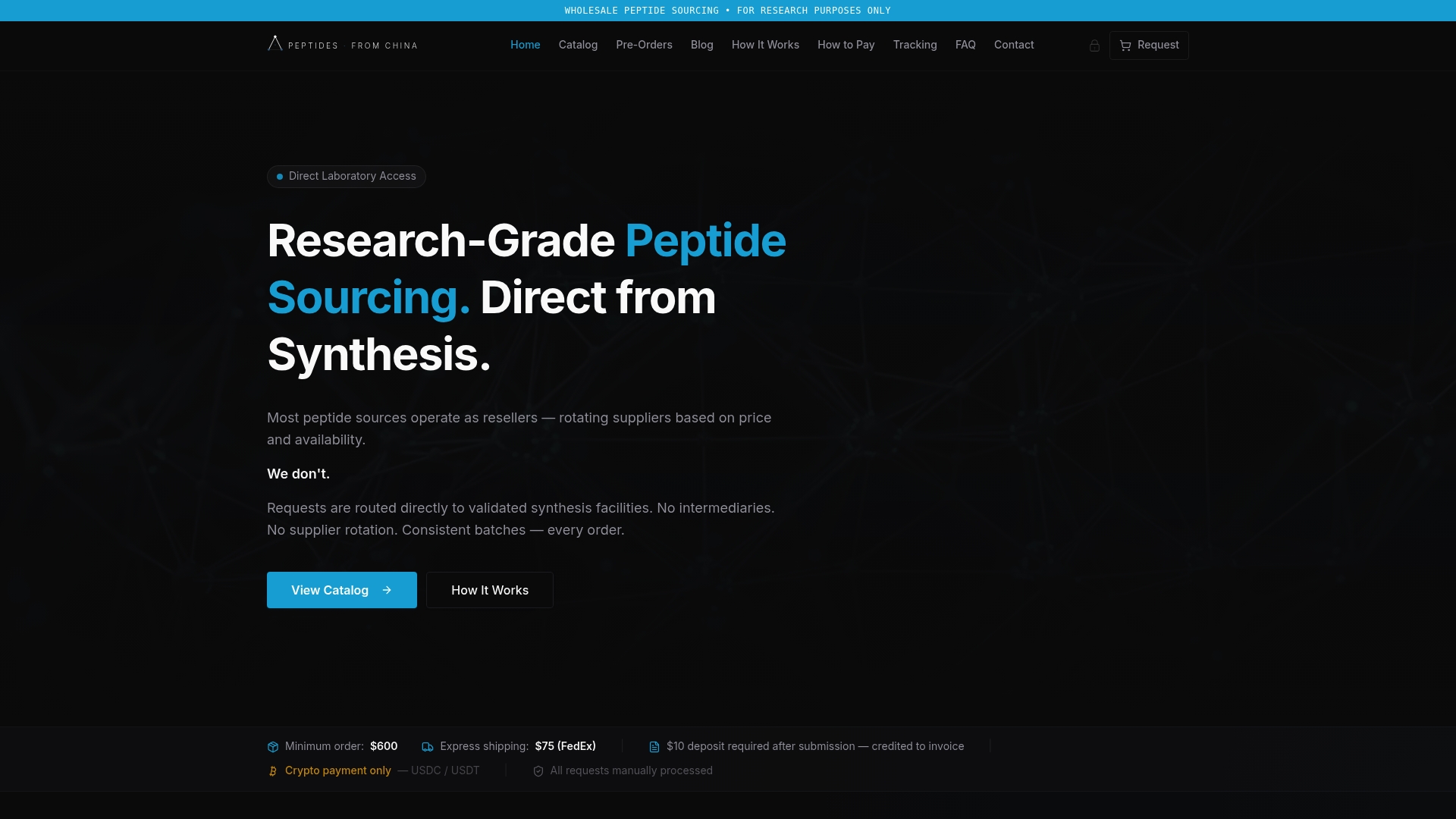
PeptidesFromChina operates as a direct-to-researcher sourcing platform with established relationships with synthesis facilities, not as a gray-market reseller. That structure supports the kind of volume pricing, batch traceability, and documentation consistency that research procurement requires.
Products are subject to the manufacturer’s applicable quality-control procedures and specifications. Manufacturer-side analytical documentation may be available depending on the product and batch. PeptidesFromChina is not an independent analytical testing laboratory. Consolidated multi-compound orders are supported, subject to current availability. Learn more: peptide catalog. Learn more: bulk sourcing protocols.
FAQ
What order size triggers meaningful bulk peptide discounts?
Discounts above 25% typically require 25+ unit orders. The 40–50% discount range becomes accessible at 50–100 units, depending on the compound and supplier.
Why does cost per milligram matter more than cost per vial?
Two vials at the same price can contain different amounts of peptide, making one significantly more expensive per milligram. A $275 vial versus a $32 vial can represent a 7.4x cost difference per milligram despite similar labeling.
Do COA and third-party testing costs justify the premium for research use?
Third-party testing adds a 10–25% price premium but is necessary for research reproducibility, grant compliance, and institutional audit requirements. The cost of a failed experiment from unverified material exceeds the documentation premium in most cases.
What storage conditions are required for bulk lyophilized peptides?
Lyophilized peptides require storage at minus 20°C to maintain stability. Facilities without reliable cold storage should limit order quantities to near-term consumption to avoid degradation losses that eliminate discount savings.
How should procurement teams compare quotes from multiple peptide suppliers?
Normalize all quotes to cost per milligram and include shipping, documentation, and import fees in the total landed cost. Quote-based pricing without disclosed tiers requires detailed inquiry to produce an accurate comparison.