Minimum Order Quantity for Peptides: A Researcher’s Guide
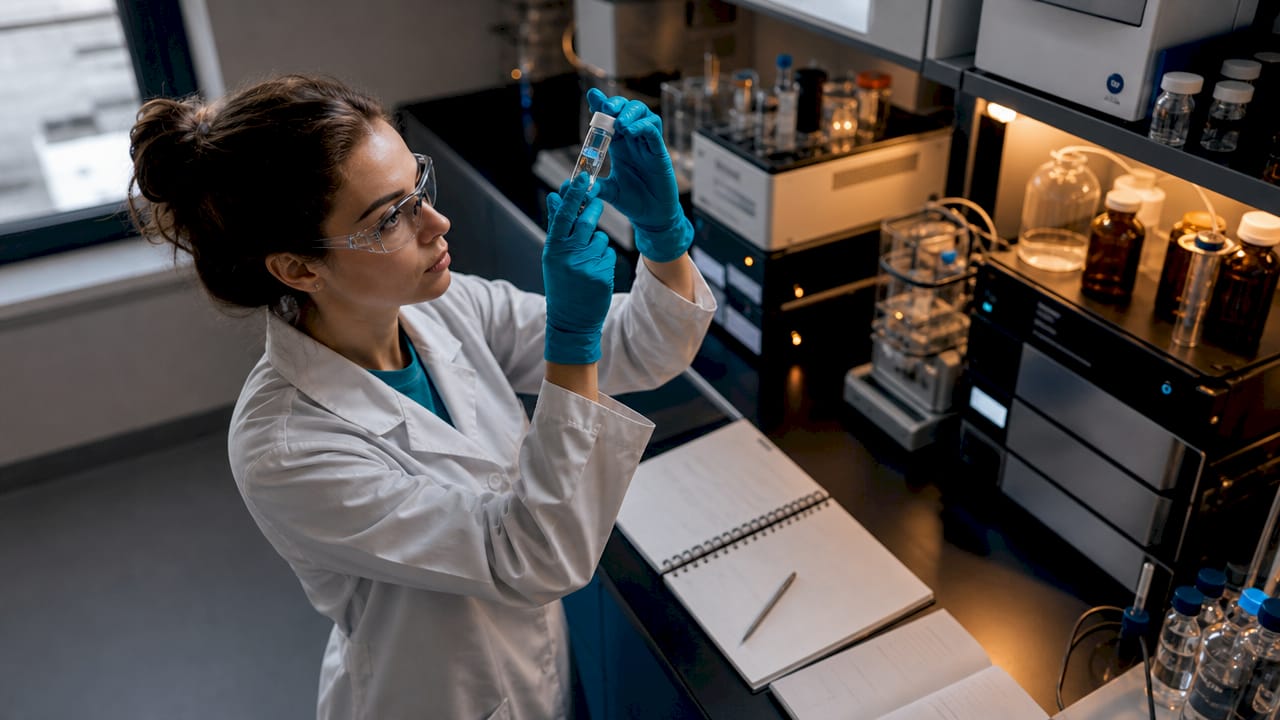
Minimum order quantity (MOQ) for peptides is defined as the smallest batch size a supplier will produce or ship per transaction, set to recover fixed costs including synthesis, lyophilization, and quality control testing. For custom peptides, MOQ commonly starts at 1 mg but shifts substantially based on purity grade, sequence length, and analytical testing scope. Understanding what drives MOQ is not a purchasing formality. It is a core variable that determines per-milligram cost, batch reproducibility, and whether a given order is operationally viable for the supplier to fulfill. Researchers who treat MOQ as a fixed rule rather than a negotiable parameter consistently overpay or receive batches that do not match their experimental requirements.
What is minimum order quantity for peptides, and why does it exist?
MOQ is a fundamental procurement parameter, not an arbitrary sales threshold. Fixed batch costs including solid-phase synthesis setup, HPLC purification, lyophilization, and mass spectrometry verification must be covered regardless of the final batch weight. A supplier producing 1 mg of a 20-amino-acid peptide at 95% purity runs essentially the same analytical workflow as one producing 100 mg. The MOQ exists to distribute those fixed costs across a quantity that makes the order economically viable.
For bulk peptide powder, MOQ typically ranges from 1 g to 5 g, varying with purity, packaging format, and third-party testing requirements. That range reflects a different cost structure than custom synthesis, where small-scale research orders at the 1 mg level are standard. The distinction between custom synthesis MOQ and bulk API MOQ matters significantly for procurement planning.
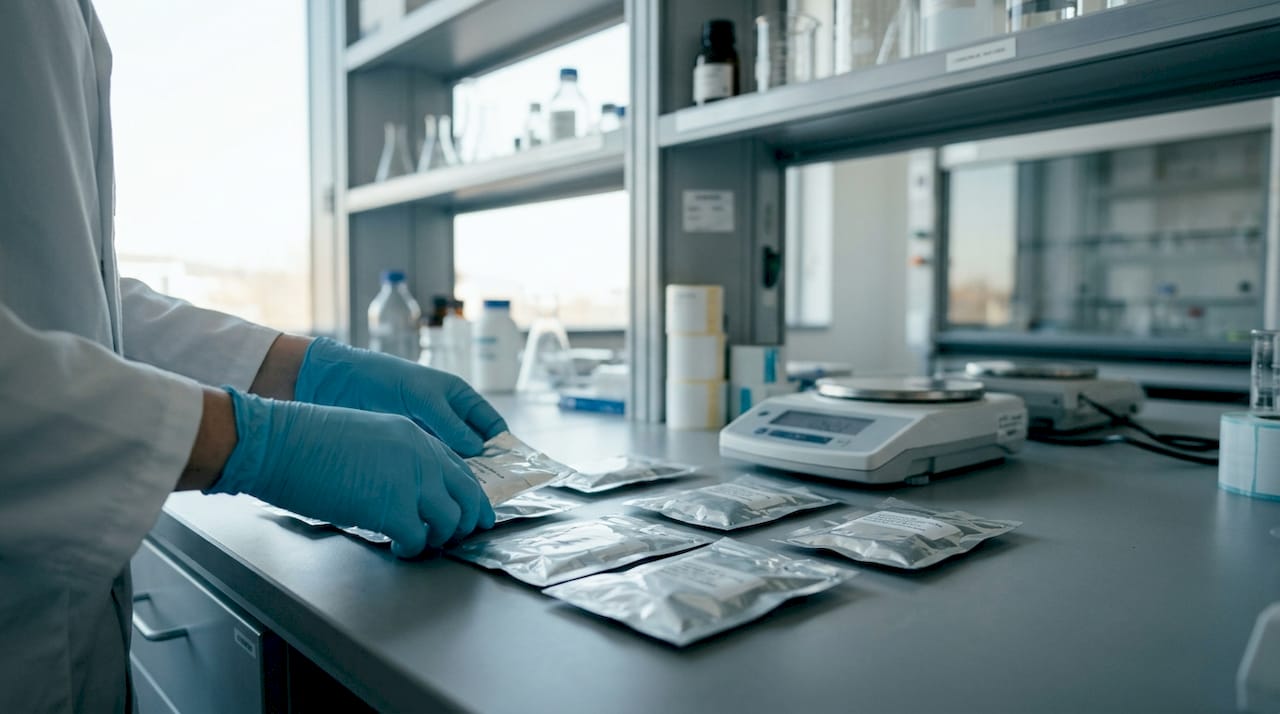
Researchers sourcing peptides for in vitro assays, animal studies, or early-stage formulation work operate in the custom synthesis range. Procurement teams building inventory for ongoing programs or private-label products operate in the bulk range. Each tier carries different MOQ logic, pricing structures, and supplier qualification criteria.
What factors determine the minimum order quantity for peptides?
Several variables interact to set the MOQ for any given peptide order. No single factor operates in isolation.
Sequence length and complexity. Longer peptides with higher amino acid counts produce lower synthesis yields and require more complex purification. A 40-amino-acid peptide is substantially more expensive and harder to produce than a 10-amino-acid peptide. Lower yield means more raw material is consumed per milligram of final product, which pushes the minimum viable batch size upward.
Purity grade. Higher purity specifications require additional purification cycles, which reduce recoverable yield and increase per-milligram cost. Crude peptide carries the lowest MOQ and price. Peptides specified at greater than 98% purity require more processing steps and therefore a larger starting batch to deliver the required final quantity.
Analytical testing scope. HPLC and mass spectrometry are standard for any research-grade peptide. Some orders require additional testing such as amino acid analysis, endotoxin testing, or sterility checks. Each additional test adds fixed cost that the MOQ must absorb.
Packaging and fill format. Requests for individual vials, sterile water reconstitution, or specific fill weights add processing steps. These packaging requirements can shift the MOQ upward even when the peptide itself is straightforward to synthesize.
Pro Tip: Request a certificate of analysis (COA) template from any supplier before placing an order. The testing scope listed on the COA tells you exactly which fixed costs are embedded in the MOQ, and gives you a basis for comparing suppliers on analytical rigor rather than price alone.
How does peptide purity and scale affect MOQ and pricing?
Purity grade is the single most direct lever on both MOQ and cost per milligram. Custom synthesis pricing at the 5 mg scale ranges from approximately $3.50 per amino acid for crude peptide up to $15.50 per amino acid for the highest purity grades. That spread reflects the compounding cost of additional purification, not a markup. A 20-amino-acid peptide at crude purity costs roughly $70 at 5 mg scale. The same peptide at greater than 98% purity costs over $300 at the same scale.
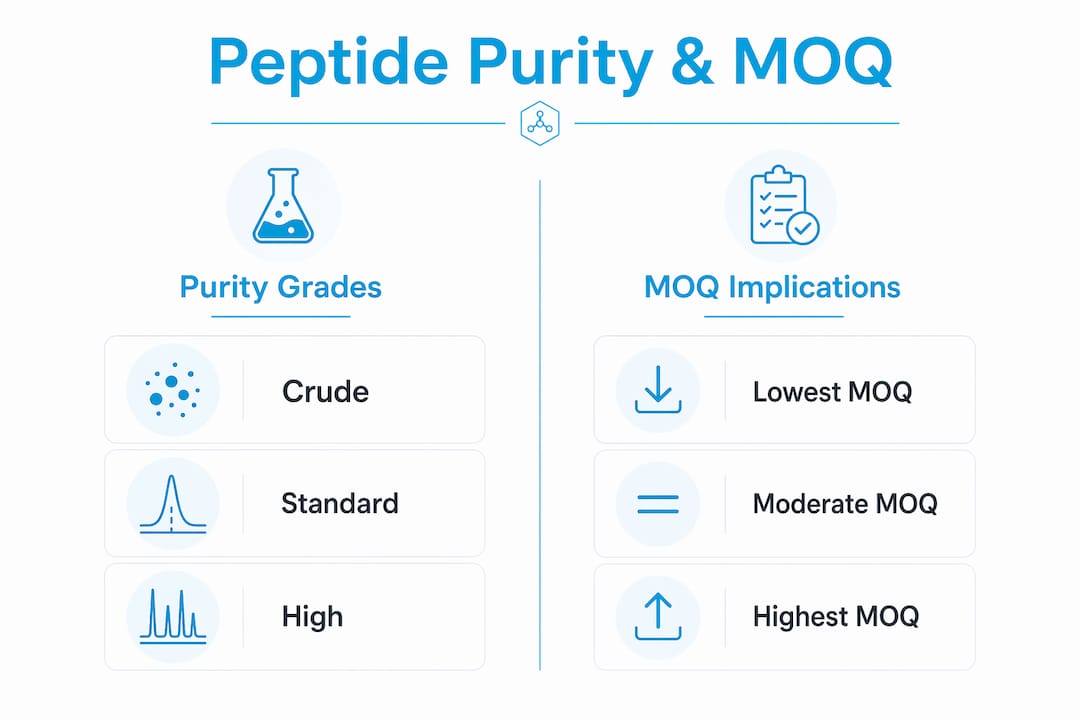
The table below shows how purity grade interacts with scale to affect cost structure.
Purity grade Typical use case Cost per AA (5 mg scale) MOQ implication Crude (less than 70%) Preliminary screening ~$3.50 Lowest MOQ Standard (greater than 75%) General research assays ~$5.00 Low to moderate High (greater than 90%) Functional studies ~$8.00 Moderate Highest (greater than 98%) Structural or clinical-stage ~$15.50 Higher MOQ
Cost amortization over batch size is where volume discounts become meaningful. Fixed synthesis and testing costs do not scale linearly with batch weight. A researcher ordering 25 mg pays proportionally less per milligram than one ordering 5 mg, because the same analytical overhead is spread across a larger quantity. Bulk discount thresholds typically begin to appear at the 25 mg level and above for custom peptides.
Researchers should match purity to application rather than defaulting to the highest available grade. Over-specifying purity for preliminary screening studies increases cost without adding experimental value. Crude or standard purity is appropriate for initial dose-response work. Reserve high-purity specifications for studies where structural integrity or quantitative accuracy is critical.
Pro Tip: If your study requires multiple peptide variants for a structure-activity relationship screen, order all variants at the same purity grade and scale in a single batch request. Consolidated orders reduce per-unit fixed costs and simplify COA documentation.
What are practical ordering strategies to optimize MOQ for research needs?
Ordering strategy directly affects whether MOQ works for or against a research program. The following approach applies across most research contexts.
Define actual quantity requirements before contacting suppliers. Calculate the total milligrams needed across all planned experiments, including replicates and contingency. Ordering to a vague estimate leads to either excess inventory that degrades or a second order that may not match the first batch.
Specify only the purity grade the application requires. Crude peptide is sufficient for many screening applications. Ordering greater than 95% purity for a preliminary binding assay adds cost without benefit. Purity specification is the fastest way to reduce MOQ and unit cost simultaneously.
Negotiate MOQ based on procurement history. MOQ is negotiable for labs with established supplier relationships or commitments to recurring orders. Suppliers reduce MOQ barriers for accounts that provide predictable order volume. Document your order history and use it as a negotiating basis.
Use lot-locking for longitudinal studies. Lot-locking allows a researcher to reserve a specific batch for future draws, eliminating batch-to-batch variability across a multi-month study. This practice is underused in academic procurement and is one of the most effective ways to maintain experimental reproducibility without inflating per-order quantity.
Request reserved stock with COA documentation. Professional procurement favors suppliers who offer documented batch traceability alongside reserved stock arrangements. A COA tied to a specific lot number provides the audit trail required for publication-quality reproducibility. Suppliers who cannot provide lot-specific COAs introduce uncontrolled variability into the supply chain.
For researchers managing academic peptide procurement, aligning order timing with grant cycles and project milestones reduces the risk of ordering more than the study can consume before the peptide degrades.
How do supplier practices and operational standards influence MOQ policies?
MOQ policies vary across the supplier landscape, and those variations reflect real differences in operational capability rather than arbitrary pricing decisions. Understanding those differences helps researchers qualify vendors beyond price alone.
In-house synthesis vs. resellers. Suppliers with direct synthesis capability set MOQ based on their own fixed costs. Resellers sourcing from third-party manufacturers add a margin layer and often impose higher MOQs to protect their economics. Direct sourcing from API manufacturers typically produces lower MOQs and more transparent pricing.
Independent batch verification. Suppliers who conduct third-party HPLC and MS testing embed those costs into their MOQ. Suppliers who skip independent verification may offer lower apparent MOQs, but the absence of testing creates quality risk that is not visible in the price. Third-party testing is a fixed cost that should be present in any research-grade order.
Supply chain transparency. Suppliers who disclose synthesis facility details, batch records, and testing methodology allow researchers to assess whether the MOQ reflects genuine operational costs or inflated margins. Opacity in supply chain documentation is a reliable signal of reseller positioning rather than manufacturer-direct pricing.
Vendor qualification criteria. Evaluating a supplier on MOQ alone misses the operational picture. The relevant criteria include batch traceability, COA completeness, testing scope, and the supplier’s ability to support lot-locking or reserved stock arrangements. Vendor qualification based on these parameters produces more reliable sourcing outcomes than price comparison alone.
Key Takeaways
MOQ for peptides is determined by fixed synthesis and testing costs, not sales minimums, and starts at approximately 1 mg for custom orders with cost-per-milligram declining as batch size increases.
Point Details MOQ starts at 1 mg for custom peptides Fixed synthesis, purification, and testing costs set the floor, not supplier preference. Purity grade drives cost more than quantity Crude peptide costs roughly $3.50 per amino acid; highest purity reaches $15.50 per amino acid at 5 mg scale. MOQ is negotiable with established suppliers Labs with recurring order history can reduce MOQ barriers through documented procurement commitments. Lot-locking protects longitudinal studies Reserving a specific batch eliminates batch drift without requiring larger per-order quantities. Supplier type affects MOQ transparency Direct synthesis facilities offer lower, more transparent MOQs than resellers with added margin layers.
What I’ve learned about MOQ that most procurement guides skip
Most articles on peptide MOQ treat it as a fixed number to work around. That framing is wrong, and it costs labs real money.
MOQ is a cost-recovery mechanism. Once you understand what costs the supplier is recovering, you can engage with MOQ as a variable rather than a constraint. The most consistent mistake I see is researchers ordering at the highest available purity grade by default, assuming it signals quality. For a preliminary screen, that decision can triple the per-milligram cost with zero experimental benefit.
The second mistake is treating each order as a one-time transaction. Suppliers who see recurring, predictable demand from a lab will negotiate MOQ downward. That negotiation rarely happens because researchers do not document their order history or present it as leverage. A simple spreadsheet of prior orders, projected forward, is often enough to open that conversation.
Lot-locking is the most underused tool in peptide procurement. Batch drift between orders is a real and underreported source of experimental variability. Reserving a batch at the point of first order, with a COA tied to that specific lot, eliminates the problem entirely. The cost of holding reserved stock is almost always lower than the cost of repeating experiments because a new batch behaved differently.
The suppliers worth working with are the ones who can explain their MOQ in terms of specific cost components. If a supplier cannot tell you what testing is included in the COA or where the synthesis is performed, the MOQ is not a reflection of operational reality. It is a margin decision.
— Sam Levin
How PeptidesFromChina approaches MOQ for research procurement
PeptidesFromChina operates with MOQ starting at 1 mg for custom research peptides, with scalable batch sizes designed to match project scope rather than force researchers into excess inventory. Every order includes a lot-specific COA with HPLC and MS verification, giving procurement teams the documentation required for reproducibility and audit trails.
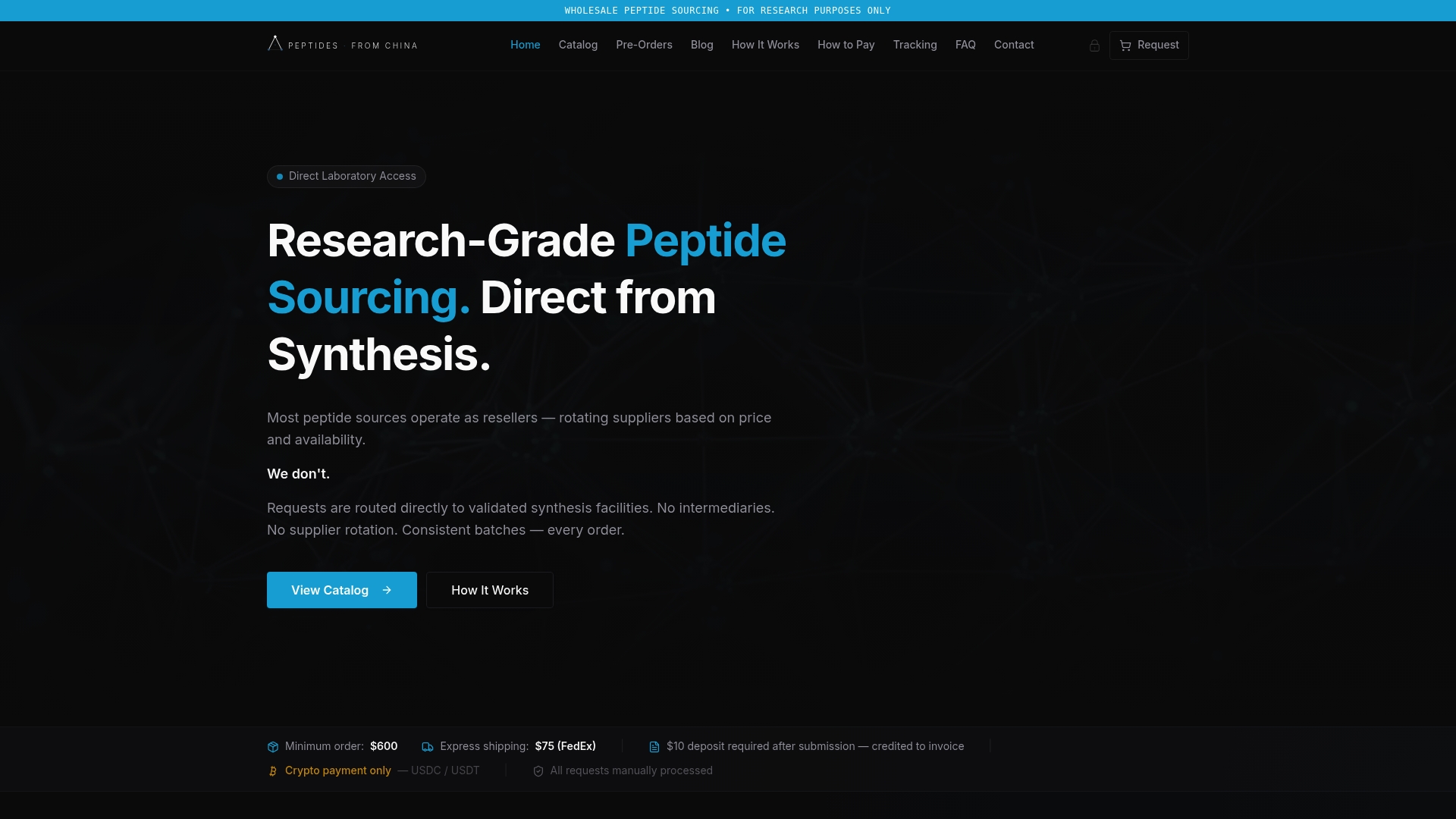
Direct relationships with established synthesis facilities mean pricing reflects actual manufacturing costs rather than reseller margins. Researchers can access the full peptide catalog for standard research compounds or explore VIP research-grade options for priority batch handling and enhanced documentation. For teams managing ongoing programs, reserved stock and lot-locking arrangements are available on request.
FAQ
What is the minimum order quantity for custom peptides?
Custom peptide MOQ commonly starts at 1 mg, with no upper limit in most cases. The exact minimum depends on purity grade, sequence length, and the analytical testing scope required.
Why does higher purity increase the minimum order size?
Higher purity requires additional purification cycles that reduce recoverable yield. More starting material is consumed per milligram of final product, which raises the minimum batch size needed to deliver the specified quantity.
Can MOQ be negotiated with peptide suppliers?
MOQ is negotiable for labs with established procurement relationships or commitments to recurring orders. Suppliers reduce MOQ barriers for accounts that provide predictable, documented order volume.
What is lot-locking and how does it relate to MOQ?
Lot-locking is the practice of reserving a specific production batch for future draws, preventing batch-to-batch variability across a study. It allows researchers to maintain reproducibility without inflating individual order quantities.
How does bulk peptide MOQ differ from custom synthesis MOQ?
Bulk peptide powder MOQ typically ranges from 1 g to 5 g, reflecting the cost structure of larger-scale API production. Custom synthesis MOQ starts at 1 mg and is driven by per-batch analytical testing costs rather than production volume.