How to Evaluate Peptide Supplier Lead Times in 2026

Evaluating peptide supplier lead times requires analyzing the complete production and delivery process, not just the synthesis time quoted on a spec sheet. A quoted lead time that covers only synthesis can underrepresent the true delivery window by 50% or more once vial filling, lyophilization, HPLC and LC-MS quality control, certificate of analysis (COA) preparation, and export clearance are included. Procurement professionals in biotechnology and pharmaceutical research face compounding pressure from amino acid shortages and rising GLP-1 demand that have stretched raw material timelines significantly since 2024. PeptidesFromChina addresses this directly through supply chain transparency and documented batch traceability, but the framework for evaluating any supplier starts with understanding what a complete lead time actually contains.
What components make up peptide supplier lead times?
The true end-to-end lead time often doubles the synthesis-only time due to post-synthesis processing steps that many suppliers omit from their initial quotes. Procurement teams that accept a single number without a breakdown are accepting a number that may not reflect reality.
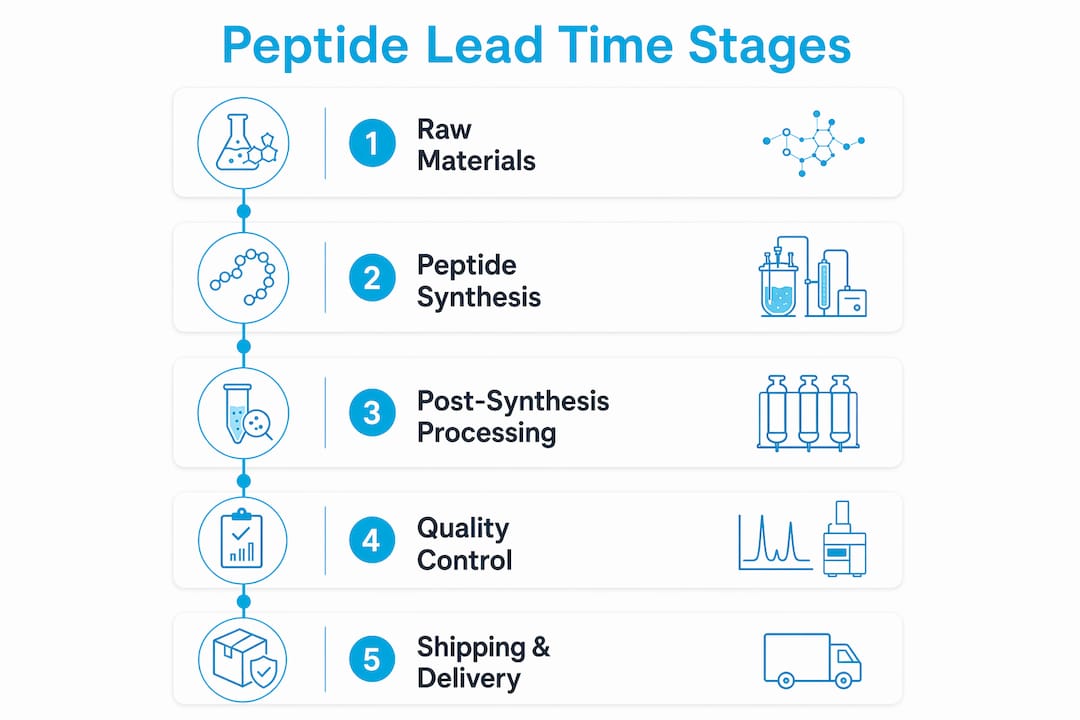
Each stage in the production chain carries its own timing variable:
Stage Typical Duration Common Bottleneck Raw material sourcing (Fmoc amino acids, resins) 4–16 weeks Supplier backorders, geopolitical delays Peptide synthesis (under 30 amino acids) 5–10 business days Sequence complexity, coupling failures Vial filling and formulation 2–5 business days Capacity scheduling at fill-finish sites Lyophilization cycle 3–7 business days Equipment availability, cycle optimization QC testing (HPLC, LC-MS) 3–7 business days Instrument queue, retest requirements COA preparation and documentation 1–3 business days Regulatory review, batch record completion Export clearance and shipping (Asia to U.S.) 2–8 weeks Customs holds, freight capacity
Standard research-grade peptide orders for sequences under 30 amino acids typically take 10–14 business days for synthesis alone. Pilot commercial scales require 14–21 days, and larger commercial batches require 35–60 days. Those figures cover synthesis only. Adding the downstream steps in the table above produces a realistic end-to-end window that procurement teams must plan against.
Peptide complexity adds further variability. Sequences requiring unusual Fmoc-protected amino acids, disulfide bridges, or non-standard modifications extend raw material sourcing and synthesis time independently. Modified peptides also require additional QC validation steps, which extend the testing phase beyond standard HPLC and LC-MS turnaround. Procurement professionals evaluating vendor reliability should request a stage-by-stage breakdown for their specific sequence, not a generic catalog estimate.
How have supply chain disruptions affected peptide availability?
Raw material lead times have increased sharply since 2024, and the change is not marginal. Amino acid lead times rose from 4–6 weeks in 2024 to 10–16 weeks in 2026, a 150% increase. Resin availability has been backordered 8–12 weeks at multiple suppliers. These are not temporary fluctuations. They reflect structural capacity constraints driven by surging GLP-1 peptide demand and concentrated manufacturing geography.
Supply Chain Factor 2024 Baseline 2026 Status Amino acid lead time 4–6 weeks 10–16 weeks Resin availability Spot available 8–12 week backorder Shipping (Asia to U.S.) 3–4 weeks 5–8 weeks CDMO capacity booking 2–3 months 4–6 months
Shipping times from Asia to the U.S. increased by approximately 75%, now running 5–8 weeks. That figure sits on top of synthesis and QC time, not alongside it. Procurement teams that plan based on pre-2024 benchmarks will consistently miss project deadlines.
The practical implication is that any supplier quoting lead times without acknowledging current raw material constraints is either working from outdated assumptions or omitting information. Suppliers with real supply chain visibility will proactively disclose raw material status at the time of inquiry. PeptidesFromChina maintains direct commercial relationships with established synthesis facilities, which provides earlier visibility into material availability than resellers operating through intermediary channels.
Pro Tip: Ask suppliers to confirm the current availability status of the specific Fmoc-protected amino acids required for your sequence at the time of quoting. A supplier who cannot answer this question does not have real-time supply chain visibility.
How to request and interpret a lead time breakdown from suppliers
Accepting a single quoted number without a breakdown is the most common procurement error in peptide sourcing. Failure to get a full breakdown signals lack of transparency and leads directly to schedule overruns. The request process should be systematic.
Procurement professionals should require the following from any supplier before placing an order:
Confirmed raw material availability for the specific sequence, including Fmoc amino acids and resins
Synthesis timeline with a stated start date, not an estimate from order receipt
Vial filling and lyophilization schedule, including equipment availability
QC testing timeline covering HPLC purity confirmation and LC-MS mass verification
COA preparation and sign-off timeline
Export documentation preparation and expected shipping window
Carrier and freight route with current transit time estimate
Red flags in supplier communication include vague responses like “standard lead time is 2–3 weeks” without specifying which stages are included, refusal to provide stage-by-stage breakdowns, and inability to confirm raw material status. Positive indicators include proactive disclosure of current raw material lead times, willingness to provide a written production schedule, and clear escalation contacts for delay notifications.
Proactive communication from suppliers about schedule shifts indicates operational maturity. The quality of a supplier’s explanation during a delay is a stronger reliability signal than their initial lead time estimate. A supplier who identifies a problem early and communicates it clearly is more valuable than one who quotes an aggressive timeline and misses it silently.

Pro Tip: Request a written production schedule with milestone dates for each stage. If a supplier cannot provide this, treat the quoted lead time as unverified.
Strategies to mitigate lead time risks in peptide procurement
Procurement professionals who rely on spot-market purchasing for research-grade peptides face the highest exposure to lead time variability. Manufacturing capacity reservations at established CDMOs require 4–6 months of advance lead time. First-time clients often face longer, less predictable delays. The mitigation strategies below address this exposure systematically.
Secure capacity agreements early
Companies with pre-existing capacity agreements weathered demand spikes better than those relying on spot-market purchases. Early engagement, ideally 4–6 months in advance, prevents 6–12 month lead time extensions during surge periods. Building 6–12 months of upside capacity into contracts provides a buffer against sudden demand increases without requiring renegotiation.
Use repeat orders to compress timelines
Repeat orders for validated sequences compress lead times to approximately 10–14 days compared to 21–35 days for first runs. Validated synthesis routes eliminate the method development phase and reduce QC retest risk. Procurement teams managing recurring research programs should prioritize supplier relationships where synthesis routes are already validated and documented.
Qualify suppliers across multiple geopolitical regions
Single-source procurement from one geographic region concentrates supply chain risk. Qualifying suppliers across different regions provides an alternative when one supply chain faces disruption. This does not require active dual-sourcing on every order. It requires maintaining a qualified backup with a current, verified lead time estimate.
Mitigation Strategy Lead Time Impact Implementation Complexity Advance capacity agreements (4–6 months) Prevents 6–12 month extensions Medium Repeat orders on validated routes Compresses to 10–14 days Low Strategic raw material inventory Removes sourcing phase High Multi-region supplier qualification Reduces single-source risk Medium Demand planning with upside scenarios Reduces emergency orders Low
Maintaining a strategic inventory of critical raw materials, particularly Fmoc-protected amino acids for high-frequency sequences, removes the sourcing phase from the lead time calculation entirely. This approach works best for procurement teams with predictable research pipelines and sufficient storage capacity for large-scale synthesis programs.
Key Takeaways
Accurately assessing peptide supplier delivery timelines requires a stage-by-stage breakdown covering synthesis, QC, lyophilization, documentation, and shipping, not a single quoted number.
Point Details Lead time includes multiple stages Synthesis is one phase; vial filling, lyophilization, QC, and export each add time. Raw material delays are structural Amino acid lead times rose 150% from 2024 to 2026, affecting all downstream timelines. Request written production schedules Suppliers who cannot provide milestone dates have unverified lead time claims. Repeat orders compress timelines Validated synthesis routes reduce delivery to 10–14 days versus 21–35 for first runs. Advance booking prevents extensions Capacity agreements secured 4–6 months ahead prevent 6–12 month surge delays.
What I’ve learned about lead time claims after years in peptide procurement
The single most consistent mistake I see procurement teams make is treating the quoted synthesis time as the delivery time. It is not. The synthesis phase is often the shortest part of the process. Lyophilization cycles, QC queues, and export documentation routinely add two to three weeks that never appear in the initial quote.
The second mistake is evaluating suppliers on speed rather than transparency. A supplier who quotes 10 days and delivers in 28 is less useful than one who quotes 22 days and delivers in 22. Procurement planning depends on accuracy, not optimism. Suppliers who prioritize quality control often quote longer lead times because they build in independent, batch-specific validation. That is a positive signal, not a weakness.
The current supply chain environment makes this more consequential than it was two years ago. Amino acid lead times have tripled in some cases. Resin backorders are real. Shipping from Asia has lengthened. Any supplier who quotes lead times without acknowledging these realities is working from outdated data or choosing not to share current constraints. Neither is acceptable for research-grade procurement.
My preferred qualification practice is simple: ask the supplier to confirm raw material availability for the specific sequence at the time of quoting, then ask for a written production schedule with milestone dates. Suppliers who can answer both questions clearly have real operational visibility. Those who cannot are guessing. For teams managing manufacturer-side sourcing relationships, this distinction determines whether projects stay on schedule or not.
— Sam Levin
PeptidesFromChina: transparent lead times for research procurement
PeptidesFromChina operates through direct commercial relationships with established synthesis facilities in China, which provides earlier visibility into raw material availability and production scheduling than resellers working through intermediary channels.
Every order through the peptide catalog includes a COA with HPLC purity data and LC-MS mass confirmation. Lead time estimates reflect the full production process, including synthesis, lyophilization, QC review, and export clearance, not synthesis alone. Procurement teams evaluating research-grade peptides for recurring programs can request quotes directly and receive stage-by-stage production timelines. For teams sourcing specific compounds, individual product pages for Epithalon and other research peptides include current availability and documented sourcing details.
FAQ
What does a complete peptide supplier lead time include?
A complete lead time covers raw material sourcing, peptide synthesis, vial filling, lyophilization, QC testing (HPLC and LC-MS), COA preparation, and export clearance. The true end-to-end timeline often doubles the synthesis-only time.
How long does peptide delivery from China typically take?
Shipping from Asia to the U.S. currently runs 5–8 weeks, up approximately 75% from pre-2024 baselines. This transit time adds to synthesis and QC timelines, not alongside them.
Why have peptide lead times increased since 2024?
Amino acid lead times rose from 4–6 weeks in 2024 to 10–16 weeks in 2026, driven by surging GLP-1 demand and concentrated manufacturing capacity. Resin availability has been backordered 8–12 weeks at multiple suppliers.
How can procurement teams shorten peptide lead times?
Repeat orders on validated synthesis routes compress delivery to 10–14 days. Securing capacity agreements 4–6 months in advance prevents extensions of 6–12 months during demand surges.
What are the red flags in a supplier’s lead time quote?
Red flags include vague single-number quotes without stage breakdowns, inability to confirm current raw material availability, and no written production schedule with milestone dates. Proactive communication about delays is a positive reliability indicator.