How to Choose a High Purity Peptide Supplier

Choosing a high purity peptide supplier means selecting vendors who provide batch-specific analytical documentation, including HPLC chromatograms, mass spectrometry identity confirmation, and quantitative endotoxin data, rather than relying on headline purity percentages alone. In professional biochemistry and pharmacology research, a supplier’s stated “98% purity” is only as meaningful as the underlying data that supports it. Batch-specific COAs with detailed analytical records are the baseline standard for any procurement decision that affects experimental reproducibility. Endotoxin contamination is a separate and equally critical variable, one that can invalidate immune-cell assays regardless of chromatographic purity. The criteria covered here apply directly to researchers evaluating high quality peptide sources for publication-grade or regulated work.
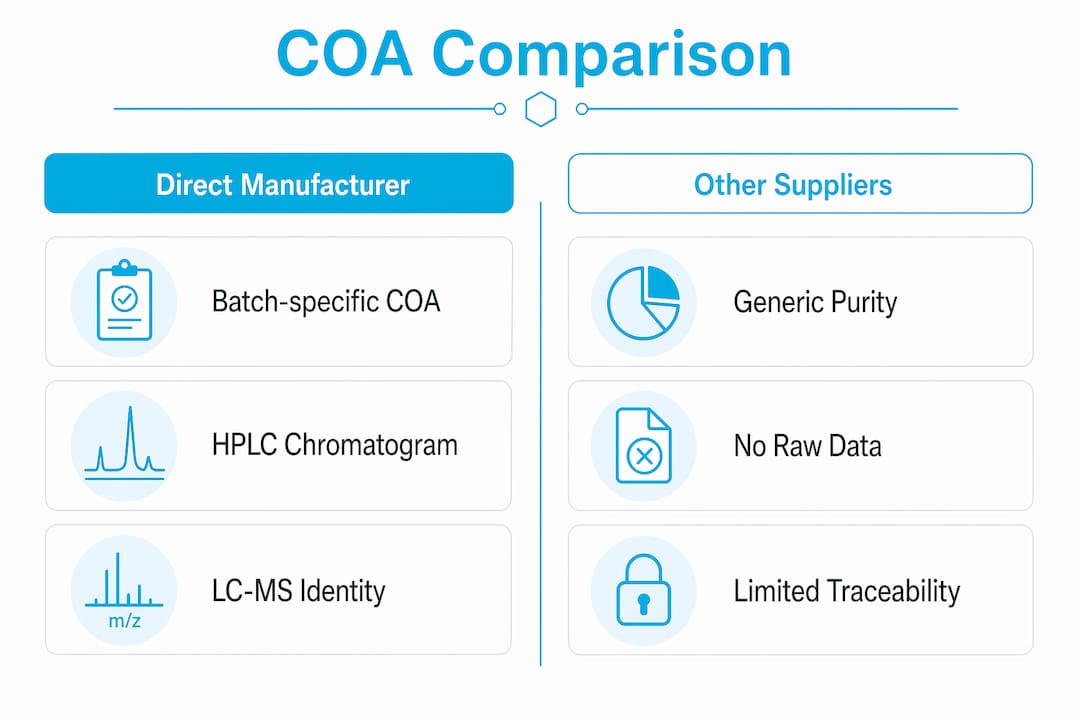
What documentation must a high purity peptide supplier provide?
The core procurement error in peptide sourcing is treating a purity percentage as verification. A number without supporting chromatograms and mass spectrometry data tells you almost nothing about what is actually in the vial. Purity percentages typically reflect HPLC area percent, which does not account for counterions, residual moisture, or actual peptide mass fraction. Actual peptide content can be substantially lower than the labeled figure.
Batch-specific Certificates of Analysis are the minimum documentation standard. Generic COAs that apply to a product category rather than a specific production lot are not acceptable for research procurement. Batch COAs with HPLC and MS data must be tied to the exact lot number printed on the vial label, with a test date that falls within a recent and relevant window.
The key documentation elements to require from any supplier are:
HPLC chromatogram: shows the impurity profile, peak resolution, and co-elution patterns across the separation run
LC-MS identity confirmation: verifies the correct molecular mass and flags sequence errors or truncations that HPLC cannot detect
Batch or lot number: must match the vial label exactly, with test dates ideally within 12 months of procurement
Endotoxin data: quantitative EU/mg or EU/vial values, not a simple pass/fail notation
Lab identification: specifies whether testing was performed in-house or by a third-party facility
HPLC purity alone cannot confirm correct peptide identity. A peptide can show 99% chromatographic purity while being the wrong sequence entirely. Mass spectrometry is the gatekeeper for molecular identity, and both methods must appear together in any credible COA.
Third-party testing removes the conflict of interest that exists when a supplier grades its own product. Independent COAs are published on verification platforms where results cannot be edited after the fact, which is critical for publication-grade procurement. In-house testing is not inherently invalid, but it requires additional scrutiny of the lab’s instrumentation records and calibration history.
Pro Tip: Request the raw HPLC chromatogram file, not just a summary table. A chromatogram image allows you to visually inspect peak shape, baseline noise, and any unresolved impurity shoulders that a percentage figure would obscure.
Why does endotoxin testing matter for biological assays?
Endotoxin is a heat-stable lipopolysaccharide (LPS) derived from gram-negative bacterial cell walls. It survives standard sterilization processes, including autoclaving, and is not eliminated by filtration alone. Even nanogram-level endotoxin contamination can trigger strong inflammatory responses in immune-cell assays, macrophage cultures, and in vivo models, producing false-positive or confounded results.
Quantitative endotoxin reporting in EU/mg or EU/vial is the required standard for research procurement. A COA that states only “endotoxin: pass” provides no actionable data. The acceptable endotoxin threshold varies by assay type. Immune-cell sensitive studies may require limits below 1 EU/mg, while less sensitive applications may tolerate higher values. Without a numerical result, researchers cannot match the lot to their assay requirements.
The steps for evaluating endotoxin data in a COA are:
Confirm the reporting unit is EU/mg or EU/vial, not a qualitative pass/fail designation
Identify the testing method. The Limulus Amebocyte Lysate (LAL) assay, particularly kinetic chromogenic variants, is the standard for quantitative endotoxin detection
Check the detection limit stated by the testing lab. A reported result of “less than 1 EU/mg” is only meaningful if the assay’s detection limit is below that threshold
Compare the reported value against your assay’s sensitivity requirements before approving the lot for use
Verify that the endotoxin test was performed on the same lot number as the purity and identity data
Sterility testing is a separate QC dimension and must not be confused with endotoxin testing. Sterility testing under USP <71> involves 14-day incubation across multiple growth media to confirm the absence of viable microorganisms. A peptide lot can pass sterility testing and still carry significant endotoxin load, because LPS is a non-viable contaminant. Both data sets are required for injectable or sterile-relevant workflows. For guidance on sterility testing methods in peptide manufacturing, the distinction between these two QC categories is foundational.
Pro Tip: When sourcing peptides for cytokine assays or primary immune-cell work, request the actual numerical LAL result rather than accepting a lot-release summary. Independent endotoxin labs using kinetic chromogenic LAL assays report precise numerical values that allow you to select lots matched to your assay’s sensitivity floor.
How to compare peptide suppliers using COA criteria
Supplier comparison in peptide procurement requires a structured framework, not a review of marketing materials. The baseline standard for any credible vendor includes HPLC chromatogram evidence, LC-MS identity confirmation, quantitative endotoxin data, and batch-specific COAs with lab and lot identification. Suppliers who cannot provide all four elements should be deprioritized regardless of price.
The table below outlines how COA features typically differ across supplier categories:
COA Feature Direct Manufacturer Established Reseller Gray-Market Vendor Batch-specific COA Standard Variable Rare HPLC chromatogram included Yes Sometimes Rarely LC-MS identity confirmation Yes Sometimes Rarely Third-party testing available Often Occasionally No Quantitative endotoxin data Available on request Uncommon No Lot number matches vial label Yes Usually Unreliable
Direct manufacturers maintain synthesis records and can trace a lot through every production step. Resellers operating through gray-market channels typically repackage material without access to original batch documentation. The quality gap between direct sourcing and resellers is most visible at the COA level, where resellers often provide generic or recycled documentation.
Additional evaluation criteria beyond the COA include:
Storage conditions during transit and warehousing (lyophilized peptides require cold-chain management)
Fulfillment speed relative to storage temperature requirements
Whether the supplier can provide vial-level identity confirmation, not only batch-level data
Availability of sample lots for independent verification before full procurement
COA lot number traceability is a practical verification step that many researchers skip. The lot number on the COA must match the number on the vial label exactly. A mismatch indicates the documentation was not generated for the material in the vial. For a structured approach to vetting peptide suppliers, a documented checklist reduces the risk of accepting mismatched or outdated COAs.
What mistakes do researchers make when sourcing peptides?
The most common sourcing failure is approving a lot based on a purity percentage without reviewing the underlying chromatogram. A headline figure of 98% does not reveal whether that remaining 2% consists of a single minor impurity or multiple overlapping peaks with biological activity. Chromatogram review takes minutes and prevents significant downstream problems.
Other procurement mistakes that affect research reproducibility include:
Accepting a COA without confirming the lot number matches the vial label
Failing to request quantitative endotoxin data before using peptides in immune-cell assays
Relying on a supplier’s reputation rather than batch-level documentation for each new order
Skipping independent verification for lots from new or unvetted vendors
Neglecting to record COA data in procurement logs, making repeat verification impossible
Pro Tip: Request identity confirmation at the vial level, not only the batch level. Batch-level testing can miss degradation or mislabeling that occurs after batches are split or relabeled during fulfillment.
Procurement record-keeping is a practical reproducibility tool. Logging the lot number, test date, HPLC purity, MS confirmation status, and endotoxin value for every peptide lot creates a traceable record that supports data integrity across experiments. When a result is anomalous, the procurement log is the first place to check. For researchers who want a structured approach to laboratory verification, maintaining this record is standard practice in regulated environments and should be applied equally in academic research settings.
Time-saving strategies for supplier vetting include requesting a sample lot before committing to bulk procurement and sending it to an independent lab for identity and endotoxin confirmation. The cost of a single LC-MS run is negligible compared to the cost of repeating experiments with a compromised lot. Consistent reagent quality directly affects the reliability of downstream data, and independent verification reduces the risk of batch-to-batch variability affecting conclusions.
Key takeaways
Choosing a high purity peptide supplier requires batch-specific COAs with HPLC chromatograms, LC-MS identity confirmation, and quantitative endotoxin data, not purity percentages alone.
Point Details Batch COAs are non-negotiable Require lot-specific documentation with HPLC and MS data for every procurement decision. Purity % is not verification Chromatographic purity excludes counterions and moisture; actual peptide content may be lower. Endotoxin data must be quantitative EU/mg or EU/vial values are required to match lots to assay sensitivity thresholds. Sterility and endotoxin are separate A sterile lot can still carry significant LPS load; both tests are required for sterile workflows. Lot number matching is mandatory The COA lot number must match the vial label exactly before any lot is approved for use.
What i’ve learned from watching researchers get this wrong
The pattern repeats across labs: a researcher sources a peptide from a vendor with a polished website, receives a COA showing 98% purity, and proceeds directly to experiments. Three months later, the assay data is inconsistent and the lot is flagged. When the COA is reviewed carefully, there is no chromatogram, no MS confirmation, and no endotoxin value. The 98% figure came from an in-house summary with no supporting data.
The peptide industry does not have uniform documentation standards enforced across all vendors. Some suppliers provide genuinely detailed batch records. Others provide formatted PDFs that look credible but contain no verifiable analytical data. The difference is not always obvious from a supplier’s website or pricing structure.
Batch-level validation matters more than broad supplier reputation. A vendor that produced reliable lots six months ago may have switched synthesis facilities or changed raw material sources without disclosure. Every new lot requires the same documentation review as the first. Reputation is a starting point, not a substitute for verification.
The researchers who avoid reproducibility failures are the ones who treat COA review as a non-negotiable step in every procurement cycle, not a one-time due diligence exercise. They also maintain procurement logs that allow them to trace any anomalous result back to a specific lot and its documentation. That practice alone separates labs that publish reproducible data from those that spend months troubleshooting reagent quality.
— Sam Levin
Verified peptide sourcing through PeptidesFromChina
Buyers requiring independent verification may arrange third-party analytical testing.
Manufacturer-side analytical documentation may be available depending on the product and batch. It is not guaranteed with every order and is not independent verification by PFC. Buyers may arrange third-party analytical testing when required.
FAQ
What does “high purity” mean for research peptides?
High purity in research peptides refers to chromatographic purity measured by HPLC, typically expressed as area percent. A result above 95% is generally considered research grade, but this figure must be supported by LC-MS identity confirmation and does not reflect absolute peptide mass fraction.
Why do purity standards vary across peptide suppliers?
Purity standards vary because the peptide industry lacks a single enforced documentation standard. Suppliers differ in whether they use in-house or third-party testing, whether they provide batch-specific or generic COAs, and whether they report endotoxin data at all.
How do i verify a peptide COA is legitimate?
Confirm the lot number on the COA matches the vial label exactly, check that the test date is recent, and verify that the document includes an HPLC chromatogram and LC-MS data rather than summary figures only. Third-party COAs published on independent verification platforms provide the highest confidence.
What endotoxin level is acceptable for cell-based assays?
Acceptable endotoxin levels depend on assay sensitivity. Immune-cell assays and cytokine studies often require lots below 1 EU/mg. The LAL assay with kinetic chromogenic detection is the standard method for generating quantitative values suitable for this comparison.
Is sterility testing required for all research peptides?
Sterility testing under USP <71> is required for peptides used in injectable or sterile-relevant workflows. For non-sterile in vitro applications, endotoxin data is the more critical parameter, as LPS contamination affects assay outcomes independently of microbial viability.