How Peptides Are Used in Model Organism Research

Peptides are defined as short chains of amino acids that function as regulators, probes, and delivery agents across the major biological systems studied in life sciences. Understanding how peptides are used in model organism research requires examining their roles in three primary experimental systems: Drosophila melanogaster, Caenorhabditis elegans, and zebrafish (Danio rerio). Each system offers distinct genetic and physiological advantages that peptide researchers exploit at different scales. Peptides fill a critical design niche between small molecules and biologics, making them indispensable for target validation and structure-activity relationship studies. PeptidesFromChina coordinates sourcing from established Chinese manufacturing facilities; manufacturer-side analytical documentation may be available depending on the product and batch.
How peptides are used in model organism research: regulatory roles in Drosophila and C. elegans
Peptides govern physiological and developmental processes in invertebrate models with a specificity that small molecules rarely match. Two well-characterized examples illustrate this point clearly.
In Drosophila larvae, ion transport peptides regulate water balance by activating the receptor guanylyl cyclase Gyc76C in the hindgut. Hindgut-specific knockdown of Gyc76C abolishes the water reabsorption response triggered by synthetic saITP. This finding demonstrates that a single peptide-receptor axis controls a survival-critical osmoregulatory function. Researchers use this system to map how neuropeptide signaling couples environmental stress to organ-level physiology.
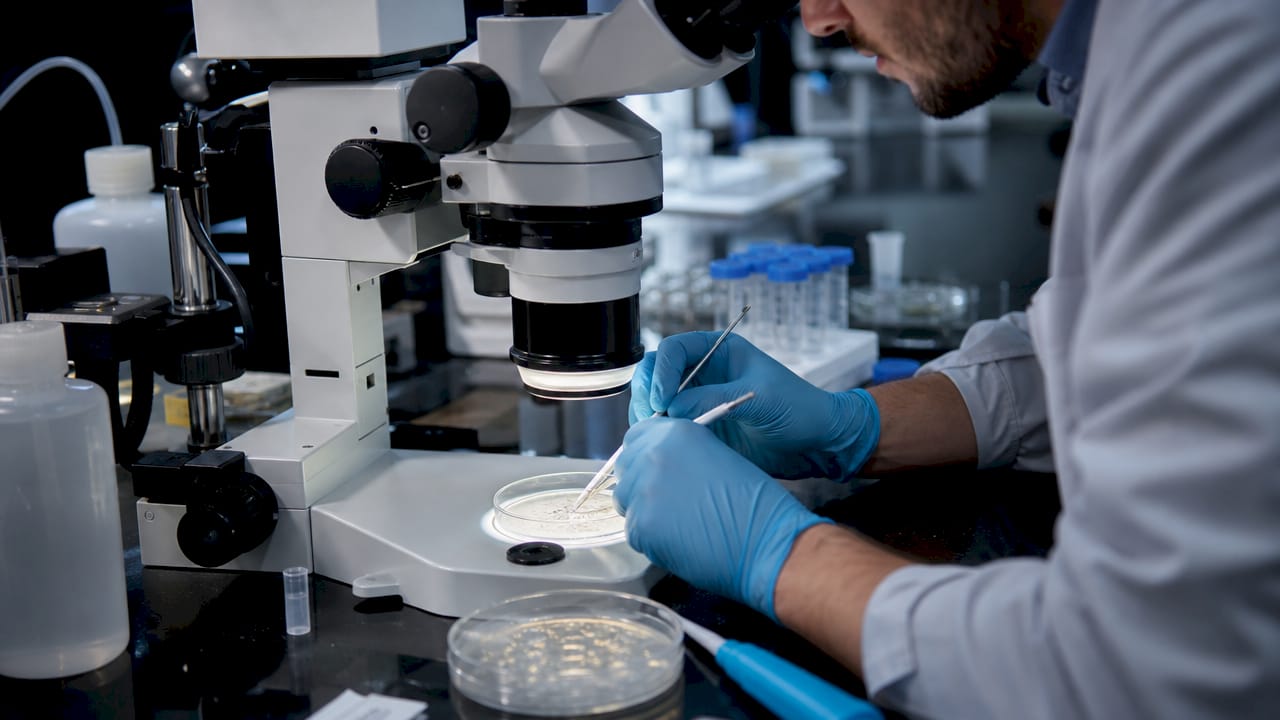
The FLP family of peptides in C. elegans modulates development and behavior through receptor-mediated pathways, offering a tractable genetic platform for knockdown and receptor binding studies. Peptide applications in research on C. elegans benefit from the organism’s fully mapped connectome and transparent body, which allow direct visualization of peptide-driven behavioral outputs. Researchers routinely combine RNA interference with synthetic peptide administration to separate receptor-dependent from receptor-independent effects.
In Drosophila, miPEPs and sex peptides add another layer of complexity. Sex peptides like Acp70A induce prolonged post-mating physiological changes, while miPEP8 regulates cell size through direct interaction with the autophagy scaffold protein ref(2)P/p62. This places miPEPs in a distinct mechanistic category from plant miPEPs, which activate pri-miRNA expression rather than modulating protein interactions. The distinction matters for experimental design: researchers targeting Drosophila miPEP pathways need protein interaction assays, not transcriptional reporters.
Key experimental approaches used in this space include:
Receptor knockdown via tissue-specific RNAi to confirm peptide-receptor specificity
Synthetic peptide administration paired with cGMP or cAMP readouts to quantify signaling activity
Behavioral assays combined with genetic rescue experiments to link peptide function to phenotype
Mass spectrometry-based peptidomics to identify endogenous peptide pools in specific tissues
Pro Tip: When designing knockdown experiments in Drosophila, always include a receptor-null control alongside the RNAi line. Residual receptor expression in RNAi lines can produce partial phenotypes that obscure the full functional range of the target peptide.
How do fluorescent peptide probes work in zebrafish disease models?
Zebrafish offer a vertebrate platform with optical transparency at early developmental stages, making them ideal for in vivo peptide imaging studies. The Collagen Hybridizing Peptide (CHP) approach demonstrates how peptide probes can detect pathological tissue changes in real time.
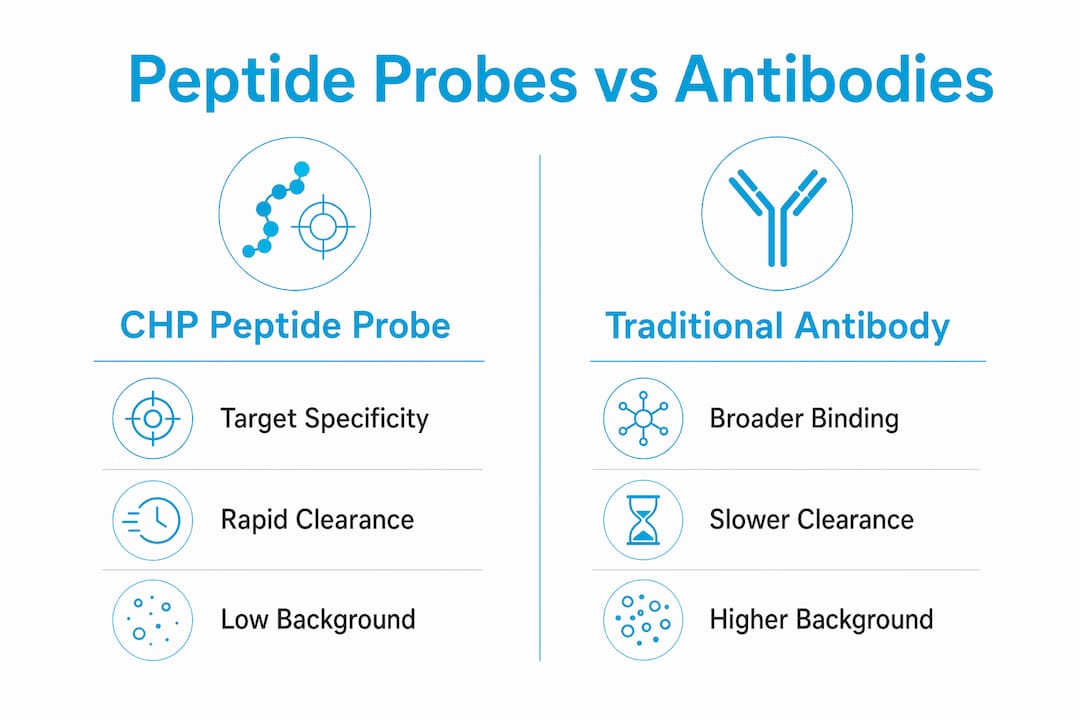
Cy5-labeled CHP selectively binds misfolded collagen I in a zebrafish Osteogenesis Imperfecta model within 24 hours of injection. Fluorescence concentrates in collagen-rich tissues including the vertebral column and heart, while the brain shows low signal. This tissue specificity confirms that CHP binding reflects structural collagen pathology rather than nonspecific accumulation. The result is a quantifiable, spatially resolved readout of disease progression without the need for antibody-based staining.
Feature CHP peptide probe Traditional antibody Target specificity Misfolded collagen triple helix Epitope-dependent In vivo clearance Within 24 hours post injection Variable, often slower Signal location Collagen-rich tissues confirmed Requires tissue permeabilization Real-time imaging Compatible with live zebrafish Typically requires fixation
Peptide probes clear faster than antibodies, which reduces background signal and improves the signal-to-noise ratio in live imaging experiments. This clearance kinetic is a practical advantage when researchers need to track disease progression across multiple time points in the same animal.
Peptides also function as homing devices and enzymatically cleavable linkers for targeted drug delivery in preclinical zebrafish models. This dual role, detection and delivery, positions peptides as translational tools that connect basic model organism findings to therapeutic development. Researchers studying tissue-targeted delivery in zebrafish should account for the organism’s rapid metabolic rate when calculating dosing intervals.
Pro Tip: In zebrafish imaging studies, always run a scrambled peptide sequence as a negative control alongside your CHP or homing peptide. This separates sequence-specific binding from charge-mediated or hydrophobic nonspecific interactions.
What engineering advances are improving peptide function in model systems?
Modern peptide engineering has moved well beyond solid-phase synthesis. Flow-based peptide synthesis and peptide stapling now give researchers direct control over peptide stability, binding affinity, and membrane permeability. These tools shift the field from passive assembly to programmable molecular design. The practical result is that researchers can now specify the pharmacological profile of a peptide before committing to animal experiments.
Peptide stapling, which introduces a covalent crosslink between non-adjacent residues, locks the peptide into a defined secondary structure. This prevents proteolytic degradation in biological fluids and increases cell permeability. For model organism peptide analysis, stapled peptides maintain their conformation inside living tissue, producing cleaner structure-activity data than their linear counterparts.
Cell-penetrating peptides (CPPs) represent a separate engineering category. A 16-amino-acid penetratin sequence crosses cell membranes efficiently, while a 15-amino-acid variant with a single residue change fails to translocate. This finding establishes that CPP function depends on precise sequence length and amphipathic structure, not simply on positive charge density. Researchers designing CPP-cargo conjugates for Drosophila or zebrafish studies must validate each sequence variant independently.
Small peptide tags offer a complementary approach for studying endogenous proteins in their native context. Tags like HiBiT minimize disruption to protein folding and trafficking compared to large fusion proteins like GFP. This matters in model organism research because overexpression artifacts from large tags can produce misleading localization data. Small tags preserve the endogenous expression level and trafficking behavior of the target protein.
Post-translational modifications add another layer of functional control. C-terminal amidation and N-terminal cyclization are required for neuropeptide activity and stability in many model organism systems. Standard proteomics pipelines miss these modifications, which means researchers relying on unmodified synthetic peptides may fail to replicate endogenous activity. Specialized peptidomics workflows that account for these modifications are necessary for accurate functional studies.
Key engineering strategies that improve model organism peptide analysis include:
Peptide stapling to lock secondary structure and resist proteolysis in biological fluids
CPP conjugation to deliver cargo across cell membranes with sequence-verified efficiency
Small peptide tags (HiBiT, ALFA tag) for endogenous protein tracking without overexpression artifacts
Post-translational modification profiling to confirm that synthetic peptides match endogenous activity
What should researchers consider when integrating peptides into model organism workflows?
Peptide selection and sourcing directly affect experimental reproducibility. Batch-to-batch variation in purity, sequence fidelity, and modification status can produce inconsistent results that are difficult to diagnose without traceability data. Researchers should request a certificate of analysis (COA) that includes HPLC purity data and mass spectrometry confirmation for every batch used in published work.
Delivery method selection is the second critical variable. Local versus systemic peptide delivery produces different pharmacokinetic profiles in animal models. Local injection maximizes tissue concentration at the target site and reduces systemic exposure, which is useful for studying organ-specific peptide function. Systemic delivery is appropriate when the research question involves circulating peptide levels or whole-organism physiological responses.
Common pitfalls in peptide-based model organism studies include:
Peptide degradation in biological fluids before reaching the target tissue, addressable by using stabilized analogs or CPP conjugates
Nonspecific binding to off-target proteins, detectable through scrambled sequence controls and competitive displacement assays
Solubility issues at physiological pH, which require formulation testing before in vivo administration
Incomplete receptor knockdown in RNAi experiments, which produces partial phenotypes and complicates dose-response interpretation
PeptidesFromChina maintains direct commercial relationships with established synthesis facilities. Products are subject to the manufacturer’s applicable quality-control procedures and specifications. Manufacturer-side analytical documentation may be available depending on the product and batch. PeptidesFromChina is not an independent analytical testing laboratory. Learn more: proteomics workflows.
Pro Tip: Before committing a peptide batch to a full animal study, run a small-scale stability assay in the same biological matrix you plan to use (hemolymph, zebrafish water, or cell culture medium). Degradation rates vary significantly across matrices and can invalidate dose calculations made from buffer-based stability data.
Key Takeaways
Peptides function as regulators, probes, and delivery agents in model organism research, and their experimental value depends entirely on sequence integrity, modification status, and sourcing traceability.
Point Details Peptide regulatory roles Ion transport peptides and FLP family peptides control osmoregulation and behavior in Drosophila and C. elegans via receptor-specific pathways. Imaging with CHP probes Cy5-CHP detects misfolded collagen in live zebrafish within 24 hours, offering faster clearance and better specificity than antibody-based methods. Engineering for stability Peptide stapling and flow-based synthesis improve proteolytic resistance and membrane permeability, producing more reliable in vivo data. CPP sequence sensitivity A single amino acid change in penetratin abolishes membrane translocation, requiring independent validation of each CPP variant used in experiments. Sourcing and traceability Batch COA documentation with HPLC and mass spectrometry confirmation is the minimum standard for reproducible model organism peptide studies.
Peptides in model research: what the field is getting wrong
The field has made real progress in peptide engineering, but the experimental controls have not kept pace. Researchers routinely invest in sophisticated stapled peptides or CPP conjugates and then use a single scrambled sequence as the only negative control. That is not enough. A scrambled sequence controls for charge and length but not for secondary structure or amphipathicity. When a CPP experiment fails to replicate, the problem is often the control design, not the peptide itself.
The shift toward programmable molecular engineering is genuine and significant. The transition to programmable peptide design represents a real change in how researchers approach target validation. But programmable design only delivers value if the peptide batch used in the experiment matches the designed sequence. Synthesis errors, incomplete modifications, and degradation during shipping all break the chain between design and data. Researchers who spend months designing a stapled peptide and then source it from an unverified supplier are undermining their own work.
The sourcing conversation in life sciences is still underdeveloped. Most methods sections describe the peptide sequence and the assay but say nothing about batch purity, modification verification, or supplier traceability. Journals are beginning to require this information, and that pressure will eventually change procurement behavior. Researchers who build traceability into their workflows now will have cleaner data and fewer replication problems later.
The other underappreciated issue is post-translational modification matching. Synthetic peptides used to study neuropeptide function in Drosophila or C. elegans must carry the correct C-terminal amidation or N-terminal cyclization to replicate endogenous activity. Using an unmodified linear sequence and expecting full biological activity is a design error, not a sourcing problem. The distinction matters because it points to a different solution.
— Sam Levin
PeptidesFromChina for model organism research
Products are subject to the manufacturer’s applicable quality-control procedures and specifications. Manufacturer-side analytical documentation may be available depending on the product and batch. PeptidesFromChina is not an independent analytical testing laboratory. Learn more: research-grade peptides.
Products are subject to the manufacturer’s applicable quality-control procedures and specifications. Manufacturer-side analytical documentation may be available depending on the product and batch. PeptidesFromChina is not an independent analytical testing laboratory. Researchers can ask whether lot-specific documentation is available before committing material to animal studies. The platform’s catalog covers signaling peptides, neuropeptides, and longevity compounds relevant to model organism workflows. For researchers building reproducible peptide-based assays, batch traceability is not optional. PeptidesFromChina treats it as the baseline, not a premium feature.
FAQ
What are model organisms in peptide research?
Model organisms in peptide research are species like Drosophila melanogaster, C. elegans, and zebrafish used to study peptide function in controlled genetic and physiological contexts. Their well-characterized genomes and experimental tractability make them the primary platforms for peptide applications in research.
How do ion transport peptides work in Drosophila?
Ion transport peptides activate the receptor guanylyl cyclase Gyc76C in the Drosophila hindgut, triggering cGMP production and water reabsorption critical for larval survival. Hindgut-specific knockdown of Gyc76C abolishes this response, confirming receptor specificity.
Why are small peptide tags preferred over GFP in model organism studies?
Small tags like HiBiT minimize disruption to protein folding and trafficking compared to large fusion proteins like GFP. This produces more accurate localization and turnover data in sensitive model organism assays.
What makes cell-penetrating peptides effective in live models?
Cell-penetrating peptide function depends on precise sequence length and amphipathic structure, not just positive charge. A single amino acid difference between a 16-residue and 15-residue penetratin sequence determines whether membrane translocation occurs.
How does peptide sourcing affect reproducibility in model organism experiments?
Batch variation in purity, sequence fidelity, and modification status directly affects experimental outcomes. Researchers should require HPLC purity data and mass spectrometry confirmation for every batch used in published model organism studies.