How Peptide Sourcing Contracts Work: A Procurement Guide

Peptide sourcing contracts are defined as multi-document frameworks that combine a commercial supply agreement, a quality agreement, and batch-level documentation responsibilities into a single coordinated procurement system. Understanding how peptide sourcing contracts work is not optional for research organizations and procurement teams. A missing quality agreement or an ambiguous batch documentation clause creates inspection gaps, material holds, and schedule failures that no commercial contract can fix. The FDA 2016 guidance on quality agreements makes clear that GMP responsibility is shared between sponsor and contract manufacturer. No single document can carry all of that weight alone.
How peptide sourcing contracts work: the three-document framework
A peptide sourcing contract is operationally effective only when it distinctly layers three documents: the commercial supply agreement, the quality agreement, and batch-level quality paperwork. Each document governs a separate domain, and each carries distinct legal and compliance weight.
The commercial supply agreement covers pricing structures, committed volumes, lead times, delivery terms, and payment conditions. This document defines the business relationship. It specifies minimum order quantities, price adjustment mechanisms tied to raw material indices, and force majeure provisions. Procurement teams often treat this as the primary contract, which creates problems when quality disputes arise and there is no separate governance document to reference.

The quality agreement exclusively governs GMP-related responsibilities. Per FDA guidance, a well-constructed quality agreement includes purpose, scope, definitions, a mechanism for resolving disagreements, manufacturing activity specifications, and a document revision control lifecycle. The quality agreement maps which party owns each GMP activity: the sponsor’s Quality Unit or the contract development and manufacturing organization (CDMO). Omitting this document creates inspection and execution gaps even when the commercial agreement is fully executed.
Batch-level documentation sits below both agreements and operates at the lot level. This includes lot-specific Certificates of Analysis (CoA), batch manufacturing records, deviation reports, and release documentation. A mismatch between documentation and physical lot can cause rework, material holds, and schedule slips. Contracts must specify when batch documentation is delivered relative to material shipment, not as an afterthought.
Pro Tip: Require that batch documentation receipt is contractually synchronized with material delivery. A shipment that arrives without a lot-specific CoA is operationally unusable regardless of what the commercial agreement says.
What does supplier qualification require in a sourcing agreement?
Supplier qualification is a risk-based process, and the qualification tier assigned to a supplier directly determines what the sourcing contract must contain. Critical suppliers require on-site audits, signed quality agreements, and CoA verification, with periodic requalification every two to three years or more frequently if quality issues arise.
The qualification process integrates with sourcing contracts through four required provisions:
Audit rights clause: The contract must grant the sponsor the right to conduct an initial on-site audit before commercial orders begin and to repeat audits on a defined cadence. Contracts that omit specific audit rights language leave the sponsor unable to enforce access.
Documentation submission requirements: Contracts must specify which documents the supplier must provide during qualification. These include quality agreements, CoA records, audit reports, stability data, and regulatory certificates. These documents must be maintained as part of the GMP compliance program.
Change control and deviation notification: The contract must require the supplier to notify the sponsor’s Quality Unit before implementing process changes and within a defined window after any deviation occurs. Failure to include these clauses is one of the most common causes of procurement execution failures.
Sub-tier transparency: Contracts should require the supplier to disclose the qualification status of their own raw material suppliers. Single-sourced amino acid building blocks or resin suppliers represent a supply continuity risk that the sponsor cannot manage without visibility.
A risk-tailored approach to supplier qualification optimizes resource allocation while maintaining compliance. Not every supplier warrants the same documentation burden. The contract should reflect the supplier’s risk tier explicitly.
Pro Tip: Build requalification triggers directly into the contract language. A clause that mandates requalification after any critical deviation or regulatory inspection finding removes ambiguity about when the process restarts.
What does the contract manufacturing workflow look like from inquiry to delivery?
The peptide OEM manufacturing workflow follows a stage-gated progression, and each stage carries specific contractual obligations. First-time buyers consistently underestimate OEM peptide contract timelines, which makes milestone-based contract language a practical necessity rather than a formality.
Stage Contractual obligation Typical timeline NDA execution Confidentiality terms, IP ownership clauses 1 to 5 business days Quote and scope agreement Pricing, purity specifications, analytical methods 3 to 10 business days Pilot or sample synthesis Pilot batch scope, acceptance criteria, payment terms 2 to 6 weeks Batch documentation review CoA review, deviation sign-off, release authorization 1 to 2 weeks Commercial production Volume commitments, batch scale, GMP compliance scope Variable; larger batches can exceed 26 weeks Shipment and logistics Cold-chain requirements, documentation sign-off, customs terms 1 to 3 weeks
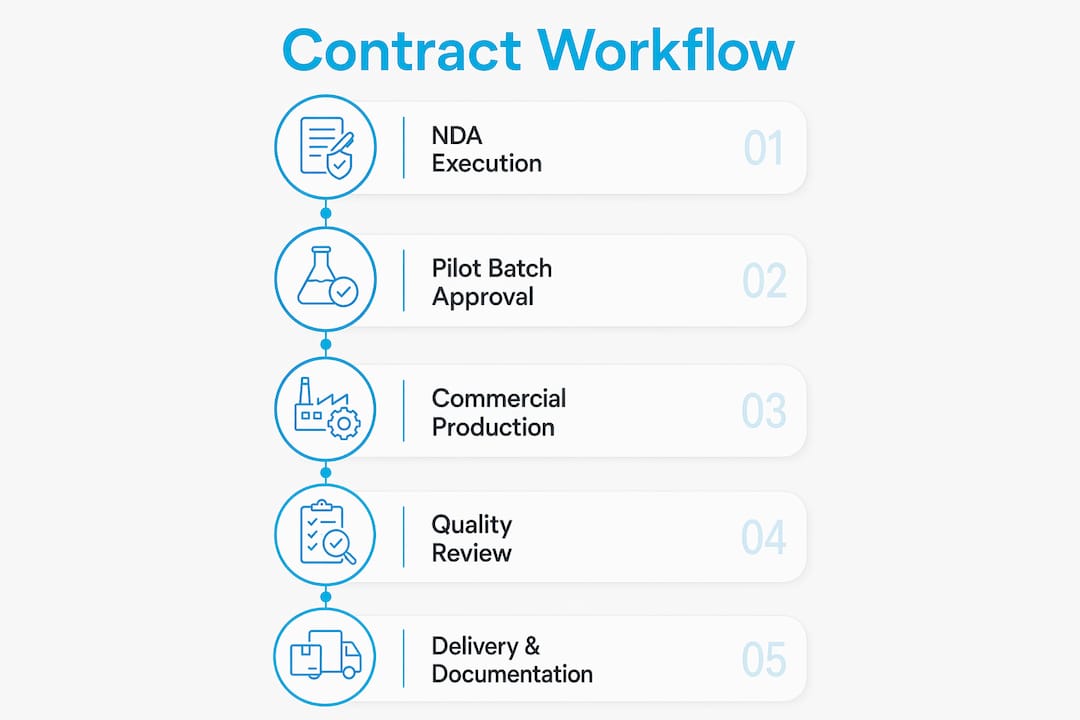
Each stage transition functions as a contractual quality gate. The sponsor’s Quality Unit must formally approve the pilot batch CoA before commercial production begins. This approval step is frequently absent from contracts negotiated by procurement teams without GMP experience. Validated cold-chain shipment is standard for lyophilized peptide APIs, and the contract must specify temperature excursion protocols and who bears liability if the cold chain is broken in transit.
The stage-gated onboarding model with strict compliance review prevents stalled timelines and inflated costs. Contracts that skip the pilot synthesis stage to accelerate timelines often produce commercial batches that fail purity specifications, requiring full remanufacture at the sponsor’s expense.
What are the most common pitfalls when negotiating peptide sourcing agreements?
Procurement teams negotiating peptide sourcing agreements encounter a predictable set of structural failures. Recognizing these pitfalls before contract execution is more cost-effective than resolving them during a quality investigation.
Conflating commercial and quality documents: Bundling GMP responsibilities into the commercial supply agreement produces ambiguous language that neither legal nor quality teams can enforce. The FDA guidance is explicit that quality agreements must be separate documents with their own governance structure.
Omitting pre-change notification requirements: Quality agreements must include pre-change notification requirements and detailed roles for deviation handling. Without this language, suppliers can alter synthesis routes, raw material sources, or analytical methods without sponsor approval.
Single-sourcing raw materials without alternate qualification: Contracts should mandate raw material supply base transparency and require the CDMO to maintain at least one qualified alternate source for critical starting materials. A single-sourced resin or protecting group supplier can halt an entire production campaign.
Incomplete batch documentation mandates: Contracts that do not specify the exact documents required at batch release create disputes at delivery. The minimum set includes a lot-specific CoA, batch manufacturing record summary, and any open deviation reports with disposition status.
Missing audit rights language: A contract that references audits without specifying frequency, notice requirements, and access scope gives the sponsor no enforceable mechanism to conduct oversight.
Pro Tip: Review the contract negotiation checklist before finalizing any peptide sourcing agreement. Milestone-based responsibilities and explicit audit rights are the two clauses most frequently omitted by first-time procurement teams.
How do contracts support ongoing supplier oversight and risk management?
Ongoing supplier oversight is not a post-contract activity. It is a contractual obligation that must be written into the sourcing agreement before the first purchase order is issued. Annual on-site audits for critical suppliers are common practice, with requalification cadence set at two to three years under normal performance and accelerated upon quality issues or regulatory inspection findings.
Contracts that support continuous supply chain security include the following provisions:
Periodic audit cadence: Define audit frequency by supplier risk tier. Critical peptide API manufacturers warrant annual or biennial audits. Lower-risk suppliers may qualify for document-based reviews on a three-year cycle.
Supplier performance KPIs: Contracts should specify measurable performance indicators reviewed on a defined schedule. Relevant metrics include on-time delivery rate, CoA first-pass acceptance rate, deviation frequency, and response time to quality notifications.
Dispute resolution framework: Quality agreements must include a structured process for resolving disagreements between the sponsor’s Quality Unit and the CDMO. This framework should define escalation steps, resolution timelines, and the authority of each party.
Sub-tier audit transparency: Contracts should require the CDMO to share audit reports for their own critical raw material suppliers on request. This provision is rarely included by default and must be negotiated explicitly.
The table below compares contract provisions in a minimal versus a well-structured peptide sourcing agreement:
Provision Minimal contract Well-structured contract Audit rights Referenced but unspecified Frequency, scope, and notice period defined Change control Not addressed Pre-change notification with Quality Unit approval required Batch documentation CoA mentioned Full document set specified with delivery timing Raw material sourcing Not addressed Alternate supplier qualification required Requalification triggers Not addressed Defined by deviation frequency and inspection findings
GMP responsibility cannot be delegated solely by contract. Shared accountability requires operational clarity through quality agreements that assign specific roles, not general obligations. Procurement teams that treat the quality agreement as a formality rather than an operational document consistently encounter the same compliance failures.
Key takeaways
Peptide sourcing contracts require three distinct documents: a commercial supply agreement, a quality agreement, and batch-level documentation, each with separate governance and enforcement mechanisms.
Point Details Three-document structure Commercial, quality, and batch documents each govern separate domains and cannot be merged without creating compliance gaps. Supplier qualification tiers Risk tier determines audit frequency, documentation requirements, and requalification cadence written into the contract. Stage-gated workflow Each manufacturing stage from NDA to shipment carries specific contractual obligations and quality gate approvals. Change control clauses Pre-change notification and deviation handling roles must be explicitly assigned in the quality agreement. Ongoing oversight provisions Audit cadence, KPIs, and sub-tier transparency rights must be negotiated into the contract before the first order.
What experience actually teaches about peptide contract structure
The most consistent failure pattern in peptide procurement is not a supplier quality problem. It is a contract structure problem. Procurement teams negotiate pricing and lead times with precision, then sign a quality agreement that was drafted by the CDMO’s legal team and reviewed by nobody with GMP experience on the sponsor side.
The separation between commercial and quality documents is not bureaucratic formality. It reflects a real operational distinction. The commercial team manages pricing and delivery. The Quality Unit manages manufacturing specifications, deviation handling, and release decisions. When those responsibilities are mixed into a single document, neither team has clear authority, and disputes take weeks to resolve because the contract does not assign ownership.
The other pattern worth noting is the underestimation of raw material risk. A peptide API manufacturer with excellent synthesis capabilities can still fail to deliver if a single amino acid building block supplier goes offline. Contracts that do not require alternate source qualification are transferring that risk entirely to the buyer without the buyer’s awareness. Requiring the CDMO to maintain a qualified alternate source for critical starting materials is a negotiable term, and most established manufacturers will accept it.
The professional guide to vetting peptide manufacturers covers audit frameworks in detail. The procurement checklist at PeptidesFromChina provides a structured starting point for teams building their first supplier qualification program. Both resources reflect the same principle: contract clarity is a procurement competency, not a legal one.
— Sam Levin
How PeptidesFromChina supports compliant peptide procurement
PeptidesFromChina operates as a research-focused sourcing platform with direct relationships with established synthesis facilities, not as a reseller operating through gray-market channels. Orders from the research peptide catalog are subject to the manufacturer’s applicable quality-control procedures and specifications. Manufacturer-side analytical documentation may be available depending on the product and batch. PeptidesFromChina is not an independent analytical testing laboratory. PeptidesFromChina currently has a $600 total minimum order; multiple catalog products can be combined to reach it, starting from one 10-vial kit per product.
FAQ
What documents make up a peptide sourcing contract?
A complete peptide sourcing contract includes three documents: a commercial supply agreement covering pricing and delivery terms, a quality agreement governing GMP responsibilities between sponsor and CDMO, and lot-specific batch documentation including the Certificate of Analysis and deviation records.
How often should peptide suppliers be reaudited?
Critical peptide API suppliers are typically reaudited every two to three years under normal performance conditions. Requalification frequency increases after quality deviations, regulatory inspection findings, or significant process changes at the manufacturing site.
What is the difference between a commercial supply agreement and a quality agreement?
The commercial supply agreement defines business terms such as pricing, volumes, and lead times. The quality agreement separately governs GMP responsibilities including manufacturing specifications, change control, deviation handling, and audit rights. Merging these documents into one creates enforcement ambiguity.
Why do peptide contract manufacturing timelines vary so widely?
Timeline variation reflects batch scale, synthesis complexity, and analytical testing requirements. Larger commercial batches can exceed 26 weeks from synthesis initiation through release testing. Contracts that do not include milestone-based timelines with defined approval gates consistently produce schedule overruns.
What clause is most commonly missing from peptide sourcing agreements?
Pre-change notification requirements are the most frequently omitted clause. Without this provision, CDMOs can alter synthesis routes or raw material sources without sponsor Quality Unit approval, which creates undocumented process changes and potential batch failures.