How Academic Peptide Procurement Works: A 2026 Guide

Academic peptide procurement is the structured process by which research institutions identify, qualify, purchase, and receive peptides that meet defined purity and traceability standards for scientific use. Understanding how academic peptide procurement works is not optional for researchers who depend on reproducible results. A single unverified batch can invalidate months of experimental data. This guide covers the full sourcing workflow, supplier qualification programs, cold chain logistics, and documentation requirements that define compliant peptide procurement in research environments.
What is the academic peptide sourcing process and why does it matter?
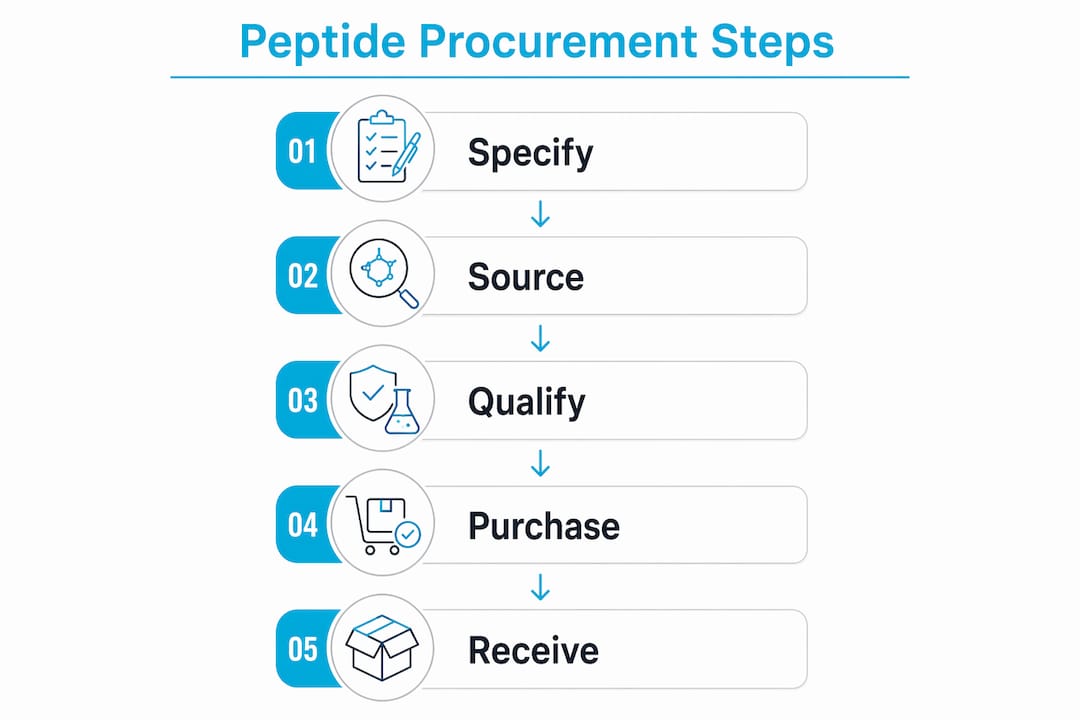
The academic peptide sourcing process is a sequential workflow that begins with specification and ends with verified delivery. Each step directly affects the reproducibility and regulatory defensibility of downstream research. Skipping or compressing any stage introduces risk that compounds over time.
The standard steps in peptide procurement for academic use follow this order:
Define peptide specifications. Researchers establish sequence, purity threshold (typically 95%+ by HPLC), modification requirements, and quantity. Vague specs produce inconsistent orders.
Identify candidate suppliers. Procurement teams compile a shortlist of synthesis facilities, distinguishing direct API manufacturers from resellers. Resellers add a layer of opacity to batch traceability.
Conduct supplier qualification. Each candidate undergoes documentation review, risk tiering, and where possible, an audit. This step is covered in detail in the next section.
Issue a purchase order with technical specifications attached. The spec sheet travels with the order to prevent substitution or reformulation at the synthesis facility.
Confirm cold chain requirements before shipment. Temperature-sensitive peptides require validated shipping lanes and pre-agreed temperature excursion protocols.
Receive and verify the batch. Upon delivery, procurement teams check the Certificate of Analysis against independent test data before releasing material to the lab.
Archive all records. Purchase orders, COAs, temperature logs, and supplier correspondence form the traceability record for the batch.
Academic procurement environments face challenges that commercial pharmaceutical teams do not. Budget cycles are annual and often inflexible, which limits the ability to pre-qualify multiple suppliers or hold safety stock. Institutional purchasing offices may impose vendor list restrictions that conflict with scientific sourcing requirements. These structural constraints make early planning and supplier relationship management more critical, not less.
How are peptide suppliers qualified and audited in academic procurement?

Supplier qualification in peptide procurement is defined by system-based auditability, not product-based purity claims alone. A supplier who provides a COA showing 98% purity but cannot produce archival batch data or an unbroken chain-of-custody record fails qualification on transparency grounds. System-based auditability over simple purity claims is the defining standard in modern supplier qualification programs.
Risk tiering and qualification activities
Suppliers are classified by risk tier before qualification activities begin. A tier-1 supplier providing GLP study peptides faces more rigorous review than a tier-3 supplier providing exploratory screening material. Qualification activities scale accordingly.
Key elements of a functional supplier qualification program include:
Standard operating procedures (SOPs) that define qualification criteria, approval thresholds, and re-qualification intervals
Risk classification based on peptide application, regulatory context, and supply criticality
Documentation review covering synthesis records, analytical methods, quality agreements, and deviation logs
On-site or remote audits for high-tier suppliers, with structured audit reports retained in the supplier file
Ongoing monitoring through batch-level COA review, complaint tracking, and periodic re-qualification
The difference between product-based and system-based qualification is practical. Product-based qualification accepts a COA and moves on. System-based qualification asks whether the supplier can reproduce that result, explain any deviation, and provide the raw analytical data behind the certificate. Qualification steps include classification, qualification activities, approval decisions, and periodic re-qualification with full documentation management.
For academic researchers evaluating suppliers independently, the vendor qualification criteria that matter most are batch traceability, synthesis facility transparency, and the availability of independent third-party test data.
Pro Tip: Request a sample batch data package before placing a first order. A supplier who cannot provide synthesis records, HPLC chromatograms, and mass spec data for a reference batch is not operating at the transparency level academic procurement requires.
Qualification data table
Qualification element What to request Why it matters Certificate of Analysis HPLC purity, MS confirmation, water content Confirms batch meets spec Synthesis batch record Raw material sourcing, reaction conditions Establishes reproducibility Chain-of-custody documentation Handling logs from synthesis to shipment Supports audit trail Quality agreement Deviation notification, change control terms Defines supplier obligations Re-qualification schedule Interval and trigger criteria Prevents qualification decay
What role does cold chain logistics play in peptide procurement?
Cold chain management is one of the most frequent compliance failure points in peptide supply chain management. Temperature log documentation is mandatory for long-term study integrity and regulatory compliance. A temperature excursion during transit that goes unrecorded is not just a quality event. It is a data integrity problem that can invalidate a study retrospectively.
Validated cold chain shipping lanes require pre-qualification of the carrier, the packaging configuration, and the temperature monitoring device. Continuous monitoring, not spot checks, is the standard for research-grade peptide shipments. GPS tracking and electronic temperature loggers provide the documentation trail that institutional compliance offices require.
Key cold chain requirements for academic peptide sourcing include:
Validated packaging configurations tested to ISTA or equivalent standards
Continuous electronic temperature monitoring with downloadable logs
Pre-defined excursion thresholds and documented response protocols
Carrier qualification records retained in the procurement file
Coordination between the synthesis facility, logistics provider, and receiving lab
“Procurement specialists now qualify multiple backup suppliers to mitigate disruptions in cold-chain logistics and manufacturing failures.” — Peptide Supply Chain Resilience 2026
The shift to multi-supplier sourcing reflects a hard lesson from single-source dependency failures. When one synthesis facility encounters a production disruption or cold chain failure, a research program with no qualified backup faces a complete stop. Qualifying a backup supplier takes 6–18 months, which means the work must begin before a disruption occurs, not after.
Timeline management is the other underappreciated factor. Integrated peptide projects typically require 9–12 months from specification to delivery, and early project coordination can save at least three months. Academic procurement teams that treat peptide sourcing as a last-minute task routinely face study delays that could have been avoided.
What documentation and compliance practices support trustworthy peptide sourcing?
Documentation is the backbone of responsible peptide procurement in research. Certificates of Analysis and independent batch verification simplify institutional approvals and provide the transparency record that compliance offices require. Without complete documentation, a research institution cannot demonstrate that the peptide used in a published study met the specifications claimed in the methods section.
The core documentation set for each procurement event includes:
Purchase order with attached technical specification. This creates a contractual record of what was ordered and to what standard.
Certificate of Analysis from the supplier. The COA must include HPLC purity data, mass spectrometry confirmation, and water content by Karl Fischer titration.
Independent third-party test report. Where study integrity is critical, an independent analytical lab should verify the supplier COA. Supplier-issued COAs alone are not sufficient for GLP or regulated studies.
Temperature monitoring log from shipment. The log must cover the full transit period from dispatch to receipt.
Institutional approval records. Many academic institutions require procurement approval for research reagents above a defined risk threshold. These records must be retained with the batch file.
Pro Tip: Maintain a procurement record folder for each batch that contains all five document types above. When a study is published or audited, the ability to produce a complete batch file in under 24 hours is the difference between a clean audit and a compliance finding.
Legitimate documentation practices in peptide shipping extend beyond the COA. Import declarations, customs records, and carrier handoff logs all form part of the traceability chain. Research peptides are not subject to the same regulatory framework as pharmaceutical APIs, but the documentation standards that protect research integrity are functionally equivalent.
Electronic quality management systems that handle deviation tracking, change control, and corrective action require FDA 21 CFR Part 11 compliance when used in regulated research environments. Academic institutions operating under GLP or GCP frameworks should verify that their procurement software meets this standard before relying on it for audit-ready records.
Key Takeaways
Academic peptide procurement requires systematic supplier qualification, validated cold chain logistics, and complete batch documentation to protect research integrity and institutional compliance.
Point Details Define specs before sourcing Purity thresholds, sequence, and modification requirements must be fixed before supplier contact begins. Use system-based qualification Audit supplier traceability and batch records, not just the COA purity figure. Qualify backup suppliers early The qualification process takes 6–18 months; start before a supply disruption forces the issue. Document every cold chain event Continuous temperature logs from dispatch to receipt are mandatory for study defensibility. Maintain a complete batch file Purchase orders, COAs, independent test reports, and shipping logs must be retained together per batch.
What I’ve learned from watching academic procurement go wrong
The most consistent failure pattern in academic peptide procurement is not fraud or negligence. It is the assumption that a supplier who delivered a good batch last year will deliver a good batch next year without any intervening verification. Peptide synthesis facilities change raw material sources, adjust synthesis protocols, and turn over technical staff. None of those changes will appear in a COA unless the procurement team asks the right questions.
I’ve seen research programs publish results and then face reproducibility challenges that traced back to a batch-to-batch variation in the peptide itself. The supplier had changed their resin source between orders. The COA showed 97% purity both times. The biological activity was not the same. That outcome is preventable with a system-based qualification program that includes change notification requirements in the quality agreement.
The other pattern worth naming is the cost-driven shortcut on cold chain. Academic budgets are real constraints, and ambient shipping is cheaper. For some peptides, ambient shipping is acceptable. For others, it is not. The problem is that procurement teams often make that call without validated data on the specific peptide’s thermal stability. A thermal stability study is a one-time cost. A failed experiment is not.
The wholesale sourcing guide for research institutions covers the supplier evaluation framework in practical terms for teams that are building or rebuilding their qualification process. The investment in getting this right at the start pays back in study reliability and audit readiness.
— Sam Levin
How PeptidesFromChina supports academic peptide sourcing
PFC coordinates sourcing from established Chinese manufacturing facilities together with international logistics. Products in the research peptide catalog are subject to the manufacturer’s applicable quality-control procedures and specifications. Manufacturer-side analytical documentation may be available depending on the product and batch. PeptidesFromChina is not an independent analytical testing laboratory. Buyers requiring independent verification may arrange third-party analytical testing.
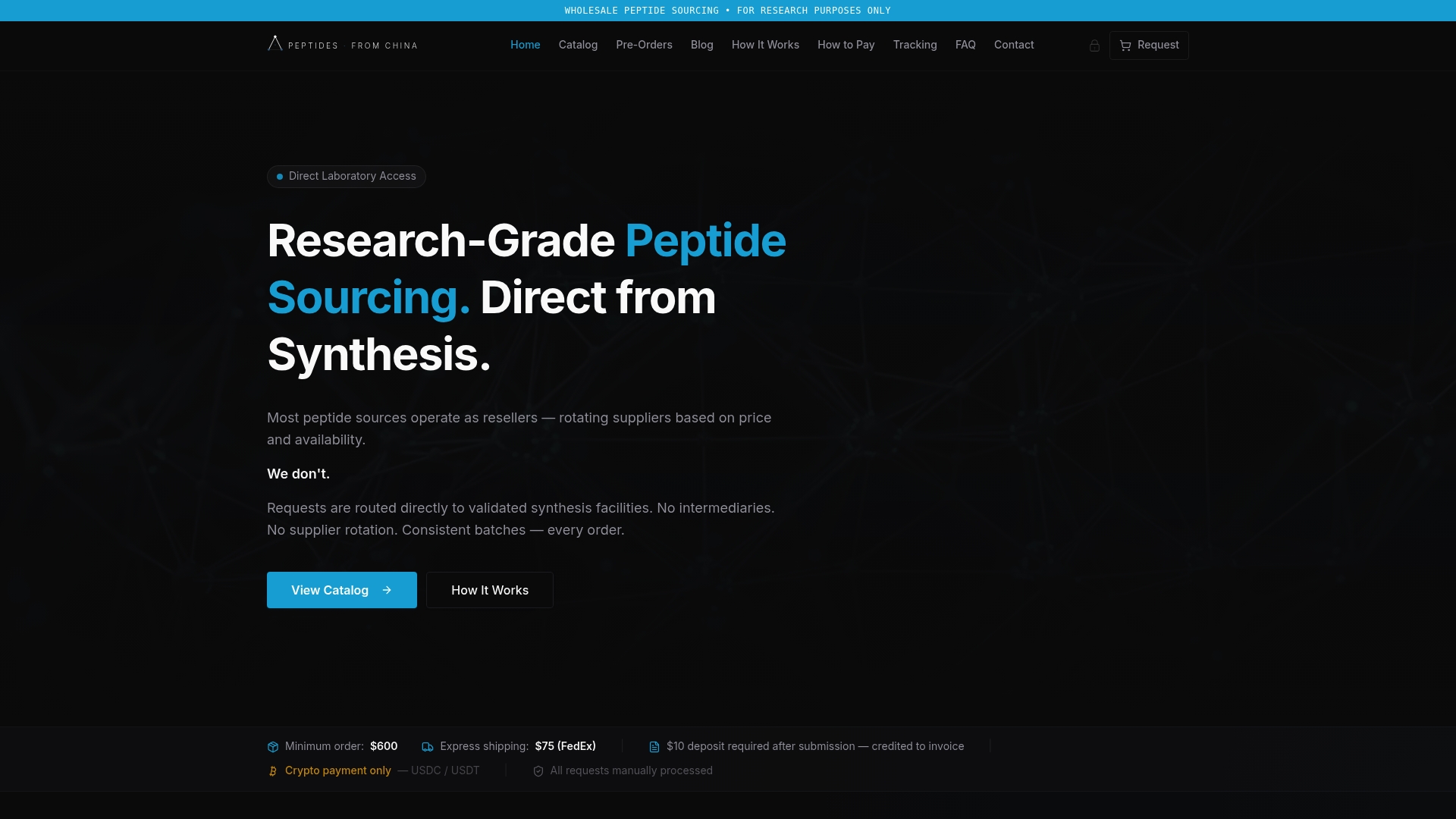
The platform’s supply chain model is built for procurement teams that need batch consistency across multiple orders, not just a single successful delivery. Researchers sourcing compounds like Epithalon for longevity studies or KPV Products are subject to the manufacturer’s applicable quality-control procedures and specifications. Manufacturer-side analytical documentation may be available depending on the product and batch. PeptidesFromChina is not an independent analytical testing laboratory. Academic institutions with specific documentation requirements for institutional review are encouraged to contact the team before placing an order.
FAQ
What is peptide procurement in academic research?
Peptide procurement in academic research is the formal process of specifying, sourcing, qualifying, and receiving research-grade peptides from verified suppliers. The process includes supplier qualification, purchase documentation, cold chain management, and batch verification.
How do researchers verify peptide quality before use?
Researchers verify peptide quality by reviewing the supplier’s Certificate of Analysis for HPLC purity and mass spectrometry data, then cross-checking against an independent third-party test report where study integrity requires it.
Why does cold chain management matter for peptide sourcing?
Temperature excursions during transit degrade peptide integrity and create data integrity problems if unrecorded. Continuous temperature monitoring with downloadable logs is the standard for research-grade shipments.
How long does academic peptide procurement typically take?
Full procurement timelines for complex peptide projects range from 9–12 months when synthesis, qualification, and logistics are factored in. Early project coordination can reduce that timeline by at least three months.
What is the difference between a product-based and system-based supplier qualification?
Product-based qualification accepts a COA and approves the supplier. System-based qualification verifies that the supplier can reproduce results, explain deviations, and provide archival batch data. System-based qualification is the standard for research environments where reproducibility is a scientific requirement.