Direct Sourcing Peptides: A Manufacturer Guide for 2026

Direct sourcing peptides from manufacturers is defined as procuring research-grade or therapeutic peptide APIs directly from synthesis facilities, bypassing resellers and intermediaries. This direct peptide sourcing model matters because purity, batch traceability, and verified origin are non-negotiable in experimental and clinical applications. The challenge is that the global peptide supply chain is fragmented, with Chinese manufacturers supplying roughly 65% of global production at widely varying quality levels. Verification labs like Janoshik Analytical and suppliers operating within certified clusters like Jiangsu’s Peptide Valley represent two anchors of a reliable sourcing framework. This guide to peptide sourcing gives researchers and procurement professionals a structured process for qualifying suppliers, reading documentation, and protecting batch integrity from synthesis to delivery.
What distinguishes direct peptide manufacturers from resellers?
Manufacturers can be distinguished from resellers by three concrete disclosures: manufacturing site location, synthesis equipment in use, and the ability to produce custom sequences. A true synthesis facility will name its production address, reference solid-phase peptide synthesis (SPPS) reactors, and accept custom sequence orders with defined lead times. Resellers typically cannot provide any of these details because they purchase finished product from third parties and relabel it.
The practical test is documentation depth. A manufacturer will supply batch-specific synthesis records, raw material sourcing information, and in-process quality control data. A reseller will supply a Certificate of Analysis (CoA) and little else. When a supplier cannot explain where its resin or protected amino acid inputs come from, that is a reseller signal regardless of what its website claims.
Facility certifications also serve as a credibility filter. Facilities holding FDA, EMA, or CFDA GMP certifications have passed external audits of their manufacturing systems. These certifications do not guarantee product quality on every batch, but they confirm that documented processes exist. A supplier that cannot produce current GMP certificates for its stated manufacturing site is almost certainly not a direct manufacturer.
Manufacturing site address disclosed and verifiable
SPPS reactor capacity and equipment specifications available on request
Custom sequence synthesis accepted with defined turnaround
Batch-specific synthesis and in-process QC records provided
GMP certification tied to the stated facility, not a corporate entity
Pro Tip: Ask any prospective supplier for the physical address of its synthesis facility and cross-reference it against publicly available GMP registration databases. Resellers frequently list a trading company address, not a manufacturing site.
Which quality standards are non-negotiable when sourcing peptides directly?
The minimum purity threshold for research-grade peptides is ≥99% HPLC purity, confirmed with a batch-specific chromatogram. Mass spectrometry identity confirmation must accompany HPLC data to verify the correct molecular weight and sequence. A CoA that reports purity without a chromatogram attachment is incomplete and should be treated as unverified.

Third-party independent CoA verification is the standard that separates serious procurement from casual purchasing. Manufacturer-provided CoAs are self-reported documents. They reflect the manufacturer’s own testing, which may use uncalibrated equipment, non-validated methods, or selective sampling. Independent testing through labs like Janoshik Analytical or Vanta costs $150–$350 per compound per batch. That cost is small relative to the risk of running experiments on material with incorrect purity or identity.
For high-risk or critical suppliers, the qualification process extends beyond CoA review. Formal audits, quality management system reviews, and signed quality agreements are standard practice for therapeutic-grade sourcing. These agreements define acceptable purity ranges, batch release criteria, change notification requirements, and dispute resolution procedures.
A structured quality evaluation follows this sequence:
Request batch-specific HPLC chromatogram and mass spectrometry data before ordering.
Confirm that the CoA references the specific batch number, not a generic product specification.
Submit a sample from the received batch to an independent lab for identity and purity confirmation.
Compare independent results against the manufacturer CoA. Flag discrepancies above 0.5% purity variance.
For ongoing supply relationships, establish a periodic re-qualification schedule, typically every 12 months or after any manufacturing site change.
Procurement professionals must treat manufacturer CoAs as internal reports requiring third-party corroboration. A CoA that has not been independently verified is a starting point, not a conclusion.
How to navigate Chinese manufacturing clusters for peptide sourcing
China produces approximately 65% of global research-grade and therapeutic peptides, but that figure masks significant regional variation in quality infrastructure. Understanding which clusters to prioritize is one of the most practical tips for sourcing peptides at scale.
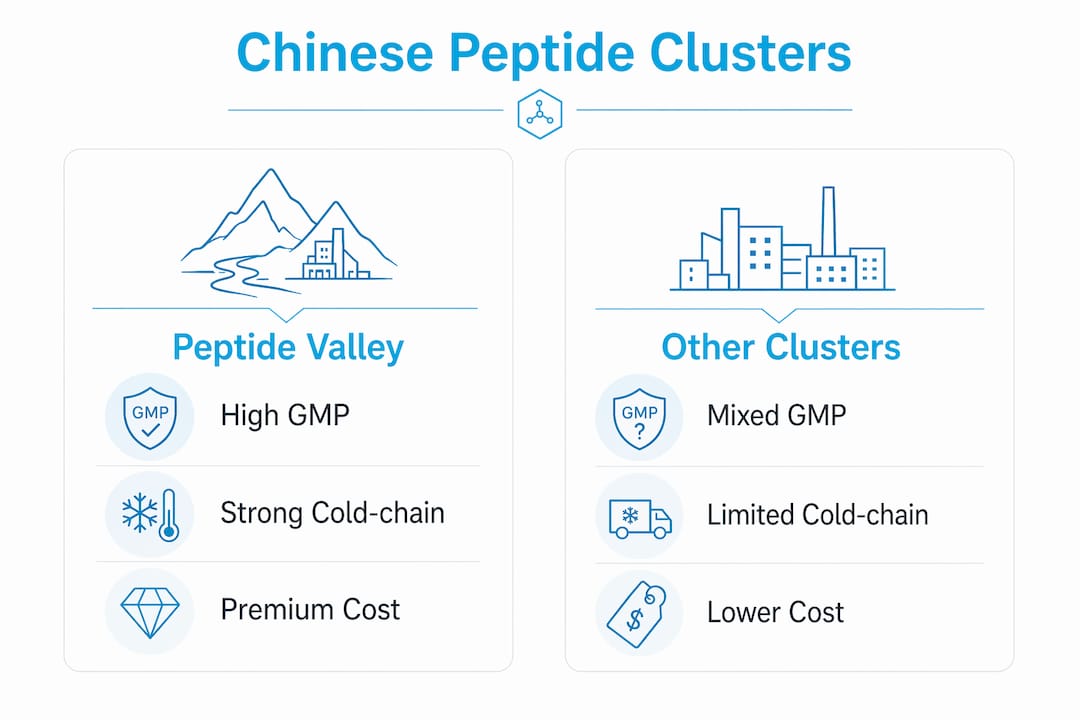
Jiangsu Province, specifically the area known as Peptide Valley, holds multiple FDA, EMA, and CFDA GMP certifications across at least five simultaneously certified facilities. This concentration of regulatory-compliant manufacturers makes Jiangsu the most reliable starting point for procurement teams sourcing therapeutic-grade material. Zhejiang Province has a strong chemical synthesis base but fewer peptide-specific GMP certifications. Sichuan and other inland clusters offer lower costs but typically less regulatory documentation and weaker cold-chain infrastructure.
Cold-chain logistics is a critical differentiator across all Chinese clusters. 42% of Chinese peptide suppliers lack validated cold-chain infrastructure. Lyophilized peptides are stable at ambient temperature for short periods, but finished vials and reconstituted products require controlled temperature shipping. A supplier without validated cold-chain systems introduces degradation risk that no amount of upstream quality control can correct.
Cluster GMP certification density Cold-chain infrastructure Cost profile Best use case Jiangsu (Peptide Valley) High Generally available Premium Therapeutic-grade, regulated research Zhejiang Moderate Variable Mid-range Research APIs, bulk synthesis Sichuan Low Limited Lower Non-critical research compounds Guangdong Moderate Variable Mid-range Export-focused, mixed quality
Pro Tip: When evaluating a Chinese supplier, ask specifically which province and city the synthesis facility is located in. Jiangsu-based manufacturers with verifiable GMP registration carry a lower qualification burden than isolated suppliers in less-regulated clusters.
For a detailed breakdown of Chinese synthesis facilities and compliance factors, the China peptide synthesis labs guide from PeptidesFromChina covers regional risk profiling in depth.
What are the best practices for verifying peptide batches and logistics?
Batch verification starts before the shipment arrives. The batch number on the CoA must match the batch number on the product label and the shipping documentation. Any mismatch between these three documents indicates either a documentation error or a substitution, both of which require immediate supplier clarification before the material enters any research workflow.
Independent third-party testing through labs like Janoshik Analytical or Vanta is the standard method for confirming manufacturer CoA claims. The test request should specify HPLC purity, mass spectrometry identity, and, for sterile products, endotoxin and sterility testing. Results typically return within 5–10 business days. Procurement teams that skip this step and rely solely on manufacturer CoAs accept a risk that is not justified by the cost savings.
Physical inspection of lyophilized peptides provides a secondary quality signal. Acceptable lyophilized material presents as a uniform white to off-white powder or cake with no visible discoloration, clumping from moisture exposure, or particulate contamination. Discoloration or hygroscopic clumping suggests improper lyophilization or cold-chain failure during transit.
Confirm batch number matches across CoA, product label, and shipping documents
Submit received material to Janoshik Analytical or Vanta for independent HPLC and MS confirmation
Inspect lyophilized appearance for discoloration, moisture damage, or particulate contamination
Verify temperature log data from the shipment if cold-chain monitoring devices were included
Document all results in a batch record tied to the supplier and lot number
Raw material dependency is a supply chain risk that batch testing alone cannot detect. A manufacturer may pass every quality test on a given batch but face delivery failures if its protected amino acid or resin supplier has a production disruption. Procurement teams should require manufacturers to disclose their raw material sourcing and confirm that they use more than one input supplier for critical components. Single-source raw material dependency is a hidden risk that surfaces only when a disruption occurs.
Key takeaways
Direct peptide sourcing requires a structured qualification process covering manufacturer authenticity, quality documentation, geographic risk, and independent batch verification at every stage.
Point Details Manufacturer vs. reseller Confirm SPPS equipment, facility address, and custom synthesis capability before qualifying any supplier. Minimum quality threshold Require ≥99% HPLC purity with batch chromatogram and mass spectrometry identity on every order. Independent verification Budget $150–$350 per batch for third-party testing through labs like Janoshik Analytical or Vanta. Geographic risk profiling Prioritize Jiangsu-based suppliers with verifiable GMP certifications over isolated or inland alternatives. Raw material transparency Require suppliers to disclose input sourcing and confirm they do not rely on a single raw material supplier.
The sourcing realities most guides skip
The peptide supplier market has a low barrier to entry. A trading company can register a domain, order product from a synthesis facility, and present itself as a manufacturer within weeks. I’ve seen this pattern repeat across dozens of supplier evaluations. The documentation looks credible until you ask for the synthesis facility address and the conversation stops.
The fragmented supplier landscape means brand reputation is a weak proxy for quality. A vendor-agnostic qualification framework that scores documentation completeness, independent purity results, logistics infrastructure, and raw material transparency is more reliable than any reputation signal. Reputation can be manufactured. A batch-specific HPLC chromatogram from an independent lab cannot.
What I find most procurement teams underestimate is the ongoing monitoring requirement. Initial qualification is not a permanent clearance. Manufacturing sites change. Key personnel leave. Raw material suppliers get consolidated. A supplier that passed qualification 18 months ago may be operating under different conditions today. Periodic re-qualification, triggered either by time or by any change notification from the supplier, is the only way to maintain confidence in a long-term supply relationship.
The cost-versus-reliability tension is real but often overstated. Independent testing at $150–$350 per batch is a fraction of the cost of a failed experiment or a regulatory finding tied to impure material. The suppliers worth working with understand this and welcome third-party testing. The ones that resist it are telling you something important.
For researchers working within peptide vendor qualification criteria, the framework matters more than any single supplier relationship.
— Sam Levin
How PeptidesFromChina supports direct manufacturer sourcing
PeptidesFromChina operates as a research-focused sourcing platform with direct relationships with established Chinese synthesis facilities, not a reseller catalog. Every batch listed through the platform includes third-party verified CoA documentation, batch-specific chromatograms, and cold-chain logistics support.
Researchers and procurement teams can access the full peptide catalog covering GMP-certified research peptides sourced directly from verified Chinese manufacturers. For teams requiring the highest verification standard, VIP research-grade peptides include independent lab-confirmed CoAs on every batch. PeptidesFromChina also supports bulk and custom peptide orders with direct manufacturer access, removing reseller markup and providing full supply chain documentation from synthesis to delivery.
FAQ
What is direct sourcing in peptide procurement?
Direct sourcing means purchasing peptide APIs directly from the synthesis facility rather than through a reseller or distributor. It gives procurement teams access to batch-specific documentation, custom synthesis options, and lower per-unit costs.
How do I confirm a supplier is a manufacturer and not a reseller?
Ask for the physical address of the synthesis facility, the type of SPPS reactors in use, and whether custom sequences are available. Resellers typically cannot provide synthesis equipment details or a verifiable manufacturing site address.
Why is a manufacturer CoA not sufficient on its own?
Manufacturer CoAs are self-reported and reflect the supplier’s own testing methods. Independent labs like Janoshik provide unbiased purity and identity confirmation that the manufacturer cannot supply for itself.
What purity standard should research-grade peptides meet?
Research-grade peptides should meet ≥99% HPLC purity confirmed with a batch-specific chromatogram and mass spectrometry identity data. Any CoA that reports purity without an attached chromatogram is incomplete.
Which Chinese manufacturing region offers the most reliable sourcing?
Jiangsu Province, specifically the Peptide Valley cluster, holds the highest concentration of GMP-certified peptide facilities in China and represents the lowest qualification risk for therapeutic-grade and regulated research sourcing.